

Loading...

Top
Help
×

By creating an account you can:

Logo TaxTMI
Call Us / Help / Feedback

Contact Us At :

E-mail: [email protected]

Call / WhatsApp at: +91 99117 96707

For more information, Check Contact Us

FAQs :

To know Frequently Asked Questions, Check FAQs

Most Asked Video Tutorials :

For more tutorials, Check Video Tutorials

Submit Feedback/Suggestion :

Email :
Please provide your email address so we can follow up on your feedback.
Category :
Description :
Min 15 characters 0/2000
Make Most of Text Search
  1. Checkout this video tutorial: How to search effectively on TaxTMI.
  2. Put words in double quotes for exact word search, eg: "income tax"
  3. Avoid noise words such as : 'and, of, the, a'
  4. Sort by Relevance to get the most relevant document.
  5. Press Enter to add multiple terms/multiple phrases, and then click on Search to Search.
  6. Text Search
  7. The system will try to fetch results that contains ALL your words.
  8. Once you add keywords, you'll see a new 'Search In' filter that makes your results even more precise.
  9. Text Search
Add to...
You have not created any category. Kindly create one to bookmark this item!
Create New Category
Hide
Title :
Description :
❮❮ Hide
Default View
Expand ❯❯
Close ✕
🔎 News - Adv. Search
TEXT SEARCH:

Press 'Enter' to add multiple search terms. Rules for Better Search

Search In:
Main Text + AI Text
  • Main Text
  • Main Text + AI Text
  • AI Text
Category: ?
Categorized by AI
---- All Categories ----
  • ---- All Categories ----
  • Income Tax
  • GST
  • Customs, DGFT & SEZ
  • FEMA & RBI
  • Corp. Laws, SEBI & IBC
  • PMLA, Black Money & ED
  • Budget
  • News and Press Release
  • PTI News
Month:
---- All Months ----
  • ---- All Months ----
  • January
  • February
  • March
  • April
  • May
  • June
  • July
  • August
  • September
  • October
  • November
  • December
Year:
---- All Years ----
  • ---- All Years ----
  • 2026
  • 2025
  • 2024
  • 2023
  • 2022
  • 2021
  • 2020
  • 2019
  • 2018
  • 2017
  • 2016
  • 2015
  • 2014
  • 2013
  • 2012
  • 2011
Sort By: ?
In Sort By 'Default', exact matches for text search are shown at the top, followed by the remaining results in their regular order.
Relevance Default Date
    Tina Ambani skips ED summons for second time
    J&K records Rs 24,080.79 cr GST collection in three years, gets Rs 15,795.13 cr IGST share: CM
    The cumulative exports (merchandise & services) during April-January 2025-26 is estimated at US$ 720.76 Billion, as compared to US$ 679.02 Billion in ...
    Assam govt tables Rs 62,294.78 cr interim budget for FY'27
    Finance Minister tables Interim Budget, alleges Centre attempts creating 'fiscal crisis' for TN
    India engaging global partners more intensively, says Jaishankar; cites recent trade deals
    Exports inch up 0.61 pc in Jan; trade deficit widens to 3-month high
    Tina Ambani may appear before ED on Tuesday for questioning in money-laundering case
    PM Modi 'surrendered' before Trump; farmers' interests, energy security sacrificed: Cong
    Indian team to visit US next week to finalise legal text for interim trade pact: Comm Secy
    VHP slams Karnataka minister Priyank Kharge for 'money laundering' comment on RSS
    Fintech Platform Endl Secures 1.5 Million Dollar Investment to Scale Global Payment Infrastructure
    Delhi court notices against Videocon Group founder Dhoot, 12 others in bank fraud case: ED
    Indian team to visit US next week to finalise legal text for interim trade pact: Commerce Secretary
    IDFC FIRST Bank launches FD backed Hello Cashback Credit Card with up to 5% Cashback
    Bajaj Finance Offers Instant Personal Loans with Quick and Easy Approval Process
    Exports rise 0.61 pc to USD 36.56 bn in January
    DFS, M/o Finance releases Report titled “Socio-Economic Impact Analysis of Incentive Scheme for Promotion of RuPay Debit Card and low-value BHIM-UPI...
    Markets rebound nearly 1 pc on buying in power, banking stocks; Sensex jumps 650 pts
    Wholesale price inflation rises to 1.81 pc in Jan
❯❯
Maximize Maximize Maximize
0 / 200
Expand Note
Add to Folder

No Folders have been created

+

Are you sure you want to delete "My most important" ?

NOTE:

News
Showing Results for :
Reset Filters
Results Found:
Show All Summaries Hide All Summaries
February 17, 2026
Show AI Summary
Money laundering probe: Tina Ambani skips ED summons; investigation targets alleged fraudulent foreign remittance and property sale.
Tina Ambani failed to appear for a second ED summons in a PMLA investigation concerning an alleged money trail tied to a Manhattan condominium purchase; she has been issued a fresh notice and will be questioned with her statement recorded under the Prevention of Money Laundering Act. The ED alleges a fraudulent sale of the New York property during a corporate insolvency process and that sale proceeds were remitted via a sham investment arrangement through a Dubai-based entity without the Resolution Professional's knowledge. The agency has arrested a former executive, formed a Special Investigation Team, attached assets, and filed multiple Enforcement Case Information Reports against group companies.
February 17, 2026
Show AI Summary
Goods and Services Tax expansion lifted revenues and IGST settlements, backed by tech-driven compliance and targeted small-taxpayer measures.
GST receipts in the Union Territory rose steadily over three years, with concurrent IGST settlements from the Centre reflecting the destination-based tax design. The unified Goods and Services Tax (GST) regime and technology-enabled compliance (online registration, return filing, refunds, e-way bills) strengthened tax administration and widened the tax base. Administrative measures-Composition Scheme, quarterly returns, QRMP and district Suvidha Kendras-aim to ease compliance for small taxpayers, while sector-specific rate rationalisation and concessional inputs support handicrafts, horticulture and tourism. Remaining issues for small and unorganised producers include compliance burdens and IGST refund delays, which authorities are addressing through simplification and support.
February 17, 2026
Show AI Summary
Exports growth drives trade expansion with larger services surplus despite a widening merchandise trade deficit in estimates.
India's combined merchandise and services exports for April-January 2025-26 are estimated at US$ 720.76 billion, up year on year, while combined imports are estimated at US$ 823.41 billion, producing a wider trade deficit; merchandise exports were US$ 366.63 billion and non petroleum exports US$ 320.94 billion, with services exports driving a services surplus of US$ 180.58 billion for the period.
February 17, 2026
Show AI Summary
Vote on account authorizes provisional state expenditures to maintain services pending a full election year budget.
An interim state budget was presented seeking a vote on account to authorize provisional expenditures for the initial months of the 2026-27 financial year, enabling continuity of government services pending a full budget. The finance minister framed the vote on account alongside reported strong GDP expansion and rising per capita income to contextualize fiscal planning in the election year.
February 17, 2026
Show AI Summary
Fiscal consolidation emphasized as interim budget pledges targeted social and transport allocations while alleging central fiscal bias.
Interim Budget 2026-27 allocates major sums to social security and transport-including a fare free bus travel scheme for women, student bus fares, diesel subsidy, and a Viability Gap Fund-while reporting a large revenue deficit and projecting a Fiscal Deficit targeted to reduce to three percent of GSDP. The estimates set out planned borrowings and repayments as part of debt management. The Minister alleged central actions have intensified Tamil Nadu's fiscal stress, criticised the 16th Finance Commission's recommendations, and urged central approval for pending metro projects.
February 17, 2026
Show AI Summary
Tariff reduction and FTA negotiations signal strengthened trade engagement and strategic economic diplomacy to secure market access.
India is intensifying economic engagement to secure market access through negotiated tariff reductions and the conclusion of substantive negotiations on a proposed free trade agreement, while responding to global shifts that include the use of export controls, market leverage and other measures as instruments of state economic policy.
February 16, 2026
Show AI Summary
Tariffs on Indian goods and ongoing trade agreement adjustments affect export competitiveness and sectoral trade flows.
India's merchandise exports rose slightly while the trade deficit widened as imports-notably gold and silver-surged; sectoral exports were mixed and services exports increased. The piece stresses the disruptive impact of steep tariffs on labour intensive outbound shipments and notes partial tariff removals with further reductions conditioned on a trade agreement. Industry called for a dedicated MSME export policy and a Special Interest Package Scheme to address borrowing cost inconsistencies and support exporters.
February 16, 2026
Show AI Summary
Money laundering inquiry under PMLA prompts summons to Tina Ambani over alleged foreign property transaction and remittance.
Summons under the PMLA require Tina Ambani to appear for questioning and have her statement recorded in a money laundering probe concerning an allegedly fraudulent sale of a foreign condominium during a corporate insolvency resolution process and subsequent remittances routed through a sham investment arrangement; the agency has arrested a former company executive, formed a special investigation team, attached significant assets, and filed multiple ECIRs against group companies.
February 16, 2026
Show AI Summary
Sovereignty in trade agreements: interim India US deal alleged to compromise farmers' livelihoods and national energy security.
The interim India-US trade agreement is alleged to compromise national sovereignty by requiring India to open its agricultural market to duty free US products, remove non tariff trade barriers, and make concessions on subsidies and GM crops, thereby threatening farmer livelihoods, biodiversity and seed purity. The deal is also claimed to jeopardise energy security by obliging India to refrain from buying crude oil from Russia and permitting US monitoring and penalty threats, while raising concerns about digital autonomy and data privacy.
February 16, 2026
Show AI Summary
Interim trade agreement: reciprocal tariff reductions and mutual duty concessions to be finalised through legal text.
An Indian negotiating team will visit the US to translate a previously announced framework into a signed interim trade agreement legal text. Ongoing virtual talks will be advanced to resolve drafting intricacies; tariff and preferential market access measures agreed in the framework will take effect only after the legal agreement is finalised and signed. The discussions cover reciprocal duty concessions, including a US processing of a reciprocal tariff reduction and the sequencing of implementation tied to signature of the legal pact.
February 16, 2026
Show AI Summary
Money laundering allegation against a nationalist organisation denounced as defamatory strategy and political insult to patriots.
VHP condemns a Karnataka minister's claim linking the RSS to money laundering as false, defamatory and a deliberate political strategy to insult patriotic organisations and reduce the speakers' acceptance; it asserts such tactics aim at appeasement and defamation, calls for those who prioritise Hindu interests to hold power for community protection, and warns against exploiting religion for political gain.
February 16, 2026
Show AI Summary
Compliance first stablecoin payments enable regulated cross border payouts and corporate cards for emerging market businesses.
Endl secured pre seed funding to scale a compliance focused, stablecoin centred cross border payments platform offering multi currency accounts, regulated stablecoin rails, fiat stablecoin conversions, corporate cards and treasury services, with investments directed toward regional banking integrations, compliance systems and enterprise security to serve businesses in emerging markets.
February 16, 2026
Show AI Summary
Money laundering notices issued after chargesheet alleging diversion of foreign loan proceeds into non-oil uses.
A special PMLA proceeding alleges systematic diversion of foreign currency loan facilities sanctioned for Mozambique oil and gas assets; loan proceeds were routed via Videocon Hydrocarbon Holdings Ltd and multiple overseas group companies, layered through a complex web of entities, and remitted back to India for non-sanctioned uses including non-oil business expenses, investments and creation of personal and corporate assets, with the ED quantifying the proceeds of crime and a PMLA court issuing notices to thirteen accused following the chargesheet.
February 16, 2026
Show AI Summary
Interim trade agreement: delegation to finalise legal text ahead of expected signing following framework agreement.
An interim trade agreement framework will be converted into operative legal text through bilateral drafting: an Indian negotiating delegation will travel to the United States to finalise the legal agreement while virtual talks continue, moving from a joint statement of contours to definitive treaty language and preparing the instrument for signature.
February 16, 2026
Show AI Summary
FD-backed secured credit: card links credit limit to fixed deposit, with tiered cashback, fee waivers, and FD access.
Introduction of a fixed deposit-backed secured credit card linking credit limit to 100% of an underlying fixed deposit, permitting FD access via ATM withdrawals subject to a withdrawal fee and an interest free window. The card applies a tiered cashback structure with category and monthly caps, includes joining and annual fees with time limited waivers and conditional reversals tied to annual spends, and provides consumer protections such as insurance, purchase protection, lost card liability cover, and surcharge waivers.
February 16, 2026
Show AI Summary
Deposit-taking NBFC registration enables instant digital personal loans with streamlined KYC, quick disbursal, and flexible repayment options.
Bajaj Finance offers an instant digital personal loan delivered via a personal loan app that uses analytics and electronic verification to provide quick eligibility decisions, minimal documentation, OTP mobile verification, online KYC completion, and rapid electronic disbursal to the customer's registered bank account, with flexible tenures, repayment management tools, and features designed to meet diverse consumer financing needs.
February 16, 2026
Show AI Summary
Trade balance worsens as imports outpace exports, prompting elevated trade deficit and revised export projections for the fiscal year.
Merchandise exports rose 0.61% to USD 36.56 billion in January while imports grew 19.2% to USD 71.24 billion, producing a January trade deficit of USD 34.68 billion; April-January exports increased 2.22% to USD 366.63 billion. The Commerce Secretary stated exports in goods and services remain on an upward trend and projected combined fiscal year exports of goods and services are likely to exceed USD 860 billion.
February 16, 2026
Show AI Summary
Incentive Scheme for digital payments increased UPI adoption and expanded payment infrastructure, recommending targeted measures for RuPay uptake.
The report assesses the design, implementation and socio-economic effects of the Incentive Scheme for promotion of RuPay debit cards and low-value BHIM-UPI P2M transactions, noting that structured budgetary support reduced cost barriers, accelerated merchant onboarding, expanded acceptance infrastructure and strengthened the payments ecosystem. Based on primary and secondary research, it finds marked increases in UPI adoption, merchant QR deployment and bank participation, increased user confidence and reduced cash reliance, and recommends targeted measures to deepen RuPay usage, rural penetration, connectivity, digital literacy and fraud mitigation.
February 16, 2026
Show AI Summary
Market rebound as banking and power stocks lead recovery amid global rate-cut expectations and stable currency support.
Equity benchmarks rebounded nearly one percent led by renewed buying in banking and power stocks, reversing a recent decline as large-cap financials and utilities outperformed. The rally was supported by expectations of sustained power demand, improving loan growth and stable bank asset quality. Macro cues-falling US long-term yields, a stable rupee and steady crude oil-added support, while foreign institutional investors were net sellers and domestic institutional investors were net buyers.
February 16, 2026
Show AI Summary
Inflation trends show rising wholesale prices, prompting continued RBI focus on retail inflation for monetary policy.
Wholesale price inflation rose to 1.81% in January due to increases in food articles, non-food articles, textiles and manufacturing subgroups, while fuel and power remained in deflation. Manufactured products and non-food articles recorded higher inflation compared with the prior month. The Reserve Bank of India continues to emphasise retail inflation as the primary indicator for benchmark interest-rate decisions, having reduced policy rates earlier in the fiscal year and subsequently retained key rates.

News

Back

All News

Showing Results for :
Reset Filters
No Records Found

News

Showing Results for : Reset Filters
Customs, DGFT & SEZ

Directorate General of Commercial Intelligence and Statistics Revises Base Year of Merchandise Trade Indices to FY 2022–23 to Reflect Current Trade Structure and Global Patterns

February 21, 2026

Contents
Summary
Note

Note

-

Bookmark

Print

Print

Merchandise Trade Indices are compiled and published by the Directorate General of Commercial Intelligence and Statistics (DGCI&S), Ministry of Commerce & Industry, to measure changes in the unit values (prices) of India’s exports and imports over time. These indices serve as important indicators of external sector price movements and are widely used for economic analysis, including national accounts compilation and assessment of terms of trade. Over the years, the base year of the indices has been periodically revised to reflect structural changes in India’s trade composition and evolving global trade patterns. The most recent revision updates the base year to FY 2022–23 (2022–23 = 100), replacing the earlier base of FY 2012–13, thereby ensuring that the indices accurately represent the current structure of India’s merchandise trade.

Revision of Base Year of India’s Merchandise Trade Indices to FY 2022–23

The Directorate General of Commercial Intelligence and Statistics (DGCI&S), Ministry of Commerce & Industry, has revised the base year of India’s Merchandise Trade Indices from FY 2012–13 to FY 2022–23 (2022–23 = 100), in view of the structural changes in the economy, shifts in commodity composition, evolving trade patterns, and the need for improved alignment with contemporary macroeconomic indicators.

The revision has been undertaken on the recommendations of a committee constituted by DGCI&S under the Chairmanship of Prof. Nachiketa Chattopadhyay, Professor, Indian Statistical Institute, Kolkata. The Committee examined the existing methodology, data coverage, weighting structure, and compilation practices, and recommended suitable refinements in line with international best practices.

Key Features of the Revised Series (Base: FY 2022–23)

  1. Updated Base Year:
    The new base year FY 2022–23 makes the Indices reflect the current structure of India’s external trade more accurately.
  2. Revised Commodity Basket:
    The coverage and classification of commodities have been reviewed at the Principal Commodity level to better capture emerging and declining trade items.
  3. Revised Weighting Structure:
    Weights have been updated based on trade values of the new base year to reflect the latest value shares in exports and imports.
  4. Improved Methodology:
    Methodological refinements have been introduced in:
    1. Selection of common commodity basket for base year selection (procedure of selection for common commodity basket explained in detail report of the committee).
    2. Treatment of missing unit values (Imputation of missing unit values in base year selection have been explained in detail in the committee report).
  5. Indices Compiled:
    The revised series includes:
    1. Monthly, Quarterly and Annual Indices (Export Unit Value Index,Import Unit Value Index).
    2. Principal Commodity (PC) Classification wise Trade Indices (Export/Import).
    3. Standard International Trade Classification-wise (SITC) Trade Indices.
    4. Broad economic categories-wise (BEC) Trade Indices.
    5. Bilateral and Region-wise Trade Indices of Top 20 Export and Import partner nations of India.
    6. Terms of Trade (Gross terms of trade, Net terms of trade and Income terms of trade).

Rationale for Revision

Over the past decade, India’s trade basket has undergone substantial changes due to emergence of new commodities, technological advancements, Global supply chain restructuring and changes in relative price structures.

The earlier base year (FY 2012–13) no longer adequately reflected the prevailing trade structure. The revision ensures improved relevance, reliability, and analytical usefulness of the Merchandise Trade Indices for policymakers, researchers, and other stakeholders.

Use of the Revised Series

Merchandise Trade Indices compiled by the Directorate General of Commercial Intelligence and Statistics (DGCI&S) are extensively used by key government institutions for economic analysis and policy formulation. The National Accounts Division (NAD) of the Ministry of Statistics and Programme Implementation uses the Export and Import Unit Value Indices as deflators for estimating real exports and imports in GDP compilation. The Reserve Bank of India (RBI) relies on these indices for external sector assessment, balance of payments analysis, and evaluation of price competitiveness. Various Ministries and Government agencies also use them to frame and review trade-related policies and to assess movements in international prices. In addition, academic institutions, research organizations, and economic analysts utilize Merchandise Trade Indices for empirical research, modelling, and analysis of trade dynamics and terms of trade trendson and economic research.

Availability of Data

The revised Merchandise Trade Indices (Base: FY 2022–23) will be released on the official website of DGCI&S. Detailed methodological documentation is available in the Report of the Committee on Revision of Base Year for Merchandise Trade Indices.

Comparison of the new revised Indices (Base Year: 2022-23) with the already released Indices (Base Year : 2012-13) for 2022-23 and 2023-24 is given below.
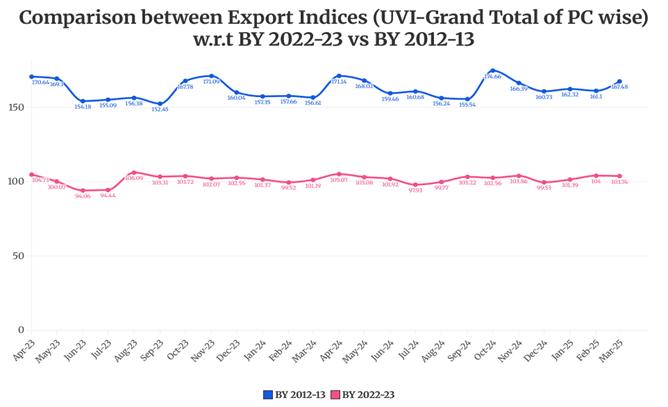
#BY means Base Year.
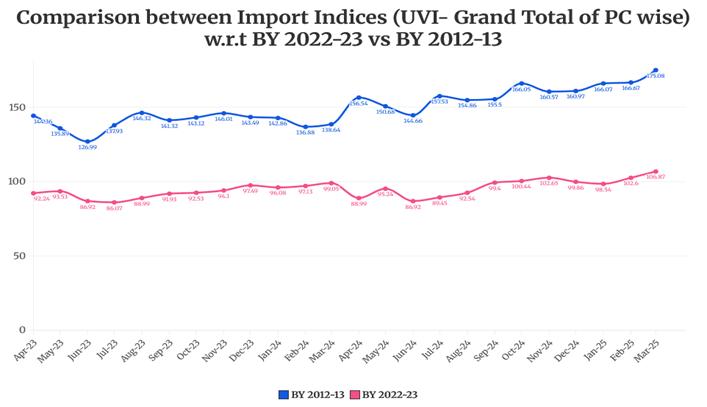
 

#BY means Base Year.

Table: Unit Value Index (UVI) and Quantity Index (QI) during FY 2025-26(Apr-Nov) using FY 2022-23 as base year


Month

Apr_25

May_25

Jun_25

1st Qtr 25-26

Jul_25

Aug_25

Sep_25

2nd Qtr 25-26

Oct_25

Nov_25

Unit Value Index

Export

105.31

99.73

96.31

100.33

99.31

100.55

104.08

101.23

103.78

105.32

Import

92.33

97.97

91.74

94.08

96.34

100.81

108.69

101.93

110.17

106.59

Quantity Index

Export

107.85

104.76

93.88

101.91

103.41

102.64

111.04

105.57

116.19

113.06

Import

138.16

126.61

112.58

125.17

122.47

124.06

126.45

124.32

137.04

121.75

Qtr  means Quarter.

Meaning and interpretation of the Indices

The Unit Value Indices and the Quantity Indices may be interpreted along the following lines.

The Unit Value Index answers the question: What is the growth in the average Unit Value of the items1 traded in the current month with respect to the same month in the Base Year?

So, an Unit Value Index of, say, 120 means that if the items that have been traded in the current month had been traded in the same month of the base year, and if the average price (or unit value) of those items had been Rs.100 in that month of the base year, then the average price (or unit value) of these items in the current month is Rs.120. Or that, there is a 20% increase in the average Unit Value, with respect to the Base Year, of the items that have been traded in the Current Month.

For example, let us suppose 30 items, 10 items each from 3 different Principal Commodities, have been traded in the current month. If these 30 items had been traded in the corresponding month of the base year at an average price of Rs.100, then the average price of these items in the current year is Rs.120.

It is to be noted that there are two successive steps of averaging done here. The first averaging is done over all the items (or ITCHS) of a PC group to arrive at the Index of that PC group. And the second averaging is done over all the PC groups to arrive at the Index at the Grand Total level for all commodities (which is the overall Index for India for a month). In both the stages, a weighted average is taken where the weights are proportional to the importance of the items and the PC groups respectively, and the Laspeyres Formula is used for averaging.

Quantity Indices, say, 200 means that if in the base year on an average 100 units were traded in India in the base year, then in the current year on an average 200 units were traded. However, it must be remembered that averaging quantities are different from averaging prices, since quantities in different units cannot be added directly.

So, the Quantity Indices are calculated by dividing the Value Indices by the Unit Value Indices. For example, if there is an increase in the Value of Export from Rs. 10,000 to Rs. 24,000, then the Value Index is 24000/10000 × 100 = 240. If the Unit Value Index is 120, then the Quantity Index comes to 240/120 × 100 = 200. So, loosely it can be said that, if the value of export has increased 2.4 times and the price of the commodities has increased 1.2 times, then the quantity must have doubled.

However, it may be noted that a very high or low Quantity Index may indicate the presence of Base Effect.

The Interpretation of the Bilateral and Regional Indices can be seen as an extension of the above.

A Unit Value Index of 120 with respect to a country, say Bangladesh, means that if all the items that have been traded with Bangladesh in the current month had been traded in the same month of the base year with the same country, and if the average price (or unit value) of those items had been Rs.100 in that month of the base year, then the average price (or unit value) of these items in the current month is Rs.120.

Similarly, a Quantity Index of 200 with respect to a country, say Bangladesh, means that if in the base year on an average 100 units were traded in India in the base year, then in the current year on an average 200 units were traded.

Comparability of the Indices across time

It is to be noted that the weights in the Index Number formula are fixed across time and there are twelve sets of weights for the twelve months. Hence, comparability of Indices is meaningful only when Indices of same month are compared across years. Different months may attach different weights to the same item, and hence comparing indices of two different months becomes vague and may have little applicability.

Further, the weights of the items that are not present in the trade basket of the current month are distributed to all the items that have been traded in the current month. This distribution is done in proportion to the weights of those items.

For example, let us suppose there are only 3 commodities for trade, say A, B and C. In month May of the Base year, let us suppose that the trade value of A was Rs. 50, B was Rs. 100 and C was Rs. 50. Then the weights assigned to A, B and C in the month of May of the following years would be in the ratio 50 :100 :50. However, in case, C is not traded in the current month, then the weight of C would be distributed proportionately among A and B, again in the ratio 1:2 (since in May the weights of A and B are in the ratio of 50 : 100, i.e., 1 : 2). So, in the current month the weights of A and B would be 3313  and 6623 .

As a result, the weights in any two given months are dependent on exactly the number of items (ITCHS codes) traded in those months. If the items traded are widely different, inference drawn from the comparison of the Indices may be done accordingly. On the other hand, more the similarity in the number of items traded more is the comparability of the two indices.

Net Terms of Trade:

Net Terms of Trade also called commodity Terms of Trade is defined as a ratio of export prices to import prices.

Let say 2022-23 be the base year and 2023-24 be the final year. We express both export and import prices in 2022-23 as 100. Now, suppose that at the end of 2023-24, it is found that the index of export prices decreased to 90 and index of import prices roses to 150. Then the Net Terms of Trade has changed to 90100150100=35 . Then terms of trade as index=35*100=60 . It implies that terms of trade of the country have decreased by about 40% in 2023-24 as compared with 2022-23. It thus shows a deterioration or a worsening of the terms of trade of the country.

If the index of export prices has risen to 150 and that of import prices had risen to 120, then the net terms of trade would have changed to 150120*100=125 . This implies an improvement in the net terms of trade of the country by 25% in 2023-24 over 2022-23.

Gross Terms of Trade:

Gross Terms of Trade is the ratio of physicalquantity of import to physical quantity of export.

Let say 2022-23 be the base year. In that year, the quantities export and import are denoted by 100. Now, suppose that in the year 2023-24, the index of quantity of import was 150 and that of quantity of export was 120. Then the gross terms of trade is given by 150100120100=54,  in terms of percentage =54*100=125 . This implies that there was an improvement of gross terms of trade by 25% in 2023-24 compared to 2022-23.

Income Terms of Trade: Income Terms of Trade is defined as- Net Terms of Trade multiplied by quantity of export.

Topics

Acts Income Tax
