

Loading...

Top
Help
×

By creating an account you can:

Logo TaxTMI
Call Us / Help / Feedback

Contact Us At :

E-mail: [email protected]

Call / WhatsApp at: +91 99117 96707

For more information, Check Contact Us

FAQs :

To know Frequently Asked Questions, Check FAQs

Most Asked Video Tutorials :

For more tutorials, Check Video Tutorials

Submit Feedback/Suggestion :

Email :
Please provide your email address so we can follow up on your feedback.
Category :
Description :
Min 15 characters 0/2000
Make Most of Text Search
  1. Checkout this video tutorial: How to search effectively on TaxTMI.
  2. Put words in double quotes for exact word search, eg: "income tax"
  3. Avoid noise words such as : 'and, of, the, a'
  4. Sort by Relevance to get the most relevant document.
  5. Press Enter to add multiple terms/multiple phrases, and then click on Search to Search.
  6. Text Search
  7. The system will try to fetch results that contains ALL your words.
  8. Once you add keywords, you'll see a new 'Search In' filter that makes your results even more precise.
  9. Text Search
Add to...
You have not created any category. Kindly create one to bookmark this item!
Create New Category
Hide
Title :
Description :
❮❮ Hide
Default View
Expand ❯❯
Close ✕
🔎 News - Adv. Search
TEXT SEARCH:

Press 'Enter' to add multiple search terms. Rules for Better Search

Search In:
Main Text + AI Text
  • Main Text
  • Main Text + AI Text
  • AI Text
Category: ?
Categorized by AI
---- All Categories ----
  • ---- All Categories ----
  • Income Tax
  • GST
  • Customs, DGFT & SEZ
  • FEMA & RBI
  • Corp. Laws, SEBI & IBC
  • PMLA, Black Money & ED
  • Budget
  • News and Press Release
  • PTI News
Month:
---- All Months ----
  • ---- All Months ----
  • January
  • February
  • March
  • April
  • May
  • June
  • July
  • August
  • September
  • October
  • November
  • December
Year:
---- All Years ----
  • ---- All Years ----
  • 2026
  • 2025
  • 2024
  • 2023
  • 2022
  • 2021
  • 2020
  • 2019
  • 2018
  • 2017
  • 2016
  • 2015
  • 2014
  • 2013
  • 2012
  • 2011
Sort By: ?
In Sort By 'Default', exact matches for text search are shown at the top, followed by the remaining results in their regular order.
Relevance Default Date
    Can't say when I'll return to India; legally barred from leaving UK: Mallya to Bombay HC
    Sitharaman highlights India's expanding trade architecture in meeting with Norwegian CEOs
    Rs 640 crore cyber fraud: SC refuses anticipatory bail to CA in ED case
    PM Modi meets president of Spain, PM of Finland; says India-EU FTA ushers in golden era
    Rising number of Indian freelancers, digital entrepreneurs forming US companies; compliance risks often overlooked, say experts
    imm india 2026 Positions India's Furniture & Interiors Industry for Global Leadership
    Asian shares gain as most regional markets stay closed for Lunar New Year holidays
    Cong cites OCCRP report to allege use of benami funds to amass large stakes in Adani Group
    AU Small Finance Bank Enhances Digital Savings Account Experience for Smarter Everyday Banking
    Tenth meeting of Monitoring Committee on Business Correspondents takes place under the chairmanship of Secretary, DFS
    BJP govt's budget is shaped by public suggestions: Haryana CM Saini
    I say as agriculture minister, trade deal with US won't cause losses to India's farmers: Shivraj
    Delhi court rejects ex-Jaypee Infratech MD's bail plea in money-laundering case
    Aakash undertakes in SC to secure 25.7 pc Byju's shares in rights dispute
    RBI releases draft Directions on Reporting Instructions for Authorised Dealer Category – I Banks
    Glottis Logistics Aligns Expansion with Budget's Infrastructure Push
    RBI releases draft Directions on Foreign Exchange Dealings of Authorised Persons
    Secretary, DFS inaugurates facilitation camps to promote ‘Paripoorna Mediclaim Ayush Bima’ for CGHS beneficiaries
    India intensifying engagement with global partners from position of strength: Jaishankar
    Axis Max Life Reports 20% YoY Growth in Individual Adjusted First Year Premium in 9M FY'26; VNB Increases by 30% YoY
❯❯
Maximize Maximize Maximize
0 / 200
Expand Note
Add to Folder

No Folders have been created

+

Are you sure you want to delete "My most important" ?

NOTE:

News
Showing Results for :
Reset Filters
Results Found:
Show All Summaries Hide All Summaries
February 18, 2026
Show AI Summary
Fugitive economic offender status limits challengeability while the declared person is legally barred from leaving a foreign jurisdiction.
This matter concerns a challenge to a declaration under the Fugitive Economic Offenders regime and a constitutional challenge to the Act, where the petitioner states he cannot return because his Indian passport was revoked and English and Welsh orders bar his departure, and the court has invited the government to reply while indicating it will not hear the challenge to the declaration until the petitioner returns.
February 18, 2026
Show AI Summary
Trade agreements driving investment: operationalising TEPA and sectoral cooperation to convert agreements into industrial collaboration and investments.
India emphasises an expanding trade architecture providing a durable framework for trade, industrial collaboration and long-term investments, supported by domestic regulatory and budgetary reforms to ease compliance. Discussions focused on operationalising the TEPA with the European Free Trade Association (EFTA) and on sectoral cooperation in renewables, carbon capture, rare earths, green tech, maritime, fisheries, semiconductors and financial services, with presentations outlining bilateral investment potential and mechanisms to translate agreements into practical cooperation.
February 18, 2026
Show AI Summary
Anticipatory bail denial in money laundering probe tied to cyber fraud highlights custodial interrogation necessity.
Refusal of anticipatory bail to a chartered accountant in a PMLA investigation stemmed from an alleged intricate mesh of laundering involving layering through thousands of mule accounts, use of an overseas payment platform and cross border cash withdrawals; the high court held custodial interrogation necessary to unravel transactions crafted by skilled professionals and to secure electronic evidence, distinguishing ordinary cryptocurrency dealings from an organised scheme to siphon investors' funds and noting allegations of assault, bribery and destruction of electronic material.
February 18, 2026
Show AI Summary
India-EU Free Trade Agreement expands economic ties and drives technology, defence and education cooperation across Europe and India.
The India EU Free Trade Agreement is presented as the principal catalyst for deeper India-Europe economic relations, expected to expand market access and commercial opportunities. Bilateral meetings with Spain and Finland focused on leveraging the FTA to strengthen economic partnership and targeted cooperation in defence, security, advanced technologies (including AI and 6G), clean energy and higher education, while India's AI Expo serves as a platform to operationalise joint technology, startup and institutional collaboration.
February 18, 2026
Show AI Summary
Foreign owned US LLC compliance: nonresident owners face mandatory IRS reporting and parallel Indian tax and FEMA obligations.
Nonresident ownership of US single member LLCs triggers an annual IRS Form 5472 filing obligation with steep per form penalties for non filing; this filing must be submitted by mail or fax. The US FinCEN BOI exemption for domestically formed entities does not remove Form 5472 duties. Indian residents must report and tax worldwide income and may face FEMA and Overseas Direct Investment reporting requirements, so professional cross border tax and FEMA advice is recommended before formation.
February 18, 2026
Show AI Summary
Tariff elimination boosts India's export competitiveness, enhancing global sourcing and buyer engagement through imm india's trade platform.
Trade-policy shifts, notably the EU-India Free Trade Agreement, have eliminated or substantially reduced import duties on several Indian furniture categories, lowering average tariffs and simplifying customs procedures. imm india 2026 is structured as a B2B trade platform-featuring a Hosted Buyer Programme, The Sourcing Hub, curated showcases, and industry alliances-to enable direct sourcing, streamline buyer-seller engagement, and translate tariff and customs liberalisation into expanded export market access for Indian manufacturers.
February 18, 2026
Show AI Summary
Trade tariffs reshape investment flows as US-Japan deal ties increased export levies to large bilateral investment commitments.
A bilateral trade arrangement between Japan and the United States is reported to include a substantial Japanese investment pledge in the US and an associated increase in export tariffs on Japanese goods, while a Japanese subsidiary's participation in a major US natural gas facility links cross border investment commitments to energy project involvement, framing market movements alongside investor concerns about overinvestment in AI infrastructure and resultant volatility.
February 18, 2026
Show AI Summary
Benami funds allegations prompt call for parliamentary probe amid claimed regulatory inaction and governance failures.
Allegations assert the use of benami funds by close associates to amass significant stakes in a corporate conglomerate through intermediaries and trading firms, accompanied by claims of over-invoicing, cross-border transfers, and an alleged bribery scheme to secure contracts; these claims form the basis for demands for a parliamentary inquiry into corporate ownership concealment and associated governance failures amid perceived regulatory and enforcement inaction.
February 18, 2026
Show AI Summary
Digital savings account transparency improves customer decision-making through instant account opening, UPI integration and built in interest tools.
AU Small Finance Bank's enhanced digital savings account focuses on instant digital account opening, UPI integration, 24x7 mobile banking, contactless debit card capabilities, and an integrated savings account interest rate calculator that provides transparent interest rate visibility to help customers evaluate returns, plan finances, and maintain liquidity while supporting financial inclusion.
February 18, 2026
Show AI Summary
Business correspondent operationalisation advances as banks urged to scale services and complete digital monitoring and geotagging.
Monitoring Committee reviewed operational and governance aspects of the Business Correspondent model, noting implementation of a Business Correspondent Registry that identifies duplicate BCs and captures service and performance records; member banks completed geotagging of BC points and are using digital monitoring tools. The Committee advised banks to scale up and expand services at BC outlets, and discussed commission structures in remote areas, grievance resolution for BC organisations, and coordination to strengthen performance monitoring and financial inclusion.
February 17, 2026
Show AI Summary
People's budget shaped by public suggestions to advance development priorities while maintaining fiscal discipline in state finances.
The upcoming state budget is characterized as a people's budget shaped by public suggestions, with over twelve thousand submissions and several thousand to be incorporated. It follows prior budget commitments-248 announcements with seventy-seven implemented and most others near completion-and is presented against strengthened fiscal metrics: rising GDP and per capita income, increased own revenue, broad departmental expenditure, fiscal deficit within FRBM limits, and a higher central tax share under the 16th Finance Commission. Socio economic gains cited include employment growth, expanded higher education, MSME formalisation, and export increases.
February 17, 2026
Show AI Summary
Trade deal protections for farmers: government assures imports will be allowed only where farmer interests are safeguarded.
The minister stated the interim India-US trade agreement includes safeguards to prevent harm to farmers while allowing necessary imports to address domestic shortages; he defended policy choices on MSP orientation, procurement and buffer stocks as central to protecting farmer interests, and announced Bharat-VISTAAR, an AI-based platform to deliver market prices, crop advice, weather updates and scheme information to enhance farmer welfare and transparency.
February 17, 2026
Show AI Summary
PMLA bail conditions prevent release where alleged large-scale fund diversion, multiple FIRs and risk of evidence tampering exist.
Denial of regular bail under the Prevention of Money Laundering Act followed allegations that the accused diverted homebuyer funds, leaving major construction incomplete; investigative records and account certifications showed a large shortfall between amounts collected and expenditure, and the accused was named in multiple FIRs and charge-sheets. The court found a strong possibility of reoffending or tampering with evidence if released and held that the PMLA twin bail conditions-opportunity for the prosecutor to oppose bail and judicial satisfaction of non-guilt and non-recidivism-were not satisfied.
February 17, 2026
Show AI Summary
Secured shareholding: Byju's stake in Aakash to remain secured pending NCLAT disposal; TLPL allowed to subscribe.
Aakash undertook in the Supreme Court that Byju's shareholding in Aakash shall remain secured until disposal of the interlocutory application before the NCLAT; the Court recorded that undertaking and gave Byju's parent a limited period to subscribe to the second tranche of the rights issue. The dispute arises from TLPL's challenge to the rights issue amid TLPL's insolvency proceedings, and the NCLAT has permitted TLPL to apply for shares up to its original entitlement while restraining Aakash from taking matters requiring a special resolution until the dispute is adjudicated.
February 17, 2026
Show AI Summary
Reporting requirement for local-currency foreign exchange derivatives now covers related-party global transactions; stakeholders invited to comment.
The Reserve Bank proposes draft Directions requiring Authorised Dealer Category - I banks to report foreign exchange derivative transactions involving the Indian currency undertaken by their related parties globally, extending trade repository coverage to offshore rupee derivative flows to enhance market transparency and pricing. The measure builds on earlier requirements for market-makers, primary dealers, and banks to report OTC and rupee interest-rate derivatives, and is published for stakeholder consultation with specified submission procedures.
February 17, 2026
Show AI Summary
Customs digitisation shortens clearance times, enabling asset-backed logistics expansion aligned with infrastructure-focused trade reforms.
Union Budget emphasis on multimodal freight connectivity and customs modernisation is expected to reduce structural logistics costs and improve transit predictability. Glottis Logistics will invest in trailers and container assets to increase owned capacity, reduce third-party dependence and strengthen execution across trade corridors. Concurrent customs digitisation measures-electronic cargo sealing, non-intrusive inspections and extended duty deferment for authorised operators-aim to shorten clearance times and ease working capital pressures, making asset-backed operators with disciplined capital allocation better positioned to capture long-term trade competitiveness gains.
February 17, 2026
Show AI Summary
Draft directions on foreign exchange dealings invite public comment to broaden authorised dealers' flexibility in products, risk management and platforms.
The Reserve Bank has issued draft Directions on Foreign Exchange Dealings of Authorised Persons and invited stakeholder comments. The draft seeks to refine regulation by expanding facilities and operational flexibility available to authorised dealers, focusing on foreign exchange products, risk management and trading platforms. It forms part of regulatory updates announced in the recent Statement on Developmental and Regulatory Policies, and specifies submission channels for public feedback.
February 17, 2026
Show AI Summary
Health insurance co-payment options enhance CGHS beneficiary coverage with cashless hospitalization access and flexible network choices.
Paripoorna Mediclaim Ayush Bima is an optional indemnity-based in patient hospitalization policy exclusively for CGHS beneficiaries, coverable up to six members per policy. The product offers selectable co-payment sharing ratios between insurer and subscriber, cashless treatment through insurer and Third Party Administrator networks, and is promoted as a retail complement to existing CGHS benefits with a GST exemption to improve affordability.
February 17, 2026
Show AI Summary
Economic security tied to self-reliance and trusted partners as trade deals reshape export controls and supply chains.
India is intensifying engagement from a position of strength, using recent trade agreements to strengthen economic security through self reliance, trusted partners, supply chain diversification and de risking in response to weaponised production, tightened export controls, market leverage and tariff induced demand uncertainty.
February 17, 2026
Show AI Summary
Financial performance: Axis Max Life posts strong premium and profitability growth, boosting market share and new business margins.
Axis Max Life's 9M FY26 results show 20% YoY growth in Individual Adjusted First Year Premium to Rs. 6,396 crores and a 30% YoY increase in Value of New Business to Rs. 1,633 crores, with New Business Margin at 23.6% and private market share rising by 53 basis points to 9.8%; renewal premium, gross written premium, Embedded Value and Assets Under Management also registered double digit growth, while the release includes a standard disclaimer on forward looking statements and investment reliance.

News

Back

All News

Showing Results for :
Reset Filters
No Records Found

News

Showing Results for : Reset Filters
Customs, DGFT & SEZ

Directorate General of Commercial Intelligence and Statistics Revises Base Year of Merchandise Trade Indices to FY 2022–23 to Reflect Current Trade Structure and Global Patterns

February 21, 2026

Contents
Summary
Note

Note

-

Bookmark

Print

Print

Merchandise Trade Indices are compiled and published by the Directorate General of Commercial Intelligence and Statistics (DGCI&S), Ministry of Commerce & Industry, to measure changes in the unit values (prices) of India’s exports and imports over time. These indices serve as important indicators of external sector price movements and are widely used for economic analysis, including national accounts compilation and assessment of terms of trade. Over the years, the base year of the indices has been periodically revised to reflect structural changes in India’s trade composition and evolving global trade patterns. The most recent revision updates the base year to FY 2022–23 (2022–23 = 100), replacing the earlier base of FY 2012–13, thereby ensuring that the indices accurately represent the current structure of India’s merchandise trade.

Revision of Base Year of India’s Merchandise Trade Indices to FY 2022–23

The Directorate General of Commercial Intelligence and Statistics (DGCI&S), Ministry of Commerce & Industry, has revised the base year of India’s Merchandise Trade Indices from FY 2012–13 to FY 2022–23 (2022–23 = 100), in view of the structural changes in the economy, shifts in commodity composition, evolving trade patterns, and the need for improved alignment with contemporary macroeconomic indicators.

The revision has been undertaken on the recommendations of a committee constituted by DGCI&S under the Chairmanship of Prof. Nachiketa Chattopadhyay, Professor, Indian Statistical Institute, Kolkata. The Committee examined the existing methodology, data coverage, weighting structure, and compilation practices, and recommended suitable refinements in line with international best practices.

Key Features of the Revised Series (Base: FY 2022–23)

  1. Updated Base Year:
    The new base year FY 2022–23 makes the Indices reflect the current structure of India’s external trade more accurately.
  2. Revised Commodity Basket:
    The coverage and classification of commodities have been reviewed at the Principal Commodity level to better capture emerging and declining trade items.
  3. Revised Weighting Structure:
    Weights have been updated based on trade values of the new base year to reflect the latest value shares in exports and imports.
  4. Improved Methodology:
    Methodological refinements have been introduced in:
    1. Selection of common commodity basket for base year selection (procedure of selection for common commodity basket explained in detail report of the committee).
    2. Treatment of missing unit values (Imputation of missing unit values in base year selection have been explained in detail in the committee report).
  5. Indices Compiled:
    The revised series includes:
    1. Monthly, Quarterly and Annual Indices (Export Unit Value Index,Import Unit Value Index).
    2. Principal Commodity (PC) Classification wise Trade Indices (Export/Import).
    3. Standard International Trade Classification-wise (SITC) Trade Indices.
    4. Broad economic categories-wise (BEC) Trade Indices.
    5. Bilateral and Region-wise Trade Indices of Top 20 Export and Import partner nations of India.
    6. Terms of Trade (Gross terms of trade, Net terms of trade and Income terms of trade).

Rationale for Revision

Over the past decade, India’s trade basket has undergone substantial changes due to emergence of new commodities, technological advancements, Global supply chain restructuring and changes in relative price structures.

The earlier base year (FY 2012–13) no longer adequately reflected the prevailing trade structure. The revision ensures improved relevance, reliability, and analytical usefulness of the Merchandise Trade Indices for policymakers, researchers, and other stakeholders.

Use of the Revised Series

Merchandise Trade Indices compiled by the Directorate General of Commercial Intelligence and Statistics (DGCI&S) are extensively used by key government institutions for economic analysis and policy formulation. The National Accounts Division (NAD) of the Ministry of Statistics and Programme Implementation uses the Export and Import Unit Value Indices as deflators for estimating real exports and imports in GDP compilation. The Reserve Bank of India (RBI) relies on these indices for external sector assessment, balance of payments analysis, and evaluation of price competitiveness. Various Ministries and Government agencies also use them to frame and review trade-related policies and to assess movements in international prices. In addition, academic institutions, research organizations, and economic analysts utilize Merchandise Trade Indices for empirical research, modelling, and analysis of trade dynamics and terms of trade trendson and economic research.

Availability of Data

The revised Merchandise Trade Indices (Base: FY 2022–23) will be released on the official website of DGCI&S. Detailed methodological documentation is available in the Report of the Committee on Revision of Base Year for Merchandise Trade Indices.

Comparison of the new revised Indices (Base Year: 2022-23) with the already released Indices (Base Year : 2012-13) for 2022-23 and 2023-24 is given below.
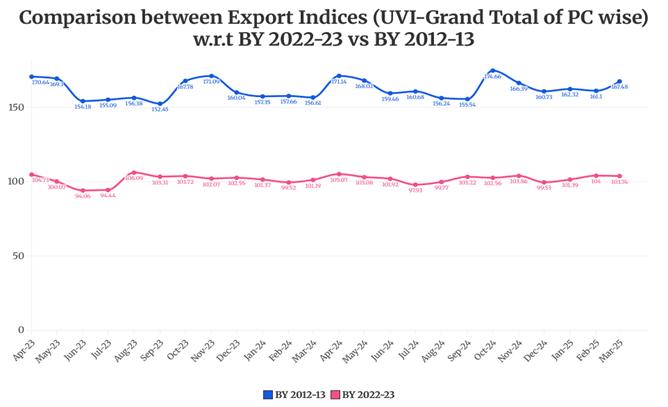
#BY means Base Year.
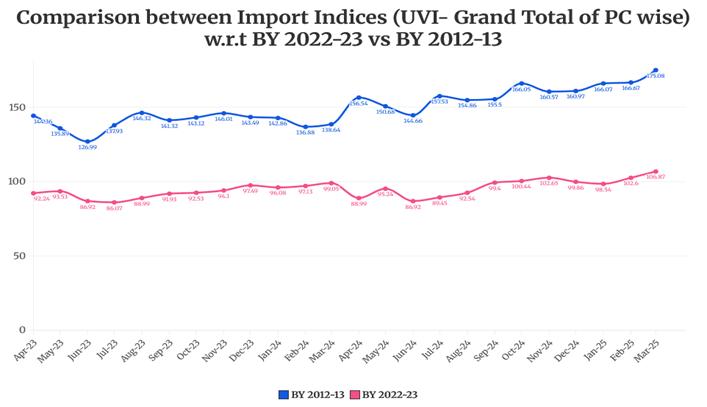
 

#BY means Base Year.

Table: Unit Value Index (UVI) and Quantity Index (QI) during FY 2025-26(Apr-Nov) using FY 2022-23 as base year


Month

Apr_25

May_25

Jun_25

1st Qtr 25-26

Jul_25

Aug_25

Sep_25

2nd Qtr 25-26

Oct_25

Nov_25

Unit Value Index

Export

105.31

99.73

96.31

100.33

99.31

100.55

104.08

101.23

103.78

105.32

Import

92.33

97.97

91.74

94.08

96.34

100.81

108.69

101.93

110.17

106.59

Quantity Index

Export

107.85

104.76

93.88

101.91

103.41

102.64

111.04

105.57

116.19

113.06

Import

138.16

126.61

112.58

125.17

122.47

124.06

126.45

124.32

137.04

121.75

Qtr  means Quarter.

Meaning and interpretation of the Indices

The Unit Value Indices and the Quantity Indices may be interpreted along the following lines.

The Unit Value Index answers the question: What is the growth in the average Unit Value of the items1 traded in the current month with respect to the same month in the Base Year?

So, an Unit Value Index of, say, 120 means that if the items that have been traded in the current month had been traded in the same month of the base year, and if the average price (or unit value) of those items had been Rs.100 in that month of the base year, then the average price (or unit value) of these items in the current month is Rs.120. Or that, there is a 20% increase in the average Unit Value, with respect to the Base Year, of the items that have been traded in the Current Month.

For example, let us suppose 30 items, 10 items each from 3 different Principal Commodities, have been traded in the current month. If these 30 items had been traded in the corresponding month of the base year at an average price of Rs.100, then the average price of these items in the current year is Rs.120.

It is to be noted that there are two successive steps of averaging done here. The first averaging is done over all the items (or ITCHS) of a PC group to arrive at the Index of that PC group. And the second averaging is done over all the PC groups to arrive at the Index at the Grand Total level for all commodities (which is the overall Index for India for a month). In both the stages, a weighted average is taken where the weights are proportional to the importance of the items and the PC groups respectively, and the Laspeyres Formula is used for averaging.

Quantity Indices, say, 200 means that if in the base year on an average 100 units were traded in India in the base year, then in the current year on an average 200 units were traded. However, it must be remembered that averaging quantities are different from averaging prices, since quantities in different units cannot be added directly.

So, the Quantity Indices are calculated by dividing the Value Indices by the Unit Value Indices. For example, if there is an increase in the Value of Export from Rs. 10,000 to Rs. 24,000, then the Value Index is 24000/10000 × 100 = 240. If the Unit Value Index is 120, then the Quantity Index comes to 240/120 × 100 = 200. So, loosely it can be said that, if the value of export has increased 2.4 times and the price of the commodities has increased 1.2 times, then the quantity must have doubled.

However, it may be noted that a very high or low Quantity Index may indicate the presence of Base Effect.

The Interpretation of the Bilateral and Regional Indices can be seen as an extension of the above.

A Unit Value Index of 120 with respect to a country, say Bangladesh, means that if all the items that have been traded with Bangladesh in the current month had been traded in the same month of the base year with the same country, and if the average price (or unit value) of those items had been Rs.100 in that month of the base year, then the average price (or unit value) of these items in the current month is Rs.120.

Similarly, a Quantity Index of 200 with respect to a country, say Bangladesh, means that if in the base year on an average 100 units were traded in India in the base year, then in the current year on an average 200 units were traded.

Comparability of the Indices across time

It is to be noted that the weights in the Index Number formula are fixed across time and there are twelve sets of weights for the twelve months. Hence, comparability of Indices is meaningful only when Indices of same month are compared across years. Different months may attach different weights to the same item, and hence comparing indices of two different months becomes vague and may have little applicability.

Further, the weights of the items that are not present in the trade basket of the current month are distributed to all the items that have been traded in the current month. This distribution is done in proportion to the weights of those items.

For example, let us suppose there are only 3 commodities for trade, say A, B and C. In month May of the Base year, let us suppose that the trade value of A was Rs. 50, B was Rs. 100 and C was Rs. 50. Then the weights assigned to A, B and C in the month of May of the following years would be in the ratio 50 :100 :50. However, in case, C is not traded in the current month, then the weight of C would be distributed proportionately among A and B, again in the ratio 1:2 (since in May the weights of A and B are in the ratio of 50 : 100, i.e., 1 : 2). So, in the current month the weights of A and B would be 3313  and 6623 .

As a result, the weights in any two given months are dependent on exactly the number of items (ITCHS codes) traded in those months. If the items traded are widely different, inference drawn from the comparison of the Indices may be done accordingly. On the other hand, more the similarity in the number of items traded more is the comparability of the two indices.

Net Terms of Trade:

Net Terms of Trade also called commodity Terms of Trade is defined as a ratio of export prices to import prices.

Let say 2022-23 be the base year and 2023-24 be the final year. We express both export and import prices in 2022-23 as 100. Now, suppose that at the end of 2023-24, it is found that the index of export prices decreased to 90 and index of import prices roses to 150. Then the Net Terms of Trade has changed to 90100150100=35 . Then terms of trade as index=35*100=60 . It implies that terms of trade of the country have decreased by about 40% in 2023-24 as compared with 2022-23. It thus shows a deterioration or a worsening of the terms of trade of the country.

If the index of export prices has risen to 150 and that of import prices had risen to 120, then the net terms of trade would have changed to 150120*100=125 . This implies an improvement in the net terms of trade of the country by 25% in 2023-24 over 2022-23.

Gross Terms of Trade:

Gross Terms of Trade is the ratio of physicalquantity of import to physical quantity of export.

Let say 2022-23 be the base year. In that year, the quantities export and import are denoted by 100. Now, suppose that in the year 2023-24, the index of quantity of import was 150 and that of quantity of export was 120. Then the gross terms of trade is given by 150100120100=54,  in terms of percentage =54*100=125 . This implies that there was an improvement of gross terms of trade by 25% in 2023-24 compared to 2022-23.

Income Terms of Trade: Income Terms of Trade is defined as- Net Terms of Trade multiplied by quantity of export.

Topics

Acts Income Tax
