

Loading...

Top
Help
×

By creating an account you can:

Logo TaxTMI
Call Us / Help / Feedback

Contact Us At :

E-mail: [email protected]

Call / WhatsApp at: +91 99117 96707

For more information, Check Contact Us

FAQs :

To know Frequently Asked Questions, Check FAQs

Most Asked Video Tutorials :

For more tutorials, Check Video Tutorials

Submit Feedback/Suggestion :

Email :
Please provide your email address so we can follow up on your feedback.
Category :
Description :
Min 15 characters 0/2000
Make Most of Text Search
  1. Checkout this video tutorial: How to search effectively on TaxTMI.
  2. Put words in double quotes for exact word search, eg: "income tax"
  3. Avoid noise words such as : 'and, of, the, a'
  4. Sort by Relevance to get the most relevant document.
  5. Press Enter to add multiple terms/multiple phrases, and then click on Search to Search.
  6. Text Search
  7. The system will try to fetch results that contains ALL your words.
  8. Once you add keywords, you'll see a new 'Search In' filter that makes your results even more precise.
  9. Text Search
Add to...
You have not created any category. Kindly create one to bookmark this item!
Create New Category
Hide
Title :
Description :
❮❮ Hide
Default View
Expand ❯❯
Close ✕
🔎 News - Adv. Search
TEXT SEARCH:

Press 'Enter' to add multiple search terms. Rules for Better Search

Search In:
Main Text + AI Text
  • Main Text
  • Main Text + AI Text
  • AI Text
Category: ?
Categorized by AI
---- All Categories ----
  • ---- All Categories ----
  • Income Tax
  • GST
  • Customs, DGFT & SEZ
  • FEMA & RBI
  • Corp. Laws, SEBI & IBC
  • PMLA, Black Money & ED
  • Budget
  • News and Press Release
  • PTI News
Month:
---- All Months ----
  • ---- All Months ----
  • January
  • February
  • March
  • April
  • May
  • June
  • July
  • August
  • September
  • October
  • November
  • December
Year:
---- All Years ----
  • ---- All Years ----
  • 2026
  • 2025
  • 2024
  • 2023
  • 2022
  • 2021
  • 2020
  • 2019
  • 2018
  • 2017
  • 2016
  • 2015
  • 2014
  • 2013
  • 2012
  • 2011
Sort By: ?
In Sort By 'Default', exact matches for text search are shown at the top, followed by the remaining results in their regular order.
Relevance Default Date
    ED issues fresh summons to Anil Ambani for February 26
    Tripura tea auction centre likely to be operational by April: official
    IICA Renews MoU with NALSAR University of Law to Strengthen Academic Collaboration and Capacity Building
    IICA Constitutes High-Level Advisory Group on Ease of Doing Business under the Chairmanship of DG & CEO
    Release of Report of the ‘Sub-Committee on Methodological Improvements' in 2022-23 series of National Accounts
    India will lead the Global South one day: Mohan Bhagwat in Lucknow
    No reason to believe change in India's stance on Russian oil: Russian Foreign Ministry
    PM Modi, Estonia prez welcome significant strategic upswing in India-EU ties
    WinZo case: ED attaches Rs 500-crore bank deposits in US, Singapore
    Can't say when I'll return to India; legally barred from leaving UK: Mallya tells Bombay HC
    Save Box app case: ED attaches asset linked to Malayalam actor Jayasurya
    PM Modi, Croatia PM discuss ways to add momentum to bilateral ties
    CCI approves proposed Merger of Hinduja Leyland Finance into NDL Ventures
    CCI approves internal reorganization of Bennett Coleman & Co. Ltd.’s (BCCL) certain businesses etc. into Times Horizon Pvt Ltd (THPL) on a going con...
    CCI approves acquisition of portfolio management services business of Axis Securities by Axis Asset Management Company
    Kerala grants temporary pay relief to 20,000 teachers after SC K-TET ruling
    Indo US Bio-Tech Limited to invest Rs.71.51 crore in Agricultural Innovation and Research and Development by 2030-31
    Delhi govt mandates online application for ration cards, Aadhaar details of all family members
    Can't say when I'll return to India; legally barred from leaving UK: Mallya to Bombay HC
    Sitharaman highlights India's expanding trade architecture in meeting with Norwegian CEOs
❯❯
Maximize Maximize Maximize
0 / 200
Expand Note
Add to Folder

No Folders have been created

+

Are you sure you want to delete "My most important" ?

NOTE:

News
Showing Results for :
Reset Filters
Results Found:
Show All Summaries Hide All Summaries
February 19, 2026
Show AI Summary
PMLA summons prompt fresh ED questioning over alleged money trail and disputed property sale.
Fresh summons under the Prevention of Money Laundering Act require the Reliance Group chairman and his spouse to give separate statements in an ED money laundering inquiry concerning an allegedly fraudulent sale of a Manhattan condominium, a related cross border remittance routed through a foreign entity, the arrest of a former executive, the constitution of a special investigation team, filing of ECIRs, and asset attachment measures.
February 19, 2026
Show AI Summary
State GST eligibility and transport subsidy shaping a local tea auction centre to retain value and improve price realisation.
Establishment of a local tea auction centre at Gurkhabasti aims to internalise tea transactions, improve price realisation for Tripura producers, and reduce time and transport costs. The Tripura Tea Development Corporation will provide a transport subsidy from its own resources to enhance viability. Converting outbound auctioning into in-state auctions is expected to affect State GST eligibility and receipts, thereby altering the fiscal profile of tea transactions and retaining value within the state supply chain.
February 19, 2026
Show AI Summary
Memorandum of Understanding renewal strengthens academic collaboration, joint research, faculty exchanges and capacity building between institutions.
Memorandum of Understanding renewal establishes a five-year institutional framework for academic collaboration between IICA and NALSAR, formalising faculty and student exchanges, joint research and publications, expert advisory services, and the organisation of workshops, seminars and conferences; it consolidates a two-year residential LL.M. programme in Insolvency and Bankruptcy Laws combining academic instruction and industry exposure.
February 19, 2026
Show AI Summary
Ease of Doing Business reforms to rationalise e-forms and streamline corporate compliance through digital governance and consultations.
A high-level Advisory Group on Ease of Doing Business will recommend measures to rationalise e-forms and simplify corporate compliance under the Companies Act by reducing duplicative filings through consolidation, automation and event-based processing, develop an Integrated Form Blueprint and a phased implementation roadmap, conduct stakeholder consultations and impact assessments, and propose draft amendments to support a modern, transparent, technology-driven corporate regulatory framework; the School of Business Environment, IICA, will serve as Secretariat and a research MoU with the Ministry will produce evidence-based recommendations.
February 19, 2026
Show AI Summary
National accounts methodology revised to adopt new data sources and updated compilation methods aligning quarterly and annual estimates.
Revision of national accounts introduces new administrative and survey data, disaggregated modeling, and updated rates to improve sectoral estimates. Corporate sector changes include activity wise revenue splitting and disaggregated Paid up Capital multipliers; government estimates add imputed housing services and wider coverage; household estimates move to annual direct estimation using specific surveys. PFCE uses a mixed survey/production/commodity flow approach with COICOP 2018, and quarterly benchmarking adopts Denton proportional benchmarking to align QNA with annual accounts.
February 19, 2026
Show AI Summary
Trade tariffs nullified by national economic strength - call for self-reliance and firmness in external trade relations.
India's prospective leadership of the Global South and economic self-reliance were foregrounded, asserting that strengthened national capacity will nullify the effect of external tariffs and reduce foreign leverage. The speaker urged firmness in trade relations, linked social harmony and a shared Hindu identity to national unity, advocated moving temple administration from government control to devotees, and highlighted village-level development work including education, dispute resolution, land access, and local employment.
February 18, 2026
Show AI Summary
Sovereign energy policy: India's continued purchase of Russian hydrocarbons seen as mutually beneficial despite US claims.
Russia's Foreign Ministry states it has no reason to believe India has changed its position on purchasing Russian hydrocarbons, asserting such purchases are mutually beneficial and help maintain international energy market stability. The statement rebuts US claims that India agreed to stop importing Russian crude, notes that India has not confirmed Washington's assertion, and characterises previous US actions - tariffs, sanctions and prohibitions - as coercive measures intended to dissuade countries from buying Russian oil.
February 18, 2026
Show AI Summary
India-EU free trade agreement accelerates strategic economic and technological cooperation, enabling enhanced talent mobility and digital collaboration.
Prime Minister Modi and Estonian President Karis affirmed that the India-EU free trade agreement will act as a catalyst for deeper economic partnership and committed to leveraging it to expand trade and investment linkages, while intensifying cooperation in AI, digitalisation, e-governance, cybersecurity, startups, skilling, talent mobility, tourism, and clean energy collaboration.
February 18, 2026
Show AI Summary
Provisional attachment under PMLA of overseas deposits linked to a real money gaming app for alleged money laundering and algorithmic manipulation.
The Enforcement Directorate issued a provisional order under the Prevention of Money Laundering Act to attach overseas bank deposits held in the names of alleged shell companies linked to Winzo Pvt Ltd, operated and controlled by its promoters, as part of a money laundering investigation into the real money gaming business alleging use of BOTs/AI and restrictions on customer withdrawals; a chargesheet has been filed and cumulative attachments have been reported.
February 18, 2026
Show AI Summary
Fugitive economic offender status challenged as absence due to passport revocation and UK travel prohibition.
The petitioner challenges his designation as a fugitive economic offender and the constitutional validity of the Fugitive Economic Offenders Act, asserting he cannot specify a return date because his Indian passport was revoked and English and Welsh court orders prohibit him from leaving; counsel contends absence stems from international legal constraints and need not bar the High Court from hearing the petitions. The bench directed the Union government to file its reply and posted the matter for further hearing.
February 18, 2026
Show AI Summary
Provisional attachment under PMLA used to secure asset linked to alleged investor cheating and diverted endorsement proceeds.
Provisional attachment under the Prevention of Money Laundering Act was used to secure an immovable property in Kerala linked to proceeds allegedly generated through cheating by an online bidding application, with investigators tracing diverted funds to celebrity endorsement payments, cryptocurrency trading losses and personal expenses and issuing a provisional order to preserve the property equivalent to the identified proceeds.
February 18, 2026
Show AI Summary
Free trade agreement momentum boosted as leaders discuss cooperation across technology, shipbuilding and corridor connectivity.
Leaders focused on strengthening bilateral ties by promoting a Free Trade Agreement and enhancing cooperation in technology, innovation, shipbuilding, blue economy, and connectivity via the India Middle East Europe Economic Corridor. Croatia flagged increased trade and opportunities in logistics, maritime transport, digital transformation, defence and security, and emphasised its gateway role linking the Three Seas Initiative with the IMEC corridor. The visit occurred alongside the AI Impact Summit, framing AI's policy relevance to these economic agendas.
February 18, 2026
Show AI Summary
Merger approval: consolidation of an NBFC's asset finance business into an inactive holding entity cleared, detailed regulatory order to follow.
The Competition Commission approved the proposed merger of Hinduja Leyland Finance Limited into NDL Ventures Limited, enabling consolidation of Hinduja Leyland Finance's asset finance activities-small ticket retail and vehicle loans, loan against property and housing loans-into NDL Ventures, which presently has no active business; a detailed regulatory order and any conditions will follow.
February 18, 2026
Show AI Summary
Competition approval for internal reorganisation permits transfer of specified BCCL businesses to newly formed THPL on going concern basis.
Competition Commission approval granted for an internal reorganisation by Bennett Coleman & Company Limited to demerge and transfer specified entities, businesses, undertakings, assets and liabilities (EIBME Business) into newly incorporated Times Horizon Private Limited on a going concern basis, with further detailed order to follow.
February 18, 2026
Show AI Summary
Competition approval for acquisition of portfolio management services business, consolidating PMS activities under an asset manager.
The Competition Commission of India has approved an acquisition in which Axis Asset Management Company Limited will acquire the portfolio management services business of Axis Securities Limited in India. The Acquirer manages a mutual fund business, provides portfolio management services, and manages alternative investment funds across Category II and Category III; the Target Business comprises the Transferor's portfolio management services in India. A detailed order will follow.
February 18, 2026
Show AI Summary
Teacher eligibility requirement: temporary pay preserved for affected teachers pending K-TET compliance within the prescribed compliance period.
Following the court's removal of a pre-existing exemption, the State will grant temporary pay-scale approval to teachers appointed before the ruling's effective date provided they clear K-TET within the prescribed compliance period; equivalent qualifications are accepted and promotions will be considered after legal advice. The State will also re-fix posts to include students with Aadhaar EIDs or pending corrections to remedy staff losses caused by Aadhaar data discrepancies.
February 18, 2026
Show AI Summary
Agricultural innovation investment roadmap drives company expansion into exports, joint ventures and multiyear seed R&D projects.
Indo US Bio-Tech Limited's roadmap commits to phased investments in infrastructure, capacity and crop-specific multi-year R&D through 2030-31, including a high-tech greenhouse, a 5,000 sq. ft. seed processing plant with dedicated machinery, processing capacity modernization, a joint venture groundnut seed plant, and multiple staged tomato, bottle gourd, chilli and brinjal breeding and commercialization projects, alongside a strategic export push into the US and African markets with staged pilot-to-full-scale operations.
February 18, 2026
Show AI Summary
Aadhaar linkage: Delhi mandates household Aadhaar for online ration card applications, with verification and eligibility checks.
Delhi mandates online applications via the e-district portal for new ration cards with Aadhaar numbers for all family members and supporting residence and income documentation. Food supply officers will scrutinise and verify applications, forwarding eligible cases to assistant commissioners and a district-level committee which applies Delhi Food Security Rules, 2026 and the SOP, enforces exclusion criteria, prioritises needy applicants, maintains a waiting list, and routes appeals to the Public Grievance Commission as State Food Commission.
February 18, 2026
Show AI Summary
Fugitive economic offender status limits challengeability while the declared person is legally barred from leaving a foreign jurisdiction.
This matter concerns a challenge to a declaration under the Fugitive Economic Offenders regime and a constitutional challenge to the Act, where the petitioner states he cannot return because his Indian passport was revoked and English and Welsh orders bar his departure, and the court has invited the government to reply while indicating it will not hear the challenge to the declaration until the petitioner returns.
February 18, 2026
Show AI Summary
Trade agreements driving investment: operationalising TEPA and sectoral cooperation to convert agreements into industrial collaboration and investments.
India emphasises an expanding trade architecture providing a durable framework for trade, industrial collaboration and long-term investments, supported by domestic regulatory and budgetary reforms to ease compliance. Discussions focused on operationalising the TEPA with the European Free Trade Association (EFTA) and on sectoral cooperation in renewables, carbon capture, rare earths, green tech, maritime, fisheries, semiconductors and financial services, with presentations outlining bilateral investment potential and mechanisms to translate agreements into practical cooperation.

News

Back

All News

Showing Results for :
Reset Filters
No Records Found

News

Showing Results for : Reset Filters
Customs, DGFT & SEZ

Directorate General of Commercial Intelligence and Statistics Revises Base Year of Merchandise Trade Indices to FY 2022–23 to Reflect Current Trade Structure and Global Patterns

February 21, 2026

Contents
Summary
Note

Note

-

Bookmark

Print

Print

Merchandise Trade Indices are compiled and published by the Directorate General of Commercial Intelligence and Statistics (DGCI&S), Ministry of Commerce & Industry, to measure changes in the unit values (prices) of India’s exports and imports over time. These indices serve as important indicators of external sector price movements and are widely used for economic analysis, including national accounts compilation and assessment of terms of trade. Over the years, the base year of the indices has been periodically revised to reflect structural changes in India’s trade composition and evolving global trade patterns. The most recent revision updates the base year to FY 2022–23 (2022–23 = 100), replacing the earlier base of FY 2012–13, thereby ensuring that the indices accurately represent the current structure of India’s merchandise trade.

Revision of Base Year of India’s Merchandise Trade Indices to FY 2022–23

The Directorate General of Commercial Intelligence and Statistics (DGCI&S), Ministry of Commerce & Industry, has revised the base year of India’s Merchandise Trade Indices from FY 2012–13 to FY 2022–23 (2022–23 = 100), in view of the structural changes in the economy, shifts in commodity composition, evolving trade patterns, and the need for improved alignment with contemporary macroeconomic indicators.

The revision has been undertaken on the recommendations of a committee constituted by DGCI&S under the Chairmanship of Prof. Nachiketa Chattopadhyay, Professor, Indian Statistical Institute, Kolkata. The Committee examined the existing methodology, data coverage, weighting structure, and compilation practices, and recommended suitable refinements in line with international best practices.

Key Features of the Revised Series (Base: FY 2022–23)

  1. Updated Base Year:
    The new base year FY 2022–23 makes the Indices reflect the current structure of India’s external trade more accurately.
  2. Revised Commodity Basket:
    The coverage and classification of commodities have been reviewed at the Principal Commodity level to better capture emerging and declining trade items.
  3. Revised Weighting Structure:
    Weights have been updated based on trade values of the new base year to reflect the latest value shares in exports and imports.
  4. Improved Methodology:
    Methodological refinements have been introduced in:
    1. Selection of common commodity basket for base year selection (procedure of selection for common commodity basket explained in detail report of the committee).
    2. Treatment of missing unit values (Imputation of missing unit values in base year selection have been explained in detail in the committee report).
  5. Indices Compiled:
    The revised series includes:
    1. Monthly, Quarterly and Annual Indices (Export Unit Value Index,Import Unit Value Index).
    2. Principal Commodity (PC) Classification wise Trade Indices (Export/Import).
    3. Standard International Trade Classification-wise (SITC) Trade Indices.
    4. Broad economic categories-wise (BEC) Trade Indices.
    5. Bilateral and Region-wise Trade Indices of Top 20 Export and Import partner nations of India.
    6. Terms of Trade (Gross terms of trade, Net terms of trade and Income terms of trade).

Rationale for Revision

Over the past decade, India’s trade basket has undergone substantial changes due to emergence of new commodities, technological advancements, Global supply chain restructuring and changes in relative price structures.

The earlier base year (FY 2012–13) no longer adequately reflected the prevailing trade structure. The revision ensures improved relevance, reliability, and analytical usefulness of the Merchandise Trade Indices for policymakers, researchers, and other stakeholders.

Use of the Revised Series

Merchandise Trade Indices compiled by the Directorate General of Commercial Intelligence and Statistics (DGCI&S) are extensively used by key government institutions for economic analysis and policy formulation. The National Accounts Division (NAD) of the Ministry of Statistics and Programme Implementation uses the Export and Import Unit Value Indices as deflators for estimating real exports and imports in GDP compilation. The Reserve Bank of India (RBI) relies on these indices for external sector assessment, balance of payments analysis, and evaluation of price competitiveness. Various Ministries and Government agencies also use them to frame and review trade-related policies and to assess movements in international prices. In addition, academic institutions, research organizations, and economic analysts utilize Merchandise Trade Indices for empirical research, modelling, and analysis of trade dynamics and terms of trade trendson and economic research.

Availability of Data

The revised Merchandise Trade Indices (Base: FY 2022–23) will be released on the official website of DGCI&S. Detailed methodological documentation is available in the Report of the Committee on Revision of Base Year for Merchandise Trade Indices.

Comparison of the new revised Indices (Base Year: 2022-23) with the already released Indices (Base Year : 2012-13) for 2022-23 and 2023-24 is given below.
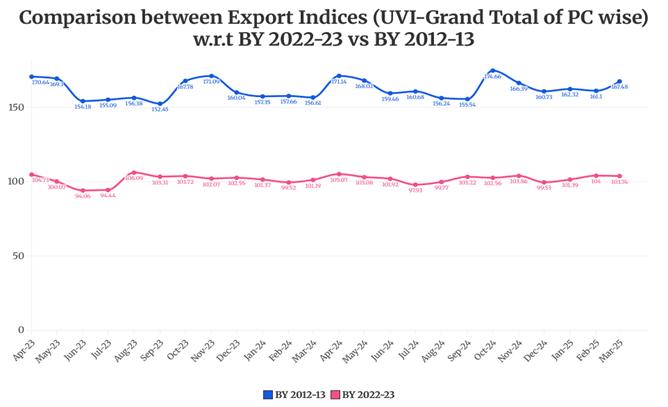
#BY means Base Year.
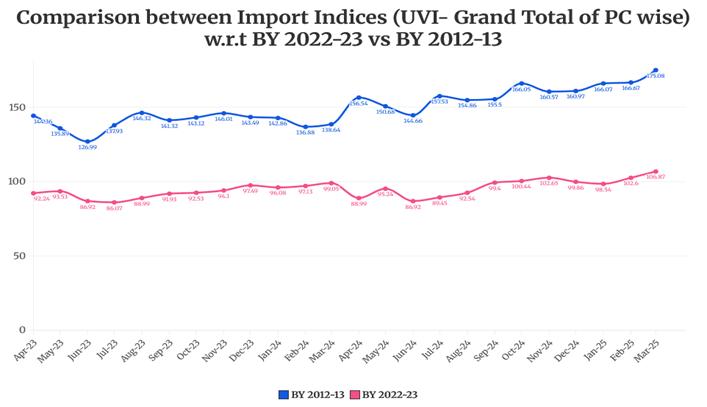
 

#BY means Base Year.

Table: Unit Value Index (UVI) and Quantity Index (QI) during FY 2025-26(Apr-Nov) using FY 2022-23 as base year


Month

Apr_25

May_25

Jun_25

1st Qtr 25-26

Jul_25

Aug_25

Sep_25

2nd Qtr 25-26

Oct_25

Nov_25

Unit Value Index

Export

105.31

99.73

96.31

100.33

99.31

100.55

104.08

101.23

103.78

105.32

Import

92.33

97.97

91.74

94.08

96.34

100.81

108.69

101.93

110.17

106.59

Quantity Index

Export

107.85

104.76

93.88

101.91

103.41

102.64

111.04

105.57

116.19

113.06

Import

138.16

126.61

112.58

125.17

122.47

124.06

126.45

124.32

137.04

121.75

Qtr  means Quarter.

Meaning and interpretation of the Indices

The Unit Value Indices and the Quantity Indices may be interpreted along the following lines.

The Unit Value Index answers the question: What is the growth in the average Unit Value of the items1 traded in the current month with respect to the same month in the Base Year?

So, an Unit Value Index of, say, 120 means that if the items that have been traded in the current month had been traded in the same month of the base year, and if the average price (or unit value) of those items had been Rs.100 in that month of the base year, then the average price (or unit value) of these items in the current month is Rs.120. Or that, there is a 20% increase in the average Unit Value, with respect to the Base Year, of the items that have been traded in the Current Month.

For example, let us suppose 30 items, 10 items each from 3 different Principal Commodities, have been traded in the current month. If these 30 items had been traded in the corresponding month of the base year at an average price of Rs.100, then the average price of these items in the current year is Rs.120.

It is to be noted that there are two successive steps of averaging done here. The first averaging is done over all the items (or ITCHS) of a PC group to arrive at the Index of that PC group. And the second averaging is done over all the PC groups to arrive at the Index at the Grand Total level for all commodities (which is the overall Index for India for a month). In both the stages, a weighted average is taken where the weights are proportional to the importance of the items and the PC groups respectively, and the Laspeyres Formula is used for averaging.

Quantity Indices, say, 200 means that if in the base year on an average 100 units were traded in India in the base year, then in the current year on an average 200 units were traded. However, it must be remembered that averaging quantities are different from averaging prices, since quantities in different units cannot be added directly.

So, the Quantity Indices are calculated by dividing the Value Indices by the Unit Value Indices. For example, if there is an increase in the Value of Export from Rs. 10,000 to Rs. 24,000, then the Value Index is 24000/10000 × 100 = 240. If the Unit Value Index is 120, then the Quantity Index comes to 240/120 × 100 = 200. So, loosely it can be said that, if the value of export has increased 2.4 times and the price of the commodities has increased 1.2 times, then the quantity must have doubled.

However, it may be noted that a very high or low Quantity Index may indicate the presence of Base Effect.

The Interpretation of the Bilateral and Regional Indices can be seen as an extension of the above.

A Unit Value Index of 120 with respect to a country, say Bangladesh, means that if all the items that have been traded with Bangladesh in the current month had been traded in the same month of the base year with the same country, and if the average price (or unit value) of those items had been Rs.100 in that month of the base year, then the average price (or unit value) of these items in the current month is Rs.120.

Similarly, a Quantity Index of 200 with respect to a country, say Bangladesh, means that if in the base year on an average 100 units were traded in India in the base year, then in the current year on an average 200 units were traded.

Comparability of the Indices across time

It is to be noted that the weights in the Index Number formula are fixed across time and there are twelve sets of weights for the twelve months. Hence, comparability of Indices is meaningful only when Indices of same month are compared across years. Different months may attach different weights to the same item, and hence comparing indices of two different months becomes vague and may have little applicability.

Further, the weights of the items that are not present in the trade basket of the current month are distributed to all the items that have been traded in the current month. This distribution is done in proportion to the weights of those items.

For example, let us suppose there are only 3 commodities for trade, say A, B and C. In month May of the Base year, let us suppose that the trade value of A was Rs. 50, B was Rs. 100 and C was Rs. 50. Then the weights assigned to A, B and C in the month of May of the following years would be in the ratio 50 :100 :50. However, in case, C is not traded in the current month, then the weight of C would be distributed proportionately among A and B, again in the ratio 1:2 (since in May the weights of A and B are in the ratio of 50 : 100, i.e., 1 : 2). So, in the current month the weights of A and B would be 3313  and 6623 .

As a result, the weights in any two given months are dependent on exactly the number of items (ITCHS codes) traded in those months. If the items traded are widely different, inference drawn from the comparison of the Indices may be done accordingly. On the other hand, more the similarity in the number of items traded more is the comparability of the two indices.

Net Terms of Trade:

Net Terms of Trade also called commodity Terms of Trade is defined as a ratio of export prices to import prices.

Let say 2022-23 be the base year and 2023-24 be the final year. We express both export and import prices in 2022-23 as 100. Now, suppose that at the end of 2023-24, it is found that the index of export prices decreased to 90 and index of import prices roses to 150. Then the Net Terms of Trade has changed to 90100150100=35 . Then terms of trade as index=35*100=60 . It implies that terms of trade of the country have decreased by about 40% in 2023-24 as compared with 2022-23. It thus shows a deterioration or a worsening of the terms of trade of the country.

If the index of export prices has risen to 150 and that of import prices had risen to 120, then the net terms of trade would have changed to 150120*100=125 . This implies an improvement in the net terms of trade of the country by 25% in 2023-24 over 2022-23.

Gross Terms of Trade:

Gross Terms of Trade is the ratio of physicalquantity of import to physical quantity of export.

Let say 2022-23 be the base year. In that year, the quantities export and import are denoted by 100. Now, suppose that in the year 2023-24, the index of quantity of import was 150 and that of quantity of export was 120. Then the gross terms of trade is given by 150100120100=54,  in terms of percentage =54*100=125 . This implies that there was an improvement of gross terms of trade by 25% in 2023-24 compared to 2022-23.

Income Terms of Trade: Income Terms of Trade is defined as- Net Terms of Trade multiplied by quantity of export.

Topics

Acts Income Tax
