

Loading...

Top
Help
×

By creating an account you can:

Logo TaxTMI
Call Us / Help / Feedback

Contact Us At :

E-mail: [email protected]

Call / WhatsApp at: +91 99117 96707

For more information, Check Contact Us

FAQs :

To know Frequently Asked Questions, Check FAQs

Most Asked Video Tutorials :

For more tutorials, Check Video Tutorials

Submit Feedback/Suggestion :

Email :
Please provide your email address so we can follow up on your feedback.
Category :
Description :
Min 15 characters 0/2000
Make Most of Text Search
  1. Checkout this video tutorial: How to search effectively on TaxTMI.
  2. Put words in double quotes for exact word search, eg: "income tax"
  3. Avoid noise words such as : 'and, of, the, a'
  4. Sort by Relevance to get the most relevant document.
  5. Press Enter to add multiple terms/multiple phrases, and then click on Search to Search.
  6. Text Search
  7. The system will try to fetch results that contains ALL your words.
  8. Once you add keywords, you'll see a new 'Search In' filter that makes your results even more precise.
  9. Text Search
Add to...
You have not created any category. Kindly create one to bookmark this item!
Create New Category
Hide
Title :
Description :
❮❮ Hide
Default View
Expand ❯❯
Close ✕
🔎 News - Adv. Search
TEXT SEARCH:

Press 'Enter' to add multiple search terms. Rules for Better Search

Search In:
Main Text + AI Text
  • Main Text
  • Main Text + AI Text
  • AI Text
Category: ?
Categorized by AI
---- All Categories ----
  • ---- All Categories ----
  • Income Tax
  • GST
  • Customs, DGFT & SEZ
  • FEMA & RBI
  • Corp. Laws, SEBI & IBC
  • PMLA, Black Money & ED
  • Budget
  • News and Press Release
  • PTI News
Month:
---- All Months ----
  • ---- All Months ----
  • January
  • February
  • March
  • April
  • May
  • June
  • July
  • August
  • September
  • October
  • November
  • December
Year:
---- All Years ----
  • ---- All Years ----
  • 2026
  • 2025
  • 2024
  • 2023
  • 2022
  • 2021
  • 2020
  • 2019
  • 2018
  • 2017
  • 2016
  • 2015
  • 2014
  • 2013
  • 2012
  • 2011
Sort By: ?
In Sort By 'Default', exact matches for text search are shown at the top, followed by the remaining results in their regular order.
Relevance Default Date
    J&K govt initiates liquidation of SCARD bank, assures protection of depositors’ interests: Dar
    Access pass for fishing in country's EEZ to be launched in Gujarat's Veraval
    Gujarat's debt rises to Rs 3.99 lakh cr in 2024-25 as per revised estimates: Desai in assembly
    US trade deficit slipped to USD 901 billion last year amid Trump tariffs
    Tata Group working on building AI chips, says Chairman N Chandrasekaran
    AccessifyLabs Appoints Abin Roy Choudhury as Chief Executive Officer to Accelerate Global Expansion and Enterprise Accessibility Leadership
    Proposed India-US trade deal compromises India’s sovereignty, farmers' interests: Sachin Pilot
    Cristiano Ronaldo Invests $7.5 Million in Herbalife's Pro2col™ Technology, Acquires 10% Equity Stake
    rivexa Ignites a New Era of Global Exports
    Summer 2026 AC Guide: Top picks, deals and savings
    DPIIT and National Productivity Council Organize ‘Chintan Shivir on Boilers’ to Foster Innovation and Align Industry Roadmap with Vision 2047
    Secretary, DFS, inaugurates Facilitation Camp for ‘Salary Account Package for Central Government Employees’
    In a largest operation of its kind by any agency in Madhya Pradesh, officers of Central Bureau of Narcotics (CBN) seize 43.820 kg high-quality MD/Meth...
    KIAASA Retail Limited's Initial Public Offering to open on Monday, February 23, 2026, price band set at Rs 121 – Rs 127 per Equity Share
    Yiwu in the Year of the Horse: Understanding the Chinese Expression of a 'Global Community'
    ED issues fresh summons to Anil Ambani for February 26
    Tripura tea auction centre likely to be operational by April: official
    IICA Renews MoU with NALSAR University of Law to Strengthen Academic Collaboration and Capacity Building
    IICA Constitutes High-Level Advisory Group on Ease of Doing Business under the Chairmanship of DG & CEO
    Release of Report of the ‘Sub-Committee on Methodological Improvements' in 2022-23 series of National Accounts
❯❯
Maximize Maximize Maximize
0 / 200
Expand Note
Add to Folder

No Folders have been created

+

Are you sure you want to delete "My most important" ?

NOTE:

News
Showing Results for :
Reset Filters
Results Found:
Show All Summaries Hide All Summaries
February 19, 2026
Show AI Summary
Liquidation of cooperative bank initiated; depositors' claims to be settled under statutory priority after KYC verification and phased settlement.
Liquidation proceedings for SCARD Bank Ltd have been initiated under the Cooperative Societies Act due to accumulated losses, weak governance, poor loan recovery and liquidity pressures; the bank is not registered under the Banking Regulation Act and thus lies outside RBI purview. A comprehensive KYC verification of claims is complete and, following a winding-up order and appointment of liquidators, duly verified depositor claims will be settled in phased manner strictly pursuant to statutory provisions and the prescribed order of priority. Deposit insurance and credit guarantee mechanisms do not apply; the government has compiled depositor liability projections and may consider budgetary provisioning.
February 19, 2026
Show AI Summary
EEZ access pass allows regulated offshore fishing with traceability and sustainability safeguards to support seafood export competitiveness.
An access pass framework regulates organised fishing in India's Exclusive Economic Zone, establishing entry conditions, monitoring, compliance, and traceability standards under the Sustainable Harnessing of Fisheries in the EEZ Rules, 2025, to enable responsible offshore harvesting, empower fishing communities and support seafood export competitiveness.
February 19, 2026
Show AI Summary
Public debt increase signals higher state debt servicing obligations under revised estimates and disclosed budget figures.
Gujarat's revised estimates for 2024-25 show total public debt rising from Rs 3,52,718 crore in 2023-24 to Rs 3,99,633 crore, with interest payments and principal repayments disclosed as Rs 24,964 crore and Rs 26,136 crore for 2023-24, and Rs 25,945 crore and Rs 29,086 crore respectively for 2024-25; these figures were tabled in the state assembly alongside the 2026-27 Budget presentation.
February 19, 2026
Show AI Summary
Tariffs on imports reshape trade incentives and pricing, prompting import timing and affecting customs revenues and consumer prices.
Presidentially imposed tariffs function as a tax on US importers often passed to consumers, shift commercial incentives by prompting import timing to avoid higher duties, and can be used to protect domestic industry and raise Treasury revenue; these effects influence trade flows, customs liabilities, and have produced only a muted aggregate inflationary impact while contributing to observed annual changes in the goods-and-services trade gap.
February 19, 2026
Show AI Summary
Industry-specific AI chips drive Tata's semiconductor and AI infrastructure expansion through strategic partnerships and vertical solutions.
Tata Group is pursuing industry-specific AI chips and an industrial AI operating system while expanding semiconductor fabrication and packaging capacity, data centre AI hosting, and strategic partnerships to enable vertical AI solutions, with initial chip efforts focused on automotive applications.
February 19, 2026
Show AI Summary
Digital accessibility compliance elevated to enterprise governance, integrating audits, remediation, documentation and continuous monitoring.
Digital accessibility is framed as an enterprise compliance and governance requirement to be embedded in procurement, engineering and risk management frameworks, aligned to standards such as WCAG 2.2, ADA, and Section 508. The firm proposes a combined advisory and technology approach - expert audits, VPAT/ACR documentation, remediation advisory, automation, developer enablement, and continuous monitoring - to convert regulatory obligations into operational discipline, procurement readiness, and managed accessibility risk across regulated sectors.
February 19, 2026
Show AI Summary
Sovereignty concerns over trade pact: alleged compromise of farmers, regulatory protections and energy procurement autonomy.
The proposed India-US framework is alleged to compromise sovereignty and economic self reliance by opening India's agricultural market to zero duty US farm and food products, permitting duty free imports of specified processed grains, oils and cotton that threaten domestic producers, and by requiring removal of non tariff barriers which could erode subsidies, regulatory protections and seed biodiversity; it is also said to constrain energy security by limiting procurement autonomy and imposing large bilateral purchase commitments.
February 19, 2026
Show AI Summary
Equity investment creates a minority ownership stake and strategic partnership, with regulatory and privacy forward looking disclosures.
Cristiano Ronaldo acquired a 10% equity interest in HBL Pro2col Software, LLC, accompanying an investment and a commitment of services and sponsorship rights to support Herbalife's Pro2col personalized health platform; Herbalife has begun a phased beta rollout and frames the initiative within forward looking statements that identify regulatory, data protection, AI governance, FTC consent order compliance, international operating, tax, intellectual property, cybersecurity and other business risks.
February 19, 2026
Show AI Summary
Cross-border trade facilitation: rivexa advances digital export pathways and sustainability for Indian MSME global market access.
rivexa hosted rivOlution 2026 to advance digital facilitation of cross-border trade and broaden MSME market access by offering an integrated export platform-supplier discovery, quality assurance, production monitoring, and payment/finance solutions-to enhance visibility, credibility, and execution across export supply chains while promoting sustainability and ESG-aligned compliance.
February 19, 2026
Show AI Summary
EMI financing enables consumers to acquire branded air conditioners through flexible tenures and zero down payment options.
Promotional offers couple branded air conditioner sales with Easy EMI loans and an EMI Network Card permitting flexible tenures, zero down payment options, paperless point-of-sale conversion, and online pre-approved eligibility verification by mobile number and OTP; pricing and offers are location- and retailer-dependent and subject to change.
February 19, 2026
Show AI Summary
Re-enacted Boilers Act strengthens safety framework; stakeholders invited to streamline compliance and boost industry innovation.
The Boilers Act, re-enacted as the Boilers Act, 2025 and operational from 1 May 2025, was retained and reviewed to maintain a safety-focused regulatory framework; the Chintan Shivir solicited stakeholder feedback on the Act and subordinate rules, sought suggestions to rationalise regulations and reduce compliance burden, and addressed implementation issues including roles of Third-Party Inspecting Authorities and Competent Persons.
February 19, 2026
Show AI Summary
Salary account package expands banking, insurance and card benefits to central government employees through PSB facilitation camps.
The Department of Financial Services launched a Salary Account Package for Central Government employees delivered via PSB organised facilitation camps, with PSBs as nodal banks coordinating with Ministries/Departments to ensure participation. The integrated Package covers banking, insurance and cards, offering zero balance accounts, free remittances and cheque facilities, concessions on locker rental and loan processing, concessional loan rates for housing, education, vehicle and personal loans, enhanced card benefits, and layered insurance protections including accident, disability, life and medical cover.
February 19, 2026
Show AI Summary
NDPS Act enforcement uncovers clandestine synthetic drug laboratory, leading to seizure of drugs, chemicals, equipment and arrests.
Enforcement under the NDPS Act led to interception of suspects with concealed high-purity methamphetamine and admissions linking the consignment to a clandestine laboratory; coordinated multi-branch searches located a chemically hazardous manufacturing facility equipped with modern machinery and bulk chemicals, which was secured with PPE and dismantled with technical assistance, and all recovered contraband, chemicals and equipment were seized under the Act while suspects were charged or detained under relevant provisions.
February 19, 2026
Show AI Summary
Initial public offering announces book built issue with retail/institutional allocation and offshore sale under Regulation S.
The company is making an initial public offering via a book building process with a disclosed price band, specified bid period and minimum lot requirements; the fresh issue proceeds will fund store expansion and general corporate purposes. Allocation among investor categories is set between qualified institutional buyers, non institutional bidders and retail individual bidders. The RHP has been filed with the RoC and is available on regulator, exchange and company websites; the shares are not registered under the U.S. Securities Act and will be offered offshore under Regulation S, with SEBI and exchange disclaimers noted.
February 19, 2026
Show AI Summary
Cross-border trade facilitation expands as Yiwu strengthens digital trade infrastructure and foreign business integration.
Overview of Yiwu's role in facilitating international trade and community governance through infrastructure, business registration, and local dispute-resolution mechanisms. It highlights significant import-export activity, growth in cross-border e-commerce, the Global Digital Trade Centre, expanded rail connectivity, and a high density of registered foreign-invested entities that enhance trade facilitation and digital transactions.
February 19, 2026
Show AI Summary
PMLA summons prompt fresh ED questioning over alleged money trail and disputed property sale.
Fresh summons under the Prevention of Money Laundering Act require the Reliance Group chairman and his spouse to give separate statements in an ED money laundering inquiry concerning an allegedly fraudulent sale of a Manhattan condominium, a related cross border remittance routed through a foreign entity, the arrest of a former executive, the constitution of a special investigation team, filing of ECIRs, and asset attachment measures.
February 19, 2026
Show AI Summary
State GST eligibility and transport subsidy shaping a local tea auction centre to retain value and improve price realisation.
Establishment of a local tea auction centre at Gurkhabasti aims to internalise tea transactions, improve price realisation for Tripura producers, and reduce time and transport costs. The Tripura Tea Development Corporation will provide a transport subsidy from its own resources to enhance viability. Converting outbound auctioning into in-state auctions is expected to affect State GST eligibility and receipts, thereby altering the fiscal profile of tea transactions and retaining value within the state supply chain.
February 19, 2026
Show AI Summary
Memorandum of Understanding renewal strengthens academic collaboration, joint research, faculty exchanges and capacity building between institutions.
Memorandum of Understanding renewal establishes a five-year institutional framework for academic collaboration between IICA and NALSAR, formalising faculty and student exchanges, joint research and publications, expert advisory services, and the organisation of workshops, seminars and conferences; it consolidates a two-year residential LL.M. programme in Insolvency and Bankruptcy Laws combining academic instruction and industry exposure.
February 19, 2026
Show AI Summary
Ease of Doing Business reforms to rationalise e-forms and streamline corporate compliance through digital governance and consultations.
A high-level Advisory Group on Ease of Doing Business will recommend measures to rationalise e-forms and simplify corporate compliance under the Companies Act by reducing duplicative filings through consolidation, automation and event-based processing, develop an Integrated Form Blueprint and a phased implementation roadmap, conduct stakeholder consultations and impact assessments, and propose draft amendments to support a modern, transparent, technology-driven corporate regulatory framework; the School of Business Environment, IICA, will serve as Secretariat and a research MoU with the Ministry will produce evidence-based recommendations.
February 19, 2026
Show AI Summary
National accounts methodology revised to adopt new data sources and updated compilation methods aligning quarterly and annual estimates.
Revision of national accounts introduces new administrative and survey data, disaggregated modeling, and updated rates to improve sectoral estimates. Corporate sector changes include activity wise revenue splitting and disaggregated Paid up Capital multipliers; government estimates add imputed housing services and wider coverage; household estimates move to annual direct estimation using specific surveys. PFCE uses a mixed survey/production/commodity flow approach with COICOP 2018, and quarterly benchmarking adopts Denton proportional benchmarking to align QNA with annual accounts.

News

Back

All News

Showing Results for :
Reset Filters
No Records Found

News

Showing Results for : Reset Filters
Customs, DGFT & SEZ

Directorate General of Commercial Intelligence and Statistics Revises Base Year of Merchandise Trade Indices to FY 2022–23 to Reflect Current Trade Structure and Global Patterns

February 21, 2026

Contents
Summary
Note

Note

-

Bookmark

Print

Print

Merchandise Trade Indices are compiled and published by the Directorate General of Commercial Intelligence and Statistics (DGCI&S), Ministry of Commerce & Industry, to measure changes in the unit values (prices) of India’s exports and imports over time. These indices serve as important indicators of external sector price movements and are widely used for economic analysis, including national accounts compilation and assessment of terms of trade. Over the years, the base year of the indices has been periodically revised to reflect structural changes in India’s trade composition and evolving global trade patterns. The most recent revision updates the base year to FY 2022–23 (2022–23 = 100), replacing the earlier base of FY 2012–13, thereby ensuring that the indices accurately represent the current structure of India’s merchandise trade.

Revision of Base Year of India’s Merchandise Trade Indices to FY 2022–23

The Directorate General of Commercial Intelligence and Statistics (DGCI&S), Ministry of Commerce & Industry, has revised the base year of India’s Merchandise Trade Indices from FY 2012–13 to FY 2022–23 (2022–23 = 100), in view of the structural changes in the economy, shifts in commodity composition, evolving trade patterns, and the need for improved alignment with contemporary macroeconomic indicators.

The revision has been undertaken on the recommendations of a committee constituted by DGCI&S under the Chairmanship of Prof. Nachiketa Chattopadhyay, Professor, Indian Statistical Institute, Kolkata. The Committee examined the existing methodology, data coverage, weighting structure, and compilation practices, and recommended suitable refinements in line with international best practices.

Key Features of the Revised Series (Base: FY 2022–23)

  1. Updated Base Year:
    The new base year FY 2022–23 makes the Indices reflect the current structure of India’s external trade more accurately.
  2. Revised Commodity Basket:
    The coverage and classification of commodities have been reviewed at the Principal Commodity level to better capture emerging and declining trade items.
  3. Revised Weighting Structure:
    Weights have been updated based on trade values of the new base year to reflect the latest value shares in exports and imports.
  4. Improved Methodology:
    Methodological refinements have been introduced in:
    1. Selection of common commodity basket for base year selection (procedure of selection for common commodity basket explained in detail report of the committee).
    2. Treatment of missing unit values (Imputation of missing unit values in base year selection have been explained in detail in the committee report).
  5. Indices Compiled:
    The revised series includes:
    1. Monthly, Quarterly and Annual Indices (Export Unit Value Index,Import Unit Value Index).
    2. Principal Commodity (PC) Classification wise Trade Indices (Export/Import).
    3. Standard International Trade Classification-wise (SITC) Trade Indices.
    4. Broad economic categories-wise (BEC) Trade Indices.
    5. Bilateral and Region-wise Trade Indices of Top 20 Export and Import partner nations of India.
    6. Terms of Trade (Gross terms of trade, Net terms of trade and Income terms of trade).

Rationale for Revision

Over the past decade, India’s trade basket has undergone substantial changes due to emergence of new commodities, technological advancements, Global supply chain restructuring and changes in relative price structures.

The earlier base year (FY 2012–13) no longer adequately reflected the prevailing trade structure. The revision ensures improved relevance, reliability, and analytical usefulness of the Merchandise Trade Indices for policymakers, researchers, and other stakeholders.

Use of the Revised Series

Merchandise Trade Indices compiled by the Directorate General of Commercial Intelligence and Statistics (DGCI&S) are extensively used by key government institutions for economic analysis and policy formulation. The National Accounts Division (NAD) of the Ministry of Statistics and Programme Implementation uses the Export and Import Unit Value Indices as deflators for estimating real exports and imports in GDP compilation. The Reserve Bank of India (RBI) relies on these indices for external sector assessment, balance of payments analysis, and evaluation of price competitiveness. Various Ministries and Government agencies also use them to frame and review trade-related policies and to assess movements in international prices. In addition, academic institutions, research organizations, and economic analysts utilize Merchandise Trade Indices for empirical research, modelling, and analysis of trade dynamics and terms of trade trendson and economic research.

Availability of Data

The revised Merchandise Trade Indices (Base: FY 2022–23) will be released on the official website of DGCI&S. Detailed methodological documentation is available in the Report of the Committee on Revision of Base Year for Merchandise Trade Indices.

Comparison of the new revised Indices (Base Year: 2022-23) with the already released Indices (Base Year : 2012-13) for 2022-23 and 2023-24 is given below.
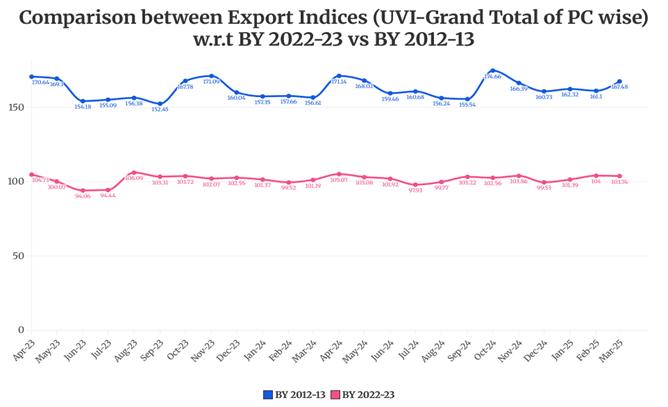
#BY means Base Year.
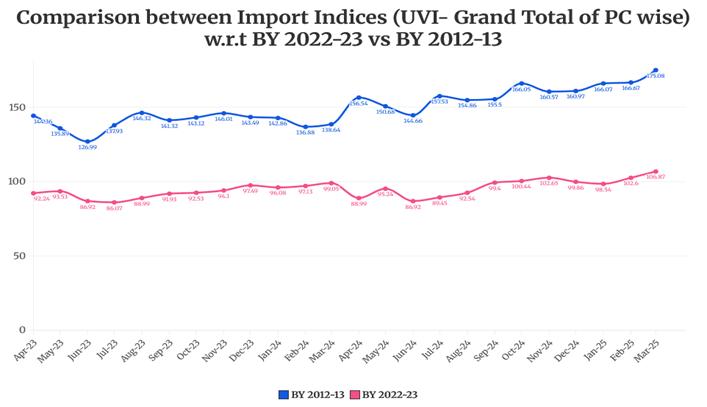
 

#BY means Base Year.

Table: Unit Value Index (UVI) and Quantity Index (QI) during FY 2025-26(Apr-Nov) using FY 2022-23 as base year


Month

Apr_25

May_25

Jun_25

1st Qtr 25-26

Jul_25

Aug_25

Sep_25

2nd Qtr 25-26

Oct_25

Nov_25

Unit Value Index

Export

105.31

99.73

96.31

100.33

99.31

100.55

104.08

101.23

103.78

105.32

Import

92.33

97.97

91.74

94.08

96.34

100.81

108.69

101.93

110.17

106.59

Quantity Index

Export

107.85

104.76

93.88

101.91

103.41

102.64

111.04

105.57

116.19

113.06

Import

138.16

126.61

112.58

125.17

122.47

124.06

126.45

124.32

137.04

121.75

Qtr  means Quarter.

Meaning and interpretation of the Indices

The Unit Value Indices and the Quantity Indices may be interpreted along the following lines.

The Unit Value Index answers the question: What is the growth in the average Unit Value of the items1 traded in the current month with respect to the same month in the Base Year?

So, an Unit Value Index of, say, 120 means that if the items that have been traded in the current month had been traded in the same month of the base year, and if the average price (or unit value) of those items had been Rs.100 in that month of the base year, then the average price (or unit value) of these items in the current month is Rs.120. Or that, there is a 20% increase in the average Unit Value, with respect to the Base Year, of the items that have been traded in the Current Month.

For example, let us suppose 30 items, 10 items each from 3 different Principal Commodities, have been traded in the current month. If these 30 items had been traded in the corresponding month of the base year at an average price of Rs.100, then the average price of these items in the current year is Rs.120.

It is to be noted that there are two successive steps of averaging done here. The first averaging is done over all the items (or ITCHS) of a PC group to arrive at the Index of that PC group. And the second averaging is done over all the PC groups to arrive at the Index at the Grand Total level for all commodities (which is the overall Index for India for a month). In both the stages, a weighted average is taken where the weights are proportional to the importance of the items and the PC groups respectively, and the Laspeyres Formula is used for averaging.

Quantity Indices, say, 200 means that if in the base year on an average 100 units were traded in India in the base year, then in the current year on an average 200 units were traded. However, it must be remembered that averaging quantities are different from averaging prices, since quantities in different units cannot be added directly.

So, the Quantity Indices are calculated by dividing the Value Indices by the Unit Value Indices. For example, if there is an increase in the Value of Export from Rs. 10,000 to Rs. 24,000, then the Value Index is 24000/10000 × 100 = 240. If the Unit Value Index is 120, then the Quantity Index comes to 240/120 × 100 = 200. So, loosely it can be said that, if the value of export has increased 2.4 times and the price of the commodities has increased 1.2 times, then the quantity must have doubled.

However, it may be noted that a very high or low Quantity Index may indicate the presence of Base Effect.

The Interpretation of the Bilateral and Regional Indices can be seen as an extension of the above.

A Unit Value Index of 120 with respect to a country, say Bangladesh, means that if all the items that have been traded with Bangladesh in the current month had been traded in the same month of the base year with the same country, and if the average price (or unit value) of those items had been Rs.100 in that month of the base year, then the average price (or unit value) of these items in the current month is Rs.120.

Similarly, a Quantity Index of 200 with respect to a country, say Bangladesh, means that if in the base year on an average 100 units were traded in India in the base year, then in the current year on an average 200 units were traded.

Comparability of the Indices across time

It is to be noted that the weights in the Index Number formula are fixed across time and there are twelve sets of weights for the twelve months. Hence, comparability of Indices is meaningful only when Indices of same month are compared across years. Different months may attach different weights to the same item, and hence comparing indices of two different months becomes vague and may have little applicability.

Further, the weights of the items that are not present in the trade basket of the current month are distributed to all the items that have been traded in the current month. This distribution is done in proportion to the weights of those items.

For example, let us suppose there are only 3 commodities for trade, say A, B and C. In month May of the Base year, let us suppose that the trade value of A was Rs. 50, B was Rs. 100 and C was Rs. 50. Then the weights assigned to A, B and C in the month of May of the following years would be in the ratio 50 :100 :50. However, in case, C is not traded in the current month, then the weight of C would be distributed proportionately among A and B, again in the ratio 1:2 (since in May the weights of A and B are in the ratio of 50 : 100, i.e., 1 : 2). So, in the current month the weights of A and B would be 3313  and 6623 .

As a result, the weights in any two given months are dependent on exactly the number of items (ITCHS codes) traded in those months. If the items traded are widely different, inference drawn from the comparison of the Indices may be done accordingly. On the other hand, more the similarity in the number of items traded more is the comparability of the two indices.

Net Terms of Trade:

Net Terms of Trade also called commodity Terms of Trade is defined as a ratio of export prices to import prices.

Let say 2022-23 be the base year and 2023-24 be the final year. We express both export and import prices in 2022-23 as 100. Now, suppose that at the end of 2023-24, it is found that the index of export prices decreased to 90 and index of import prices roses to 150. Then the Net Terms of Trade has changed to 90100150100=35 . Then terms of trade as index=35*100=60 . It implies that terms of trade of the country have decreased by about 40% in 2023-24 as compared with 2022-23. It thus shows a deterioration or a worsening of the terms of trade of the country.

If the index of export prices has risen to 150 and that of import prices had risen to 120, then the net terms of trade would have changed to 150120*100=125 . This implies an improvement in the net terms of trade of the country by 25% in 2023-24 over 2022-23.

Gross Terms of Trade:

Gross Terms of Trade is the ratio of physicalquantity of import to physical quantity of export.

Let say 2022-23 be the base year. In that year, the quantities export and import are denoted by 100. Now, suppose that in the year 2023-24, the index of quantity of import was 150 and that of quantity of export was 120. Then the gross terms of trade is given by 150100120100=54,  in terms of percentage =54*100=125 . This implies that there was an improvement of gross terms of trade by 25% in 2023-24 compared to 2022-23.

Income Terms of Trade: Income Terms of Trade is defined as- Net Terms of Trade multiplied by quantity of export.

Topics

Acts Income Tax
