

Loading...

Top
Help
Draft a reply to a
tax notice — free 🎉

150 credits · 30 days · No card needed

• Basic Search 1 Credit
• Advanced Search 3 Credits
• Drafter 20 to extract + 25 per issue
(≈ up to 2-3 drafts on us)

Already used our earlier 20-Credit Demo?
You are still eligible for this new 150-Credit Demo.

Activate your FREE Demo
×

By creating an account you can:

Logo TaxTMI
Call Us / Help / Feedback

Contact Us At :

E-mail: [email protected]

Call / WhatsApp at: +91 99117 96707

For more information, Check Contact Us

FAQs :

To know Frequently Asked Questions, Check FAQs

Most Asked Video Tutorials :

For more tutorials, Check Video Tutorials

Submit Feedback/Suggestion :

Email :
Please provide your email address so we can follow up on your feedback.
Category :
Description :
Min 15 characters 0/2000
Make Most of Text Search
  1. Checkout this video tutorial: How to search effectively on TaxTMI.
  2. Put words in double quotes for exact word search, eg: "income tax"
  3. Avoid noise words such as : 'and, of, the, a'
  4. Sort by Relevance to get the most relevant document.
  5. Press Enter to add multiple terms/multiple phrases, and then click on Search to Search.
  6. Text Search
  7. The system will try to fetch results that contains ALL your words.
  8. Once you add keywords, you'll see a new 'Search In' filter that makes your results even more precise.
  9. Text Search
Add to...
You have not created any category. Kindly create one to bookmark this item!
Create New Category
Hide
Title :
Description :
❮❮ Hide
Default View
Expand ❯❯
Close ✕
🔎 News - Adv. Search
TEXT SEARCH:

Press 'Enter' to add multiple search terms. Rules for Better Search

Search In:
Main Text + AI Text
  • Main Text
  • Main Text + AI Text
  • AI Text
Category: ?
Categorized by AI
---- All Categories ----
  • ---- All Categories ----
  • Income Tax
  • GST
  • Customs, DGFT & SEZ
  • FEMA & RBI
  • Corp. Laws, SEBI & IBC
  • PMLA, Black Money & ED
  • Budget
  • News and Press Release
  • PTI News
Month:
---- All Months ----
  • ---- All Months ----
  • January
  • February
  • March
  • April
  • May
  • June
  • July
  • August
  • September
  • October
  • November
  • December
Year:
---- All Years ----
  • ---- All Years ----
  • 2026
  • 2025
  • 2024
  • 2023
  • 2022
  • 2021
  • 2020
  • 2019
  • 2018
  • 2017
  • 2016
  • 2015
  • 2014
  • 2013
  • 2012
  • 2011
Sort By: ?
In Sort By 'Default', exact matches for text search are shown at the top, followed by the remaining results in their regular order.
Relevance Default Date
    Satyendra Kumar: The Pioneer of India’s Financial Modernisation
    Every violation of RBI fraud rules not open to court scrutiny: HC on lifting Anil Ambani case stay
    IBEX India 2026 to Honour Trailblazers at the Prestigious BFSI Tech Awards 7 April 2026 | Jio World Convention Centre, Mumbai, India
    Markets slump nearly 1 pc on IT rout; Trump tariff worries hit investor sentiment
    China puts Japanese companies on export control lists as tensions rise
    Asian shares are mixed after heavy selling of potential AI losers hits Wall Street
    PM Carney to travel to India, Australia and Japan to diversify Canada trade away from US
    After Supreme Court rebuke, Democrats call for government to refund billions in Trump tariff money
    SP's support base declining, should pay attention to its affairs: BJP
    The Latest: Trump threatens countries to abide by tariff deals despite Supreme Court decision
    US stocks drop after Trump ramps up his tariffs and worries flare about potential AI losers
    EU hits pause on US trade deal as it seeks clarity over latest Trump maneuver
    Ontario's premier says 'the walls are closing in' on Trump after Supreme Court tariff decision
    Chhattisgarh ACB/EOW arrests Tuteja in DMF 'scam', Dhebar in CSMCL overtime payment irregularities
    Rupee rises 5 paise to close at 90.89 against US dollar
    New series will better reflect consumption patterns, reduce volatility: RBI Guv
    No roadmap for merger of public sector banks: Sitharaman
    Will comply with NCLAT's directions to extend privacy guidelines to advertising-related data: WhatsApp to SC
    Silver, gold surge 3 pc on safe-haven demand
    Footwear Design and Development Institute (FDDI) celebrates its 5th Convocation Ceremony in Hyderabad.
❯❯
Maximize Maximize Maximize
0 / 200
Expand Note
Add to Folder

No Folders have been created

+

Are you sure you want to delete "My most important" ?

NOTE:

News
Showing Results for :
Reset Filters
Results Found:
Show All Summaries Hide All Summaries
February 24, 2026
Show AI Summary
Financial modernisation drove phased computerisation and regulatory reforms to strengthen banking operations and promote inclusion.
Satyendra Kumar advocated phased computerisation of banking operations as a strategic investment to correct systemic weaknesses in public sector banks, improve transaction processing and fraud prevention, and pave the way for widespread adoption of Core Banking Solutions.
February 24, 2026
Show AI Summary
Regulatory directives not always subject to judicial scrutiny; banks may proceed with fraud classification absent clear irreparable harm.
The Master Directions aim to secure public money by enabling early detection, reporting and mitigation of fraud risk, and not every contravention of those Directions is amenable to judicial scrutiny. Banks may engage external auditors or forensic experts and the Directions do not require a mandatory form of forensic report before banks make final decisions. An earlier interim stay on banks classifying accounts as fraud was set aside as procedurally irregular and based on flawed factual and legal assumptions; continuation of proceedings was held not to cause irreparable harm and injunctive relief was inappropriate.
February 24, 2026
Show AI Summary
Nomination rules: one entry per category for BFSI Tech Awards, judged by an independent expert panel; submit by the deadline.
Public and private sector banks, co-operative banks, NBFCs, and insurance companies may nominate measurable, scalable technology-led initiatives. Only one team or division may be nominated per category; multiple entries within the same category are prohibited. Nominations must include detailed case studies addressing objectives, implementation, innovation, measurable outcomes, and long-term impact. An independent panel of industry and technology experts will adjudicate entries to ensure transparent, merit-based evaluation, and awards will be conferred by a designated industry leader. A final submission cutoff and contact details are provided.
February 24, 2026
Show AI Summary
Trade policy risk from tariff remarks dents markets, compounding AI-driven IT sector rout and oil-price pressures.
Equity benchmarks fell nearly one percent as a sharp selloff in IT stocks-driven by fears of AI-related disruption-pulled indices lower, while trade-policy uncertainty from tariff remarks and rising crude oil prices compounded market unease; foreign institutional buying contrasted with domestic institutional selling.
February 24, 2026
Show AI Summary
Export controls: China bans dual-use exports to selected Japanese firms and tightens licensing with risk assessments and pledges.
China imposed targeted export controls on selected Japanese firms by banning exports of designated dual-use goods to a specified group and requiring individual export licences, risk assessment reports, and written assurances for another group; the measures also bar foreign persons from supplying those banned items and require immediate cessation of related activities.
February 24, 2026
Show AI Summary
Presidential tariffs prompt legal uncertainty after court rejection of broader authority, spurring market volatility and potential litigation.
The article reports that the president announced a temporary import tariff measure after the Supreme Court struck down a broader reciprocal tariff regime, raising questions about the scope of presidential tariff authority and the likelihood of subsequent litigation. The announcement produced market volatility as investors weighed legal uncertainty over trade policy and possible challenges to the new, narrower tariff action.
February 24, 2026
Show AI Summary
Trade diversification strategy: Canadian prime minister seeks to expand non US exports and secure partnerships on critical minerals and clean energy.
The Canadian prime minister is undertaking visits to India, Australia and Japan to expand export markets and attract investment, conducting high level meetings and sectoral talks-including defence, artificial intelligence, clean energy, critical minerals and food security-to increase non US exports and reduce dependence on the United States, driven by concerns over tariff threats and economic coercion and set against strained Canada-India relations.
February 24, 2026
Show AI Summary
Illegally collected tariffs: lawmakers seek mandatory refunds and interest while administration says refunds await court litigation.
Senate Democrats propose legislation directing Customs and Border Protection to refund tariff revenues found to have been collected under unlawful executive orders, requiring refunds within 180 days with interest, prioritising small businesses and encouraging importers and wholesalers to pass repayments to customers, while the administration maintains refunds should be resolved through litigation and that the Supreme Court ruling did not settle refund procedures.
February 24, 2026
Show AI Summary
Political criticism: BJP says opposition's remark reflects organisational decline, urging focus on party affairs and governance.
BJP leadership dismissed an SP chief's remark about potential legislative manoeuvring as reflecting opposition frustration and political bankruptcy, stressing that the SP's support base is declining amid nepotism and infighting while the BJP emphasises discipline and governance priorities.
February 24, 2026
Show AI Summary
Tariff authority challenged after court ruling; executive threatens higher uniform import taxes while refund legislation advances.
The article concerns the legal and policy dispute after the Supreme Court struck down broad import tariffs imposed under an asserted emergency powers authority, the executive threat to raise and enforce uniform import taxes despite that ruling, and proposed legislation to require refunds with interest administered by customs, prioritizing small businesses, while refund procedures remain legally and operationally uncertain.
February 24, 2026
Show AI Summary
Tariffs escalation jolts markets, triggering investor concern over AI-vulnerable firms and renewed trade uncertainty globally.
The article describes markets reacting to the administration's escalation of temporary import tariffs after the Supreme Court limited a prior broad tariff framework, with the executive signaling use of alternative statutory routes for permanent measures. That policy shift, coupled with investor selling of companies deemed vulnerable to AI-driven competition and ambiguous signals from monetary authorities, is framed as intensifying trade-policy uncertainty and contributing to sector-specific stock declines and broader market volatility.
February 24, 2026
Show AI Summary
Tariff cap breach imperils trade agreement ratification as EU seeks clarity on unilateral global import duties.
EU legislators paused ratification of the US EU trade deal after the US announced a unilateral global import tariff under an alternative trade law; the EU says applying that duty on top of existing tariffs would breach the agreed tariff ceiling and demands clarity on how the US will honour the agreement. The measure also raises questions about bilateral deals negotiated with reference to prior tariff threats and is of limited duration unless extended by the legislature.
February 23, 2026
Show AI Summary
Emergency powers limits shift trade leverage, constraining executive tariff authority and increasing political pressure ahead of midterms
A national emergency based tariff regime was largely invalidated by the highest court, prompting the executive to propose reliance on a narrower legal authority; coupled with a congressional resolution to end the declared emergency, these developments constrain executive tariff powers and affect trade sectors such as aluminum, steel, autos and lumber.
February 23, 2026
Show AI Summary
Misuse of government funds prompts arrests in alleged DMF and overtime payment diversion probes and ongoing money laundering inquiry.
Anil Tuteja and Anwar Dhebar were arrested on allegations of diversion of public funds: Tuteja is accused of facilitating DMF project allotments to known firms in exchange for commissions, establishing prima facie offences of misuse of government funds, criminal conspiracy and corrupt practices, while the ED probes money laundering; Dhebar is accused of receiving commissions from diverted overtime payments billed by agencies for CSMCL workers, causing reported financial loss to the state. Both were remanded to custodial investigation and further probe is underway.
February 23, 2026
Show AI Summary
Exchange rate volatility: Rupee edges higher as oil weakness supports the currency while geopolitical tensions cap gains.
Exchange rate movement recorded the rupee appreciating modestly against the US dollar, settling marginally stronger after declines in global crude oil prices and a softer dollar. Market dynamics included importer and foreign portfolio investor dollar purchases on dips, rising domestic debt yields that capped gains, and geopolitical tensions limiting upside. The report also notes that India's foreign exchange reserves rose to a new high, a factor relevant to reserve adequacy and forex market liquidity.
February 23, 2026
Show AI Summary
Flexible inflation targeting review may adjust the CPI inflation target after adoption of a new CPI series.
The RBI will incorporate the new 2024-base CPI series, which broadens the consumption basket and reduces volatility, into upcoming CPI projections and the April policy estimate; this change occurs alongside the review of the flexible inflation targeting regime and the government's periodic determination of the CPI inflation target, for which the RBI has submitted recommendations after stakeholder consultation.
February 23, 2026
Show AI Summary
Banking sector review to explore creation of mega-lenders while no current roadmap for public sector bank mergers.
No roadmap exists for public sector bank mergers; the Budget proposes a High-Level Committee on Banking for Viksit Bharat to review the sector and explore creation of mega-lenders while safeguarding financial stability, inclusion and consumer protection. The Budget also proposes restructuring select public sector NBFCs to improve scale and efficiency. The central bank states banks are adequately capitalised to sustain credit growth and notes rising gross FDI alongside moderated net FDI due to repatriations and increased outward investment.
February 23, 2026
Show AI Summary
Privacy guidelines extended to advertising data; companies to comply and furnish compliance report following tribunal directions.
Extension of privacy and consent safeguards to advertising-related user data is required, with Meta and WhatsApp indicating they will implement NCLAT directions to apply CCI standards to data collection and sharing for advertising. Stay applications were dismissed without prejudice and a compliance report was ordered. The CCI will examine the companies' affidavit on privacy policy and file a response, while its cross-appeal challenges the tribunal's modification permitting advertising-related data-sharing; a monetary penalty previously imposed by the CCI was retained by the tribunal.
February 23, 2026
Show AI Summary
Tariff ruling spurs safe-haven demand, lifting precious metals prices amid renewed trade-policy uncertainty and tariff adjustments.
A US Supreme Court ruling against the contested tariff measure and a subsequent executive increase in the global tariff rate from ten per cent to fifteen per cent intensified trade-policy uncertainty, triggering cross-asset volatility and prompting safe-haven demand that drove silver and gold to multi-week highs in domestic and international markets.
February 23, 2026
Show AI Summary
Skill development and sustainability urged to boost competitiveness through technology, design innovation and industry collaboration for graduates.
FDDI's 5th convocation conferred degrees and academic medals across programmes, with the institute stressing its contribution to skill development, research, innovation and industry engagement in the footwear, leather, fashion and retail ecosystem. Speakers urged adoption of technology, sustainability and design innovation to enhance global competitiveness, noted sectoral support for employment and MSME growth, and highlighted Hyderabad campus developments including a Centre of Excellence, modern laboratories and strengthened industry collaborations.

News

Back

All News

Showing Results for :
Reset Filters
No Records Found

News

Showing Results for : Reset Filters
Customs, DGFT & SEZ

Directorate General of Commercial Intelligence and Statistics Revises Base Year of Merchandise Trade Indices to FY 2022–23 to Reflect Current Trade Structure and Global Patterns

February 21, 2026

Contents
Summary
Note

Note

-

Bookmark

Print

Print

Merchandise Trade Indices are compiled and published by the Directorate General of Commercial Intelligence and Statistics (DGCI&S), Ministry of Commerce & Industry, to measure changes in the unit values (prices) of India’s exports and imports over time. These indices serve as important indicators of external sector price movements and are widely used for economic analysis, including national accounts compilation and assessment of terms of trade. Over the years, the base year of the indices has been periodically revised to reflect structural changes in India’s trade composition and evolving global trade patterns. The most recent revision updates the base year to FY 2022–23 (2022–23 = 100), replacing the earlier base of FY 2012–13, thereby ensuring that the indices accurately represent the current structure of India’s merchandise trade.

Revision of Base Year of India’s Merchandise Trade Indices to FY 2022–23

The Directorate General of Commercial Intelligence and Statistics (DGCI&S), Ministry of Commerce & Industry, has revised the base year of India’s Merchandise Trade Indices from FY 2012–13 to FY 2022–23 (2022–23 = 100), in view of the structural changes in the economy, shifts in commodity composition, evolving trade patterns, and the need for improved alignment with contemporary macroeconomic indicators.

The revision has been undertaken on the recommendations of a committee constituted by DGCI&S under the Chairmanship of Prof. Nachiketa Chattopadhyay, Professor, Indian Statistical Institute, Kolkata. The Committee examined the existing methodology, data coverage, weighting structure, and compilation practices, and recommended suitable refinements in line with international best practices.

Key Features of the Revised Series (Base: FY 2022–23)

  1. Updated Base Year:
    The new base year FY 2022–23 makes the Indices reflect the current structure of India’s external trade more accurately.
  2. Revised Commodity Basket:
    The coverage and classification of commodities have been reviewed at the Principal Commodity level to better capture emerging and declining trade items.
  3. Revised Weighting Structure:
    Weights have been updated based on trade values of the new base year to reflect the latest value shares in exports and imports.
  4. Improved Methodology:
    Methodological refinements have been introduced in:
    1. Selection of common commodity basket for base year selection (procedure of selection for common commodity basket explained in detail report of the committee).
    2. Treatment of missing unit values (Imputation of missing unit values in base year selection have been explained in detail in the committee report).
  5. Indices Compiled:
    The revised series includes:
    1. Monthly, Quarterly and Annual Indices (Export Unit Value Index,Import Unit Value Index).
    2. Principal Commodity (PC) Classification wise Trade Indices (Export/Import).
    3. Standard International Trade Classification-wise (SITC) Trade Indices.
    4. Broad economic categories-wise (BEC) Trade Indices.
    5. Bilateral and Region-wise Trade Indices of Top 20 Export and Import partner nations of India.
    6. Terms of Trade (Gross terms of trade, Net terms of trade and Income terms of trade).

Rationale for Revision

Over the past decade, India’s trade basket has undergone substantial changes due to emergence of new commodities, technological advancements, Global supply chain restructuring and changes in relative price structures.

The earlier base year (FY 2012–13) no longer adequately reflected the prevailing trade structure. The revision ensures improved relevance, reliability, and analytical usefulness of the Merchandise Trade Indices for policymakers, researchers, and other stakeholders.

Use of the Revised Series

Merchandise Trade Indices compiled by the Directorate General of Commercial Intelligence and Statistics (DGCI&S) are extensively used by key government institutions for economic analysis and policy formulation. The National Accounts Division (NAD) of the Ministry of Statistics and Programme Implementation uses the Export and Import Unit Value Indices as deflators for estimating real exports and imports in GDP compilation. The Reserve Bank of India (RBI) relies on these indices for external sector assessment, balance of payments analysis, and evaluation of price competitiveness. Various Ministries and Government agencies also use them to frame and review trade-related policies and to assess movements in international prices. In addition, academic institutions, research organizations, and economic analysts utilize Merchandise Trade Indices for empirical research, modelling, and analysis of trade dynamics and terms of trade trendson and economic research.

Availability of Data

The revised Merchandise Trade Indices (Base: FY 2022–23) will be released on the official website of DGCI&S. Detailed methodological documentation is available in the Report of the Committee on Revision of Base Year for Merchandise Trade Indices.

Comparison of the new revised Indices (Base Year: 2022-23) with the already released Indices (Base Year : 2012-13) for 2022-23 and 2023-24 is given below.
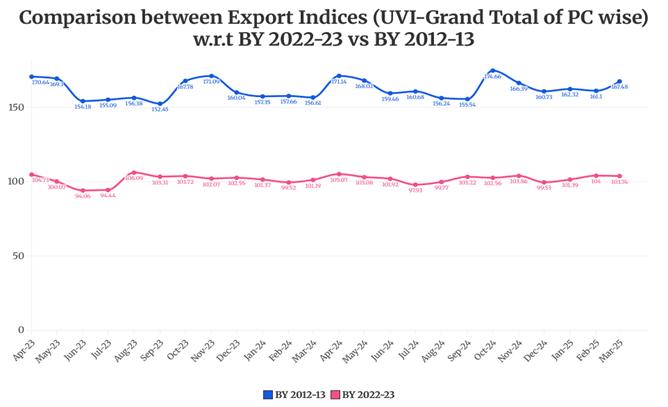
#BY means Base Year.
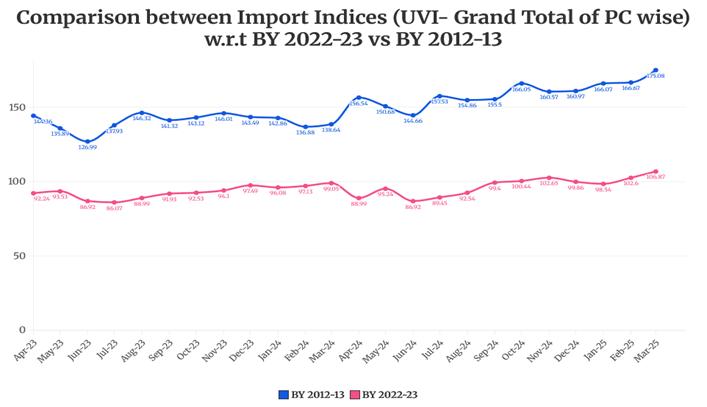
 

#BY means Base Year.

Table: Unit Value Index (UVI) and Quantity Index (QI) during FY 2025-26(Apr-Nov) using FY 2022-23 as base year


Month

Apr_25

May_25

Jun_25

1st Qtr 25-26

Jul_25

Aug_25

Sep_25

2nd Qtr 25-26

Oct_25

Nov_25

Unit Value Index

Export

105.31

99.73

96.31

100.33

99.31

100.55

104.08

101.23

103.78

105.32

Import

92.33

97.97

91.74

94.08

96.34

100.81

108.69

101.93

110.17

106.59

Quantity Index

Export

107.85

104.76

93.88

101.91

103.41

102.64

111.04

105.57

116.19

113.06

Import

138.16

126.61

112.58

125.17

122.47

124.06

126.45

124.32

137.04

121.75

Qtr  means Quarter.

Meaning and interpretation of the Indices

The Unit Value Indices and the Quantity Indices may be interpreted along the following lines.

The Unit Value Index answers the question: What is the growth in the average Unit Value of the items1 traded in the current month with respect to the same month in the Base Year?

So, an Unit Value Index of, say, 120 means that if the items that have been traded in the current month had been traded in the same month of the base year, and if the average price (or unit value) of those items had been Rs.100 in that month of the base year, then the average price (or unit value) of these items in the current month is Rs.120. Or that, there is a 20% increase in the average Unit Value, with respect to the Base Year, of the items that have been traded in the Current Month.

For example, let us suppose 30 items, 10 items each from 3 different Principal Commodities, have been traded in the current month. If these 30 items had been traded in the corresponding month of the base year at an average price of Rs.100, then the average price of these items in the current year is Rs.120.

It is to be noted that there are two successive steps of averaging done here. The first averaging is done over all the items (or ITCHS) of a PC group to arrive at the Index of that PC group. And the second averaging is done over all the PC groups to arrive at the Index at the Grand Total level for all commodities (which is the overall Index for India for a month). In both the stages, a weighted average is taken where the weights are proportional to the importance of the items and the PC groups respectively, and the Laspeyres Formula is used for averaging.

Quantity Indices, say, 200 means that if in the base year on an average 100 units were traded in India in the base year, then in the current year on an average 200 units were traded. However, it must be remembered that averaging quantities are different from averaging prices, since quantities in different units cannot be added directly.

So, the Quantity Indices are calculated by dividing the Value Indices by the Unit Value Indices. For example, if there is an increase in the Value of Export from Rs. 10,000 to Rs. 24,000, then the Value Index is 24000/10000 × 100 = 240. If the Unit Value Index is 120, then the Quantity Index comes to 240/120 × 100 = 200. So, loosely it can be said that, if the value of export has increased 2.4 times and the price of the commodities has increased 1.2 times, then the quantity must have doubled.

However, it may be noted that a very high or low Quantity Index may indicate the presence of Base Effect.

The Interpretation of the Bilateral and Regional Indices can be seen as an extension of the above.

A Unit Value Index of 120 with respect to a country, say Bangladesh, means that if all the items that have been traded with Bangladesh in the current month had been traded in the same month of the base year with the same country, and if the average price (or unit value) of those items had been Rs.100 in that month of the base year, then the average price (or unit value) of these items in the current month is Rs.120.

Similarly, a Quantity Index of 200 with respect to a country, say Bangladesh, means that if in the base year on an average 100 units were traded in India in the base year, then in the current year on an average 200 units were traded.

Comparability of the Indices across time

It is to be noted that the weights in the Index Number formula are fixed across time and there are twelve sets of weights for the twelve months. Hence, comparability of Indices is meaningful only when Indices of same month are compared across years. Different months may attach different weights to the same item, and hence comparing indices of two different months becomes vague and may have little applicability.

Further, the weights of the items that are not present in the trade basket of the current month are distributed to all the items that have been traded in the current month. This distribution is done in proportion to the weights of those items.

For example, let us suppose there are only 3 commodities for trade, say A, B and C. In month May of the Base year, let us suppose that the trade value of A was Rs. 50, B was Rs. 100 and C was Rs. 50. Then the weights assigned to A, B and C in the month of May of the following years would be in the ratio 50 :100 :50. However, in case, C is not traded in the current month, then the weight of C would be distributed proportionately among A and B, again in the ratio 1:2 (since in May the weights of A and B are in the ratio of 50 : 100, i.e., 1 : 2). So, in the current month the weights of A and B would be 3313  and 6623 .

As a result, the weights in any two given months are dependent on exactly the number of items (ITCHS codes) traded in those months. If the items traded are widely different, inference drawn from the comparison of the Indices may be done accordingly. On the other hand, more the similarity in the number of items traded more is the comparability of the two indices.

Net Terms of Trade:

Net Terms of Trade also called commodity Terms of Trade is defined as a ratio of export prices to import prices.

Let say 2022-23 be the base year and 2023-24 be the final year. We express both export and import prices in 2022-23 as 100. Now, suppose that at the end of 2023-24, it is found that the index of export prices decreased to 90 and index of import prices roses to 150. Then the Net Terms of Trade has changed to 90100150100=35 . Then terms of trade as index=35*100=60 . It implies that terms of trade of the country have decreased by about 40% in 2023-24 as compared with 2022-23. It thus shows a deterioration or a worsening of the terms of trade of the country.

If the index of export prices has risen to 150 and that of import prices had risen to 120, then the net terms of trade would have changed to 150120*100=125 . This implies an improvement in the net terms of trade of the country by 25% in 2023-24 over 2022-23.

Gross Terms of Trade:

Gross Terms of Trade is the ratio of physicalquantity of import to physical quantity of export.

Let say 2022-23 be the base year. In that year, the quantities export and import are denoted by 100. Now, suppose that in the year 2023-24, the index of quantity of import was 150 and that of quantity of export was 120. Then the gross terms of trade is given by 150100120100=54,  in terms of percentage =54*100=125 . This implies that there was an improvement of gross terms of trade by 25% in 2023-24 compared to 2022-23.

Income Terms of Trade: Income Terms of Trade is defined as- Net Terms of Trade multiplied by quantity of export.

Topics

Acts Income Tax
