

Loading...

Top
Help
×

By creating an account you can:

Logo TaxTMI
Call Us / Help / Feedback

Contact Us At :

E-mail: [email protected]

Call / WhatsApp at: +91 99117 96707

For more information, Check Contact Us

FAQs :

To know Frequently Asked Questions, Check FAQs

Most Asked Video Tutorials :

For more tutorials, Check Video Tutorials

Submit Feedback/Suggestion :

Email :
Please provide your email address so we can follow up on your feedback.
Category :
Description :
Min 15 characters 0/2000
Make Most of Text Search
  1. Checkout this video tutorial: How to search effectively on TaxTMI.
  2. Put words in double quotes for exact word search, eg: "income tax"
  3. Avoid noise words such as : 'and, of, the, a'
  4. Sort by Relevance to get the most relevant document.
  5. Press Enter to add multiple terms/multiple phrases, and then click on Search to Search.
  6. Text Search
  7. The system will try to fetch results that contains ALL your words.
  8. Once you add keywords, you'll see a new 'Search In' filter that makes your results even more precise.
  9. Text Search
Add to...
You have not created any category. Kindly create one to bookmark this item!
Create New Category
Hide
Title :
Description :
❮❮ Hide
Default View
Expand ❯❯
Close ✕
🔎 News - Adv. Search
TEXT SEARCH:

Press 'Enter' to add multiple search terms. Rules for Better Search

Search In:
Main Text + AI Text
  • Main Text
  • Main Text + AI Text
  • AI Text
Category: ?
Categorized by AI
---- All Categories ----
  • ---- All Categories ----
  • Income Tax
  • GST
  • Customs, DGFT & SEZ
  • FEMA & RBI
  • Corp. Laws, SEBI & IBC
  • PMLA, Black Money & ED
  • Budget
  • News and Press Release
  • PTI News
Month:
---- All Months ----
  • ---- All Months ----
  • January
  • February
  • March
  • April
  • May
  • June
  • July
  • August
  • September
  • October
  • November
  • December
Year:
---- All Years ----
  • ---- All Years ----
  • 2026
  • 2025
  • 2024
  • 2023
  • 2022
  • 2021
  • 2020
  • 2019
  • 2018
  • 2017
  • 2016
  • 2015
  • 2014
  • 2013
  • 2012
  • 2011
Sort By: ?
In Sort By 'Default', exact matches for text search are shown at the top, followed by the remaining results in their regular order.
Relevance Default Date
    Rajasthan cabinet approves bills to allow people with more than two children to contest local body elections
    Stock markets edge up in volatile trade; Waaree Energies tanks 10pc on 126% US solar duties
    Indo-US trade deal one-sided, should be put on hold: Congress
    109th Meeting of Network Planning Group under PM GatiShakti evaluates key Infrastructure projects - NPG evaluates projects from Ministry of Railways, ...
    Smartphone now India's top export category with total overseas shipment worth USD 30 bn: Vaishnaw
    IDFC First Bank affirms trust with INR 583 Crore Government Payment
    German leader arrives in China to press for fair trade, help ending Ukraine war
    US announces preliminary 126 pc countervailing duty on imports of certain Indian solar goods
    India and Gulf Cooperation Council Sign Joint Statement on the India–GCC Free Trade Agreement.
    India and Israel launch first round of Negotiations for Free Trade Agreement.
    India Building Bridges of Trade, Trust and Transformation; Secures Preferential Access to Two-Thirds of Global Trade: Union Minister of Commerce and I...
    Govt allows exports of 25 lakh tonnes of wheat
    Andhra milk contamination case: No urea traces detected in suspected milk, says Health dept
    Jaishankar holds talks with GCC Secretary General AlBudaiwi
    Foreign Trade dept denies sports arms import data under RTI, CIC orders disclosure
    Attachment under Benami Act can be challenged only before authorities provided under that act: SC
    Trai backs sale of all available spectrum; proposes lower entry barriers, 35 pc cap
    Bengal SIR: SC allows deployment of judicial officers from Jharkhand, Odisha for claim verification
    TransUnion CIBIL and State Bank of India's YONO App Collaborate to Integrate CIBIL Score and Report into Everyday Digital Banking
    Rupee declines 6 paise to settle at 90.95 against US dollar
❯❯
Maximize Maximize Maximize
0 / 200
Expand Note
Add to Folder

No Folders have been created

+

Are you sure you want to delete "My most important" ?

NOTE:

News
Showing Results for :
Reset Filters
Results Found:
Show All Summaries Hide All Summaries
February 25, 2026
Show AI Summary
Two-child disqualification removed for local body elections, while discriminatory disease-based bar deleted and a new economic offences directorate established.
The cabinet introduced amendment bills to remove the statutory bar on persons with more than two children contesting local body elections and approved deleting "leprosy" as a disqualifying disease in municipal election law, while replacing the State Revenue Intelligence Directorate with a Revenue Intelligence and Economic Offences Directorate to investigate and prevent financial crimes, real estate fraud, shell companies, forged documents, illegal encroachments and revenue leakages, and coordinating inputs from tax and sectoral departments.
February 25, 2026
Show AI Summary
Countervailing duty on Indian solar imports shocks markets; solar stocks plunge while benchmarks remain volatile.
A US preliminary countervailing duty of about 126 percent was imposed on certain Indian solar imports following allegations of unfair manufacturing subsidies; the announcement triggered a sharp sell-off in solar-sector equities and contributed to volatile trading in broader benchmarks, with analysts and flow data citing trade uncertainty, net foreign outflows, and cautious investor positioning as proximate market drivers.
February 25, 2026
Show AI Summary
Indo-US trade deal risks farmers as unilateral US tariff actions leave exports vulnerable; India urged to suspend the agreement.
The Indo-US interim trade deal is criticised as one-sided because US imposition of a high duty on Indian solar module imports shows Indian exports are subject to unilateral executive tariff measures, leaving exporters vulnerable; opposition leaders urge India to put the agreement on hold to protect farmers and reassess safeguards for exporters in light of a judicial finding that such presidential tariffs exceeded lawful authority.
February 25, 2026
Show AI Summary
Integrated multimodal infrastructure: four projects evaluated to strengthen connectivity, capacity and last mile linkages under national planning.
The Network Planning Group evaluated four projects for conformity with PM GatiShakti principles of integrated multimodal infrastructure, last mile connectivity and a Whole of Government approach. Two third line railway projects (Jalandhar Cantt-Jammu Tawi and Manikpur-Itarsi) aim to augment rail capacity, resilience and operational throughput on strategic corridors. A Greenfield airport at Doloo, Silchar is proposed to relieve airport capacity constraints and stimulate regional socio economic growth. A Surat Metro extension is proposed as a dedicated feeder link to the Mumbai-Ahmedabad HSR corridor to enable seamless last mile and modal integration.
February 25, 2026
Show AI Summary
Smartphone exports become top export category as manufacturing scale and premium device production boost overseas shipments.
Smartphone exports have become the country's leading export category, propelled by expanded domestic production and the manufacture of premium devices for high-value overseas markets. The growth in export value is linked to large-scale, export-oriented manufacturing and is expected to be reinforced by the commencement of new semiconductor production capacity, with market observers noting premium-brand assembly and diversified export destinations as key drivers.
February 25, 2026
Show AI Summary
Payment assurance: Bank honoured government principal and interest despite an ongoing fraud investigation and reconciliation caveats.
A branch-level fraud involving forged instruments and payment instructions affecting Government of Haryana departments is under investigation, with preliminary findings indicating possible employee collusion with external parties. Despite the ongoing probe, IDFC FIRST Bank has honored 100% of the principal and interest claimed by the affected departments, subject to final reconciliation and any further claims, and states it is cooperating with law enforcement and regulators under the FEMA / RBI framework.
February 25, 2026
Show AI Summary
Fair trade: Germany seeks balanced, regulated economic partnership with China and support for diplomatic resolution in Ukraine.
Germany seeks a fair economic playing field with China by demanding reduced barriers to foreign companies, remedies for systemic overcapacity and export or access restrictions that distort competition, and cooperation to uphold supply-chain stability. The visit also urges Chinese diplomatic assistance to help negotiate a comprehensive, lasting peace in the Russia-Ukraine conflict, linking trade concerns to multilateral crisis resolution.
February 25, 2026
Show AI Summary
Countervailing duties on Indian solar imports after preliminary subsidy finding; investigations and anti dumping probes continue.
The United States Department of Commerce issued preliminary affirmative determinations imposing a preliminary countervailing duty on certain Indian crystalline silicon photovoltaic cells and related solar goods, while announcing different preliminary duties on comparable imports from Indonesia and Laos. Commerce noted increased imports of the Indian products, is conducting concurrent anti dumping investigations of solar cells from the three countries, and has scheduled a final determination in the countervailing duty investigations to follow the preliminary findings.
February 25, 2026
Show AI Summary
Free trade agreement negotiations between India and GCC launched to deepen trade ties, provide business predictability and boost investment.
A Joint Statement and prior Terms of Reference have initiated negotiations for a comprehensive Free Trade Agreement between India and the GCC to establish a predictable, broad-based trading framework. The Statement emphasises objectives of expanding and diversifying bilateral trade and investment, enhancing market access in identified export and import sectors, and leveraging historical ties and diaspora links. It frames the FTA negotiations as a mechanism to unlock trade potential, strengthen economic integration, and provide predictability for businesses, with specific tariff and regulatory commitments to be determined through negotiations.
February 25, 2026
Show AI Summary
Free Trade Agreement negotiations aim to deepen trade and regulatory cooperation between India and Israel.
First round negotiations for an India Israel Free Trade Agreement began under a signed Terms of Reference, with technical sessions on trade in goods and services, rules of origin, sanitary and phytosanitary measures, technical barriers to trade, customs procedures and trade facilitation, and intellectual property rights, aiming to provide certainty to businesses, strengthen supply chains and expand bilateral economic cooperation.
February 25, 2026
Show AI Summary
Preferential trade access expands through high quality FTAs, enabling broader market access and stronger export competitiveness.
India has expanded preferential trade access through a series of high quality free trade agreements, advancing negotiations with multiple partners including a Gulf Cooperation Council bloc, Israel, Chile and Canada. The government connects FTAs to export growth-citing increased merchandise trade with partners-and is supporting MSME integration via an Export Promotion Mission that improves credit access, reduces costs and assists with compliance. A four point roadmap directs grassroots FTA dissemination, a focus on quality and standards, value chain upgrading, and development of local export ecosystems through industry-MSME partnerships.
February 24, 2026
Show AI Summary
Wheat export permission allows limited shipments while preserving domestic food security and protecting farmer returns through set modalities.
The government authorised limited wheat exports while maintaining a general prohibition, subject to a capped export allocation and forthcoming operational modalities. Wheat flour and related products remain largely prohibited except for a separate limited allowance and government to government food security permissions. The policy is justified by assessed higher private and central stocks, projected central pool availability and increased acreage supported by MSP and procurement, with aims to stabilise domestic prices, prevent distress sales, improve liquidity and allow exports without endangering domestic supply.
February 24, 2026
Show AI Summary
Product contamination probe: forensic and food safety testing underway after suspected coolant leak linked to renal harm.
No urea traces were detected in milk linked to deaths and hospitalisations; ethylene glycol contamination and a suspected coolant leak from a freezer are under investigation. Recognised food safety, veterinary and forensic laboratories have received milk, product and environmental samples for phased testing; results will determine whether adulteration or accidental contamination occurred. The implicated dairy unit was sealed, the vendor detained, extensive household screening and blood testing conducted, and law enforcement indicated criminal proceedings will follow based on forensic and post mortem findings.
February 24, 2026
Show AI Summary
Free Trade Agreement negotiations to advance India-GCC cooperation in energy, trade and investment and strategic ties.
India and the Gulf Cooperation Council have initiated negotiations for a Free Trade Agreement alongside a Joint Action Plan under a Strategic Dialogue to deepen cooperation in energy, trade and investment, agriculture, security, and people to people ties, positioning the FTA as the central instrument to structure and expand economic relations between India and the six member GCC bloc.
February 24, 2026
Show AI Summary
RTI disclosure: numerical figures for sports arms imports must be released following a wrongful commercial-confidentiality refusal under the Act.
A trade department withheld calibre-wise quantities of sports arms imports citing commercial-confidence exemption under the Right to Information, yet admitted possession of the numerical data and failed to justify the exemption's application to mere quantities; the commission required a revised, point-wise reply limited to numerical figures while preserving legitimately exempt material.
February 24, 2026
Show AI Summary
Challenge to benami attachment must be brought before statutory Benami Act authorities, not insolvency or company-law forums.
Attachment orders under the Prohibition of Benami Property Transactions Act, 1988 can be challenged only before the statutory authorities and appellate mechanisms provided within that Act; insolvency and company-law fora lack jurisdiction to entertain such challenges and resorting to them to circumvent Benami Act procedures amounts to an abuse of process.
February 24, 2026
Show AI Summary
Spectrum auction policy recommends selling all available bands, reclaiming insolvent holders' airwaves, and easing entry to boost competition.
Trai recommends auctioning all available IMT spectrum and reclaiming airwaves from providers in insolvency, lowers networth entry thresholds for new entrants while retaining 2024 eligibility conditions, and proposes a uniform spectrum cap to protect competition without forcing operators to surrender existing holdings. It prescribes auction modalities, standard 20 year charge periods (with special 600 MHz incentives including extended validity, a payment moratorium and delayed rollout), excludes the upper 6 GHz band pending trials, and introduces a coverage for discount scheme with mandatory tower sharing and periodic spectrum revaluation.
February 24, 2026
Show AI Summary
Deployment of judicial officers to expedite electoral roll claim verification, with document-based verification and supplementary enlistment permitted.
The Court authorised deployment of West Bengal civil judges and requisition of similarly ranked judicial officers from Jharkhand and Odisha to verify claims and objections in the SIR exercise, required minimum experience for deployed civil judges, and made the Election Commission responsible for travel, honorarium and related expenses. Judicial officers must verify documents specified in SIR notifications and judicial orders permitting Aadhaar and Class X certificates; all documents submitted on or before the cut-off date will be considered. Electoral Registration Officers and Assistant Electoral Registration Officers must satisfy judicial officers regarding document authenticity. The EC may publish the final roll and issue supplementary lists, with the Court invoking Article 142 to enlist voters in supplementary rolls.
February 24, 2026
Show AI Summary
Consumer credit information access enables customers to view and simulate effects on their credit score within their banking app.
Integration embeds consumer credit information access into the bank's YONO app, enabling authenticated customers to view their CIBIL Score and full report, use report analysis and FAQs, and operate a score simulator to model credit events (opening/closing accounts, late payments, clearing dues, new enquiries) so users can monitor credit health, learn via gamified content, and make more informed borrowing decisions within a secure digital banking interface.
February 24, 2026
Show AI Summary
Foreign exchange intervention: central bank actions influence currency stability amid trade-policy uncertainty and oil-driven external pressures.
The rupee modestly weakened amid a stronger dollar, higher global oil prices, and weak domestic equities, with reports of possible Reserve Bank intervention selling foreign currency to prevent the exchange rate breaching a psychologically sensitive level; trade-policy uncertainty and reference to a Supreme Court ruling are noted as additional volatility drivers.

News

Back

All News

Showing Results for :
Reset Filters
No Records Found

News

Showing Results for : Reset Filters
Customs, DGFT & SEZ

Directorate General of Commercial Intelligence and Statistics Revises Base Year of Merchandise Trade Indices to FY 2022–23 to Reflect Current Trade Structure and Global Patterns

February 21, 2026

Contents
Summary
Note

Note

-

Bookmark

Print

Print

Merchandise Trade Indices are compiled and published by the Directorate General of Commercial Intelligence and Statistics (DGCI&S), Ministry of Commerce & Industry, to measure changes in the unit values (prices) of India’s exports and imports over time. These indices serve as important indicators of external sector price movements and are widely used for economic analysis, including national accounts compilation and assessment of terms of trade. Over the years, the base year of the indices has been periodically revised to reflect structural changes in India’s trade composition and evolving global trade patterns. The most recent revision updates the base year to FY 2022–23 (2022–23 = 100), replacing the earlier base of FY 2012–13, thereby ensuring that the indices accurately represent the current structure of India’s merchandise trade.

Revision of Base Year of India’s Merchandise Trade Indices to FY 2022–23

The Directorate General of Commercial Intelligence and Statistics (DGCI&S), Ministry of Commerce & Industry, has revised the base year of India’s Merchandise Trade Indices from FY 2012–13 to FY 2022–23 (2022–23 = 100), in view of the structural changes in the economy, shifts in commodity composition, evolving trade patterns, and the need for improved alignment with contemporary macroeconomic indicators.

The revision has been undertaken on the recommendations of a committee constituted by DGCI&S under the Chairmanship of Prof. Nachiketa Chattopadhyay, Professor, Indian Statistical Institute, Kolkata. The Committee examined the existing methodology, data coverage, weighting structure, and compilation practices, and recommended suitable refinements in line with international best practices.

Key Features of the Revised Series (Base: FY 2022–23)

  1. Updated Base Year:
    The new base year FY 2022–23 makes the Indices reflect the current structure of India’s external trade more accurately.
  2. Revised Commodity Basket:
    The coverage and classification of commodities have been reviewed at the Principal Commodity level to better capture emerging and declining trade items.
  3. Revised Weighting Structure:
    Weights have been updated based on trade values of the new base year to reflect the latest value shares in exports and imports.
  4. Improved Methodology:
    Methodological refinements have been introduced in:
    1. Selection of common commodity basket for base year selection (procedure of selection for common commodity basket explained in detail report of the committee).
    2. Treatment of missing unit values (Imputation of missing unit values in base year selection have been explained in detail in the committee report).
  5. Indices Compiled:
    The revised series includes:
    1. Monthly, Quarterly and Annual Indices (Export Unit Value Index,Import Unit Value Index).
    2. Principal Commodity (PC) Classification wise Trade Indices (Export/Import).
    3. Standard International Trade Classification-wise (SITC) Trade Indices.
    4. Broad economic categories-wise (BEC) Trade Indices.
    5. Bilateral and Region-wise Trade Indices of Top 20 Export and Import partner nations of India.
    6. Terms of Trade (Gross terms of trade, Net terms of trade and Income terms of trade).

Rationale for Revision

Over the past decade, India’s trade basket has undergone substantial changes due to emergence of new commodities, technological advancements, Global supply chain restructuring and changes in relative price structures.

The earlier base year (FY 2012–13) no longer adequately reflected the prevailing trade structure. The revision ensures improved relevance, reliability, and analytical usefulness of the Merchandise Trade Indices for policymakers, researchers, and other stakeholders.

Use of the Revised Series

Merchandise Trade Indices compiled by the Directorate General of Commercial Intelligence and Statistics (DGCI&S) are extensively used by key government institutions for economic analysis and policy formulation. The National Accounts Division (NAD) of the Ministry of Statistics and Programme Implementation uses the Export and Import Unit Value Indices as deflators for estimating real exports and imports in GDP compilation. The Reserve Bank of India (RBI) relies on these indices for external sector assessment, balance of payments analysis, and evaluation of price competitiveness. Various Ministries and Government agencies also use them to frame and review trade-related policies and to assess movements in international prices. In addition, academic institutions, research organizations, and economic analysts utilize Merchandise Trade Indices for empirical research, modelling, and analysis of trade dynamics and terms of trade trendson and economic research.

Availability of Data

The revised Merchandise Trade Indices (Base: FY 2022–23) will be released on the official website of DGCI&S. Detailed methodological documentation is available in the Report of the Committee on Revision of Base Year for Merchandise Trade Indices.

Comparison of the new revised Indices (Base Year: 2022-23) with the already released Indices (Base Year : 2012-13) for 2022-23 and 2023-24 is given below.
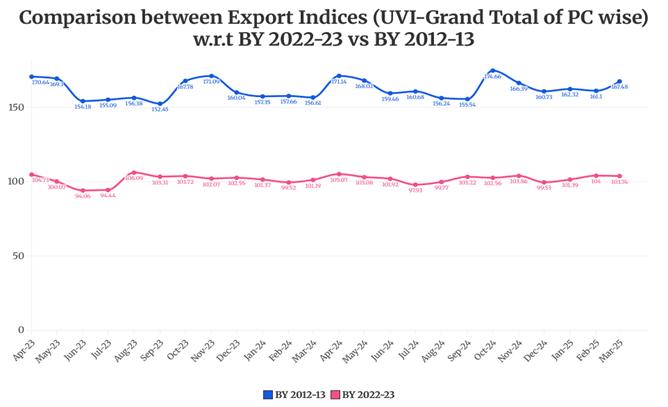
#BY means Base Year.
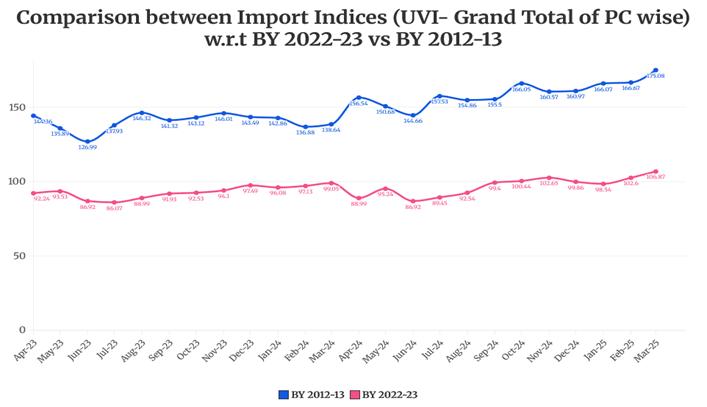
 

#BY means Base Year.

Table: Unit Value Index (UVI) and Quantity Index (QI) during FY 2025-26(Apr-Nov) using FY 2022-23 as base year


Month

Apr_25

May_25

Jun_25

1st Qtr 25-26

Jul_25

Aug_25

Sep_25

2nd Qtr 25-26

Oct_25

Nov_25

Unit Value Index

Export

105.31

99.73

96.31

100.33

99.31

100.55

104.08

101.23

103.78

105.32

Import

92.33

97.97

91.74

94.08

96.34

100.81

108.69

101.93

110.17

106.59

Quantity Index

Export

107.85

104.76

93.88

101.91

103.41

102.64

111.04

105.57

116.19

113.06

Import

138.16

126.61

112.58

125.17

122.47

124.06

126.45

124.32

137.04

121.75

Qtr  means Quarter.

Meaning and interpretation of the Indices

The Unit Value Indices and the Quantity Indices may be interpreted along the following lines.

The Unit Value Index answers the question: What is the growth in the average Unit Value of the items1 traded in the current month with respect to the same month in the Base Year?

So, an Unit Value Index of, say, 120 means that if the items that have been traded in the current month had been traded in the same month of the base year, and if the average price (or unit value) of those items had been Rs.100 in that month of the base year, then the average price (or unit value) of these items in the current month is Rs.120. Or that, there is a 20% increase in the average Unit Value, with respect to the Base Year, of the items that have been traded in the Current Month.

For example, let us suppose 30 items, 10 items each from 3 different Principal Commodities, have been traded in the current month. If these 30 items had been traded in the corresponding month of the base year at an average price of Rs.100, then the average price of these items in the current year is Rs.120.

It is to be noted that there are two successive steps of averaging done here. The first averaging is done over all the items (or ITCHS) of a PC group to arrive at the Index of that PC group. And the second averaging is done over all the PC groups to arrive at the Index at the Grand Total level for all commodities (which is the overall Index for India for a month). In both the stages, a weighted average is taken where the weights are proportional to the importance of the items and the PC groups respectively, and the Laspeyres Formula is used for averaging.

Quantity Indices, say, 200 means that if in the base year on an average 100 units were traded in India in the base year, then in the current year on an average 200 units were traded. However, it must be remembered that averaging quantities are different from averaging prices, since quantities in different units cannot be added directly.

So, the Quantity Indices are calculated by dividing the Value Indices by the Unit Value Indices. For example, if there is an increase in the Value of Export from Rs. 10,000 to Rs. 24,000, then the Value Index is 24000/10000 × 100 = 240. If the Unit Value Index is 120, then the Quantity Index comes to 240/120 × 100 = 200. So, loosely it can be said that, if the value of export has increased 2.4 times and the price of the commodities has increased 1.2 times, then the quantity must have doubled.

However, it may be noted that a very high or low Quantity Index may indicate the presence of Base Effect.

The Interpretation of the Bilateral and Regional Indices can be seen as an extension of the above.

A Unit Value Index of 120 with respect to a country, say Bangladesh, means that if all the items that have been traded with Bangladesh in the current month had been traded in the same month of the base year with the same country, and if the average price (or unit value) of those items had been Rs.100 in that month of the base year, then the average price (or unit value) of these items in the current month is Rs.120.

Similarly, a Quantity Index of 200 with respect to a country, say Bangladesh, means that if in the base year on an average 100 units were traded in India in the base year, then in the current year on an average 200 units were traded.

Comparability of the Indices across time

It is to be noted that the weights in the Index Number formula are fixed across time and there are twelve sets of weights for the twelve months. Hence, comparability of Indices is meaningful only when Indices of same month are compared across years. Different months may attach different weights to the same item, and hence comparing indices of two different months becomes vague and may have little applicability.

Further, the weights of the items that are not present in the trade basket of the current month are distributed to all the items that have been traded in the current month. This distribution is done in proportion to the weights of those items.

For example, let us suppose there are only 3 commodities for trade, say A, B and C. In month May of the Base year, let us suppose that the trade value of A was Rs. 50, B was Rs. 100 and C was Rs. 50. Then the weights assigned to A, B and C in the month of May of the following years would be in the ratio 50 :100 :50. However, in case, C is not traded in the current month, then the weight of C would be distributed proportionately among A and B, again in the ratio 1:2 (since in May the weights of A and B are in the ratio of 50 : 100, i.e., 1 : 2). So, in the current month the weights of A and B would be 3313  and 6623 .

As a result, the weights in any two given months are dependent on exactly the number of items (ITCHS codes) traded in those months. If the items traded are widely different, inference drawn from the comparison of the Indices may be done accordingly. On the other hand, more the similarity in the number of items traded more is the comparability of the two indices.

Net Terms of Trade:

Net Terms of Trade also called commodity Terms of Trade is defined as a ratio of export prices to import prices.

Let say 2022-23 be the base year and 2023-24 be the final year. We express both export and import prices in 2022-23 as 100. Now, suppose that at the end of 2023-24, it is found that the index of export prices decreased to 90 and index of import prices roses to 150. Then the Net Terms of Trade has changed to 90100150100=35 . Then terms of trade as index=35*100=60 . It implies that terms of trade of the country have decreased by about 40% in 2023-24 as compared with 2022-23. It thus shows a deterioration or a worsening of the terms of trade of the country.

If the index of export prices has risen to 150 and that of import prices had risen to 120, then the net terms of trade would have changed to 150120*100=125 . This implies an improvement in the net terms of trade of the country by 25% in 2023-24 over 2022-23.

Gross Terms of Trade:

Gross Terms of Trade is the ratio of physicalquantity of import to physical quantity of export.

Let say 2022-23 be the base year. In that year, the quantities export and import are denoted by 100. Now, suppose that in the year 2023-24, the index of quantity of import was 150 and that of quantity of export was 120. Then the gross terms of trade is given by 150100120100=54,  in terms of percentage =54*100=125 . This implies that there was an improvement of gross terms of trade by 25% in 2023-24 compared to 2022-23.

Income Terms of Trade: Income Terms of Trade is defined as- Net Terms of Trade multiplied by quantity of export.

Topics

Acts Income Tax
