

Loading...

Top
Help
×

By creating an account you can:

Logo TaxTMI
Call Us / Help / Feedback

Contact Us At :

E-mail: [email protected]

Call / WhatsApp at: +91 99117 96707

For more information, Check Contact Us

FAQs :

To know Frequently Asked Questions, Check FAQs

Most Asked Video Tutorials :

For more tutorials, Check Video Tutorials

Submit Feedback/Suggestion :

Email :
Please provide your email address so we can follow up on your feedback.
Category :
Description :
Min 15 characters 0/2000
Make Most of Text Search
  1. Checkout this video tutorial: How to search effectively on TaxTMI.
  2. Put words in double quotes for exact word search, eg: "income tax"
  3. Avoid noise words such as : 'and, of, the, a'
  4. Sort by Relevance to get the most relevant document.
  5. Press Enter to add multiple terms/multiple phrases, and then click on Search to Search.
  6. Text Search
  7. The system will try to fetch results that contains ALL your words.
  8. Once you add keywords, you'll see a new 'Search In' filter that makes your results even more precise.
  9. Text Search
Add to...
You have not created any category. Kindly create one to bookmark this item!
Create New Category
Hide
Title :
Description :
❮❮ Hide
Default View
Expand ❯❯
Close ✕
🔎 News - Adv. Search
TEXT SEARCH:

Press 'Enter' to add multiple search terms. Rules for Better Search

Search In:
Main Text + AI Text
  • Main Text
  • Main Text + AI Text
  • AI Text
Category: ?
Categorized by AI
---- All Categories ----
  • ---- All Categories ----
  • Income Tax
  • GST
  • Customs, DGFT & SEZ
  • FEMA & RBI
  • Corp. Laws, SEBI & IBC
  • PMLA, Black Money & ED
  • Budget
  • News and Press Release
  • PTI News
Month:
---- All Months ----
  • ---- All Months ----
  • January
  • February
  • March
  • April
  • May
  • June
  • July
  • August
  • September
  • October
  • November
  • December
Year:
---- All Years ----
  • ---- All Years ----
  • 2026
  • 2025
  • 2024
  • 2023
  • 2022
  • 2021
  • 2020
  • 2019
  • 2018
  • 2017
  • 2016
  • 2015
  • 2014
  • 2013
  • 2012
  • 2011
Sort By: ?
In Sort By 'Default', exact matches for text search are shown at the top, followed by the remaining results in their regular order.
Relevance Default Date
    Creditors can pursue simultaneous insolvency proceedings against both debtors, guarantors
    ED files prosecution sanction against P Chidambaram to expedite trial in 2 PMLA cases
    First Round of India–Israel FTA Talks Concludes Successfully in New Delhi.
    Recovery of MahaRERA dues to be intensified, minister Desai informs assembly
    SC frowns upon technical members outsourcing writing of verdicts, says tribunals have become liability
    5 Common AC Buying Mistakes to Avoid This Summer (2026 Guide)
    CBI files fresh case against Anil Ambani, Reliance Communications over Rs 2,220 crore bank 'fraud'
    Get Low-interest Personal Loans with Flexible Terms from Bajaj Finance
    RBI clears SBI Mutual Fund’s proposal to acquire up to 9.99 pc stake in Bandhan Bank
    Central Board of Indirect Taxes and Customs (CBIC) and Permanent Mission of India organise Special Trade Facilitation Sessions at World Trade Organisa...
    Goyal meets US Comm Secretary Lutnick, discusses trade
    Realtime Biometrics Launches Aadhaar-Enabled face recognition & fingerprint Biometric Attendance System T502F Mini
    LTM to Modernize India's Tax Analytics Platform Leveraging NVIDIA AI Technology
    Central Board of Indirect Taxes and Customs (CBIC) to host National Symposium on Customs Reforms and International Customs Day 2026 with the theme of ...
    Union Minister of Commerce and Industry Piyush Goyal Highlights Youth Power, AI and Global Trade While Giving Away the EY Entrepreneur Of The Year Awa...
    Jharkhand HC rejects petition of ex-minister Kamlesh Singh’s relatives in ED case
    Anil Ambani appears before ED in money laundering case
    Entire 11,790 MHz telecom spectrum available for auction valued at Rs 2.1 lakh cr: Sources
    India sustains 7-7.5 pc growth; Bengal should position itself as maritime state: Sanyal
    Cut costs, fix mis-selling to make insurance products affordable: IRDAI member to insurers
❯❯
Maximize Maximize Maximize
0 / 200
Expand Note
Add to Folder

No Folders have been created

+

Are you sure you want to delete "My most important" ?

NOTE:

News
Showing Results for :
Reset Filters
Results Found:
Show All Summaries Hide All Summaries
February 26, 2026
Show AI Summary
Simultaneous insolvency proceedings allowed against principal debtor and guarantor, enabling creditors to pursue parallel recovery routes.
There is no statutory bar under the Insolvency and Bankruptcy Code to initiating concurrent CIRP proceedings against a principal debtor and its corporate guarantor for the same debt; a creditor's right to realize a guarantee must not be frustrated by requiring sequential insolvency processes, the IBC does not exempt guarantors during pendency of another process, and adjudicating authorities must examine such applications independently, consistent with the principle that a surety's liability is co-extensive with the principal debtor.
February 26, 2026
Show AI Summary
Prosecution sanction requirement in PMLA cases accelerates trial after agency files requisite approvals before the special court.
Enforcement Directorate placed competent prosecution sanction and an equivalent CrPC sanction order before the Special PMLA Court to remedy procedural defects identified by the Supreme Court and to expedite trial in two money laundering prosecutions arising from the Aircel Maxis and INX Media matters. The agency's action validates earlier ED chargesheets and aims to overcome delays caused by challenges to PMLA sanction requirements.
February 26, 2026
Show AI Summary
Free Trade Agreement negotiations between India and Israel progress, covering goods, services, rules of origin, and digital trade.
Negotiations commenced under a signed Terms of Reference to establish a structured framework for an ambitious Free Trade Agreement between India and Israel, with the first round of talks addressing core chapters-trade in goods and services, rules of origin, sanitary and phytosanitary measures, technical barriers, customs procedures, intellectual property rights and digital trade-and agreeing continued virtual engagements and a further in person round in Israel.
February 26, 2026
Show AI Summary
Recovery of real estate regulatory dues intensified, with stricter property-tracing and revenue recovery measures to enforce orders.
The government will intensify recovery of unpaid dues under the Real Estate Regulatory framework by directing district collectors to expedite recoveries, identify and attach defaulting developers' properties across districts, and trace assets using land records, stamp and registration data, property tax rolls, company registrations, vehicle registration records and, where necessary, tax authority assistance; recovery will be pursued through statutory revenue-recovery mechanisms and overseen via periodic reviews by senior administrators.
February 26, 2026
Show AI Summary
Tribunal accountability undermined as technical members outsource judgments, prompting urgent tenure and vacancy reforms and oversight action.
Tribunal functioning and accountability are the central concerns: tribunals have become a "no-man's land" lacking accountability and producing questionable orders. Structural defects in the appointment and tenure regime allow technical members to assume chairpersonship and, in some instances, outsource drafting of judgments. The court directed the executive to expedite vacancy-filling mechanisms and granted interim tenure extensions for chairpersons while urging reforms to appointment, training, and accountability processes.
February 26, 2026
Show AI Summary
Consumer financing enables AC purchases on Easy EMI, improving affordability but requires checking eligibility and costs.
Guidance advises matching AC capacity and inverter technology to room conditions to avoid high bills and uneven cooling, factoring installation and maintenance costs into total ownership, and prioritising warranty, spare parts, and after sales support. Easy EMI financing options with online eligibility checks, Insta EMI card facilitation, zero down payment offers, and variable promotional terms are available, but buyers must verify precise loan limits, service availability, and partner store conditions before purchase.
February 26, 2026
Show AI Summary
Bank fraud allegations prompt fresh probe into diversion of loan funds and related money laundering inquiries.
A central investigative agency registered a fresh criminal case alleging that the promoter and his telecom group diverted and misutilised sanctioned loan funds, created fictitious related party transactions, manipulated accounts, and layered funds to conceal true flows, leading to the account's NPA classification; the bank's complaint and forensic findings allege systematic diversion through group entities and liquidation of investments to effect payments inconsistent with sanction terms.
February 26, 2026
Show AI Summary
Unsecured personal loans: flexible repayment and competitive rates available, subject to credit score, income, and eligibility.
Bajaj Finance markets unsecured personal loans with competitive, credit based interest pricing, flexible repayment tenures chosen to manage EMI burden, minimal documentation, online application and expedited disbursal. Loan amounts cover a range of consumer needs and eligibility is determined by nationality, age limits, employment status and a minimum credit score, with rates and approval conditioned on income, employment type, credit profile and repayment capacity. The lender is a deposit taking institution registered with the Reserve Bank and classified as an NBFC D and NBFC ICC.
February 26, 2026
Show AI Summary
Regulatory approval for stake acquisition with holding cap and time bound conditions, and prior approval required for increases.
RBI approved SBI Mutual Fund's acquisition of up to 9.99 per cent of Bandhan Bank's paid-up share capital or voting rights, subject to compliance with the Banking Regulation Act, 1949, RBI Directions 2025, FEMA, and SEBI regulations. The approval expires if the specified major shareholding is not acquired within one year, the aggregate holding must not exceed the approved cap at any time, and any increase to or beyond 5 per cent after falling below that level requires prior RBI approval.
February 26, 2026
Show AI Summary
Trade facilitation advances India's digital customs reforms and TFA Plus measures, enhancing MSME integration into global value chains.
India has implemented comprehensive trade facilitation reforms to fulfil and extend WTO Trade Facilitation Agreement commitments by advancing TFA Plus measures under the National Trade Facilitation Action Plan 3.0. Core elements include a Single Window Interface, Customs Automated System, Risk Management System, pre-arrival processing, electronic exchange of origin data, electronic cargo tracking and coordinated border management. Capacity building through recognised institutions and partnerships supports other countries' implementation, while measures such as advance rulings, an Authorised Economic Operator programme and trust-based processes aim to reduce compliance burdens for MSMEs and facilitate e commerce exports.
February 26, 2026
Show AI Summary
Bilateral trade agreement negotiations progress amid recent U.S. tariff policy adjustments affecting tariff treatment and transitional arrangements.
Senior-level discussions between India's commerce minister and U.S. commerce officials focused on advancing the legal text for the first phase of a bilateral trade agreement and expanding economic partnership. The talks were contextualized by a recent U.S. tariff policy adjustment-imposition of a uniform temporary tariff-which was noted as relevant to negotiations on tariff treatment, transitional arrangements, and safeguards in the prospective agreement.
February 26, 2026
Show AI Summary
Aadhaar-enabled attendance strengthens identity-verified workforce accountability through certified biometric terminals and streamlined government procurement.
Aadhaar-enabled biometric attendance systems address attendance verification failures by replacing manual registers with identity-verified entries. The T502F Mini, listed on the Government e Marketplace for streamlined procurement, offers multi-modal biometric authentication (face recognition and fingerprint), real-time data sync, STQC-certified fingerprint sensor, SafetyNet compliance, and multiple connectivity options to operate across diverse network environments, supporting government mandates for Aadhaar-integrated attendance and enhancing tamper-resistant accountability in public sector and related institutional settings.
February 26, 2026
Show AI Summary
Tax analytics modernization enables AI-driven tax administration, integrating secure cloud and citizen-facing portals to improve compliance and governance.
The program will deploy a secure cloud environment powered by NVIDIA AI infrastructure with LTM's BlueVerse as the intelligence backbone to consolidate analytics, simplify workloads, and deliver real-time insights. The integrated platform supports a smart citizen portal, automated campaign management, enhanced case workflows, and AI-driven helpdesk assistance to improve governance, reduce leakages, and strengthen taxpayer compliance and service experience.
February 26, 2026
Show AI Summary
Trust-based customs processes drive digital governance and trade facilitation with new SWIFT rollout and procedural reforms.
CBIC is convening a National Symposium and International Customs Day to advance trust-based customs processes, digital governance and trade facilitation through presentations, stakeholder consultations and the launch of digital infrastructure, including a new single-window platform, the Customs Integrated System, a Digital Travellers Guide and a revamped traveller app. The programme also highlights courier, fisheries and baggage/personal import reforms, publication releases and the recognition of officers with Certificates of Merit, stressing procedural simplification, transparency and partnership with trade.
February 26, 2026
Show AI Summary
Free Trade Agreements expand market access and call for global engagement to bolster resilient diversified supply chains.
India emphasises that Artificial Intelligence will transform jobs and increase demand for higher value skills in cybersecurity, data protection and system governance. The government highlights concluded Free Trade Agreements covering 38 nations that provide preferential market access and support integration into global value chains. Aatmanirbhar Bharat is presented as resilient, diversified supply chain building through global engagement, with calls to leverage FTAs to benefit MSMEs, farmers, exporters and fisheries and to enhance talent mobility for deeper global integration.
February 26, 2026
Show AI Summary
Money laundering allegations in relatives' petition before High Court over Enforcement Directorate's tracing of rotated funds.
Challenge to an Enforcement Directorate complaint alleging relatives of an accused engaged in laundering by rotating funds through four accounts and reverting them to the principal accused; petitioners sought quashing of the complaint claiming false implication due to kinship, while the ED relied on transaction mapping and the identified money trail as the operative factual matrix implicating the accused and his spouse.
February 26, 2026
Show AI Summary
Money laundering probe prompts PMLA questioning and property attachment as part of consolidated bank fraud investigations.
Enforcement Directorate officials recorded a statement under the Prevention of Money Laundering Act from a corporate promoter as part of ongoing probes into alleged bank loan fraud by a group company; the ED formed a Special Investigation Team to consolidate multiple fraud allegations and has used attachment powers and filed multiple money laundering cases against the group to investigate linked financial irregularities.
February 25, 2026
Show AI Summary
Spectrum auction policy: regulator recommends full-band auction with a uniform spectrum cap and lower entry thresholds.
Trai recommends auctioning the entire 11,790 MHz available across nine frequency bands under specified modalities including reserve price, band plan, block size and bid conditions; the portfolio is valued at about Rs 2.1 lakh crore at reserve price and base prices are generally lower than 2022. Trai also proposes a uniform 35 per cent spectrum cap, reduced net worth entry criteria to encourage new entrants, and immediate reclamation of spectrum held by providers undergoing insolvency for inclusion in the upcoming auction.
February 25, 2026
Show AI Summary
Maritime infrastructure expansion urged to drive regional growth and port led industrialisation, enhancing multimodal logistics competitiveness.
India's sustained sequential growth with macroeconomic stability depends on removing systemic inefficiencies rather than demand management; reforms like the Insolvency and Bankruptcy Code and infrastructure upgrades have cleaned bad assets. West Bengal should reposition as a maritime state by considering a large port and pursuing port led industrialisation, shipbuilding promotion and multimodal integration of road, rail, ports and air cargo to unlock regional economic opportunities.
February 25, 2026
Show AI Summary
Insurance affordability: rein in acquisition and management costs to expand coverage, curb mis-selling and boost product access through design.
High distribution and administrative expenses sustain a low-penetration, high-cost insurance model; insurers must reduce customer acquisition costs and expenses of management, reassess product and channel value, and adopt digital distribution and customer-centric design to improve affordability and margins. The regulator expanded the Use and File procedure to enable quicker product launches within regulatory norms. Mis-selling undermines trust and must be prevented by correct sales practices. Universal, meaningful coverage by 2047 is framed as the penetration objective, founded on affordability, accessibility and awareness.

News

Back

All News

Showing Results for :
Reset Filters
No Records Found

News

Showing Results for : Reset Filters
Customs, DGFT & SEZ

Directorate General of Commercial Intelligence and Statistics Revises Base Year of Merchandise Trade Indices to FY 2022–23 to Reflect Current Trade Structure and Global Patterns

February 21, 2026

Contents
Summary
Note

Note

-

Bookmark

Print

Print

Merchandise Trade Indices are compiled and published by the Directorate General of Commercial Intelligence and Statistics (DGCI&S), Ministry of Commerce & Industry, to measure changes in the unit values (prices) of India’s exports and imports over time. These indices serve as important indicators of external sector price movements and are widely used for economic analysis, including national accounts compilation and assessment of terms of trade. Over the years, the base year of the indices has been periodically revised to reflect structural changes in India’s trade composition and evolving global trade patterns. The most recent revision updates the base year to FY 2022–23 (2022–23 = 100), replacing the earlier base of FY 2012–13, thereby ensuring that the indices accurately represent the current structure of India’s merchandise trade.

Revision of Base Year of India’s Merchandise Trade Indices to FY 2022–23

The Directorate General of Commercial Intelligence and Statistics (DGCI&S), Ministry of Commerce & Industry, has revised the base year of India’s Merchandise Trade Indices from FY 2012–13 to FY 2022–23 (2022–23 = 100), in view of the structural changes in the economy, shifts in commodity composition, evolving trade patterns, and the need for improved alignment with contemporary macroeconomic indicators.

The revision has been undertaken on the recommendations of a committee constituted by DGCI&S under the Chairmanship of Prof. Nachiketa Chattopadhyay, Professor, Indian Statistical Institute, Kolkata. The Committee examined the existing methodology, data coverage, weighting structure, and compilation practices, and recommended suitable refinements in line with international best practices.

Key Features of the Revised Series (Base: FY 2022–23)

  1. Updated Base Year:
    The new base year FY 2022–23 makes the Indices reflect the current structure of India’s external trade more accurately.
  2. Revised Commodity Basket:
    The coverage and classification of commodities have been reviewed at the Principal Commodity level to better capture emerging and declining trade items.
  3. Revised Weighting Structure:
    Weights have been updated based on trade values of the new base year to reflect the latest value shares in exports and imports.
  4. Improved Methodology:
    Methodological refinements have been introduced in:
    1. Selection of common commodity basket for base year selection (procedure of selection for common commodity basket explained in detail report of the committee).
    2. Treatment of missing unit values (Imputation of missing unit values in base year selection have been explained in detail in the committee report).
  5. Indices Compiled:
    The revised series includes:
    1. Monthly, Quarterly and Annual Indices (Export Unit Value Index,Import Unit Value Index).
    2. Principal Commodity (PC) Classification wise Trade Indices (Export/Import).
    3. Standard International Trade Classification-wise (SITC) Trade Indices.
    4. Broad economic categories-wise (BEC) Trade Indices.
    5. Bilateral and Region-wise Trade Indices of Top 20 Export and Import partner nations of India.
    6. Terms of Trade (Gross terms of trade, Net terms of trade and Income terms of trade).

Rationale for Revision

Over the past decade, India’s trade basket has undergone substantial changes due to emergence of new commodities, technological advancements, Global supply chain restructuring and changes in relative price structures.

The earlier base year (FY 2012–13) no longer adequately reflected the prevailing trade structure. The revision ensures improved relevance, reliability, and analytical usefulness of the Merchandise Trade Indices for policymakers, researchers, and other stakeholders.

Use of the Revised Series

Merchandise Trade Indices compiled by the Directorate General of Commercial Intelligence and Statistics (DGCI&S) are extensively used by key government institutions for economic analysis and policy formulation. The National Accounts Division (NAD) of the Ministry of Statistics and Programme Implementation uses the Export and Import Unit Value Indices as deflators for estimating real exports and imports in GDP compilation. The Reserve Bank of India (RBI) relies on these indices for external sector assessment, balance of payments analysis, and evaluation of price competitiveness. Various Ministries and Government agencies also use them to frame and review trade-related policies and to assess movements in international prices. In addition, academic institutions, research organizations, and economic analysts utilize Merchandise Trade Indices for empirical research, modelling, and analysis of trade dynamics and terms of trade trendson and economic research.

Availability of Data

The revised Merchandise Trade Indices (Base: FY 2022–23) will be released on the official website of DGCI&S. Detailed methodological documentation is available in the Report of the Committee on Revision of Base Year for Merchandise Trade Indices.

Comparison of the new revised Indices (Base Year: 2022-23) with the already released Indices (Base Year : 2012-13) for 2022-23 and 2023-24 is given below.
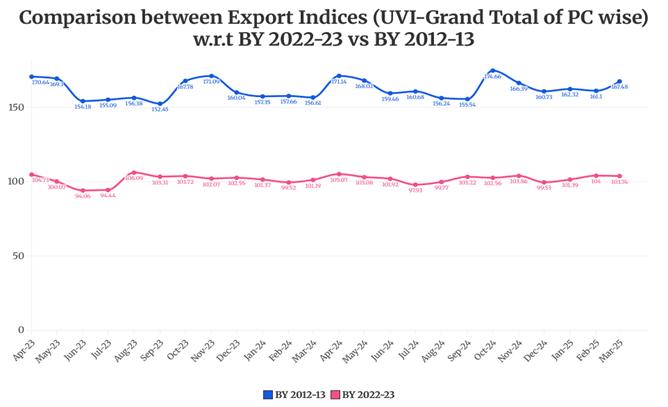
#BY means Base Year.
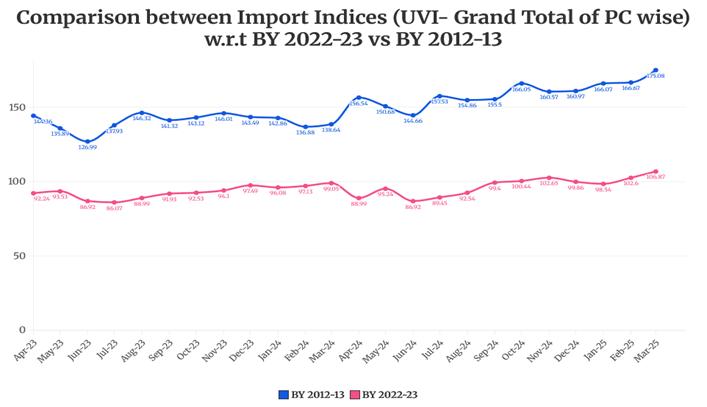
 

#BY means Base Year.

Table: Unit Value Index (UVI) and Quantity Index (QI) during FY 2025-26(Apr-Nov) using FY 2022-23 as base year


Month

Apr_25

May_25

Jun_25

1st Qtr 25-26

Jul_25

Aug_25

Sep_25

2nd Qtr 25-26

Oct_25

Nov_25

Unit Value Index

Export

105.31

99.73

96.31

100.33

99.31

100.55

104.08

101.23

103.78

105.32

Import

92.33

97.97

91.74

94.08

96.34

100.81

108.69

101.93

110.17

106.59

Quantity Index

Export

107.85

104.76

93.88

101.91

103.41

102.64

111.04

105.57

116.19

113.06

Import

138.16

126.61

112.58

125.17

122.47

124.06

126.45

124.32

137.04

121.75

Qtr  means Quarter.

Meaning and interpretation of the Indices

The Unit Value Indices and the Quantity Indices may be interpreted along the following lines.

The Unit Value Index answers the question: What is the growth in the average Unit Value of the items1 traded in the current month with respect to the same month in the Base Year?

So, an Unit Value Index of, say, 120 means that if the items that have been traded in the current month had been traded in the same month of the base year, and if the average price (or unit value) of those items had been Rs.100 in that month of the base year, then the average price (or unit value) of these items in the current month is Rs.120. Or that, there is a 20% increase in the average Unit Value, with respect to the Base Year, of the items that have been traded in the Current Month.

For example, let us suppose 30 items, 10 items each from 3 different Principal Commodities, have been traded in the current month. If these 30 items had been traded in the corresponding month of the base year at an average price of Rs.100, then the average price of these items in the current year is Rs.120.

It is to be noted that there are two successive steps of averaging done here. The first averaging is done over all the items (or ITCHS) of a PC group to arrive at the Index of that PC group. And the second averaging is done over all the PC groups to arrive at the Index at the Grand Total level for all commodities (which is the overall Index for India for a month). In both the stages, a weighted average is taken where the weights are proportional to the importance of the items and the PC groups respectively, and the Laspeyres Formula is used for averaging.

Quantity Indices, say, 200 means that if in the base year on an average 100 units were traded in India in the base year, then in the current year on an average 200 units were traded. However, it must be remembered that averaging quantities are different from averaging prices, since quantities in different units cannot be added directly.

So, the Quantity Indices are calculated by dividing the Value Indices by the Unit Value Indices. For example, if there is an increase in the Value of Export from Rs. 10,000 to Rs. 24,000, then the Value Index is 24000/10000 × 100 = 240. If the Unit Value Index is 120, then the Quantity Index comes to 240/120 × 100 = 200. So, loosely it can be said that, if the value of export has increased 2.4 times and the price of the commodities has increased 1.2 times, then the quantity must have doubled.

However, it may be noted that a very high or low Quantity Index may indicate the presence of Base Effect.

The Interpretation of the Bilateral and Regional Indices can be seen as an extension of the above.

A Unit Value Index of 120 with respect to a country, say Bangladesh, means that if all the items that have been traded with Bangladesh in the current month had been traded in the same month of the base year with the same country, and if the average price (or unit value) of those items had been Rs.100 in that month of the base year, then the average price (or unit value) of these items in the current month is Rs.120.

Similarly, a Quantity Index of 200 with respect to a country, say Bangladesh, means that if in the base year on an average 100 units were traded in India in the base year, then in the current year on an average 200 units were traded.

Comparability of the Indices across time

It is to be noted that the weights in the Index Number formula are fixed across time and there are twelve sets of weights for the twelve months. Hence, comparability of Indices is meaningful only when Indices of same month are compared across years. Different months may attach different weights to the same item, and hence comparing indices of two different months becomes vague and may have little applicability.

Further, the weights of the items that are not present in the trade basket of the current month are distributed to all the items that have been traded in the current month. This distribution is done in proportion to the weights of those items.

For example, let us suppose there are only 3 commodities for trade, say A, B and C. In month May of the Base year, let us suppose that the trade value of A was Rs. 50, B was Rs. 100 and C was Rs. 50. Then the weights assigned to A, B and C in the month of May of the following years would be in the ratio 50 :100 :50. However, in case, C is not traded in the current month, then the weight of C would be distributed proportionately among A and B, again in the ratio 1:2 (since in May the weights of A and B are in the ratio of 50 : 100, i.e., 1 : 2). So, in the current month the weights of A and B would be 3313  and 6623 .

As a result, the weights in any two given months are dependent on exactly the number of items (ITCHS codes) traded in those months. If the items traded are widely different, inference drawn from the comparison of the Indices may be done accordingly. On the other hand, more the similarity in the number of items traded more is the comparability of the two indices.

Net Terms of Trade:

Net Terms of Trade also called commodity Terms of Trade is defined as a ratio of export prices to import prices.

Let say 2022-23 be the base year and 2023-24 be the final year. We express both export and import prices in 2022-23 as 100. Now, suppose that at the end of 2023-24, it is found that the index of export prices decreased to 90 and index of import prices roses to 150. Then the Net Terms of Trade has changed to 90100150100=35 . Then terms of trade as index=35*100=60 . It implies that terms of trade of the country have decreased by about 40% in 2023-24 as compared with 2022-23. It thus shows a deterioration or a worsening of the terms of trade of the country.

If the index of export prices has risen to 150 and that of import prices had risen to 120, then the net terms of trade would have changed to 150120*100=125 . This implies an improvement in the net terms of trade of the country by 25% in 2023-24 over 2022-23.

Gross Terms of Trade:

Gross Terms of Trade is the ratio of physicalquantity of import to physical quantity of export.

Let say 2022-23 be the base year. In that year, the quantities export and import are denoted by 100. Now, suppose that in the year 2023-24, the index of quantity of import was 150 and that of quantity of export was 120. Then the gross terms of trade is given by 150100120100=54,  in terms of percentage =54*100=125 . This implies that there was an improvement of gross terms of trade by 25% in 2023-24 compared to 2022-23.

Income Terms of Trade: Income Terms of Trade is defined as- Net Terms of Trade multiplied by quantity of export.

Topics

Acts Income Tax
