

Loading...

Top
Help
×

By creating an account you can:

Logo TaxTMI
Call Us / Help / Feedback

Contact Us At :

E-mail: [email protected]

Call / WhatsApp at: +91 99117 96707

For more information, Check Contact Us

FAQs :

To know Frequently Asked Questions, Check FAQs

Most Asked Video Tutorials :

For more tutorials, Check Video Tutorials

Submit Feedback/Suggestion :

Email :
Please provide your email address so we can follow up on your feedback.
Category :
Description :
Min 15 characters 0/2000
Make Most of Text Search
  1. Checkout this video tutorial: How to search effectively on TaxTMI.
  2. Put words in double quotes for exact word search, eg: "income tax"
  3. Avoid noise words such as : 'and, of, the, a'
  4. Sort by Relevance to get the most relevant document.
  5. Press Enter to add multiple terms/multiple phrases, and then click on Search to Search.
  6. Text Search
  7. The system will try to fetch results that contains ALL your words.
  8. Once you add keywords, you'll see a new 'Search In' filter that makes your results even more precise.
  9. Text Search
Add to...
You have not created any category. Kindly create one to bookmark this item!
Create New Category
Hide
Title :
Description :
❮❮ Hide
Default View
Expand ❯❯
Close ✕
🔎 News - Adv. Search
TEXT SEARCH:

Press 'Enter' to add multiple search terms. Rules for Better Search

Search In:
Main Text + AI Text
  • Main Text
  • Main Text + AI Text
  • AI Text
Category: ?
Categorized by AI
---- All Categories ----
  • ---- All Categories ----
  • Income Tax
  • GST
  • Customs, DGFT & SEZ
  • FEMA & RBI
  • Corp. Laws, SEBI & IBC
  • PMLA, Black Money & ED
  • Budget
  • News and Press Release
  • PTI News
Month:
---- All Months ----
  • ---- All Months ----
  • January
  • February
  • March
  • April
  • May
  • June
  • July
  • August
  • September
  • October
  • November
  • December
Year:
---- All Years ----
  • ---- All Years ----
  • 2026
  • 2025
  • 2024
  • 2023
  • 2022
  • 2021
  • 2020
  • 2019
  • 2018
  • 2017
  • 2016
  • 2015
  • 2014
  • 2013
  • 2012
  • 2011
Sort By: ?
In Sort By 'Default', exact matches for text search are shown at the top, followed by the remaining results in their regular order.
Relevance Default Date
    HC grants bail to ex-CMO official in 2 cases of Chhattisgarh liquor 'scam'
    Chhattisgarh liquor 'scam': HC grants bail to former CMO official Chaurasia in ED, EOW cases
    Maharashtra AI policy for agriculture laudable but implementation weak, says NCP (SP) leader
    Oil prices set for swings next week as US-Israel strikes raise supply uncertainty
    Middle East conflict: Exporters fear rise in logistics, insurance costs, impact on shipments
    Delhi Police arrests man for Rs 1.37 crore investment fraud in meat export business
    APEDA Organises Sikkim Organic Conclave-cum-International Buyer Seller Meet in Gangtok
    Andhra to open coastline for rare earth mining, eyes China import cut
    CGA launches Government Bank Dashboard and Government Bank Manual to Strengthen Compliance, Reduce Risk, and Enhance Accountability in handling govern...
    DGGI busts Rs 593 crore fake invoice fraud; mastermind arrested in Bengaluru
    India, EU trade agreement includes model mediation procedures
    CM Yogi reviews tax collection in FY2025-26 so far
    Congress not just removed clothes at AI Summit but exposed its intellectual bankruptcy: PM Modi
    Home Minister Shah orders crackdown on illegal migrants in India-Nepal border districts
    Governor emphasises inclusive and sustainable development through tax reforms
    IBC represents legislative choice to privilege speed over exhaustive judicial scrutiny: SC
    Rupee falls 17 paise to settle at 91.08 against US dollar
    Fugitive economic offender from UP arrested in Dubai; ED moves for extradition
    Explainer: MoSPI releases new GDP series with base year 2022-23
    Judge who discharged Arvind Kejriwal in excise-policy case dealt with several key matters in past
❯❯
Maximize Maximize Maximize
0 / 200
Expand Note
Add to Folder

No Folders have been created

+

Are you sure you want to delete "My most important" ?

NOTE:

News
Showing Results for :
Reset Filters
Results Found:
Show All Summaries Hide All Summaries
March 1, 2026
Show AI Summary
Bail parity: Former CMO official released after court found investigation substantially complete and parity with other accused.
The court evaluated bail petitions in parallel Economic Offences Wing and Enforcement Directorate inquiries alleging a syndicate diverted liquor to government shops and laundered proceeds; it found the investigation substantially complete, trial unlikely to conclude soon, and that continued detention would not serve justice. Prosecution relied on asserted digital communications and co-accused statements alleging supervisory role and receipt/handling of proceeds; defence disputed incriminating material, reliance on statements, selective arrests and urged parity and repeated prior incarcerations. The court held evidentiary weight requires trial testing and noted parity with other released accused.
February 28, 2026
Show AI Summary
Bail parity principle applied where investigational delay and statement based evidence affect custodial necessity in money laundering cases.
High Court review of bail in concurrent EOW criminal and ED money laundering investigations centred on investigational stage, evidentiary weight of digital material and co accused statements, and parity with released principal accused. The court noted protracted investigation timelines, contested allegations about supervisory involvement and receipt of alleged proceeds, and held that inferential and statement based evidence must be evaluated at trial, making the stage of probe and likelihood of prolonged proceedings relevant to custodial decisions.
February 28, 2026
Show AI Summary
AI policy implementation: ensure agricultural AI delivers to farmers via infrastructure, governance and data protection.
Maharashtra's agricultural AI policy promises institutional development, digital public infrastructure, financial support and capacity building, but implementation is lagging: allocated funds remain unspent, innovation centres and leadership appointments are pending, and summit activities have not translated into grassroots adoption. Addressing the rural digital divide, establishing data protection safeguards, auditing the crop insurance scheme, stabilising price support and export policy, and creating a concrete roadmap with oversight are identified as necessary to ensure AI tools benefit ordinary farmers.
February 28, 2026
Show AI Summary
Oil supply disruption could trigger sharp global price swings as Middle East strikes raise market uncertainty and transit risks.
Oil supply uncertainty from recent strikes threatens significant market volatility: a contained campaign may cause a short-lived price spike if shipping and infrastructure remain intact, while broader disruption of pipelines, terminals or tanker traffic through the Strait of Hormuz would force buyers-particularly China-to seek alternative supplies, amplifying sustained upward pressure on global oil prices.
February 28, 2026
Show AI Summary
Supply chain disruption threatens longer routes and higher shipping and insurance costs for exporters in western markets.
Exporters expect logistical and insurance-cost disruptions from Middle East hostilities: altered air routes and uncertainty through the Red Sea and Gulf straits may force rerouting via the Cape of Good Hope, adding substantial transit time. Heightened geopolitical risk is likely to raise marine insurance premiums and container freight rates, increasing shipping costs; prolonged instability could also push up global energy-related input costs and exert currency pressure, prompting exporters to seek calibrated government support to sustain competitiveness.
February 28, 2026
Show AI Summary
Investment fraud: man arrested for allegedly inducing funds via a false export venture and issuing dishonoured cheques.
The accused is alleged to have induced investment by falsely portraying a large meat export venture, obtained funds through bank transfers and arranged foreign payments via associates, and issued cheques despite insufficient funds; he absconded after committing the offence, was later arrested, and investigations aim to trace co accused and recover the cheated amount.
February 28, 2026
Show AI Summary
Organic export compliance reinforced to boost traceability and market access following Sikkim supply chain and export readiness roadmap.
APEDA organised an Organic Conclave in Sikkim and released a Knowledge Report proposing a roadmap of infrastructure upgrades, streamlined processes, aggregation, price discovery and strategic positioning to improve export competitiveness while ensuring sustainability and traceability. The event included international buyer engagement and a technical session on the 8th Edition of the NPOP to raise compliance awareness among exporters, FPOs and certification bodies, and featured field visits to certified production clusters to strengthen farm to market linkages and buyer confidence in export readiness.
February 28, 2026
Show AI Summary
Critical mineral security: Andhra Pradesh opens coastline to build a domestic rare earth and titanium value chain.
Andhra Pradesh seeks to open its coastline to large-scale beach sand mining to build an integrated domestic value chain for titanium minerals and rare earths. APMDC has identified and secured approvals for multiple ilmenite, rutile, zircon and monazite deposits and plans extraction, separation, refining and downstream manufacturing near ports and industrial corridors to reduce import dependence and supply-chain vulnerability.
February 28, 2026
Show AI Summary
Government bank oversight reforms: standardized manual and real time dashboard to strengthen compliance and accountability.
Launch of a regulatory framework comprising the Government Bank Manual and Government Bank Dashboard to standardize bank handling of government transactions. The Manual prescribes operational procedures, reporting obligations, reconciliation timelines, and compliance requirements to reduce risk and strengthen accountability. The Dashboard provides real time monitoring of remittance timelines, scroll compliance, reconciliation status, transaction success rates, and service level adherence, enabling proactive oversight and performance management while supporting further digital integration and cybersecurity enhancements.
February 28, 2026
Show AI Summary
Wrongful availment of input tax credit exposed; GST practitioner arrested and probe launched under CGST provisions.
A tax enforcement operation exposed an organised network issuing fake invoices and e way bills to wrongfully avail input tax credit through numerous GST registrations and shell entities. A registered GST practitioner was identified as the coordinator, arrested under provisions of the CGST Act, and remanded; investigators are tracing beneficiaries and quantifying the fraudulent input tax credit claims.
February 27, 2026
Show AI Summary
Model mediation procedures enable mutually agreed mediation with a mediator and a time bound effort to reach a solution.
An annexure on model mediation procedures permits a Party to request mediation against a measure alleged to adversely affect trade, requires sufficiently detailed requests identifying the measure and effects, and makes mediation subject to mutual agreement. The annexure governs mediator selection, locations and modalities, provides that failure to agree on a mediator within the specified time results in rejection of the request, encourages a time bound endeavour to reach a mutually agreed solution after mediator appointment, and allows consideration of interim solutions.
February 27, 2026
Show AI Summary
Tax revenue review urges accelerated compliance measures and AI-driven enforcement to strengthen state tax collection.
The Chief Minister reviewed tax and non-tax receipts, identified a shortfall versus annual tax targets, and directed departments to accelerate collection through transparency, efficiency and innovation. The meeting highlighted strengthened compliance measures-GST 2.0, AI-based risk analysis, extensive taxpayer scrutiny, e-invoicing and e-way bill monitoring-resulting in targeted investigations, control of fake input tax credit claims, and recovery actions; the Chief Minister also ordered enhanced excise vigilance during festivals.
February 27, 2026
Show AI Summary
Political accountability: Opposition criticised for AI Summit protest, while government affirms focus on national development and institutional strengthening.
Prime Minister Narendra Modi criticised the opposition for a shirtless protest at an AI summit as evidence of its decline, emphasising that the government will continue its development agenda. He argued that an opposition's democratic role is to offer alternatives rather than reflexive opposition, cited millennials and Gen Z voter shifts as eroding the opposition's support, and linked recent trade deals to strengthened national institutions and reclaimed capability.
February 27, 2026
Show AI Summary
Border management measures: intensified vigilance and financial scrutiny to prevent illegal migration and secure identity records.
Directives mandate intensified vigilance, inter-agency coordination and stricter financial scrutiny in India-Nepal border districts to counter illegal migration. Authorities will verify reported migrants and death cases, update or delete identity records upon confirmation, and conduct door-to-door verification while safeguarding genuine voters. A zero-tolerance stance on illegal construction and encroachments is paired with verification of business financing. District magistrates must ensure bank compliance with RBI reporting and PAN linkage, and sub-registrar offices face accountability for defective reporting of high-value property transactions.
February 27, 2026
Show AI Summary
GST reform underscores tax policy's role in inclusive sustainable development and strengthening cooperative federalism and accountability.
Tax policy is described as the foundation for mobilising resources and promoting inclusive, sustainable development through an equitable tax framework. Goods and Services Tax is identified as a historic unifying reform that simplifies the indirect tax regime, strengthens cooperative federal relations, and aligns taxation with trust, accountability and welfare oriented objectives to promote production and shared prosperity.
February 27, 2026
Show AI Summary
Creditor-driven decision-making upheld: courts must limit review to statutory confines to preserve insolvency speed and finality.
The IBC privileges creditor-driven decision-making, speed and certainty by confining judicial review to narrow statutory compliance, thereby protecting commercial choices of the Committee of Creditors as matters of commercial wisdom. Expansive judicial scrutiny is value-destructive-lengthening timelines, raising transaction costs, encouraging strategic litigation and undermining predictability and finality-so respect for statutory limits preserves timely reorganisation of viable firms and swift exit of non-viable businesses.
February 27, 2026
Show AI Summary
Rupee depreciation driven by foreign outflows and rising oil prices puts pressure on currency and equity markets.
Rupee declined against the US dollar due to large foreign fund outflows, higher global crude oil prices and weakening domestic equity markets; foreign institutional investors sold heavily and forex reserves fell in the reporting week, even as a GDP calculation revision raised the growth estimate, highlighting resilience amid external pressures.
February 27, 2026
Show AI Summary
Fugitive economic offender arrested abroad; extradition sought under Fugitive Economic Offenders Act and PMLA measures.
A fugitive alleged to have run an extensive investment fraud was arrested in Dubai after an Interpol Red Notice; the Enforcement Directorate submitted an extradition request and dossier through the Ministry of External Affairs citing a prior declaration under the Fugitive Economic Offenders Act and ongoing PMLA investigations. ED actions include filing two chargesheets, arresting associates, attaching assets, and securing court-ordered confiscation, while coordinating with UAE authorities to effect provisional arrest and repatriation for prosecution.
February 27, 2026
Show AI Summary
Base year revision updates GDP measurement using new data and methods to better capture household and digital economy activity.
The government implemented a revised national accounts series with a new base year revision to update GDP measurement using contemporary data sources and methods. The revision addresses pandemic and tax system disruptions, will be extended into back series under the new methodology, and incorporates administrative and survey data to improve household sector measurement, private corporate allocation and new economy sectors, plus methodological shifts such as segregation of multi activity corporations and adoption of double deflation where appropriate.
February 27, 2026
Show AI Summary
Prima-facie evidence assessment dictates whether complex corruption prosecutions can be sustained on available investigative material.
Prima-facie assessment of available evidence was central to the judge's review of the excise-policy prosecution: the court found the prosecution's material lacked concrete proof and relied on conjecture, and accordingly declined to sustain charges against the accused. The judge's prior decisions emphasize insistence on statutory preconditions for money laundering allegations and close scrutiny of magistrate and summons orders.

News

Back

All News

Showing Results for :
Reset Filters
No Records Found

News

Showing Results for : Reset Filters
Customs, DGFT & SEZ

Directorate General of Commercial Intelligence and Statistics Revises Base Year of Merchandise Trade Indices to FY 2022–23 to Reflect Current Trade Structure and Global Patterns

February 21, 2026

Contents
Summary
Note

Note

-

Bookmark

Print

Print

Merchandise Trade Indices are compiled and published by the Directorate General of Commercial Intelligence and Statistics (DGCI&S), Ministry of Commerce & Industry, to measure changes in the unit values (prices) of India’s exports and imports over time. These indices serve as important indicators of external sector price movements and are widely used for economic analysis, including national accounts compilation and assessment of terms of trade. Over the years, the base year of the indices has been periodically revised to reflect structural changes in India’s trade composition and evolving global trade patterns. The most recent revision updates the base year to FY 2022–23 (2022–23 = 100), replacing the earlier base of FY 2012–13, thereby ensuring that the indices accurately represent the current structure of India’s merchandise trade.

Revision of Base Year of India’s Merchandise Trade Indices to FY 2022–23

The Directorate General of Commercial Intelligence and Statistics (DGCI&S), Ministry of Commerce & Industry, has revised the base year of India’s Merchandise Trade Indices from FY 2012–13 to FY 2022–23 (2022–23 = 100), in view of the structural changes in the economy, shifts in commodity composition, evolving trade patterns, and the need for improved alignment with contemporary macroeconomic indicators.

The revision has been undertaken on the recommendations of a committee constituted by DGCI&S under the Chairmanship of Prof. Nachiketa Chattopadhyay, Professor, Indian Statistical Institute, Kolkata. The Committee examined the existing methodology, data coverage, weighting structure, and compilation practices, and recommended suitable refinements in line with international best practices.

Key Features of the Revised Series (Base: FY 2022–23)

  1. Updated Base Year:
    The new base year FY 2022–23 makes the Indices reflect the current structure of India’s external trade more accurately.
  2. Revised Commodity Basket:
    The coverage and classification of commodities have been reviewed at the Principal Commodity level to better capture emerging and declining trade items.
  3. Revised Weighting Structure:
    Weights have been updated based on trade values of the new base year to reflect the latest value shares in exports and imports.
  4. Improved Methodology:
    Methodological refinements have been introduced in:
    1. Selection of common commodity basket for base year selection (procedure of selection for common commodity basket explained in detail report of the committee).
    2. Treatment of missing unit values (Imputation of missing unit values in base year selection have been explained in detail in the committee report).
  5. Indices Compiled:
    The revised series includes:
    1. Monthly, Quarterly and Annual Indices (Export Unit Value Index,Import Unit Value Index).
    2. Principal Commodity (PC) Classification wise Trade Indices (Export/Import).
    3. Standard International Trade Classification-wise (SITC) Trade Indices.
    4. Broad economic categories-wise (BEC) Trade Indices.
    5. Bilateral and Region-wise Trade Indices of Top 20 Export and Import partner nations of India.
    6. Terms of Trade (Gross terms of trade, Net terms of trade and Income terms of trade).

Rationale for Revision

Over the past decade, India’s trade basket has undergone substantial changes due to emergence of new commodities, technological advancements, Global supply chain restructuring and changes in relative price structures.

The earlier base year (FY 2012–13) no longer adequately reflected the prevailing trade structure. The revision ensures improved relevance, reliability, and analytical usefulness of the Merchandise Trade Indices for policymakers, researchers, and other stakeholders.

Use of the Revised Series

Merchandise Trade Indices compiled by the Directorate General of Commercial Intelligence and Statistics (DGCI&S) are extensively used by key government institutions for economic analysis and policy formulation. The National Accounts Division (NAD) of the Ministry of Statistics and Programme Implementation uses the Export and Import Unit Value Indices as deflators for estimating real exports and imports in GDP compilation. The Reserve Bank of India (RBI) relies on these indices for external sector assessment, balance of payments analysis, and evaluation of price competitiveness. Various Ministries and Government agencies also use them to frame and review trade-related policies and to assess movements in international prices. In addition, academic institutions, research organizations, and economic analysts utilize Merchandise Trade Indices for empirical research, modelling, and analysis of trade dynamics and terms of trade trendson and economic research.

Availability of Data

The revised Merchandise Trade Indices (Base: FY 2022–23) will be released on the official website of DGCI&S. Detailed methodological documentation is available in the Report of the Committee on Revision of Base Year for Merchandise Trade Indices.

Comparison of the new revised Indices (Base Year: 2022-23) with the already released Indices (Base Year : 2012-13) for 2022-23 and 2023-24 is given below.
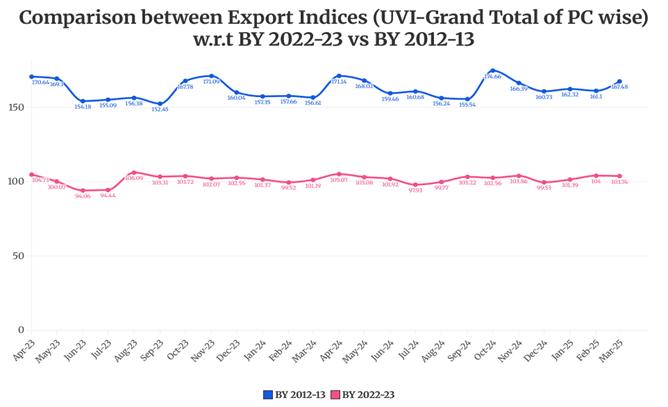
#BY means Base Year.
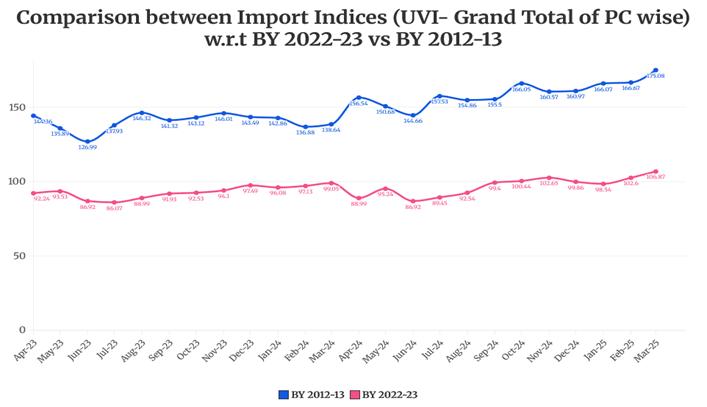
 

#BY means Base Year.

Table: Unit Value Index (UVI) and Quantity Index (QI) during FY 2025-26(Apr-Nov) using FY 2022-23 as base year


Month

Apr_25

May_25

Jun_25

1st Qtr 25-26

Jul_25

Aug_25

Sep_25

2nd Qtr 25-26

Oct_25

Nov_25

Unit Value Index

Export

105.31

99.73

96.31

100.33

99.31

100.55

104.08

101.23

103.78

105.32

Import

92.33

97.97

91.74

94.08

96.34

100.81

108.69

101.93

110.17

106.59

Quantity Index

Export

107.85

104.76

93.88

101.91

103.41

102.64

111.04

105.57

116.19

113.06

Import

138.16

126.61

112.58

125.17

122.47

124.06

126.45

124.32

137.04

121.75

Qtr  means Quarter.

Meaning and interpretation of the Indices

The Unit Value Indices and the Quantity Indices may be interpreted along the following lines.

The Unit Value Index answers the question: What is the growth in the average Unit Value of the items1 traded in the current month with respect to the same month in the Base Year?

So, an Unit Value Index of, say, 120 means that if the items that have been traded in the current month had been traded in the same month of the base year, and if the average price (or unit value) of those items had been Rs.100 in that month of the base year, then the average price (or unit value) of these items in the current month is Rs.120. Or that, there is a 20% increase in the average Unit Value, with respect to the Base Year, of the items that have been traded in the Current Month.

For example, let us suppose 30 items, 10 items each from 3 different Principal Commodities, have been traded in the current month. If these 30 items had been traded in the corresponding month of the base year at an average price of Rs.100, then the average price of these items in the current year is Rs.120.

It is to be noted that there are two successive steps of averaging done here. The first averaging is done over all the items (or ITCHS) of a PC group to arrive at the Index of that PC group. And the second averaging is done over all the PC groups to arrive at the Index at the Grand Total level for all commodities (which is the overall Index for India for a month). In both the stages, a weighted average is taken where the weights are proportional to the importance of the items and the PC groups respectively, and the Laspeyres Formula is used for averaging.

Quantity Indices, say, 200 means that if in the base year on an average 100 units were traded in India in the base year, then in the current year on an average 200 units were traded. However, it must be remembered that averaging quantities are different from averaging prices, since quantities in different units cannot be added directly.

So, the Quantity Indices are calculated by dividing the Value Indices by the Unit Value Indices. For example, if there is an increase in the Value of Export from Rs. 10,000 to Rs. 24,000, then the Value Index is 24000/10000 × 100 = 240. If the Unit Value Index is 120, then the Quantity Index comes to 240/120 × 100 = 200. So, loosely it can be said that, if the value of export has increased 2.4 times and the price of the commodities has increased 1.2 times, then the quantity must have doubled.

However, it may be noted that a very high or low Quantity Index may indicate the presence of Base Effect.

The Interpretation of the Bilateral and Regional Indices can be seen as an extension of the above.

A Unit Value Index of 120 with respect to a country, say Bangladesh, means that if all the items that have been traded with Bangladesh in the current month had been traded in the same month of the base year with the same country, and if the average price (or unit value) of those items had been Rs.100 in that month of the base year, then the average price (or unit value) of these items in the current month is Rs.120.

Similarly, a Quantity Index of 200 with respect to a country, say Bangladesh, means that if in the base year on an average 100 units were traded in India in the base year, then in the current year on an average 200 units were traded.

Comparability of the Indices across time

It is to be noted that the weights in the Index Number formula are fixed across time and there are twelve sets of weights for the twelve months. Hence, comparability of Indices is meaningful only when Indices of same month are compared across years. Different months may attach different weights to the same item, and hence comparing indices of two different months becomes vague and may have little applicability.

Further, the weights of the items that are not present in the trade basket of the current month are distributed to all the items that have been traded in the current month. This distribution is done in proportion to the weights of those items.

For example, let us suppose there are only 3 commodities for trade, say A, B and C. In month May of the Base year, let us suppose that the trade value of A was Rs. 50, B was Rs. 100 and C was Rs. 50. Then the weights assigned to A, B and C in the month of May of the following years would be in the ratio 50 :100 :50. However, in case, C is not traded in the current month, then the weight of C would be distributed proportionately among A and B, again in the ratio 1:2 (since in May the weights of A and B are in the ratio of 50 : 100, i.e., 1 : 2). So, in the current month the weights of A and B would be 3313  and 6623 .

As a result, the weights in any two given months are dependent on exactly the number of items (ITCHS codes) traded in those months. If the items traded are widely different, inference drawn from the comparison of the Indices may be done accordingly. On the other hand, more the similarity in the number of items traded more is the comparability of the two indices.

Net Terms of Trade:

Net Terms of Trade also called commodity Terms of Trade is defined as a ratio of export prices to import prices.

Let say 2022-23 be the base year and 2023-24 be the final year. We express both export and import prices in 2022-23 as 100. Now, suppose that at the end of 2023-24, it is found that the index of export prices decreased to 90 and index of import prices roses to 150. Then the Net Terms of Trade has changed to 90100150100=35 . Then terms of trade as index=35*100=60 . It implies that terms of trade of the country have decreased by about 40% in 2023-24 as compared with 2022-23. It thus shows a deterioration or a worsening of the terms of trade of the country.

If the index of export prices has risen to 150 and that of import prices had risen to 120, then the net terms of trade would have changed to 150120*100=125 . This implies an improvement in the net terms of trade of the country by 25% in 2023-24 over 2022-23.

Gross Terms of Trade:

Gross Terms of Trade is the ratio of physicalquantity of import to physical quantity of export.

Let say 2022-23 be the base year. In that year, the quantities export and import are denoted by 100. Now, suppose that in the year 2023-24, the index of quantity of import was 150 and that of quantity of export was 120. Then the gross terms of trade is given by 150100120100=54,  in terms of percentage =54*100=125 . This implies that there was an improvement of gross terms of trade by 25% in 2023-24 compared to 2022-23.

Income Terms of Trade: Income Terms of Trade is defined as- Net Terms of Trade multiplied by quantity of export.

Topics

Acts Income Tax
