

Loading...

Top
Help
×

By creating an account you can:

Logo TaxTMI
Call Us / Help / Feedback

Contact Us At :

E-mail: [email protected]

Call / WhatsApp at: +91 99117 96707

For more information, Check Contact Us

FAQs :

To know Frequently Asked Questions, Check FAQs

Most Asked Video Tutorials :

For more tutorials, Check Video Tutorials

Submit Feedback/Suggestion :

Email :
Please provide your email address so we can follow up on your feedback.
Category :
Description :
Min 15 characters 0/2000
Make Most of Text Search
  1. Checkout this video tutorial: How to search effectively on TaxTMI.
  2. Put words in double quotes for exact word search, eg: "income tax"
  3. Avoid noise words such as : 'and, of, the, a'
  4. Sort by Relevance to get the most relevant document.
  5. Press Enter to add multiple terms/multiple phrases, and then click on Search to Search.
  6. Text Search
  7. The system will try to fetch results that contains ALL your words.
  8. Once you add keywords, you'll see a new 'Search In' filter that makes your results even more precise.
  9. Text Search
Add to...
You have not created any category. Kindly create one to bookmark this item!
Create New Category
Hide
Title :
Description :
❮❮ Hide
Default View
Expand ❯❯
Close ✕
🔎 News - Adv. Search
TEXT SEARCH:

Press 'Enter' to add multiple search terms. Rules for Better Search

Search In:
Main Text + AI Text
  • Main Text
  • Main Text + AI Text
  • AI Text
Category: ?
Categorized by AI
---- All Categories ----
  • ---- All Categories ----
  • Income Tax
  • GST
  • Customs, DGFT & SEZ
  • FEMA & RBI
  • Corp. Laws, SEBI & IBC
  • PMLA, Black Money & ED
  • Budget
  • News and Press Release
  • PTI News
Month:
---- All Months ----
  • ---- All Months ----
  • January
  • February
  • March
  • April
  • May
  • June
  • July
  • August
  • September
  • October
  • November
  • December
Year:
---- All Years ----
  • ---- All Years ----
  • 2026
  • 2025
  • 2024
  • 2023
  • 2022
  • 2021
  • 2020
  • 2019
  • 2018
  • 2017
  • 2016
  • 2015
  • 2014
  • 2013
  • 2012
  • 2011
Sort By: ?
In Sort By 'Default', exact matches for text search are shown at the top, followed by the remaining results in their regular order.
Relevance Default Date
    China sets lower economic growth target of 4.5pc to 5pc for 2026 as challenges loom
    CM Naidu pushes for comprehensive Family Benefit Management System in Andhra
    Karnataka Assembly Speaker seeks probe after Aadhaar cards found on riverbank in Mangaluru
    Court denies bail to IPS officer's husband in cheating case
    Iran war posing hurdles in supply chain; industries in Sambhajinagar facing delays in export
    Qatar shuts LNG output; supplies to India hit, city gas sector flags crisis
    China's factory activity contracts for second month
    Rupee slumps 69 paise to all-time low of 92.18 against US dollar in early trade
    GST fraud racket busted in Kanpur, Rs 250 crore transactions detected; two held
    CGST Gurugram busts fake GST registration racket
    Inter-ministerial group closely monitoring developments in West Asia: Goyal
    Qatar declares force majeure, gas supplies to Indian industry cut
    India has enough oil stock to weather West Asia crisis; coverage in place for 6-8 weeks
    Debt-to-GSDP ratio down 4 pc to 44.47 pc under AAP regime, says Punjab FM Cheema
    UIDAI covers mandatory biometric update for students in over 1 lakh schools
    Modi exhorts industry to ramp up investment, focus on research to scale up manufacturing
    Terms of Reference Signed for India–Canada Comprehensive Economic Partnership Agreement
    Modi urges industry to ramp up investment, prioritise research to scale up manufacturing
    Focus on rural growth, Haryana budget proposes 'Agri Discom'; 20 pc reservation for Agniveers in state police
    West Asia crisis: Exporters seek support measures; govt ensures all facilitation
❯❯
Maximize Maximize Maximize
0 / 200
Expand Note
Add to Folder

No Folders have been created

+

Are you sure you want to delete "My most important" ?

NOTE:

News
Showing Results for :
Reset Filters
Results Found:
Show All Summaries Hide All Summaries
March 5, 2026
Show AI Summary
Economic growth target provides policy leeway amid external trade risks and domestic demand pressures.
China sets an economic growth target modestly lower than recent practice and presents it as a tool to preserve policy flexibility for structural adjustment, risk prevention, and reform in the opening year of a new five year plan. The report links the target to responses to external trade and geopolitical risks and to domestic challenges including a supply demand imbalance, while emphasising strengthening the domestic economy and promoting technology development.
March 4, 2026
Show AI Summary
Family Benefit Management System directive to build integrated household database and issue universal family cards across the state.
The administration directed creation of a Family Benefit Management System compiling twenty-six household attributes-such as family identity, Aadhaar, rice card identity, education, profession, and contact details-and integrating records from multiple public and utility sources to build a comprehensive beneficiary registry. Officials reported most data is already available and the government intends to issue a family card to every household, instructing continued interagency data integration to operationalize the system for welfare delivery.
March 4, 2026
Show AI Summary
Data protection breach: probe sought after mass discovery of identity cards, with UIDAI inquiry and legal action requested.
A data protection and public safety concern arose when a large number of Aadhaar identity cards were found on the Nethravathi riverbank, prompting the Karnataka Assembly Speaker to ask UIDAI Bengaluru for immediate intervention, a thorough investigation to determine how the cards were disposed and identify those responsible, and initiation of appropriate legal action through the concerned department.
March 4, 2026
Show AI Summary
Bail refusal upholds detention of accused amid documentary evidence and witness-influence concerns, despite prior PMLA order.
Court denied bail to an accused in a cheating conspiracy who allegedly promised plots and flats from a government quota and used forged government documents; the magistrate found the chargesheet and documentary material crystallise his role, noted the seriousness of offences and risk of witness influence, and held that filing of the chargesheet and a separate money-laundering bail order did not by themselves justify release.
March 4, 2026
Show AI Summary
Supply chain disruption delays exports from Sambhajinagar, raising transport costs and risking customer loss for manufacturers.
Supply chain disruption from the US Israel conflict has delayed containers at Jawaharlal Nehru Port Authority and suspended certain shipping services, causing longer transit times, higher transport costs, halted agricultural shipments to affected regions, and commercial risks such as customer attrition, repatriation of cargo, and potential post conflict surcharges that would raise export costs for manufacturers in Chhatrapati Sambhajinagar.
March 4, 2026
Show AI Summary
Force majeure suspends LNG deliveries, disrupting contracted supplies and straining city gas distribution and industrial feedstock.
Reciprocal force majeure notices have been issued following attacks that prevent LNG tankers transiting the Strait of Hormuz, excusing non performance by the exporter and importer and prompting the importer to issue corresponding notices to downstream offtakers; the supply shortfall has reduced contracted gas availability for industrial and city gas distribution consumers, who seek confirmation on continued allocations while market participants assess costly spot replacements and insurance exclusions for acts of war.
March 4, 2026
Show AI Summary
Tariff reduction boosts export prospects while domestic demand weakness keeps manufacturing contraction risk elevated in coming months.
China's official manufacturing PMI returned to contraction, driven by weak domestic consumption and real estate weakness, while private-sector PMI showed export-led expansion. A judicial reduction of reciprocal tariffs has lowered US tariff levels globally and is expected to provide a modest boost to exports. Upcoming high-level bilateral talks and China's national congress, which will set a growth target and approve a five-year plan focused on technology and self-reliance, are poised to influence near-term manufacturing prospects.
March 4, 2026
Show AI Summary
Currency depreciation driven by crude oil price shock and capital outflows, worsening trade balance risk and market volatility.
Rupee depreciation accelerated as a spike in international crude prices amid geopolitical tensions prompted safe-haven flows and foreign portfolio outflows, driving the currency to a record low, pressuring equity markets and raising the risk of a larger fuel import bill that could strain the trade balance and market stability.
March 3, 2026
Show AI Summary
GST input tax credit fraud exposed; arrests and shell company network identification trigger criminal and financial probes.
An organised racket used stolen identity documents to register shell firms, obtain GST numbers and open bank accounts to perform large-scale GST Input Tax Credit (ITC) fraud by issuing fake invoices and generating fraudulent e-way bills; funds were routed through multiple accounts, criminal cases for cheating and forgery filed, evidence recovered and coordination with tax authorities and banks is underway.
March 3, 2026
Show AI Summary
Fraudulent GST registrations enabling Input Tax Credit misuse uncovered; coordinated raids, electronic forensics and an arrest followed.
A large-scale operation procured GST registrations for non-existent firms through forged and fraudulently obtained KYC documents, producing fake taxpayers and fraudulent invoices that enabled the wrongful availment and passing on of Input Tax Credit; coordinated IP tracking and searches led to seizure of electronic evidence and documents and to the arrest and judicial remand of a key suspect, with further investigation ongoing.
March 3, 2026
Show AI Summary
Supply chain resilience measures initiated to monitor West Asia risks and coordinate trade, logistics and customs responses.
The government has set up an inter-ministerial group to monitor West Asia developments daily, assess vulnerabilities in shipping, logistics, exports and critical imports, and coordinate inter-ministerial actions. Measures include procedural flexibility in export authorisations, coordination with customs and port authorities to ensure smooth clearance, engagement with financial and insurance institutions to safeguard exporter interests, and a 24x7 DGFT help desk. The IMG for supply chain resilience includes departments of financial services, external affairs, shipping, petroleum and customs to facilitate coordination, monitoring and follow-up amid exporter concerns about surcharges, insurance gaps, route diversions and increased transit times.
March 3, 2026
Show AI Summary
Force majeure declaration halts key LNG deliveries, prompting contractual supply cuts and reliance on pricier spot procurement.
Qatar declared force majeure on LNG deliveries after production halted due to regional hostilities and maritime disruptions, prompting curtailed supplies to industry and relief from supplier performance obligations. Importers are assessing long term contract entitlements, pursuing spot market purchases, and reallocating available cargoes while contending with higher war risk insurance, shipping costs, and transit constraints through the Strait of Hormuz.
March 3, 2026
Show AI Summary
Fuel stock coverage ensures short-term supply continuity by using strategic reserves and diversified sourcing to mitigate disruptions.
India maintains sufficient crude and refined fuel inventories to manage short-term disruptions from West Asia hostilities, with strategic petroleum reserves and commercial stockpiles providing roughly six to eight weeks' coverage. The government has a 24x7 control room for continuous monitoring and contingency measures include drawing on strategic reserves, using commercial stocks, and diversifying sourcing from suppliers outside the Strait of Hormuz to sustain availability and affordability while managing price and freight risks.
March 3, 2026
Show AI Summary
Debt-to-GSDP reduction signals fiscal consolidation as borrowings largely went to service prior liabilities under current administration.
The administration reports a reduction in the state's debt-to-GSDP ratio from its level at the start of the term and asserts that most recent borrowings were applied to servicing legacy debt, including repayment of significant portions of past principal and interest. The Finance Minister also highlights increased mobilisation of GST and excise revenues during the current four-year period relative to prior administrations, presented as strengthening fiscal capacity.
March 3, 2026
Show AI Summary
Mandatory biometric update for children enables Aadhaar authentication for benefits, scholarships and examinations.
The UIDAI has implemented a mandatory biometric update (MBU) programme for school children aged 7-15, delivered through in-school camps and enrolment centres, with MBU made free for a limited period. Integration with UDISE+ enables identification of students due for updates and monitoring of MBU status. Initial enrolment below age five records demographic data only; fingerprints and iris biometrics are captured later via the MBU process once children reach the prescribed ages, enabling subsequent Aadhaar authentication for benefits, scholarships and examinations.
March 3, 2026
Show AI Summary
Free trade agreements prompt industry to boost investment, research, and quality to expand manufacturing exports and access markets.
India aims to use free trade agreements to expand manufacturing exports by urging industry to increase investment, adopt new technologies, and prioritise research and quality to meet global standards. The budget supports this through record capital expenditure for infrastructure and logistics, reforms in MSME classification to improve credit and technology access, and sectoral missions including the BioPharma Shakti Mission and the Carbon Capture, Utilization, and Storage Mission to boost advanced manufacturing and sustainability-linked market access.
March 3, 2026
Show AI Summary
Comprehensive Economic Partnership Agreement negotiations launched to set a negotiation framework and pursue an ambitious, balanced trade pact.
Terms of Reference for the India-Canada Comprehensive Economic Partnership Agreement establish the negotiation framework-setting format, frequency and approach-to guide talks toward an ambitious, balanced and mutually beneficial CEPA covering trade in goods, services and other mutually agreed policy areas, reflecting prior leader-level direction to advance negotiations.
March 3, 2026
Show AI Summary
Quality standards and R&D investment urged to align industry with free trade agreement opportunities and export growth.
Industry is urged to accelerate investment and prioritise research and development to meet global quality standards and fully exploit opportunities from free trade agreements; early adoption of clean technologies, including carbon capture initiatives, and expanded infrastructure and logistics spending are presented as necessary complements to enhance export readiness and supply chain resilience.
March 2, 2026
Show AI Summary
Reservation for Agniveers in police expands recruitment priority while a new Agri Discom targets uninterrupted farm power supply.
The budget creates a dedicated Haryana Agri Discom to deliver uninterrupted, reliable electricity and expedited services to all agricultural feeders and consumers, alongside biomass power projects and cropping incentives. Concurrently, it provides reserved recruitment access for returning defence personnel in the state police, forms a State Disaster Response Force with Agniveer participation, establishes an Anti Terrorist Squad under IG rank, and commits funds to rural employment guarantees, PACS reform, a Green Climate Resilience Fund, and enhanced crop compensation schemes.
March 2, 2026
Show AI Summary
Trade facilitation to protect exporters amid West Asia crisis, focusing on logistics continuity and insurer coordination.
Government coordination aims to maintain continuity of export import logistics amid the West Asia crisis by monitoring routes, capacity, surcharges and equipment availability, directing facilitative measures including procedural flexibility in export authorisations, customs coordination, engagement with financial and insurance institutions, and targeted support for time sensitive exports; exporters sought restoration of higher RoDTEP rates, restraint on insurance premium increases by ECGC, broader insurance cover and sector specific timeline relief.

News

Back

All News

Showing Results for :
Reset Filters
No Records Found

News

Back

All News

Showing Results for : Reset Filters
Customs, DGFT & SEZ

Directorate General of Commercial Intelligence and Statistics Revises Base Year of Merchandise Trade Indices to FY 2022–23 to Reflect Current Trade Structure and Global Patterns

February 21, 2026

Contents
Summary
Note

Note

-

Bookmark

Print

Print

Merchandise Trade Indices are compiled and published by the Directorate General of Commercial Intelligence and Statistics (DGCI&S), Ministry of Commerce & Industry, to measure changes in the unit values (prices) of India’s exports and imports over time. These indices serve as important indicators of external sector price movements and are widely used for economic analysis, including national accounts compilation and assessment of terms of trade. Over the years, the base year of the indices has been periodically revised to reflect structural changes in India’s trade composition and evolving global trade patterns. The most recent revision updates the base year to FY 2022–23 (2022–23 = 100), replacing the earlier base of FY 2012–13, thereby ensuring that the indices accurately represent the current structure of India’s merchandise trade.

Revision of Base Year of India’s Merchandise Trade Indices to FY 2022–23

The Directorate General of Commercial Intelligence and Statistics (DGCI&S), Ministry of Commerce & Industry, has revised the base year of India’s Merchandise Trade Indices from FY 2012–13 to FY 2022–23 (2022–23 = 100), in view of the structural changes in the economy, shifts in commodity composition, evolving trade patterns, and the need for improved alignment with contemporary macroeconomic indicators.

The revision has been undertaken on the recommendations of a committee constituted by DGCI&S under the Chairmanship of Prof. Nachiketa Chattopadhyay, Professor, Indian Statistical Institute, Kolkata. The Committee examined the existing methodology, data coverage, weighting structure, and compilation practices, and recommended suitable refinements in line with international best practices.

Key Features of the Revised Series (Base: FY 2022–23)

  1. Updated Base Year:
    The new base year FY 2022–23 makes the Indices reflect the current structure of India’s external trade more accurately.
  2. Revised Commodity Basket:
    The coverage and classification of commodities have been reviewed at the Principal Commodity level to better capture emerging and declining trade items.
  3. Revised Weighting Structure:
    Weights have been updated based on trade values of the new base year to reflect the latest value shares in exports and imports.
  4. Improved Methodology:
    Methodological refinements have been introduced in:
    1. Selection of common commodity basket for base year selection (procedure of selection for common commodity basket explained in detail report of the committee).
    2. Treatment of missing unit values (Imputation of missing unit values in base year selection have been explained in detail in the committee report).
  5. Indices Compiled:
    The revised series includes:
    1. Monthly, Quarterly and Annual Indices (Export Unit Value Index,Import Unit Value Index).
    2. Principal Commodity (PC) Classification wise Trade Indices (Export/Import).
    3. Standard International Trade Classification-wise (SITC) Trade Indices.
    4. Broad economic categories-wise (BEC) Trade Indices.
    5. Bilateral and Region-wise Trade Indices of Top 20 Export and Import partner nations of India.
    6. Terms of Trade (Gross terms of trade, Net terms of trade and Income terms of trade).

Rationale for Revision

Over the past decade, India’s trade basket has undergone substantial changes due to emergence of new commodities, technological advancements, Global supply chain restructuring and changes in relative price structures.

The earlier base year (FY 2012–13) no longer adequately reflected the prevailing trade structure. The revision ensures improved relevance, reliability, and analytical usefulness of the Merchandise Trade Indices for policymakers, researchers, and other stakeholders.

Use of the Revised Series

Merchandise Trade Indices compiled by the Directorate General of Commercial Intelligence and Statistics (DGCI&S) are extensively used by key government institutions for economic analysis and policy formulation. The National Accounts Division (NAD) of the Ministry of Statistics and Programme Implementation uses the Export and Import Unit Value Indices as deflators for estimating real exports and imports in GDP compilation. The Reserve Bank of India (RBI) relies on these indices for external sector assessment, balance of payments analysis, and evaluation of price competitiveness. Various Ministries and Government agencies also use them to frame and review trade-related policies and to assess movements in international prices. In addition, academic institutions, research organizations, and economic analysts utilize Merchandise Trade Indices for empirical research, modelling, and analysis of trade dynamics and terms of trade trendson and economic research.

Availability of Data

The revised Merchandise Trade Indices (Base: FY 2022–23) will be released on the official website of DGCI&S. Detailed methodological documentation is available in the Report of the Committee on Revision of Base Year for Merchandise Trade Indices.

Comparison of the new revised Indices (Base Year: 2022-23) with the already released Indices (Base Year : 2012-13) for 2022-23 and 2023-24 is given below.
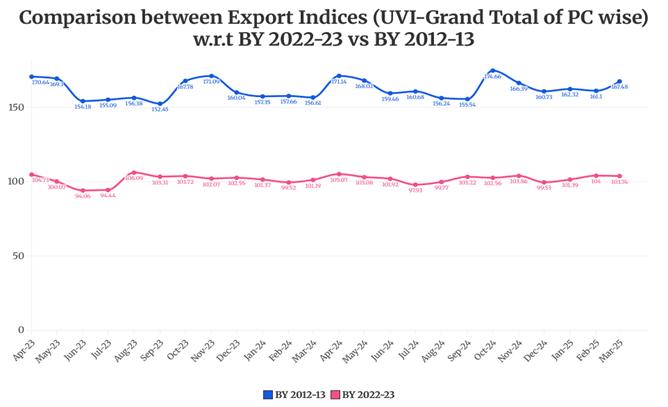
#BY means Base Year.
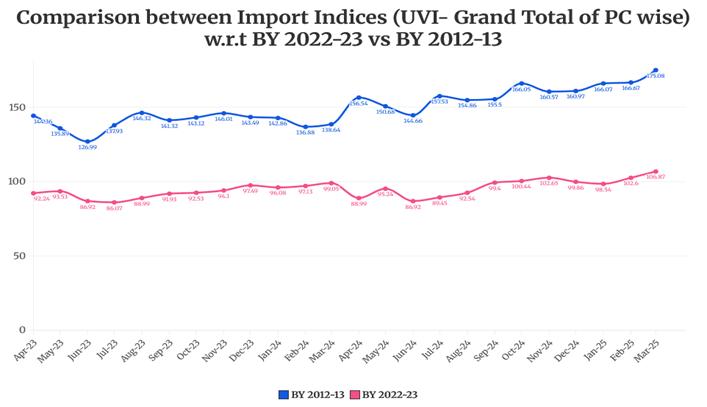
 

#BY means Base Year.

Table: Unit Value Index (UVI) and Quantity Index (QI) during FY 2025-26(Apr-Nov) using FY 2022-23 as base year


Month

Apr_25

May_25

Jun_25

1st Qtr 25-26

Jul_25

Aug_25

Sep_25

2nd Qtr 25-26

Oct_25

Nov_25

Unit Value Index

Export

105.31

99.73

96.31

100.33

99.31

100.55

104.08

101.23

103.78

105.32

Import

92.33

97.97

91.74

94.08

96.34

100.81

108.69

101.93

110.17

106.59

Quantity Index

Export

107.85

104.76

93.88

101.91

103.41

102.64

111.04

105.57

116.19

113.06

Import

138.16

126.61

112.58

125.17

122.47

124.06

126.45

124.32

137.04

121.75

Qtr  means Quarter.

Meaning and interpretation of the Indices

The Unit Value Indices and the Quantity Indices may be interpreted along the following lines.

The Unit Value Index answers the question: What is the growth in the average Unit Value of the items1 traded in the current month with respect to the same month in the Base Year?

So, an Unit Value Index of, say, 120 means that if the items that have been traded in the current month had been traded in the same month of the base year, and if the average price (or unit value) of those items had been Rs.100 in that month of the base year, then the average price (or unit value) of these items in the current month is Rs.120. Or that, there is a 20% increase in the average Unit Value, with respect to the Base Year, of the items that have been traded in the Current Month.

For example, let us suppose 30 items, 10 items each from 3 different Principal Commodities, have been traded in the current month. If these 30 items had been traded in the corresponding month of the base year at an average price of Rs.100, then the average price of these items in the current year is Rs.120.

It is to be noted that there are two successive steps of averaging done here. The first averaging is done over all the items (or ITCHS) of a PC group to arrive at the Index of that PC group. And the second averaging is done over all the PC groups to arrive at the Index at the Grand Total level for all commodities (which is the overall Index for India for a month). In both the stages, a weighted average is taken where the weights are proportional to the importance of the items and the PC groups respectively, and the Laspeyres Formula is used for averaging.

Quantity Indices, say, 200 means that if in the base year on an average 100 units were traded in India in the base year, then in the current year on an average 200 units were traded. However, it must be remembered that averaging quantities are different from averaging prices, since quantities in different units cannot be added directly.

So, the Quantity Indices are calculated by dividing the Value Indices by the Unit Value Indices. For example, if there is an increase in the Value of Export from Rs. 10,000 to Rs. 24,000, then the Value Index is 24000/10000 × 100 = 240. If the Unit Value Index is 120, then the Quantity Index comes to 240/120 × 100 = 200. So, loosely it can be said that, if the value of export has increased 2.4 times and the price of the commodities has increased 1.2 times, then the quantity must have doubled.

However, it may be noted that a very high or low Quantity Index may indicate the presence of Base Effect.

The Interpretation of the Bilateral and Regional Indices can be seen as an extension of the above.

A Unit Value Index of 120 with respect to a country, say Bangladesh, means that if all the items that have been traded with Bangladesh in the current month had been traded in the same month of the base year with the same country, and if the average price (or unit value) of those items had been Rs.100 in that month of the base year, then the average price (or unit value) of these items in the current month is Rs.120.

Similarly, a Quantity Index of 200 with respect to a country, say Bangladesh, means that if in the base year on an average 100 units were traded in India in the base year, then in the current year on an average 200 units were traded.

Comparability of the Indices across time

It is to be noted that the weights in the Index Number formula are fixed across time and there are twelve sets of weights for the twelve months. Hence, comparability of Indices is meaningful only when Indices of same month are compared across years. Different months may attach different weights to the same item, and hence comparing indices of two different months becomes vague and may have little applicability.

Further, the weights of the items that are not present in the trade basket of the current month are distributed to all the items that have been traded in the current month. This distribution is done in proportion to the weights of those items.

For example, let us suppose there are only 3 commodities for trade, say A, B and C. In month May of the Base year, let us suppose that the trade value of A was Rs. 50, B was Rs. 100 and C was Rs. 50. Then the weights assigned to A, B and C in the month of May of the following years would be in the ratio 50 :100 :50. However, in case, C is not traded in the current month, then the weight of C would be distributed proportionately among A and B, again in the ratio 1:2 (since in May the weights of A and B are in the ratio of 50 : 100, i.e., 1 : 2). So, in the current month the weights of A and B would be 3313  and 6623 .

As a result, the weights in any two given months are dependent on exactly the number of items (ITCHS codes) traded in those months. If the items traded are widely different, inference drawn from the comparison of the Indices may be done accordingly. On the other hand, more the similarity in the number of items traded more is the comparability of the two indices.

Net Terms of Trade:

Net Terms of Trade also called commodity Terms of Trade is defined as a ratio of export prices to import prices.

Let say 2022-23 be the base year and 2023-24 be the final year. We express both export and import prices in 2022-23 as 100. Now, suppose that at the end of 2023-24, it is found that the index of export prices decreased to 90 and index of import prices roses to 150. Then the Net Terms of Trade has changed to 90100150100=35 . Then terms of trade as index=35*100=60 . It implies that terms of trade of the country have decreased by about 40% in 2023-24 as compared with 2022-23. It thus shows a deterioration or a worsening of the terms of trade of the country.

If the index of export prices has risen to 150 and that of import prices had risen to 120, then the net terms of trade would have changed to 150120*100=125 . This implies an improvement in the net terms of trade of the country by 25% in 2023-24 over 2022-23.

Gross Terms of Trade:

Gross Terms of Trade is the ratio of physicalquantity of import to physical quantity of export.

Let say 2022-23 be the base year. In that year, the quantities export and import are denoted by 100. Now, suppose that in the year 2023-24, the index of quantity of import was 150 and that of quantity of export was 120. Then the gross terms of trade is given by 150100120100=54,  in terms of percentage =54*100=125 . This implies that there was an improvement of gross terms of trade by 25% in 2023-24 compared to 2022-23.

Income Terms of Trade: Income Terms of Trade is defined as- Net Terms of Trade multiplied by quantity of export.

Topics

Acts Income Tax