

Loading...

Top
Help
×

By creating an account you can:

Logo TaxTMI
Call Us / Help / Feedback

Contact Us At :

E-mail: [email protected]

Call / WhatsApp at: +91 99117 96707

For more information, Check Contact Us

FAQs :

To know Frequently Asked Questions, Check FAQs

Most Asked Video Tutorials :

For more tutorials, Check Video Tutorials

Submit Feedback/Suggestion :

Email :
Please provide your email address so we can follow up on your feedback.
Category :
Description :
Min 15 characters 0/2000
Make Most of Text Search
  1. Checkout this video tutorial: How to search effectively on TaxTMI.
  2. Put words in double quotes for exact word search, eg: "income tax"
  3. Avoid noise words such as : 'and, of, the, a'
  4. Sort by Relevance to get the most relevant document.
  5. Press Enter to add multiple terms/multiple phrases, and then click on Search to Search.
  6. Text Search
  7. The system will try to fetch results that contains ALL your words.
  8. Once you add keywords, you'll see a new 'Search In' filter that makes your results even more precise.
  9. Text Search
Add to...
You have not created any category. Kindly create one to bookmark this item!
Create New Category
Hide
Title :
Description :
❮❮ Hide
Default View
Expand ❯❯
Close ✕
🔎 News - Adv. Search
TEXT SEARCH:

Press 'Enter' to add multiple search terms. Rules for Better Search

Search In:
Main Text + AI Text
  • Main Text
  • Main Text + AI Text
  • AI Text
Category: ?
Categorized by AI
---- All Categories ----
  • ---- All Categories ----
  • Income Tax
  • GST
  • Customs, DGFT & SEZ
  • FEMA & RBI
  • Corp. Laws, SEBI & IBC
  • PMLA, Black Money & ED
  • Budget
  • News and Press Release
  • PTI News
Month:
---- All Months ----
  • ---- All Months ----
  • January
  • February
  • March
  • April
  • May
  • June
  • July
  • August
  • September
  • October
  • November
  • December
Year:
---- All Years ----
  • ---- All Years ----
  • 2026
  • 2025
  • 2024
  • 2023
  • 2022
  • 2021
  • 2020
  • 2019
  • 2018
  • 2017
  • 2016
  • 2015
  • 2014
  • 2013
  • 2012
  • 2011
Sort By: ?
In Sort By 'Default', exact matches for text search are shown at the top, followed by the remaining results in their regular order.
Relevance Default Date
    India seeks US cover for Middle East energy cargoes: Source
    Tension over Strait of Hormuz threatens India's tea exports to Gulf markets
    Applications Are Open for ClimateLaunchpad, the World’s Largest Green Business Ideas Competition
    Clear downward pressures on China's GDP growth, but nothing for India to celebrate: Cong
    Policy Reforms That Transformed Business Environment.
    IICA Hosts “Meet the Legend” Session for PGIP Cohort on GST and PMLA–IBC Interplay.
    From Chennai Super Kings (CSK) to Clean Mobility and ZGolf: Zaggle Broadens its Enterprise and Ecosystem Strategy
    Rupee rebounds from lowest level to settle 45 paise higher at 91.60 against US dollar
    NelsonHall Recognizes LTM as a Leader in GenAI & Process Automation for Banking
    Pak considering weekly petroleum price revision, mandatory work from home to ‘keep markets liquid’
    Russia always ready to supply crude oil to India: Envoy
    IVCA Conclave 2026 Marks 15 Years of Shaping India's Alternate Capital Ecosystem
    i-exceed Technology Solutions Headlines IFIF 2026 as Principal Partner
    GHR Lakshmi Urbanblocks LLP Takes Top Honour by Winning Realty+'Developer of the Year – Residential' Award 2026
    7th India–Japan CEPA Joint Committee Meeting Held in Tokyo; Secretary, Department of Commerce Shri Rajesh Agrawal Co-Chairs Discussions.
    CCI approves acquisition of additional shareholding in Generali Central Insurance Company and Generali Central Life Insurance by Central Bank of India...
    CCI approves acquisition of certain shareholding in Balaji Wafers by General Atlantic Singapore BWP Pte.
    CCI approves proposed combination inter alia involving acquisition of certain stake by Bagmane Prime Office REIT of Bagmane Developers and others.
    Aye Finance pilots Generative AI model for image-based underwriting of trading businesses
    China lowers economic growth target to 4.5-5 pc amid global, domestic uncertainties
❯❯
Maximize Maximize Maximize
0 / 200
Expand Note
Add to Folder

No Folders have been created

+

Are you sure you want to delete "My most important" ?

NOTE:

News
Showing Results for :
Reset Filters
Results Found:
Show All Summaries Hide All Summaries
March 5, 2026
Show AI Summary
Political risk insurance sought to secure maritime energy shipments, with premiums borne by contracting parties to maintain supply continuity.
India is seeking political risk insurance and financial guarantees from the International Development Finance Corporation to secure maritime transit for oil, LPG and LNG through the Strait of Hormuz; a dedicated corpus must be established before cover can be provided and premiums will be paid by contracting parties. The government is also diversifying suppliers and considering reprioritisation of domestic gas allocation to manage LNG shortfalls caused by route disruption and force majeure.
March 5, 2026
Show AI Summary
Trade disruption risk from Strait closure threatens Indian tea exports and underscores maritime chokepoint vulnerability.
Escalating tensions in West Asia threaten India's tea exports by imperilling shipping through the Strait of Hormuz, a key maritime chokepoint for consignments to Gulf markets. A substantial share of Indian tea shipments to the Persian Gulf - notably consignments to the UAE, Iran and Iraq - transit this route, making export flows sensitive to any closure or suspension of passage. The Tea Association of India emphasises that recent export growth, driven by orthodox teas from Assam, is concentrated in markets served via the strait, increasing sectoral exposure to disruption.
March 5, 2026
Show AI Summary
Climate innovation competition expands to Asia, with Singapore hosting finals and partners supporting early-stage green ventures.
Applications are open for ClimateLaunchpad 2026, which expands into Asia with Singapore hosting regional and Global Grand Finals. The programme offers a staged accelerator curriculum-mini-course, Boot Camp, coaching, national/regional pitches and a Global Grand Final-aimed at turning early-stage climate ideas into scalable ventures. Climate KIC partners with Better Earth Ventures and TPC/NO.17 Foundation to provide local delivery, systems-oriented support, capital linkage and ecosystem access, while long-term supporters such as Bank of America and Irish Aid bolster funding and market connectivity.
March 5, 2026
Show AI Summary
Economic growth slowdown signals structural pressures; export strength and trade surplus reshape bilateral trade imbalances and strategy.
China's lowered GDP target signals slower, quality oriented growth due to structural domestic constraints - notably property market decline, unemployment and weak consumption - while policy focuses on technological innovation to raise productivity. At the same time, robust exports sustain a record trade surplus, producing rising bilateral trade imbalances as export strength contrasts with domestic weakness.
March 5, 2026
Show AI Summary
Ease of doing business reforms streamline compliance, expand credit access, modernise customs and simplify tax certainty for investors.
The Union Budget 2026-27 and related policy measures present a coordinated reform package to enhance ease of doing business by reducing compliance complexity, improving tax certainty and rationalising penalties, expanding access to finance through credit guarantee schemes and a digital Credit Assessment Model, liberalising insurance sector investment norms, modernising customs and trade facilitation with AEO benefits and electronic cargo clearances, and consolidating regulatory frameworks including master directions and a unified securities code to improve predictability and transparency.
March 5, 2026
Show AI Summary
GST-IBC interplay clarifies tax compliance and moratorium effects on statutory claims during insolvency resolution.
Interplay between GST and insolvency law addressed tax liability treatment, compliance by interim administrators and resolution professionals (fresh registration, return filing, availability of input tax credit), and the moratorium's effect on recovery; judicial authority was noted that claims not included in approved resolution plans may be extinguished. The relationship between insolvency processes and anti money laundering enforcement was examined, focusing on proceeds of crime, asset attachment during CIRP, jurisdictional friction with enforcement agencies, and statutory protections designed to preserve resolution objectives while reconciling PMLA enforcement with insolvency aims.
March 5, 2026
Show AI Summary
Governance-first fintech infrastructure expands via enterprise expense cards, closed-loop clean mobility payments and premium leadership engagement.
Zaggle is shifting toward a governance-first fintech infrastructure model by integrating Corporate Expense Cards with its Spend Management Platform for marquee enterprises, deploying a closed-loop CNG fleet payment solution aligned with clean-mobility regulatory and operational requirements, and expanding premium engagement through its ZGolf leadership platform. These platform-led integrations prioritise real-time visibility, structured controls, compliance alignment and recurring enterprise wallet share rather than standalone transactions.
March 5, 2026
Show AI Summary
RBI intervention stabilizes rupee amid strong dollar, rising crude and foreign fund outflows constraining gains.
Reports of Reserve Bank intervention supported a rebound in the rupee, with domestic equity buying also contributing; however, a strong dollar, rising crude oil prices and foreign institutional outflows continued to limit gains and pose downside risk to the currency and India's import bill.
March 5, 2026
Show AI Summary
AI governance and process automation recognized for enabling responsible, scalable GenAI deployments and compliance improvements in banking.
LTM is recognized as a Leader in NelsonHall's NEAT Evaluation for GenAI & Process Automation in Banking based on its industry experience, investments in GenAI and agentic AI, and its BlueVerseTM platform. The platform supplies modular, composable agentic solutions and digital agents across banking segments, together with pre-built industry-specific AI agents, AI-enabled compliance and risk-monitoring tools, proprietary IP, partnerships, and AI governance to enable rapid, responsible deployment of AI for compliance, personalization, payments, and operational efficiency.
March 5, 2026
Show AI Summary
Weekly petroleum price revision to preserve market liquidity and compensate fuel suppliers amid supply-route disruptions.
The government proposes immediate measures to keep markets liquid after Strait of Hormuz disruptions by shifting to weekly petroleum price revision, establishing a mechanism to compensate OMCs and refineries for surged insurance, freight and import premiums, and directing PSO to tender imports outside the Strait. Regulators will temporarily ration supplies to dealers and retailers based on an eight month sales track record to discourage hoarding, while considering mandatory work from home and alternative routing to maintain supply continuity.
March 5, 2026
Show AI Summary
Energy security: Russia offers crude while India diversifies imports amid regional instability and external trade monitoring.
Russia affirms willingness to supply crude to India as West Asia instability and Strait of Hormuz disruptions threaten energy security. The article links recent military escalations to surging global prices, notes a fall in India's Russian oil purchases, and reports U.S. executive measures tying tariff relief to monitoring of India's Russian oil procurement. India emphasizes supplier diversification and protecting national interests in its procurement strategy.
March 5, 2026
Show AI Summary
Regulatory frameworks evolving to support long-term value creation, prompting stronger governance and deeper domestic capital participation.
The IVCA Conclave 2026 focuses on aligning evolving regulatory frameworks and stronger governance standards with deeper domestic capital participation to support long-term value creation. Industry leaders, institutional allocators, and regulators will examine AIF growth, fund governance, liquidity pathways, and capital allocation priorities, with an emphasis on institutionalizing compliance and reporting practices that enable disciplined deployment and diversified exit mechanisms in India's alternate capital ecosystem.
March 5, 2026
Show AI Summary
Inclusive finance expansion catalyses cooperative bank modernisation and AI-driven institutional transformation at national finance forum.
i-exceed Technology Solutions is Principal Partner of a national forum convening regulators, ministries, and financial stakeholders to accelerate inclusive finance, cooperative bank modernisation, and the emergence of AI-led financial institutions through three tracks focusing on cooperative banking, MSME capital access, and future AI-native systemic resilience, emphasising embedded finance, assisted banking models, and secure, scalable digital infrastructure to deepen credit access for underserved populations.
March 5, 2026
Show AI Summary
RERA approval and statutory permits underpin award-winning residential project, emphasising sustainability, wellness certification, and compliance.
The Cascades Neopolis carries RERA approval (TS RERA No: P02400009538) and HMDA building permission (No: 003505/BP/HMDA/0728/SKP/2024); it emphasizes construction commencement, a planned handover timeline, and industry certifications-IGBC Platinum pre-certification and WELL Pre-Certification-as key compliance and performance credentials relied upon for award assessment and execution-readiness.
March 5, 2026
Show AI Summary
Comprehensive Economic Partnership Agreement promotes diversified trade and investment, enhancing tariff certainty and regulatory predictability.
The Comprehensive Economic Partnership Agreement was reviewed with focus on implementation, using the Agreement to secure tariff certainty and regulatory predictability, facilitate movement of natural persons, and promote diversification of bilateral trade. Officials highlighted export potential in textiles, pharmaceuticals, agriculture and services and underlined domestic measures to improve ease of doing business that complement CEPA's facilitative framework for deeper trade and investment cooperation.
March 5, 2026
Show AI Summary
Combination approval permits Central Bank of India to increase shareholding in Generali insurers, subject to a regulatory order.
The Competition Commission has granted combination approval for Central Bank of India to increase its equity stakes in Generali Central Insurance Company Limited (general insurance) and Generali Central Life Insurance Company Limited (life insurance), expanding the bank's ownership in entities that supply distinct insurance products in India; a detailed Commission order will follow.
March 5, 2026
Show AI Summary
Merger control approval permits an investment firm to acquire shareholding in a national packaged foods manufacturer.
The Competition Commission of India approved the acquisition whereby General Atlantic Singapore BWP Pte. Ltd. will acquire certain fully diluted shareholding in Balaji Wafers Private Limited from existing shareholders, clearing the notified combination under the merger control framework; a detailed order will follow.
March 5, 2026
Show AI Summary
Combination approval: REIT to acquire developers and issue units in exchange for target shareholdings.
The Commission approved a proposed combination where Bagmane Prime Office REIT will directly acquire Bagmane Developers Private Limited (including Bagmane Green Power LLP), indirectly acquire Bagmane Rio Private Limited and, through BDPL, acquire the Luxor asset from Bagmane Constructions; Sponsor and certain third party shareholders will receive units of the Acquirer REIT in consideration for transfer of their shareholdings. The Acquirer REIT is SEBI registered and the Target Entities operate in commercial real estate, hospitality and renewable power generation.
March 5, 2026
Show AI Summary
Image-based underwriting using Generative AI standardizes income estimation and speeds credit decisions in underserved micro enterprise markets.
Aye Finance piloted an in house system using Generative AI and ML-including a Multimodal Large Language Model integrated with proprietary models-to estimate monthly sales of trading stores from store images and related parameters, automating income estimation to reduce manual fieldwork, lower cost to serve, increase processing speed, and standardise underwriting, thereby facilitating credit inclusion for micro scale MSMEs.
March 5, 2026
Show AI Summary
Economic growth target lowered to prioritise consumption, jobs and fiscal measures amid global and domestic uncertainties.
China reduced its economic growth target and set accompanying macro targets-including urban unemployment, urban job creation, CPI moderation, income growth alignment, balance of payments stability, steady grain output, and lower carbon emissions intensity-while announcing demand-side fiscal measures: an income-growth plan, targeted support for low-income groups and property income, reforms to remuneration and social security, issuance of special treasury bonds for consumer trade-in schemes, and a fiscal-financial coordination fund to expand domestic consumption.

News

Back

All News

Showing Results for :
Reset Filters
No Records Found

News

Back

All News

Showing Results for : Reset Filters
Customs, DGFT & SEZ

Directorate General of Commercial Intelligence and Statistics Revises Base Year of Merchandise Trade Indices to FY 2022–23 to Reflect Current Trade Structure and Global Patterns

February 21, 2026

Contents
Summary
Note

Note

-

Bookmark

Print

Print

Merchandise Trade Indices are compiled and published by the Directorate General of Commercial Intelligence and Statistics (DGCI&S), Ministry of Commerce & Industry, to measure changes in the unit values (prices) of India’s exports and imports over time. These indices serve as important indicators of external sector price movements and are widely used for economic analysis, including national accounts compilation and assessment of terms of trade. Over the years, the base year of the indices has been periodically revised to reflect structural changes in India’s trade composition and evolving global trade patterns. The most recent revision updates the base year to FY 2022–23 (2022–23 = 100), replacing the earlier base of FY 2012–13, thereby ensuring that the indices accurately represent the current structure of India’s merchandise trade.

Revision of Base Year of India’s Merchandise Trade Indices to FY 2022–23

The Directorate General of Commercial Intelligence and Statistics (DGCI&S), Ministry of Commerce & Industry, has revised the base year of India’s Merchandise Trade Indices from FY 2012–13 to FY 2022–23 (2022–23 = 100), in view of the structural changes in the economy, shifts in commodity composition, evolving trade patterns, and the need for improved alignment with contemporary macroeconomic indicators.

The revision has been undertaken on the recommendations of a committee constituted by DGCI&S under the Chairmanship of Prof. Nachiketa Chattopadhyay, Professor, Indian Statistical Institute, Kolkata. The Committee examined the existing methodology, data coverage, weighting structure, and compilation practices, and recommended suitable refinements in line with international best practices.

Key Features of the Revised Series (Base: FY 2022–23)

  1. Updated Base Year:
    The new base year FY 2022–23 makes the Indices reflect the current structure of India’s external trade more accurately.
  2. Revised Commodity Basket:
    The coverage and classification of commodities have been reviewed at the Principal Commodity level to better capture emerging and declining trade items.
  3. Revised Weighting Structure:
    Weights have been updated based on trade values of the new base year to reflect the latest value shares in exports and imports.
  4. Improved Methodology:
    Methodological refinements have been introduced in:
    1. Selection of common commodity basket for base year selection (procedure of selection for common commodity basket explained in detail report of the committee).
    2. Treatment of missing unit values (Imputation of missing unit values in base year selection have been explained in detail in the committee report).
  5. Indices Compiled:
    The revised series includes:
    1. Monthly, Quarterly and Annual Indices (Export Unit Value Index,Import Unit Value Index).
    2. Principal Commodity (PC) Classification wise Trade Indices (Export/Import).
    3. Standard International Trade Classification-wise (SITC) Trade Indices.
    4. Broad economic categories-wise (BEC) Trade Indices.
    5. Bilateral and Region-wise Trade Indices of Top 20 Export and Import partner nations of India.
    6. Terms of Trade (Gross terms of trade, Net terms of trade and Income terms of trade).

Rationale for Revision

Over the past decade, India’s trade basket has undergone substantial changes due to emergence of new commodities, technological advancements, Global supply chain restructuring and changes in relative price structures.

The earlier base year (FY 2012–13) no longer adequately reflected the prevailing trade structure. The revision ensures improved relevance, reliability, and analytical usefulness of the Merchandise Trade Indices for policymakers, researchers, and other stakeholders.

Use of the Revised Series

Merchandise Trade Indices compiled by the Directorate General of Commercial Intelligence and Statistics (DGCI&S) are extensively used by key government institutions for economic analysis and policy formulation. The National Accounts Division (NAD) of the Ministry of Statistics and Programme Implementation uses the Export and Import Unit Value Indices as deflators for estimating real exports and imports in GDP compilation. The Reserve Bank of India (RBI) relies on these indices for external sector assessment, balance of payments analysis, and evaluation of price competitiveness. Various Ministries and Government agencies also use them to frame and review trade-related policies and to assess movements in international prices. In addition, academic institutions, research organizations, and economic analysts utilize Merchandise Trade Indices for empirical research, modelling, and analysis of trade dynamics and terms of trade trendson and economic research.

Availability of Data

The revised Merchandise Trade Indices (Base: FY 2022–23) will be released on the official website of DGCI&S. Detailed methodological documentation is available in the Report of the Committee on Revision of Base Year for Merchandise Trade Indices.

Comparison of the new revised Indices (Base Year: 2022-23) with the already released Indices (Base Year : 2012-13) for 2022-23 and 2023-24 is given below.
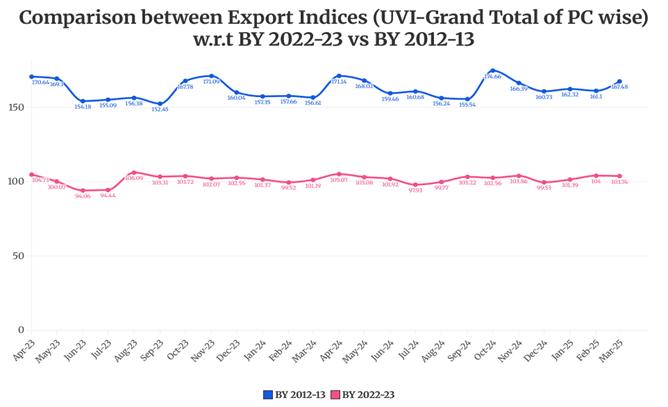
#BY means Base Year.
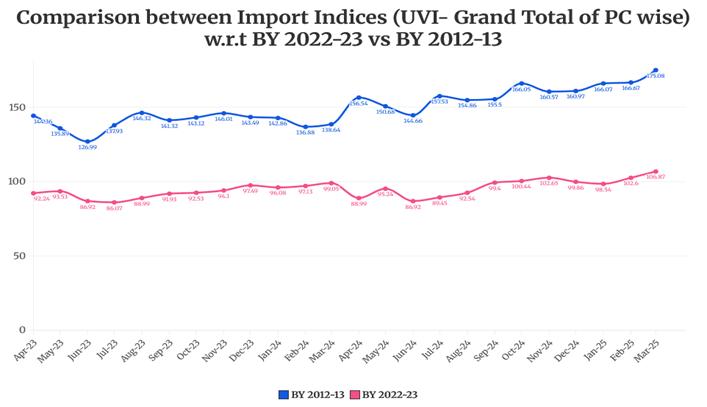
 

#BY means Base Year.

Table: Unit Value Index (UVI) and Quantity Index (QI) during FY 2025-26(Apr-Nov) using FY 2022-23 as base year


Month

Apr_25

May_25

Jun_25

1st Qtr 25-26

Jul_25

Aug_25

Sep_25

2nd Qtr 25-26

Oct_25

Nov_25

Unit Value Index

Export

105.31

99.73

96.31

100.33

99.31

100.55

104.08

101.23

103.78

105.32

Import

92.33

97.97

91.74

94.08

96.34

100.81

108.69

101.93

110.17

106.59

Quantity Index

Export

107.85

104.76

93.88

101.91

103.41

102.64

111.04

105.57

116.19

113.06

Import

138.16

126.61

112.58

125.17

122.47

124.06

126.45

124.32

137.04

121.75

Qtr  means Quarter.

Meaning and interpretation of the Indices

The Unit Value Indices and the Quantity Indices may be interpreted along the following lines.

The Unit Value Index answers the question: What is the growth in the average Unit Value of the items1 traded in the current month with respect to the same month in the Base Year?

So, an Unit Value Index of, say, 120 means that if the items that have been traded in the current month had been traded in the same month of the base year, and if the average price (or unit value) of those items had been Rs.100 in that month of the base year, then the average price (or unit value) of these items in the current month is Rs.120. Or that, there is a 20% increase in the average Unit Value, with respect to the Base Year, of the items that have been traded in the Current Month.

For example, let us suppose 30 items, 10 items each from 3 different Principal Commodities, have been traded in the current month. If these 30 items had been traded in the corresponding month of the base year at an average price of Rs.100, then the average price of these items in the current year is Rs.120.

It is to be noted that there are two successive steps of averaging done here. The first averaging is done over all the items (or ITCHS) of a PC group to arrive at the Index of that PC group. And the second averaging is done over all the PC groups to arrive at the Index at the Grand Total level for all commodities (which is the overall Index for India for a month). In both the stages, a weighted average is taken where the weights are proportional to the importance of the items and the PC groups respectively, and the Laspeyres Formula is used for averaging.

Quantity Indices, say, 200 means that if in the base year on an average 100 units were traded in India in the base year, then in the current year on an average 200 units were traded. However, it must be remembered that averaging quantities are different from averaging prices, since quantities in different units cannot be added directly.

So, the Quantity Indices are calculated by dividing the Value Indices by the Unit Value Indices. For example, if there is an increase in the Value of Export from Rs. 10,000 to Rs. 24,000, then the Value Index is 24000/10000 × 100 = 240. If the Unit Value Index is 120, then the Quantity Index comes to 240/120 × 100 = 200. So, loosely it can be said that, if the value of export has increased 2.4 times and the price of the commodities has increased 1.2 times, then the quantity must have doubled.

However, it may be noted that a very high or low Quantity Index may indicate the presence of Base Effect.

The Interpretation of the Bilateral and Regional Indices can be seen as an extension of the above.

A Unit Value Index of 120 with respect to a country, say Bangladesh, means that if all the items that have been traded with Bangladesh in the current month had been traded in the same month of the base year with the same country, and if the average price (or unit value) of those items had been Rs.100 in that month of the base year, then the average price (or unit value) of these items in the current month is Rs.120.

Similarly, a Quantity Index of 200 with respect to a country, say Bangladesh, means that if in the base year on an average 100 units were traded in India in the base year, then in the current year on an average 200 units were traded.

Comparability of the Indices across time

It is to be noted that the weights in the Index Number formula are fixed across time and there are twelve sets of weights for the twelve months. Hence, comparability of Indices is meaningful only when Indices of same month are compared across years. Different months may attach different weights to the same item, and hence comparing indices of two different months becomes vague and may have little applicability.

Further, the weights of the items that are not present in the trade basket of the current month are distributed to all the items that have been traded in the current month. This distribution is done in proportion to the weights of those items.

For example, let us suppose there are only 3 commodities for trade, say A, B and C. In month May of the Base year, let us suppose that the trade value of A was Rs. 50, B was Rs. 100 and C was Rs. 50. Then the weights assigned to A, B and C in the month of May of the following years would be in the ratio 50 :100 :50. However, in case, C is not traded in the current month, then the weight of C would be distributed proportionately among A and B, again in the ratio 1:2 (since in May the weights of A and B are in the ratio of 50 : 100, i.e., 1 : 2). So, in the current month the weights of A and B would be 3313  and 6623 .

As a result, the weights in any two given months are dependent on exactly the number of items (ITCHS codes) traded in those months. If the items traded are widely different, inference drawn from the comparison of the Indices may be done accordingly. On the other hand, more the similarity in the number of items traded more is the comparability of the two indices.

Net Terms of Trade:

Net Terms of Trade also called commodity Terms of Trade is defined as a ratio of export prices to import prices.

Let say 2022-23 be the base year and 2023-24 be the final year. We express both export and import prices in 2022-23 as 100. Now, suppose that at the end of 2023-24, it is found that the index of export prices decreased to 90 and index of import prices roses to 150. Then the Net Terms of Trade has changed to 90100150100=35 . Then terms of trade as index=35*100=60 . It implies that terms of trade of the country have decreased by about 40% in 2023-24 as compared with 2022-23. It thus shows a deterioration or a worsening of the terms of trade of the country.

If the index of export prices has risen to 150 and that of import prices had risen to 120, then the net terms of trade would have changed to 150120*100=125 . This implies an improvement in the net terms of trade of the country by 25% in 2023-24 over 2022-23.

Gross Terms of Trade:

Gross Terms of Trade is the ratio of physicalquantity of import to physical quantity of export.

Let say 2022-23 be the base year. In that year, the quantities export and import are denoted by 100. Now, suppose that in the year 2023-24, the index of quantity of import was 150 and that of quantity of export was 120. Then the gross terms of trade is given by 150100120100=54,  in terms of percentage =54*100=125 . This implies that there was an improvement of gross terms of trade by 25% in 2023-24 compared to 2022-23.

Income Terms of Trade: Income Terms of Trade is defined as- Net Terms of Trade multiplied by quantity of export.

Topics

Acts Income Tax