

Loading...

Top
Help
×

By creating an account you can:

Logo TaxTMI
Call Us / Help / Feedback

Contact Us At :

E-mail: [email protected]

Call / WhatsApp at: +91 99117 96707

For more information, Check Contact Us

FAQs :

To know Frequently Asked Questions, Check FAQs

Most Asked Video Tutorials :

For more tutorials, Check Video Tutorials

Submit Feedback/Suggestion :

Email :
Please provide your email address so we can follow up on your feedback.
Category :
Description :
Min 15 characters 0/2000
Make Most of Text Search
  1. Checkout this video tutorial: How to search effectively on TaxTMI.
  2. Put words in double quotes for exact word search, eg: "income tax"
  3. Avoid noise words such as : 'and, of, the, a'
  4. Sort by Relevance to get the most relevant document.
  5. Press Enter to add multiple terms/multiple phrases, and then click on Search to Search.
  6. Text Search
  7. The system will try to fetch results that contains ALL your words.
  8. Once you add keywords, you'll see a new 'Search In' filter that makes your results even more precise.
  9. Text Search
Add to...
You have not created any category. Kindly create one to bookmark this item!
Create New Category
Hide
Title :
Description :
❮❮ Hide
Default View
Expand ❯❯
Close ✕
🔎 News - Adv. Search
TEXT SEARCH:

Press 'Enter' to add multiple search terms. Rules for Better Search

Search In:
Main Text + AI Text
  • Main Text
  • Main Text + AI Text
  • AI Text
Category: ?
Categorized by AI
---- All Categories ----
  • ---- All Categories ----
  • Income Tax
  • GST
  • Customs, DGFT & SEZ
  • FEMA & RBI
  • Corp. Laws, SEBI & IBC
  • PMLA, Black Money & ED
  • Budget
  • News and Press Release
  • PTI News
Month:
---- All Months ----
  • ---- All Months ----
  • January
  • February
  • March
  • April
  • May
  • June
  • July
  • August
  • September
  • October
  • November
  • December
Year:
---- All Years ----
  • ---- All Years ----
  • 2026
  • 2025
  • 2024
  • 2023
  • 2022
  • 2021
  • 2020
  • 2019
  • 2018
  • 2017
  • 2016
  • 2015
  • 2014
  • 2013
  • 2012
  • 2011
Sort By: ?
In Sort By 'Default', exact matches for text search are shown at the top, followed by the remaining results in their regular order.
Relevance Default Date
    Cabinet approves a New Era of Plug-and-Play Industrial Development through Bharat Audyogik Vikas Yojna (BHAVYA)
    SBI-led secured lenders move SC for claims from Rs 5,100 cr deposited by Sterling Biotech
    Trump's tariffs hurting American manufacturers instead of helping them
    Ministry of Statistics and Programme Implementation has undertaken several technological initiatives to modernise “National Sample Survey”
    NICDC Organises Stakeholder Consultation on Revitalising Export-Oriented Industrial Clusters
    Indian vessel 'Jag Laadki' carrying over 80,000 MT crude oil reaches Gujarat's Mundra Port
    Why Frost-Free Inverter Refrigerators Are Worth the Upgrade This Gudi Padwa
    Japan records trade surplus as export growth balances out weak China demand
    Ramping up domestic LPG production to ensure supplies to households: Sitharaman
    Over 1 Lakh Startups have at Least One-Woman Director/Partner Among 2.12 Lakh Recognised by DPIIT
    Why details of bank accounts of deceased persons can't be disclosed to heirs: SC to Centre
    India’s Largest Sourcing Show for Plastic Finished Products to Connect with Global Buyers at PlastiWorld 2026
    CSR non-compliance: Govt imposes Rs 20 cr penalties on cos in last 3 financial yrs
    Workshop on ‘Capacity Building Workshop on Monitoring Frameworks of Sustainable Development Goals, Compilation of Environment Accounts, and Gender S...
    Financial Inclusion of the Persons with Disabilities
    Government and RBI Strengthen Measures Against Fraudulent Loan Apps
    Government Strengthens Institutional Credit Framework for Agriculture and Allied Sectors
    Rupee falls 12 paise to settle at record low of 92.40 against US dollar
    West Asia crisis: India's second LPG carrier 'Nanda Devi' arrives at Gujarat port
    Maharashtra is power surplus, prepared for industry demand: Fadnavis
❯❯
Maximize Maximize Maximize
0 / 200
Expand Note
Add to Folder

No Folders have been created

+

Are you sure you want to delete "My most important" ?

NOTE:

News
Showing Results for :
Reset Filters
Results Found:
Show All Summaries Hide All Summaries
March 18, 2026
Show AI Summary
Industrial infrastructure development enabling plug-and-play parks with streamlined approvals and funding to boost manufacturing and jobs.
The Cabinet approved a centrally funded programme to create plug-and-play industrial parks implemented with States, NICDC and private partners, prioritising streamlined single-window approvals and investor-friendly reforms; funding covers core, value-added and social infrastructure with additional support for external connectivity, project selection by challenge mode, and park design requirements emphasizing multimodal connectivity, underground utility corridors, green energy and cluster-based development to drive investment and employment.
March 18, 2026
Show AI Summary
Distribution of court-deposited settlement funds under lenders' agreed formula seeking approval for proportionate payouts to secured banks.
The SBI led consortium seeks court authorisation to disburse funds deposited in the registry pursuant to a settlement by allocating the deposited amount proportionately among secured lenders based on consolidated admitted dues across group companies. The lenders adopted a uniform methodology-aggregating domestic and foreign exposures, converting foreign loans at a fixed exchange rate of Rs 63 per US dollar, applying nine percent interest per annum from NPA date with annual rests, and adjusting amounts recovered through insolvency-to compute each lender's share and propose payment into specified bank accounts.
March 18, 2026
Show AI Summary
Tariff policy uncertainty driving higher input costs and deterring investment, worsening supply chain disruptions for manufacturers.
Tariff measures enacted and announced by the executive have raised input costs for many US manufacturers, producing supply chain disruption, higher downstream prices, and employment contraction among small and medium producers. Uncertainty from frequent proclamations, reversals, exemptions and litigation has deterred capital investment and relocation decisions. While some construction and sectoral gains are cited by the administration, those reflect earlier subsidy driven projects rather than a broad manufacturing revival attributable to tariffs, and stakeholders call for targeted relief and clearer, coordinated trade strategies.
March 18, 2026
Show AI Summary
Digital data collection for national surveys streamlines submission and reduces processing time via CAPI and AI tools.
Modernisation of NSS data collection uses CAPI and web applications with in-built validation, bilingual interfaces, and chatbot features to enable near real-time submission, supervisory digital monitoring, and reduced processing time for survey outputs; MoSPI publishes an Advance Release Calendar for report schedules and is integrating AI into portals and a website chatbot without a fixed full-implementation timeline.
March 18, 2026
Show AI Summary
Cluster rejuvenation for export competitiveness: integrated infrastructure, MSME centric reforms and industry led governance drive implementation.
Rejuvenation of export oriented industrial clusters requires integrated infrastructure upgradation, technology adoption, capacity building and strengthened domestic manufacturing. Emphasis on enhanced testing, certification and quality infrastructure, promotion of innovation and technology commercialisation, and sustainable financing models. MSMEs are central, needing improved access to finance, capability enhancement and integration into global value chains. Implementation should adopt industry led governance via Special Purpose Vehicles, cluster level facilitation systems, regulatory simplification, and greater state and district flexibility to translate policy into actionable, demand aligned interventions.
March 18, 2026
Show AI Summary
Energy security: port maritime coordination ensured safe crude handling to sustain imports despite regional supply-route disruptions.
Arrival of tanker Jag Laadki at Mundra Port demonstrates the port operator's role in ensuring safe berthing and maritime coordination to maintain crude import handling amid regional hostilities. The event highlights legal-regulatory implications for port responsibilities in maritime safety and security, the impact of Strait of Hormuz disruptions on India's import-dependent energy supply, and the consequent need for sourcing diversification and resilient port governance to uphold refinery feedstock continuity.
March 18, 2026
Show AI Summary
NBFC registration permits deposit-taking and consumer EMI lending after KYC and instant credit limit approval.
Bajaj Finance Limited is a registered NBFC-D and classified as an NBFC-ICC, authorised to lend and accept deposits. It markets the Bajaj Finserv Easy EMI Loan to convert retail appliance purchases into monthly instalments: customers complete basic KYC (mobile number and PAN), receive an instant approved limit, and finalise EMI tenure and paperwork at partner stores. Promotional terms such as zero down payment and cashback vary by store and offers, and standard disclaimers apply.
March 18, 2026
Show AI Summary
Trade surplus driven by export growth offsets rising import costs as tariffs and energy shocks shape trade dynamics.
Japan swung to a February trade surplus as stronger-than-expected export growth, supported by Europe and other Asian markets and aided by currency depreciation, offset rising import costs driven by higher energy prices and geopolitical tensions; shipments to China and the US fell, with auto exports hit by US tariffs, while markets watch central bank policy and impending bilateral talks that may affect trade dynamics.
March 17, 2026
Show AI Summary
Domestic LPG production increased to secure household cooking fuel supplies amid supply-route disruptions and import risks.
Domestic LPG production has been increased by diverting propane, butane, propylene and butane streams from refineries and petrochemical complexes into the LPG pool, raising domestic capacity by about twenty-five percent and allocating the full increment to domestic consumers to ensure steady household cooking gas supplies amid Strait of Hormuz-related supply risks; fertiliser stocks are adequate for Kharif and global bidding for Rabi nutrient imports will commence.
March 17, 2026
Show AI Summary
Women representation in startups highlighted as government schemes channel targeted funding and guarantees to women-led ventures.
Women representation in DPIIT recognised startups is quantified alongside MCA corporate status data identifying closed entities with female participation. Government support schemes-FFS, SISFS, and CGSS-are described with scheme mechanics, cumulative amounts channelled through AIFs, incubators, and guarantee arrangements, and specified allocations reported to women led startups. Scheme selection counts and corresponding numbers of supported startups later categorized as closed are tabulated, while State/UT and year wise annexures detail recognised and closed entities with at least one woman director/partner.
March 17, 2026
Show AI Summary
Disclosure of deceased account details: call for policy to enable legal heirs to access information on unclaimed accounts.
The Supreme Court queried the Centre and the Reserve Bank of India on why details of deceased persons' bank accounts cannot be disclosed to legal heirs and directed the government to devise a policy. A PIL seeks a mechanism to inform heirs about unclaimed deposits and creation of a Centralised and Searchable Database under RBI control to trace accounts; the petition also asks for procedures to minimise litigation and notes the Depositor Education and Awareness Fund as a source for refunding genuine heirs.
March 17, 2026
Show AI Summary
Focused sourcing platform connects verified international buyers with export-ready manufacturers for streamlined finished-plastics trade.
PlastiWorld 2026 is a dedicated sourcing platform for finished plastic products that connects verified international buyers with India's export-ready manufacturers by excluding upstream suppliers and employing category-wise product zoning to streamline supplier discovery, enable targeted comparisons within product segments, and enhance trade engagement to support export growth.
March 17, 2026
Show AI Summary
CSR compliance obligations: statutory penalties apply for company and officer defaults, enforcement follows Companies Act procedures.
The statutory CSR regime obliges certain profitable companies to allocate prescribed portions of profit to CSR; boards decide amounts and projects, and both companies and officers in default face penalties under the Companies Act and CSR Rules. Enforcement is initiated after examination and due process upon reported violations, and while the ministry may request companies to undertake projects in particular states, directing board spending raises legal limits.
March 17, 2026
Show AI Summary
Capacity building for SDG monitoring and environmental and gender statistics to enhance evidence-based policymaking and accounting.
Capacity-building workshop to strengthen monitoring frameworks for Sustainable Development Goals, Environment Accounts, and Gender Statistics by aligning national and state indicator frameworks, enhancing use of SDG data for evidence-based policymaking, building institutional capacities for gender-responsive governance through improved gender statistics, and operationalising the System of Environmental-Economic Accounting with methods for valuing forest services, biodiversity, and ecosystem services.
March 17, 2026
Show AI Summary
Indian Sign Language access required to ensure communication and inclusive financial services for persons with hearing and speech impairments.
The Department of Financial Services directs financial institutions to facilitate communication with persons with hearing and speech impairments by adopting Indian Sign Language and technology-enabled tools, including AI, and to use volunteers for sign language interpretation while training frontline staff to assist customers using sign language.
March 17, 2026
Show AI Summary
Digital lending regulation tightens app vetting and reporting mechanisms to curb fraudulent loan apps nationwide.
Digital lending regulation is reinforced via RBI guidelines requiring Regulated Entities to comply, with supervisory checks and possible enforcement for non-compliance. RBI operates a Digital Lending Apps (DLA) directory for consumer verification. MeitY can block fraudulent apps under the IT framework, intermediaries must implement technology-driven vetting to curb malicious advertisements, and national cybercrime reporting and helpline channels enable public reporting. States lead investigation and prosecution, supported by central advisories, capacity-building and public awareness efforts.
March 17, 2026
Show AI Summary
Priority sector lending targets and Kisan Credit Card expansion improve institutional credit access for agriculture and allied sectors.
Ground Level Credit targets are set annually by region, agency and loan category with dedicated allied activity targets; Priority Sector Lending mandates a specified allocation of Adjusted Net Bank Credit to agriculture including a sub target for Small and Marginal Farmers, supported by district incentive/dis incentive measures; Kisan Credit Card coverage and the Modified Interest Subvention Scheme provide concessional short term finance with prompt repayment incentives; collateral free short term loan limits were raised; NABARD prepares district Potential Linked Credit Plans and extends short and long term refinance and concessional support to rural financial institutions and targeted subsectors.
March 17, 2026
Show AI Summary
Currency depreciation pressures foreign exchange stability and may prompt central bank intervention to stabilise markets.
Sharp currency depreciation against the US dollar, driven by rising crude prices and continued foreign institutional investor outflows, has tightened external balances and coincided with rising wholesale inflation. The central bank may deploy market-stabilising tools-including forex intervention and reserve management-while monitoring international monetary policy and domestic macro indicators to calibrate responses and guide short-term USD-INR trading ranges.
March 17, 2026
Show AI Summary
Priority handling of incoming LPG vessels mandated to ensure expedited, safe ship-to-ship transfers and uninterrupted domestic fuel supply.
Ministry directive mandates priority handling of incoming LPG vessels at Vadinar, requiring expedited ship-to-ship transfers to daughter vessels and strict adherence to safety protocols. Vadinar port authority must ensure maximum operational efficiency, rigorous multi-agency monitoring, and elimination of procedural bottlenecks so transfers and subsequent discharges at eastern ports are completed as expeditiously as possible.
March 17, 2026
Show AI Summary
Power tariff stability with ToD concessions and storage-driven renewable integration to meet industrial and data centre demand.
Maharashtra maintains a stable tariff regime while revising the Time-of-Day (ToD) tariff to align with solar generation-offering daytime concessions-and plans further tariff reductions to support industry and data centre growth. The policy pairs renewable targets (52% by 2030; 65% by 2035) with large-scale battery and pumped storage investments to ensure grid stability and round-the-clock cheaper power, and notes regulatory procurement estimate corrections that avoided potential financial stress.

News

Back

All News

Showing Results for :
Reset Filters
No Records Found

News

Back

All News

Showing Results for : Reset Filters
Customs, DGFT & SEZ

Directorate General of Commercial Intelligence and Statistics Revises Base Year of Merchandise Trade Indices to FY 2022–23 to Reflect Current Trade Structure and Global Patterns

February 21, 2026

Contents
Summary
Note

Note

-

Bookmark

Print

Print

Merchandise Trade Indices are compiled and published by the Directorate General of Commercial Intelligence and Statistics (DGCI&S), Ministry of Commerce & Industry, to measure changes in the unit values (prices) of India’s exports and imports over time. These indices serve as important indicators of external sector price movements and are widely used for economic analysis, including national accounts compilation and assessment of terms of trade. Over the years, the base year of the indices has been periodically revised to reflect structural changes in India’s trade composition and evolving global trade patterns. The most recent revision updates the base year to FY 2022–23 (2022–23 = 100), replacing the earlier base of FY 2012–13, thereby ensuring that the indices accurately represent the current structure of India’s merchandise trade.

Revision of Base Year of India’s Merchandise Trade Indices to FY 2022–23

The Directorate General of Commercial Intelligence and Statistics (DGCI&S), Ministry of Commerce & Industry, has revised the base year of India’s Merchandise Trade Indices from FY 2012–13 to FY 2022–23 (2022–23 = 100), in view of the structural changes in the economy, shifts in commodity composition, evolving trade patterns, and the need for improved alignment with contemporary macroeconomic indicators.

The revision has been undertaken on the recommendations of a committee constituted by DGCI&S under the Chairmanship of Prof. Nachiketa Chattopadhyay, Professor, Indian Statistical Institute, Kolkata. The Committee examined the existing methodology, data coverage, weighting structure, and compilation practices, and recommended suitable refinements in line with international best practices.

Key Features of the Revised Series (Base: FY 2022–23)

  1. Updated Base Year:
    The new base year FY 2022–23 makes the Indices reflect the current structure of India’s external trade more accurately.
  2. Revised Commodity Basket:
    The coverage and classification of commodities have been reviewed at the Principal Commodity level to better capture emerging and declining trade items.
  3. Revised Weighting Structure:
    Weights have been updated based on trade values of the new base year to reflect the latest value shares in exports and imports.
  4. Improved Methodology:
    Methodological refinements have been introduced in:
    1. Selection of common commodity basket for base year selection (procedure of selection for common commodity basket explained in detail report of the committee).
    2. Treatment of missing unit values (Imputation of missing unit values in base year selection have been explained in detail in the committee report).
  5. Indices Compiled:
    The revised series includes:
    1. Monthly, Quarterly and Annual Indices (Export Unit Value Index,Import Unit Value Index).
    2. Principal Commodity (PC) Classification wise Trade Indices (Export/Import).
    3. Standard International Trade Classification-wise (SITC) Trade Indices.
    4. Broad economic categories-wise (BEC) Trade Indices.
    5. Bilateral and Region-wise Trade Indices of Top 20 Export and Import partner nations of India.
    6. Terms of Trade (Gross terms of trade, Net terms of trade and Income terms of trade).

Rationale for Revision

Over the past decade, India’s trade basket has undergone substantial changes due to emergence of new commodities, technological advancements, Global supply chain restructuring and changes in relative price structures.

The earlier base year (FY 2012–13) no longer adequately reflected the prevailing trade structure. The revision ensures improved relevance, reliability, and analytical usefulness of the Merchandise Trade Indices for policymakers, researchers, and other stakeholders.

Use of the Revised Series

Merchandise Trade Indices compiled by the Directorate General of Commercial Intelligence and Statistics (DGCI&S) are extensively used by key government institutions for economic analysis and policy formulation. The National Accounts Division (NAD) of the Ministry of Statistics and Programme Implementation uses the Export and Import Unit Value Indices as deflators for estimating real exports and imports in GDP compilation. The Reserve Bank of India (RBI) relies on these indices for external sector assessment, balance of payments analysis, and evaluation of price competitiveness. Various Ministries and Government agencies also use them to frame and review trade-related policies and to assess movements in international prices. In addition, academic institutions, research organizations, and economic analysts utilize Merchandise Trade Indices for empirical research, modelling, and analysis of trade dynamics and terms of trade trendson and economic research.

Availability of Data

The revised Merchandise Trade Indices (Base: FY 2022–23) will be released on the official website of DGCI&S. Detailed methodological documentation is available in the Report of the Committee on Revision of Base Year for Merchandise Trade Indices.

Comparison of the new revised Indices (Base Year: 2022-23) with the already released Indices (Base Year : 2012-13) for 2022-23 and 2023-24 is given below.
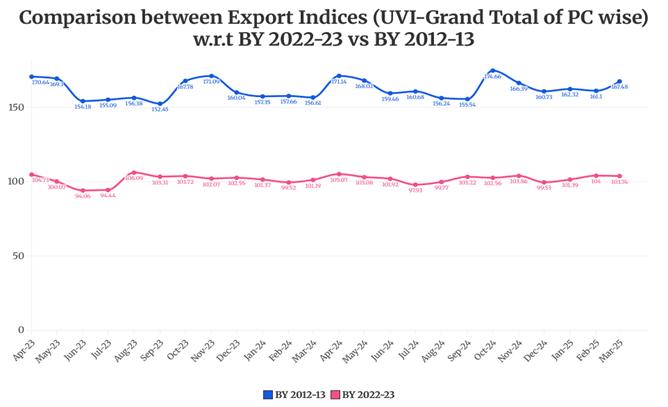
#BY means Base Year.
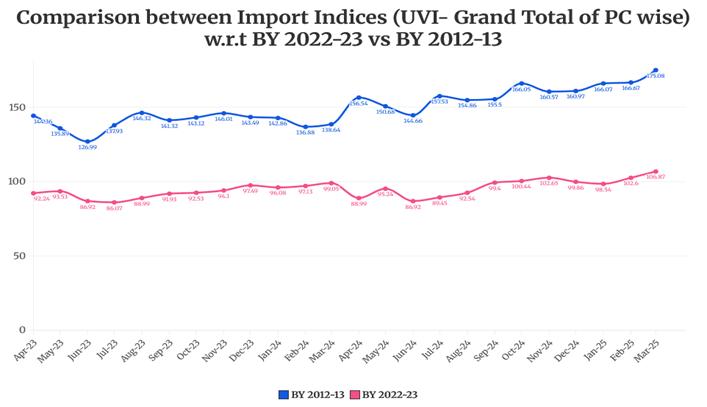
 

#BY means Base Year.

Table: Unit Value Index (UVI) and Quantity Index (QI) during FY 2025-26(Apr-Nov) using FY 2022-23 as base year


Month

Apr_25

May_25

Jun_25

1st Qtr 25-26

Jul_25

Aug_25

Sep_25

2nd Qtr 25-26

Oct_25

Nov_25

Unit Value Index

Export

105.31

99.73

96.31

100.33

99.31

100.55

104.08

101.23

103.78

105.32

Import

92.33

97.97

91.74

94.08

96.34

100.81

108.69

101.93

110.17

106.59

Quantity Index

Export

107.85

104.76

93.88

101.91

103.41

102.64

111.04

105.57

116.19

113.06

Import

138.16

126.61

112.58

125.17

122.47

124.06

126.45

124.32

137.04

121.75

Qtr  means Quarter.

Meaning and interpretation of the Indices

The Unit Value Indices and the Quantity Indices may be interpreted along the following lines.

The Unit Value Index answers the question: What is the growth in the average Unit Value of the items1 traded in the current month with respect to the same month in the Base Year?

So, an Unit Value Index of, say, 120 means that if the items that have been traded in the current month had been traded in the same month of the base year, and if the average price (or unit value) of those items had been Rs.100 in that month of the base year, then the average price (or unit value) of these items in the current month is Rs.120. Or that, there is a 20% increase in the average Unit Value, with respect to the Base Year, of the items that have been traded in the Current Month.

For example, let us suppose 30 items, 10 items each from 3 different Principal Commodities, have been traded in the current month. If these 30 items had been traded in the corresponding month of the base year at an average price of Rs.100, then the average price of these items in the current year is Rs.120.

It is to be noted that there are two successive steps of averaging done here. The first averaging is done over all the items (or ITCHS) of a PC group to arrive at the Index of that PC group. And the second averaging is done over all the PC groups to arrive at the Index at the Grand Total level for all commodities (which is the overall Index for India for a month). In both the stages, a weighted average is taken where the weights are proportional to the importance of the items and the PC groups respectively, and the Laspeyres Formula is used for averaging.

Quantity Indices, say, 200 means that if in the base year on an average 100 units were traded in India in the base year, then in the current year on an average 200 units were traded. However, it must be remembered that averaging quantities are different from averaging prices, since quantities in different units cannot be added directly.

So, the Quantity Indices are calculated by dividing the Value Indices by the Unit Value Indices. For example, if there is an increase in the Value of Export from Rs. 10,000 to Rs. 24,000, then the Value Index is 24000/10000 × 100 = 240. If the Unit Value Index is 120, then the Quantity Index comes to 240/120 × 100 = 200. So, loosely it can be said that, if the value of export has increased 2.4 times and the price of the commodities has increased 1.2 times, then the quantity must have doubled.

However, it may be noted that a very high or low Quantity Index may indicate the presence of Base Effect.

The Interpretation of the Bilateral and Regional Indices can be seen as an extension of the above.

A Unit Value Index of 120 with respect to a country, say Bangladesh, means that if all the items that have been traded with Bangladesh in the current month had been traded in the same month of the base year with the same country, and if the average price (or unit value) of those items had been Rs.100 in that month of the base year, then the average price (or unit value) of these items in the current month is Rs.120.

Similarly, a Quantity Index of 200 with respect to a country, say Bangladesh, means that if in the base year on an average 100 units were traded in India in the base year, then in the current year on an average 200 units were traded.

Comparability of the Indices across time

It is to be noted that the weights in the Index Number formula are fixed across time and there are twelve sets of weights for the twelve months. Hence, comparability of Indices is meaningful only when Indices of same month are compared across years. Different months may attach different weights to the same item, and hence comparing indices of two different months becomes vague and may have little applicability.

Further, the weights of the items that are not present in the trade basket of the current month are distributed to all the items that have been traded in the current month. This distribution is done in proportion to the weights of those items.

For example, let us suppose there are only 3 commodities for trade, say A, B and C. In month May of the Base year, let us suppose that the trade value of A was Rs. 50, B was Rs. 100 and C was Rs. 50. Then the weights assigned to A, B and C in the month of May of the following years would be in the ratio 50 :100 :50. However, in case, C is not traded in the current month, then the weight of C would be distributed proportionately among A and B, again in the ratio 1:2 (since in May the weights of A and B are in the ratio of 50 : 100, i.e., 1 : 2). So, in the current month the weights of A and B would be 3313  and 6623 .

As a result, the weights in any two given months are dependent on exactly the number of items (ITCHS codes) traded in those months. If the items traded are widely different, inference drawn from the comparison of the Indices may be done accordingly. On the other hand, more the similarity in the number of items traded more is the comparability of the two indices.

Net Terms of Trade:

Net Terms of Trade also called commodity Terms of Trade is defined as a ratio of export prices to import prices.

Let say 2022-23 be the base year and 2023-24 be the final year. We express both export and import prices in 2022-23 as 100. Now, suppose that at the end of 2023-24, it is found that the index of export prices decreased to 90 and index of import prices roses to 150. Then the Net Terms of Trade has changed to 90100150100=35 . Then terms of trade as index=35*100=60 . It implies that terms of trade of the country have decreased by about 40% in 2023-24 as compared with 2022-23. It thus shows a deterioration or a worsening of the terms of trade of the country.

If the index of export prices has risen to 150 and that of import prices had risen to 120, then the net terms of trade would have changed to 150120*100=125 . This implies an improvement in the net terms of trade of the country by 25% in 2023-24 over 2022-23.

Gross Terms of Trade:

Gross Terms of Trade is the ratio of physicalquantity of import to physical quantity of export.

Let say 2022-23 be the base year. In that year, the quantities export and import are denoted by 100. Now, suppose that in the year 2023-24, the index of quantity of import was 150 and that of quantity of export was 120. Then the gross terms of trade is given by 150100120100=54,  in terms of percentage =54*100=125 . This implies that there was an improvement of gross terms of trade by 25% in 2023-24 compared to 2022-23.

Income Terms of Trade: Income Terms of Trade is defined as- Net Terms of Trade multiplied by quantity of export.

Topics

Acts Income Tax