

Loading...

Top
Help
×

By creating an account you can:

Logo TaxTMI
Call Us / Help / Feedback

Contact Us At :

E-mail: [email protected]

Call / WhatsApp at: +91 99117 96707

For more information, Check Contact Us

FAQs :

To know Frequently Asked Questions, Check FAQs

Most Asked Video Tutorials :

For more tutorials, Check Video Tutorials

Submit Feedback/Suggestion :

Email :
Please provide your email address so we can follow up on your feedback.
Category :
Description :
Min 15 characters 0/2000
Make Most of Text Search
  1. Checkout this video tutorial: How to search effectively on TaxTMI.
  2. Put words in double quotes for exact word search, eg: "income tax"
  3. Avoid noise words such as : 'and, of, the, a'
  4. Sort by Relevance to get the most relevant document.
  5. Press Enter to add multiple terms/multiple phrases, and then click on Search to Search.
  6. Text Search
  7. The system will try to fetch results that contains ALL your words.
  8. Once you add keywords, you'll see a new 'Search In' filter that makes your results even more precise.
  9. Text Search
Add to...
You have not created any category. Kindly create one to bookmark this item!
Create New Category
Hide
Title :
Description :
❮❮ Hide
Default View
Expand ❯❯
Close ✕
🔎 News - Adv. Search
TEXT SEARCH:

Press 'Enter' to add multiple search terms. Rules for Better Search

Search In:
Main Text + AI Text
  • Main Text
  • Main Text + AI Text
  • AI Text
Category: ?
Categorized by AI
---- All Categories ----
  • ---- All Categories ----
  • Income Tax
  • GST
  • Customs, DGFT & SEZ
  • FEMA & RBI
  • Corp. Laws, SEBI & IBC
  • PMLA, Black Money & ED
  • Budget
  • News and Press Release
  • PTI News
Month:
---- All Months ----
  • ---- All Months ----
  • January
  • February
  • March
  • April
  • May
  • June
  • July
  • August
  • September
  • October
  • November
  • December
Year:
---- All Years ----
  • ---- All Years ----
  • 2026
  • 2025
  • 2024
  • 2023
  • 2022
  • 2021
  • 2020
  • 2019
  • 2018
  • 2017
  • 2016
  • 2015
  • 2014
  • 2013
  • 2012
  • 2011
Sort By: ?
In Sort By 'Default', exact matches for text search are shown at the top, followed by the remaining results in their regular order.
Relevance Default Date
    Govt classifies energy data as national security matter; mandates disclosure across oil, gas chain
    Foreign Travel Insurance Guide: A List of Vital Documents for Immigration and Customs This Vacation Season
    Govt launches Rs 497-cr 'RELIEF' scheme to help exporters hit by West Asia crisis; sets up IMG
    TN surpasses Gujarat, Maharashtra to become India''s top textile exporter
    Built on Service, Trust and Quality: How Alpex Pharma Became the Manufacturing Partner Pharma Brands Rely On
    GSTAT/Pr. Bench - User Advisory for the GSTAT E-Filing Portal
    UP: Man arrested for involvement in gang manufacturing forged Aadhaar cards
    TN surpasses Gujarat, Maharashtra to become India's top textile exporter
    HDFC Life Reaffirms Strong Corporate Governance Track Record with IiAS Leadership Recognition in Corporate Governance Scorecard for 2025
    CCI approves additional shareholding acquisition in Baby Memorial Hospital (BMH) by Bentley Asia; and BMH’s subsequent acquisition of certain shareh...
    Agriculture Insurance Company of India Ltd. (AIC) Launches Krishi Sakhi Initiative to empower women farmers
    Haryana CM rebuts opposition's claims on online shopping, says no distress among small traders
    Direct tax kitty rises 7.1 pc to Rs 22.8 lakh cr till March 17 this fiscal
    India-US trade deal will dent income of farmers, adversely impact Indian economy: Opposition MPs in Lok Sabha
    Japan's leader heads to Washington for visit complicated by Iran war fallout
    SC rejects UP power body's claims in Essar Power MP insolvency dispute
    Setco Expands into Brake Disc Segment with Global Multi-Brand Portfolio
    RNFI Enables Cardless Cash Withdrawals via UPI QR Across India with Jio Payments Bank
    Cabinet approves construction of 4-Lane Access-Controlled National Highway-927 from Barabanki to Bahraich (101.515 km) in Uttar Pradesh on Hybrid Annu...
    Cabinet approves MSP funding of Rs.1,718.56 crore to CCI for cotton seasons 2023-24 for direct support to cotton farmers
❯❯
Maximize Maximize Maximize
0 / 200
Expand Note
Add to Folder

No Folders have been created

+

Are you sure you want to delete "My most important" ?

NOTE:

News
Showing Results for :
Reset Filters
Results Found:
Show All Summaries Hide All Summaries
March 19, 2026
Show AI Summary
Energy data classified as national security mandates real time disclosure across oil and gas supply chains to central agency.
The Petroleum and Natural Gas (Furnishing of Information) Order, 2026 classifies energy data as national security and requires entities across the petroleum and natural gas supply chain to furnish production, imports, exports, stocks, storage, allocation, transportation, supply, consumption and utilisation data, aggregated or disaggregated by geography, time or consumers, to PPAC in such form, manner, electronic platform and periodicity as specified, and overrides contractual confidentiality or commercial sensitivity claims.
March 19, 2026
Show AI Summary
Travel Document Requirements: carry passport, visa, insurance and proof of funds to smooth immigration checks.
Entry into foreign jurisdictions requires organised proof of identity, travel authorisation and intent: carry a valid passport, visa or electronic travel authorisation, proof of onward or return travel and an accessible itinerary in cabin baggage with digital backups. Carry travel insurance documents-policy certificate, coverage summary and emergency contacts-saved offline when required by entry rules. Also present accommodation confirmations, financial evidence and destination-specific health documentation such as vaccination certificates, prescriptions and medical device notes. Consolidate these papers in a single folder and ensure consistency of names and dates across documents.
March 19, 2026
Show AI Summary
Export relief scheme extends export obligations and offers logistical and financial support to exporters affected by West Asia conflict.
The government launched a targeted export support scheme to assist exporters disrupted by the West Asia conflict, with ECGC as implementing agency and an inter ministerial group coordinating daily. The scheme covers consignments to specified West Asia destinations and comprises three components: automatic, penalty free extension of Advance Authorisation and EPCG export obligations and protection of insured shipments over an immediate one month window; measures to promote ECGC coverage for upcoming consignments over a three month period; and targeted partial reimbursement of extraordinary freight and insurance costs for MSMEs not covered by ECGC during a specified one month period.
March 19, 2026
Show AI Summary
Textile export leadership: Tamil Nadu tops India in textile shipments, surpassing Gujarat and Maharashtra in 2024-25.
Tamil Nadu leads India in textile exports for fiscal year 2024-25 with shipments of USD 7,997.17 million, up from USD 6,193.39 million in 2020-21 and representing 21.84% of national textile exports; Gujarat and Maharashtra follow in second and third place. The National Import-Export Record for Yearly Analysis of Trade is cited as the source, and the state credits cross-departmental schemes for the multifaceted export growth.
March 19, 2026
Show AI Summary
GMP compliance as a market access tool: certified divisional containment and neutral code manufacturing enable regulated exports and client reliability.
Alpex Pharma is a certified third party manufacturer holding WHO GMP, GMP, GLP and Ghana GMP credentials, operating three fully separated divisions (General, Beta Lactam, Cephalosporin) with dedicated containment and compliance architectures to prevent cross contamination, enable export compliance, and support neutral code manufacturing partnerships alongside a client centric account management model aligned to regulatory and commercial timelines.
March 19, 2026
Show AI Summary
GSTAT e-filing guidance sets out role selection, document upload, payment, digital signing, and filing number generation.
GSTAT e-filing for appeals requires advance preparation through the offline draft Excel sheet, role selection, sequential completion of the appeal form, upload of PDF documents within the prescribed size limit, payment of appeal fee through the approved modes, and digital signing for final submission. The advisory also highlights mandatory vakalatnama requirements for certain representatives, entry of demand details where APL-04 is unavailable, and payment of the pre-deposit required under section 112(8). Successful filing generates a filing number and acknowledgement.
March 19, 2026
Show AI Summary
Aadhaar forgery: arrest and seizure of devices as suspect taken for further interrogation and investigation.
Allegations concern a gang producing forged Aadhaar cards and the arrest of an individual alleged to have provided technical assistance to that syndicate; electronic devices and documentary material were recovered during a raid and the suspect was transferred for further interrogation as part of an ongoing inter-district probe.
March 19, 2026
Show AI Summary
Textile export leadership shifts as Tamil Nadu becomes nation's top textile exporter, surpassing Gujarat and Maharashtra.
Tamil Nadu has become India's leading state in textile exports for fiscal 2024-25, surpassing Gujarat and Maharashtra, according to national import-export data compiled on a centralised trade-data platform; the state's rise is attributed to coordinated departmental schemes and planned policy measures driving multifaceted growth in the textile sector.
March 19, 2026
Show AI Summary
Corporate governance recognition: HDFC Life placed in Leadership category under national scorecard, reaffirming transparency and accountability.
Recognition under the Indian Corporate Governance Scorecard placed HDFC Life in the Leadership category for scoring 75 and above as of 31 December 2025, reflecting the company's commitment to transparency, accountability, and governance practices treated as an organisational value rather than mere compliance within a widely used benchmarking framework.
March 19, 2026
Show AI Summary
Merger approval: competition regulator clears Bentley's stake increase in Baby Memorial and BMH's secondary purchase in Unimed.
The Competition Commission approved a two-step Proposed Combination: Bentley Asia will acquire additional shareholding in Baby Memorial Hospital Limited, and BMH will thereafter acquire certain shareholding in Unimed Health Care Private Limited by way of a secondary purchase; the parties include a Singapore investor (Bentley), a multi-specialty hospital network (BMH), and Unimed operating Star Hospitals, with a detailed order to follow.
March 19, 2026
Show AI Summary
Women farmer empowerment via month-wise awareness, workshops and crop insurance outreach under a corporate Krishi Sakhi initiative.
AIC launched the Krishi Sakhi Initiative to promote women farmer empowerment and inclusive participation in agriculture and crop insurance through sustained month-wise activities. Operative measures include an introductory awareness video, a staff Walkathon to symbolize support, ground-level workshops and awareness programs on crop insurance benefits, publication of related articles and interviews, and targeted sanitation and hygiene campaigns in rural areas to recognize and engage women farmers.
March 19, 2026
Show AI Summary
GST Council authority over tax rates affirmed; no unilateral state proposal to impose heavy tax on online shopping.
The Chief Minister denied evidence of small-trader distress from online shopping, emphasised digital payments' strengthening effect on small businesses, cited interest-free loans to street vendors during COVID-19 as support measures, and stated that proposals to change tax rates on online shopping are initiated, examined and recommended by the GST Council under the GST framework.
March 18, 2026
Show AI Summary
Direct tax collections rise driven by stronger corporate tax receipts and lower refund outflows, boosting fiscal cash flows.
Net direct tax receipts increased 7.1 per cent to Rs 22.8 lakh crore till March 17, driven by higher corporate tax mop up and reduced refund outflows; corporate tax rose about 13 per cent while non corporate receipts rose about 3 per cent. Advance tax rose 6.4 per cent in four tranches despite a marginal decline in non corporate advance tax, and gross direct tax collection also increased against the government's Revised Estimates target.
March 18, 2026
Show AI Summary
Trade deal impact: tariff asymmetry threatens farmer incomes, prompting calls for MSP guarantee and stronger crop protections.
India-US trade negotiations are depicted as posing asymmetric market access that would expose Indian farmers to tariff-free competition from US agricultural exports while domestic producers face duties, threatening incomes and sectoral competitiveness. Parliamentary interlocutors advocated compensatory domestic measures including a Minimum Support Price guarantee, reorientation of fertiliser subsidies to end-users, reform of the crop insurance scheme to favour farmers, targeted debt relief, and import curbs on selected agricultural commodities to protect farmer livelihoods and national food security.
March 18, 2026
Show AI Summary
Constitutional constraints on military deployment limit Japan's warship commitments, shaping talks on security and defence cooperation.
Japan declined to commit warships in response to US requests, citing constitutional constraints, legal questions over the US action, and public opposition; limited non combat missions such as survey, intelligence, or minesweeping are possible only after a ceasefire and with domestic legal authorization. Concurrently, Tokyo is revising defence policy to accelerate long range missile deployment, consider joining a US multi layer missile defence system, and lift the lethal arms exports ban to bolster defence industry cooperation, while pursuing energy and rare earth investment projects to diversify supplies.
March 18, 2026
Show AI Summary
Resolution plan finality prevents reopening admitted contingent claims after implementation, preserving creditor priority and CIRP finality.
The dispute concerns admission of pre insolvency operational claims as contingent claims admitted nominally by the resolution professional while an approved resolution plan provided no payment to operational creditors due to secured financial creditor priority. Appellate tribunals treated the RP's role as administrative and accepted nominal admission where disputes are pending, and the court stressed that the implemented resolution plan is final and reopening settled claims would disrupt the insolvency process.
March 18, 2026
Show AI Summary
Brake disc expansion: OEM-grade multi-brand range launched to serve passenger, LCV and MHCV markets and exports.
Setco Auto Systems has introduced a Brake Disc range of over 200 part numbers for 15+ vehicle brands, engineered to meet OEM specifications in ventilated and solid configurations with precision fitment, instant bedding, thermal fade resistance and materials resisting wear, warping and corrosion. The launch targets both OEM and aftermarket channels and leverages Setco's manufacturing capacity, distribution network and export relationships to capitalise on a market shift toward disc brakes.
March 18, 2026
Show AI Summary
Cardless cash withdrawals via UPI QR enable instant assisted cash access through merchant business correspondent networks nationwide.
RNFI Services Limited, via its Relipay platform in partnership with Jio Payments Bank, launched a nationwide UPI QR-based cash withdrawal facility enabling cardless assisted cash disbursements at authorised retail outlets within RNFI's Business Correspondent network; customers scan a QR code, enter the withdrawal amount and authenticate with their UPI PIN, after which the merchant dispenses cash, removing the need for ATM cards or biometric authentication and operating across UPI-enabled applications.
March 18, 2026
Show AI Summary
Hybrid Annuity Mode highway project approved to deliver access controlled 4 lane connectivity and cross border trade link.
Approval for a 101.515 km 4 lane access controlled Barabanki-Bahraich highway under Hybrid Annuity Mode includes continuous service roads and bypasses to address geometric deficiencies, reduce travel time and improve safety and efficiency; it links national and state highways, airports, railway stations and the Rupaidiha Land Port to enhance multi modal integration and establish a cross border trade corridor to Nepal while supporting regional development and generating substantial employment.
March 18, 2026
Show AI Summary
Minimum Support Price funding secures direct price support to cotton farmers through CCI procurement when markets fall below MSP.
The Cabinet approved funding for the Minimum Support Price mechanism for the 2023-24 cotton season, allocating resources to the Cotton Corporation of India (CCI) to provide direct price support by procuring Fair Average Quality cotton without quantitative ceilings whenever market prices fall below MSP. CCI is designated the central nodal agency and will deploy its procurement network across 11 major cotton-growing States, supported by information dissemination, the Bale Identification and Traceability System (BITS) and the "Cott-Ally" mobile application to enhance transparency and outreach.

News

Back

All News

Showing Results for :
Reset Filters
No Records Found

News

Back

All News

Showing Results for : Reset Filters
Customs, DGFT & SEZ

Directorate General of Commercial Intelligence and Statistics Revises Base Year of Merchandise Trade Indices to FY 2022–23 to Reflect Current Trade Structure and Global Patterns

February 21, 2026

Contents
Summary
Note

Note

-

Bookmark

Print

Print

Merchandise Trade Indices are compiled and published by the Directorate General of Commercial Intelligence and Statistics (DGCI&S), Ministry of Commerce & Industry, to measure changes in the unit values (prices) of India’s exports and imports over time. These indices serve as important indicators of external sector price movements and are widely used for economic analysis, including national accounts compilation and assessment of terms of trade. Over the years, the base year of the indices has been periodically revised to reflect structural changes in India’s trade composition and evolving global trade patterns. The most recent revision updates the base year to FY 2022–23 (2022–23 = 100), replacing the earlier base of FY 2012–13, thereby ensuring that the indices accurately represent the current structure of India’s merchandise trade.

Revision of Base Year of India’s Merchandise Trade Indices to FY 2022–23

The Directorate General of Commercial Intelligence and Statistics (DGCI&S), Ministry of Commerce & Industry, has revised the base year of India’s Merchandise Trade Indices from FY 2012–13 to FY 2022–23 (2022–23 = 100), in view of the structural changes in the economy, shifts in commodity composition, evolving trade patterns, and the need for improved alignment with contemporary macroeconomic indicators.

The revision has been undertaken on the recommendations of a committee constituted by DGCI&S under the Chairmanship of Prof. Nachiketa Chattopadhyay, Professor, Indian Statistical Institute, Kolkata. The Committee examined the existing methodology, data coverage, weighting structure, and compilation practices, and recommended suitable refinements in line with international best practices.

Key Features of the Revised Series (Base: FY 2022–23)

  1. Updated Base Year:
    The new base year FY 2022–23 makes the Indices reflect the current structure of India’s external trade more accurately.
  2. Revised Commodity Basket:
    The coverage and classification of commodities have been reviewed at the Principal Commodity level to better capture emerging and declining trade items.
  3. Revised Weighting Structure:
    Weights have been updated based on trade values of the new base year to reflect the latest value shares in exports and imports.
  4. Improved Methodology:
    Methodological refinements have been introduced in:
    1. Selection of common commodity basket for base year selection (procedure of selection for common commodity basket explained in detail report of the committee).
    2. Treatment of missing unit values (Imputation of missing unit values in base year selection have been explained in detail in the committee report).
  5. Indices Compiled:
    The revised series includes:
    1. Monthly, Quarterly and Annual Indices (Export Unit Value Index,Import Unit Value Index).
    2. Principal Commodity (PC) Classification wise Trade Indices (Export/Import).
    3. Standard International Trade Classification-wise (SITC) Trade Indices.
    4. Broad economic categories-wise (BEC) Trade Indices.
    5. Bilateral and Region-wise Trade Indices of Top 20 Export and Import partner nations of India.
    6. Terms of Trade (Gross terms of trade, Net terms of trade and Income terms of trade).

Rationale for Revision

Over the past decade, India’s trade basket has undergone substantial changes due to emergence of new commodities, technological advancements, Global supply chain restructuring and changes in relative price structures.

The earlier base year (FY 2012–13) no longer adequately reflected the prevailing trade structure. The revision ensures improved relevance, reliability, and analytical usefulness of the Merchandise Trade Indices for policymakers, researchers, and other stakeholders.

Use of the Revised Series

Merchandise Trade Indices compiled by the Directorate General of Commercial Intelligence and Statistics (DGCI&S) are extensively used by key government institutions for economic analysis and policy formulation. The National Accounts Division (NAD) of the Ministry of Statistics and Programme Implementation uses the Export and Import Unit Value Indices as deflators for estimating real exports and imports in GDP compilation. The Reserve Bank of India (RBI) relies on these indices for external sector assessment, balance of payments analysis, and evaluation of price competitiveness. Various Ministries and Government agencies also use them to frame and review trade-related policies and to assess movements in international prices. In addition, academic institutions, research organizations, and economic analysts utilize Merchandise Trade Indices for empirical research, modelling, and analysis of trade dynamics and terms of trade trendson and economic research.

Availability of Data

The revised Merchandise Trade Indices (Base: FY 2022–23) will be released on the official website of DGCI&S. Detailed methodological documentation is available in the Report of the Committee on Revision of Base Year for Merchandise Trade Indices.

Comparison of the new revised Indices (Base Year: 2022-23) with the already released Indices (Base Year : 2012-13) for 2022-23 and 2023-24 is given below.
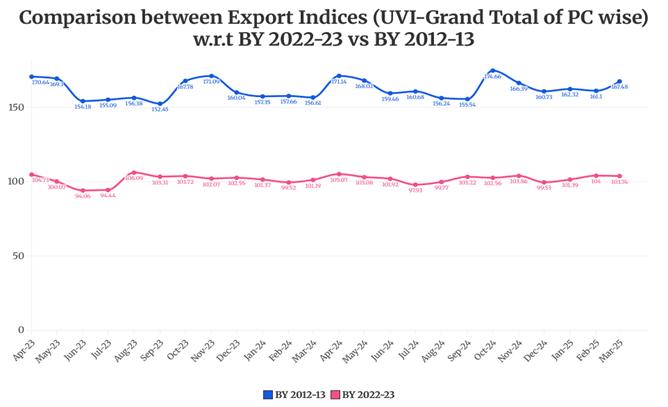
#BY means Base Year.
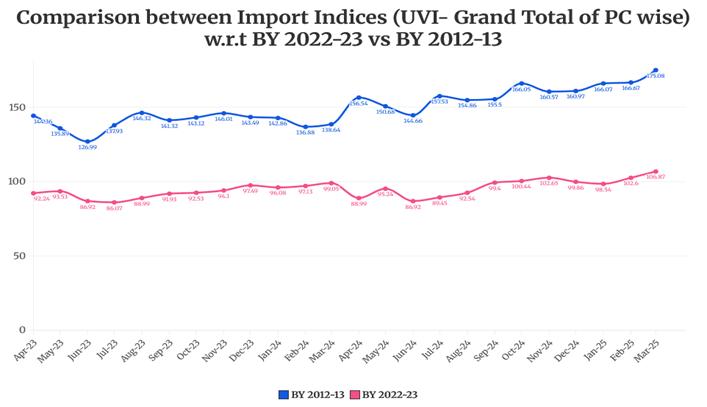
 

#BY means Base Year.

Table: Unit Value Index (UVI) and Quantity Index (QI) during FY 2025-26(Apr-Nov) using FY 2022-23 as base year


Month

Apr_25

May_25

Jun_25

1st Qtr 25-26

Jul_25

Aug_25

Sep_25

2nd Qtr 25-26

Oct_25

Nov_25

Unit Value Index

Export

105.31

99.73

96.31

100.33

99.31

100.55

104.08

101.23

103.78

105.32

Import

92.33

97.97

91.74

94.08

96.34

100.81

108.69

101.93

110.17

106.59

Quantity Index

Export

107.85

104.76

93.88

101.91

103.41

102.64

111.04

105.57

116.19

113.06

Import

138.16

126.61

112.58

125.17

122.47

124.06

126.45

124.32

137.04

121.75

Qtr  means Quarter.

Meaning and interpretation of the Indices

The Unit Value Indices and the Quantity Indices may be interpreted along the following lines.

The Unit Value Index answers the question: What is the growth in the average Unit Value of the items1 traded in the current month with respect to the same month in the Base Year?

So, an Unit Value Index of, say, 120 means that if the items that have been traded in the current month had been traded in the same month of the base year, and if the average price (or unit value) of those items had been Rs.100 in that month of the base year, then the average price (or unit value) of these items in the current month is Rs.120. Or that, there is a 20% increase in the average Unit Value, with respect to the Base Year, of the items that have been traded in the Current Month.

For example, let us suppose 30 items, 10 items each from 3 different Principal Commodities, have been traded in the current month. If these 30 items had been traded in the corresponding month of the base year at an average price of Rs.100, then the average price of these items in the current year is Rs.120.

It is to be noted that there are two successive steps of averaging done here. The first averaging is done over all the items (or ITCHS) of a PC group to arrive at the Index of that PC group. And the second averaging is done over all the PC groups to arrive at the Index at the Grand Total level for all commodities (which is the overall Index for India for a month). In both the stages, a weighted average is taken where the weights are proportional to the importance of the items and the PC groups respectively, and the Laspeyres Formula is used for averaging.

Quantity Indices, say, 200 means that if in the base year on an average 100 units were traded in India in the base year, then in the current year on an average 200 units were traded. However, it must be remembered that averaging quantities are different from averaging prices, since quantities in different units cannot be added directly.

So, the Quantity Indices are calculated by dividing the Value Indices by the Unit Value Indices. For example, if there is an increase in the Value of Export from Rs. 10,000 to Rs. 24,000, then the Value Index is 24000/10000 × 100 = 240. If the Unit Value Index is 120, then the Quantity Index comes to 240/120 × 100 = 200. So, loosely it can be said that, if the value of export has increased 2.4 times and the price of the commodities has increased 1.2 times, then the quantity must have doubled.

However, it may be noted that a very high or low Quantity Index may indicate the presence of Base Effect.

The Interpretation of the Bilateral and Regional Indices can be seen as an extension of the above.

A Unit Value Index of 120 with respect to a country, say Bangladesh, means that if all the items that have been traded with Bangladesh in the current month had been traded in the same month of the base year with the same country, and if the average price (or unit value) of those items had been Rs.100 in that month of the base year, then the average price (or unit value) of these items in the current month is Rs.120.

Similarly, a Quantity Index of 200 with respect to a country, say Bangladesh, means that if in the base year on an average 100 units were traded in India in the base year, then in the current year on an average 200 units were traded.

Comparability of the Indices across time

It is to be noted that the weights in the Index Number formula are fixed across time and there are twelve sets of weights for the twelve months. Hence, comparability of Indices is meaningful only when Indices of same month are compared across years. Different months may attach different weights to the same item, and hence comparing indices of two different months becomes vague and may have little applicability.

Further, the weights of the items that are not present in the trade basket of the current month are distributed to all the items that have been traded in the current month. This distribution is done in proportion to the weights of those items.

For example, let us suppose there are only 3 commodities for trade, say A, B and C. In month May of the Base year, let us suppose that the trade value of A was Rs. 50, B was Rs. 100 and C was Rs. 50. Then the weights assigned to A, B and C in the month of May of the following years would be in the ratio 50 :100 :50. However, in case, C is not traded in the current month, then the weight of C would be distributed proportionately among A and B, again in the ratio 1:2 (since in May the weights of A and B are in the ratio of 50 : 100, i.e., 1 : 2). So, in the current month the weights of A and B would be 3313  and 6623 .

As a result, the weights in any two given months are dependent on exactly the number of items (ITCHS codes) traded in those months. If the items traded are widely different, inference drawn from the comparison of the Indices may be done accordingly. On the other hand, more the similarity in the number of items traded more is the comparability of the two indices.

Net Terms of Trade:

Net Terms of Trade also called commodity Terms of Trade is defined as a ratio of export prices to import prices.

Let say 2022-23 be the base year and 2023-24 be the final year. We express both export and import prices in 2022-23 as 100. Now, suppose that at the end of 2023-24, it is found that the index of export prices decreased to 90 and index of import prices roses to 150. Then the Net Terms of Trade has changed to 90100150100=35 . Then terms of trade as index=35*100=60 . It implies that terms of trade of the country have decreased by about 40% in 2023-24 as compared with 2022-23. It thus shows a deterioration or a worsening of the terms of trade of the country.

If the index of export prices has risen to 150 and that of import prices had risen to 120, then the net terms of trade would have changed to 150120*100=125 . This implies an improvement in the net terms of trade of the country by 25% in 2023-24 over 2022-23.

Gross Terms of Trade:

Gross Terms of Trade is the ratio of physicalquantity of import to physical quantity of export.

Let say 2022-23 be the base year. In that year, the quantities export and import are denoted by 100. Now, suppose that in the year 2023-24, the index of quantity of import was 150 and that of quantity of export was 120. Then the gross terms of trade is given by 150100120100=54,  in terms of percentage =54*100=125 . This implies that there was an improvement of gross terms of trade by 25% in 2023-24 compared to 2022-23.

Income Terms of Trade: Income Terms of Trade is defined as- Net Terms of Trade multiplied by quantity of export.

Topics

Acts Income Tax