

Loading...

Top
Help
×

By creating an account you can:

Logo TaxTMI
Call Us / Help / Feedback

Contact Us At :

E-mail: [email protected]

Call / WhatsApp at: +91 99117 96707

For more information, Check Contact Us

FAQs :

To know Frequently Asked Questions, Check FAQs

Most Asked Video Tutorials :

For more tutorials, Check Video Tutorials

Submit Feedback/Suggestion :

Email :
Please provide your email address so we can follow up on your feedback.
Category :
Description :
Min 15 characters 0/2000
Make Most of Text Search
  1. Checkout this video tutorial: How to search effectively on TaxTMI.
  2. Put words in double quotes for exact word search, eg: "income tax"
  3. Avoid noise words such as : 'and, of, the, a'
  4. Sort by Relevance to get the most relevant document.
  5. Press Enter to add multiple terms/multiple phrases, and then click on Search to Search.
  6. Text Search
  7. The system will try to fetch results that contains ALL your words.
  8. Once you add keywords, you'll see a new 'Search In' filter that makes your results even more precise.
  9. Text Search
Add to...
You have not created any category. Kindly create one to bookmark this item!
Create New Category
Hide
Title :
Description :
❮❮ Hide
Default View
Expand ❯❯
Close ✕
🔎 News - Adv. Search
TEXT SEARCH:

Press 'Enter' to add multiple search terms. Rules for Better Search

Search In:
Main Text + AI Text
  • Main Text
  • Main Text + AI Text
  • AI Text
Category: ?
Categorized by AI
---- All Categories ----
  • ---- All Categories ----
  • Income Tax
  • GST
  • Customs, DGFT & SEZ
  • FEMA & RBI
  • Corp. Laws, SEBI & IBC
  • PMLA, Black Money & ED
  • Budget
  • News and Press Release
  • PTI News
Month:
---- All Months ----
  • ---- All Months ----
  • January
  • February
  • March
  • April
  • May
  • June
  • July
  • August
  • September
  • October
  • November
  • December
Year:
---- All Years ----
  • ---- All Years ----
  • 2026
  • 2025
  • 2024
  • 2023
  • 2022
  • 2021
  • 2020
  • 2019
  • 2018
  • 2017
  • 2016
  • 2015
  • 2014
  • 2013
  • 2012
  • 2011
Sort By: ?
In Sort By 'Default', exact matches for text search are shown at the top, followed by the remaining results in their regular order.
Relevance Default Date
    Galgotias University Hosts 'Galgotias Investo Pitch 2026', Awards Grants to 12 Promising Startups
    Axis Max Life and YES BANK Celebrate Twenty-One Years of Strategic Excellence; Set Sights on Digital-First Future
    Why damage to Qatar's gas infrastructure could push costs higher for years to come
    West Asia crisis: Govt restores full RoDTEP benefits to exporters till Mar 31
    Sebi adopts conflict of interest, disclosure framework for top officials
    Oppn parties object to introduction of CAPF Bill, BAC allots 8-hr discussion
    Govt introduces bill to amend companies, LLP laws; proposes changes in CSR norms
    Torres jewellery fraud case: ED initiates extradition process against absconding Ukranian accused
    ED attaches assets worth Rs 34.5 crore in Mumbai US Club fraud, alleges Rs 77 crore diverted
    HDFC Bank crisis: Sebi says independent directors must act responsibly, back up insinuations
    Gujarat maintaining fiscal discipline, says FM Desai; Cong flags debt, spending pattern
    Bihar Police arrests key accused in teacher job exam paper leak case
    India needs to take proactive steps limit impact of West Asia crisis, says RBI bulletin
    Rupee breaches 94-level against US dollar intraday; ends flat
    Iranian oil purchase to depend on techno-commercial feasibility, payments route unclear
    Congress, BJP trade charges on petrol price hike, corporate tax
    West Asia crisis: Govt restores full RoDTEP benefits to exporters
    Federal immigration agents seen at Atlanta airport after Trump order amid partial shutdown
    DMK MP flags sharp tariff hike for Kudankulam Nuclear Units 3 & 4; seeks regulatory framework
    Gold tumbles Rs 9,050, silver declines by Rs 10,500/kg in Delhi on weak demand
❯❯
Maximize Maximize Maximize
0 / 200
Expand Note
Add to Folder

No Folders have been created

+

Are you sure you want to delete "My most important" ?

NOTE:

News
Showing Results for :
Reset Filters
Results Found:
Show All Summaries Hide All Summaries
March 24, 2026
Show AI Summary
Startup incubation and investor access drive Galgotias Investo Pitch 2026 with grants for early-stage ventures.
Galgotias University organised "Galgotias Investo Pitch 2026" to support innovation and entrepreneurship by connecting startups with investors, industry leaders, incubation stakeholders, and government representatives. The event focused on startup scaling, venture capital access, business incubation, mentorship, market entry, and the use of artificial intelligence for scalable and cost-effective business growth. The University also announced an endowment grant for twelve early-stage startups as part of its continued support for the startup ecosystem.
March 24, 2026
Show AI Summary
Bancassurance partnership drives digital-first insurance access, streamlined underwriting, and broader financial inclusion across underserved markets.
Strategic bancassurance partnership between Axis Max Life Insurance Limited and YES BANK has been reaffirmed as a long-running distribution alliance focused on digital-first delivery and hyper-personalized protection solutions. The collaboration combines the insurer's protection expertise with the bank's branch network and digital infrastructure to deliver insurance through streamlined customer journeys, including video consultations and agile underwriting, across protection, savings, education planning, retirement planning and wealth creation needs. The partnership is also directed toward expanding insurance access in underserved markets and supporting the objective of "Insurance for All by 2047".
March 24, 2026
Show AI Summary
LNG supply disruption and force majeure risk could keep global gas prices elevated for years.
Damage to Qatar's Ras Laffan liquefied natural gas terminal has disrupted a major part of the country's LNG export capacity and may trigger force majeure on long-term supply contracts. The facility is complex, costly to repair, and likely to require a prolonged shutdown and staged restoration because LNG plants must be warmed and cooled slowly. The supply shortfall is likely to keep global LNG prices elevated and may shift some markets toward coal.
March 23, 2026
Show AI Summary
RoDTEP benefits restored for exporters as West Asia crisis raises freight costs and disrupts maritime trade.
Restoration of RoDTEP benefits was announced for eligible export products from February 23, 2026 to March 31, 2026, with the rates and value caps applicable on February 22, 2026 restored in full. The measure responds to the West Asia crisis and the resulting disruption to global trade, including higher freight costs, rising insurance premiums, and maritime logistics challenges affecting export consignments moving to or through the region.
March 23, 2026
Show AI Summary
Conflict of interest framework strengthens disclosure, recusal, and investment restrictions for top market regulator officials.
Sebi approved a conflict of interest and disclosure framework for its top officials, bringing the Chairman and Whole Time Members within the definition of insider and requiring disclosure of assets, liabilities, and immovable property in specified formats. The framework also provides for ethics infrastructure, a digital conflict-management system, a whistleblower mechanism, recusal procedures, and uniform restrictions on investments and trading in equity and equity-related instruments for senior officials.
March 23, 2026
Show AI Summary
CAPF recruitment and promotion law draws opposition objections as discussion time is allotted in the Rajya Sabha.
The Business Advisory Committee of the Rajya Sabha allotted eight hours for discussion on the proposed Central Armed Police Forces (General Administration) Bill, 2026, while the Bill was not taken up in the House on the reported day. The proposed umbrella legislation is intended to regulate the recruitment, deputation and promotion of CAPF officers, and several opposition parties objected to its introduction and sought fuller scrutiny of such legislation.
March 23, 2026
Show AI Summary
Corporate compliance reform proposals expand CSR flexibility, decriminalise procedural defaults, and streamline mergers and governance.
Proposed amendments to the Companies Act and LLP Act seek to promote ease of doing business, reduce compliance burden, and decriminalise procedural defaults by replacing criminal provisions with civil penalties. The bill also proposes streamlined mergers and amalgamations, hybrid-mode meetings, flexibility in share buy-backs, simplified closure and voluntary exit, and easier compliance for small companies, startups, producer companies, and certain LLPs.
March 23, 2026
Show AI Summary
PMLA extradition proceedings advance in Torres jewellery fraud case involving alleged hawala routing and USDT conversion.
Extradition proceedings were initiated under the PMLA against an absconding Ukrainian accused in the Torres jewellery fraud investigation after the Enforcement Directorate approached the special PMLA court for compilation and attestation of papers to prepare a dossier for transmission to foreign authorities. The case concerns allegations that customers were cheated through Platinum Hern Private Limited, operating as Torres Jewellery, by collecting cash in exchange for Moissanite diamonds and other jewellery, with the receipts allegedly routed through hawala operators and converted into USDT cryptocurrency in a money-laundering investigation.
March 23, 2026
Show AI Summary
Money laundering attachment over alleged diversion of club funds through fake accounts and routing of proceeds to properties and deposits.
Provisional attachment under the Prevention of Money Laundering Act covered assets worth about Rs 34.51 crore, including movable and immovable properties and fixed deposits linked to persons connected with the United Services Club matter. The Enforcement Directorate alleged that club funds were diverted through fake bank accounts opened in the names of genuine vendors, then routed to personal and joint accounts of the accused and associates. The alleged proceeds of crime were used to acquire properties, create fixed deposits, and channel funds through a trust to accounts linked to a chartered accountant and related entities.
March 23, 2026
Show AI Summary
Independent directors must support governance concerns with evidence and record unresolved issues to protect minority shareholder interests.
Independent directors must act responsibly when raising concerns about a company's functioning or proposed actions, and any insinuations affecting governance or minority shareholder interests must be supported by proper evidence. Such concerns should be taken up with the board and, if unresolved, recorded in the minutes of the board meeting. Independent directors may question the company in board-level forums, but they cannot make vague or unsubstantiated allegations and must ensure that minority shareholder interests are protected.
March 23, 2026
Show AI Summary
Fiscal discipline and GST compliance in Gujarat are highlighted through surplus targets, controlled debt, higher capital spending and rising tax collections.
Gujarat's fiscal management is said to be maintained under the Gujarat Fiscal Responsibility Act, 2005, with an aim to ensure fiscal stability, accountability and a revenue surplus. The state reportedly remains within prescribed ceilings for fiscal deficit and debt, has not defaulted on debt repayment, and has not taken an overdraft or advance for many years. The discussion also highlights increased capital expenditure, concerns over non-developmental spending and debt burden, and growth in GST taxpayers, return filing compliance and tax revenue.
March 23, 2026
Show AI Summary
Paper leak investigation deepens as Bihar Police arrests an alleged gang member linked to the TRE-3 exam case.
Bihar Police's Economic Offences Unit arrested Praveen Kumar Sinha in the BPSC Teacher Recruitment Exam (TRE-3) paper leak case and described him as an active member of the Sanjeev Kumar Singh gang. The statement said the arrest followed a tip-off and that, during interrogation, Sinha claimed he took teacher aspirants to Hazaribagh before the exam and supplied question papers. Officials also said the wider network operates across multiple states and that 293 people have been arrested so far.
March 23, 2026
Show AI Summary
Crude oil dependence and West Asia spillovers drive calls for proactive buffering and closer economic monitoring.
India's external dependence on crude oil requires close monitoring of the West Asia crisis and proactive measures to limit adverse spillovers from disrupted energy supplies, trade policy uncertainty and volatility in global commodity and financial markets. India's economic position is described as resilient, supported by adequate foreign exchange reserves, strong growth, sound macroeconomic fundamentals and robust external sector buffers, with an Economic Stabilisation Fund suggested as an additional buffer against external shocks.
March 23, 2026
Show AI Summary
Rupee pressure intensifies as it breaches the 94 mark intraday amid crude, equity and global sentiment weakness.
The rupee breached the 94 level against the US dollar in intraday trade for the first time before closing unchanged at 93.53. The movement reflected pressure from global market conditions, including a correction in crude prices, weakening domestic equities, foreign institutional investor outflows and broader geopolitical tensions, while the dollar index remained firm. Intermittent intervention by the Reserve Bank was expected to provide support at lower levels.
March 23, 2026
Show AI Summary
Techno-commercial feasibility governs any possible resumption of Iranian crude imports amid sanctions, payment and logistics uncertainty.
India may resume buying Iranian crude only if it is techno-commercially feasible, with the decision shaped by refinery compatibility, pricing, sanctions relief, and available payment, insurance and logistics mechanisms. The report says the payment route remains unclear because Iran is cut off from SWIFT and earlier settlement channels are no longer available. Any return to imports would depend on commercial and geopolitical conditions rather than technical constraints.
March 23, 2026
Show AI Summary
Energy security and fiscal discipline dominate Finance Bill debate as parties clash over fuel prices, taxes and trade deficits.
Petroleum pricing, corporate tax collection, energy security, fiscal discipline and free trade deficits were raised during the Finance Bill debate. One side alleged that the government was avoiding a petrol and diesel price hike because of upcoming elections and questioned the gap between corporate tax and income tax collections, while the response defended the decision not to raise fuel prices and highlighted diversification of oil sourcing as part of energy security. The debate also criticised earlier enforcement of the Benami Transactions Act and minimum alternate tax, and questioned compliance with fiscal discipline and the trade deficit under free trade agreements.
March 23, 2026
Show AI Summary
RoDTEP benefits restored for exporters as duty remission rates and caps are reinstated amid West Asia trade disruption.
Restoration of RoDTEP benefits to exporters was announced through a DGFT notification in response to disruption in global trade caused by the West Asia crisis. The notification restored the RoDTEP rates and value caps applicable on February 22, 2026, for all eligible export products, with effect from February 23, 2026 to March 31, 2026. The measure reverses the earlier reduction in duty benefits and revives the higher remission level for the specified period.
March 23, 2026
Show AI Summary
Federal immigration deployment at airports highlights shutdown pressures, TSA checkpoint strain, and disputes over immigration enforcement policy.
Federal immigration officers were seen at Atlanta's airport after the President said agents would be deployed to assist Transportation Security Administration operations during a government shutdown. Their presence at airport checkpoints is unusual because screening there is typically handled by transportation security officers, while the deployment is linked to a lapse in Department of Homeland Security funding and wider disagreement over immigration enforcement.
March 23, 2026
Show AI Summary
Nuclear power tariff regulation faces scrutiny over steep Kudankulam pricing, cost assumptions, and lack of independent oversight.
Concerns were raised over the indicative tariff proposed for electricity from Kudankulam Nuclear Power Plant Units 3 and 4, as it represents a sharp escalation over the tariff currently applicable to Units 1 and 2 and may exceed prevailing competitive benchmarks. The tariff was described as likely to impose a substantial long-term burden on Tamil Nadu and other southern states, especially because nuclear power is must-run supply and pricing is presently determined administratively without independent regulatory oversight.
March 23, 2026
Show AI Summary
Gold and silver prices fall sharply as weak demand, rate expectations, and dollar strength pressure bullion markets.
Gold and silver prices fell sharply in Delhi amid subdued domestic demand and weak global trends. Analysts linked the decline to higher interest rate expectations, stronger US Treasury yields, a firmer dollar, and inflation concerns arising from geopolitical tensions. The commentary also noted that slower reserve accumulation by some central banks and weaker spot prices overseas added to the pressure on bullion markets.

News

Back

All News

Showing Results for :
Reset Filters
No Records Found

News

Back

All News

Showing Results for : Reset Filters
Customs, DGFT & SEZ

Directorate General of Commercial Intelligence and Statistics Revises Base Year of Merchandise Trade Indices to FY 2022–23 to Reflect Current Trade Structure and Global Patterns

February 21, 2026

Contents
Summary
Note

Note

-

Bookmark

Print

Print

Merchandise Trade Indices are compiled and published by the Directorate General of Commercial Intelligence and Statistics (DGCI&S), Ministry of Commerce & Industry, to measure changes in the unit values (prices) of India’s exports and imports over time. These indices serve as important indicators of external sector price movements and are widely used for economic analysis, including national accounts compilation and assessment of terms of trade. Over the years, the base year of the indices has been periodically revised to reflect structural changes in India’s trade composition and evolving global trade patterns. The most recent revision updates the base year to FY 2022–23 (2022–23 = 100), replacing the earlier base of FY 2012–13, thereby ensuring that the indices accurately represent the current structure of India’s merchandise trade.

Revision of Base Year of India’s Merchandise Trade Indices to FY 2022–23

The Directorate General of Commercial Intelligence and Statistics (DGCI&S), Ministry of Commerce & Industry, has revised the base year of India’s Merchandise Trade Indices from FY 2012–13 to FY 2022–23 (2022–23 = 100), in view of the structural changes in the economy, shifts in commodity composition, evolving trade patterns, and the need for improved alignment with contemporary macroeconomic indicators.

The revision has been undertaken on the recommendations of a committee constituted by DGCI&S under the Chairmanship of Prof. Nachiketa Chattopadhyay, Professor, Indian Statistical Institute, Kolkata. The Committee examined the existing methodology, data coverage, weighting structure, and compilation practices, and recommended suitable refinements in line with international best practices.

Key Features of the Revised Series (Base: FY 2022–23)

  1. Updated Base Year:
    The new base year FY 2022–23 makes the Indices reflect the current structure of India’s external trade more accurately.
  2. Revised Commodity Basket:
    The coverage and classification of commodities have been reviewed at the Principal Commodity level to better capture emerging and declining trade items.
  3. Revised Weighting Structure:
    Weights have been updated based on trade values of the new base year to reflect the latest value shares in exports and imports.
  4. Improved Methodology:
    Methodological refinements have been introduced in:
    1. Selection of common commodity basket for base year selection (procedure of selection for common commodity basket explained in detail report of the committee).
    2. Treatment of missing unit values (Imputation of missing unit values in base year selection have been explained in detail in the committee report).
  5. Indices Compiled:
    The revised series includes:
    1. Monthly, Quarterly and Annual Indices (Export Unit Value Index,Import Unit Value Index).
    2. Principal Commodity (PC) Classification wise Trade Indices (Export/Import).
    3. Standard International Trade Classification-wise (SITC) Trade Indices.
    4. Broad economic categories-wise (BEC) Trade Indices.
    5. Bilateral and Region-wise Trade Indices of Top 20 Export and Import partner nations of India.
    6. Terms of Trade (Gross terms of trade, Net terms of trade and Income terms of trade).

Rationale for Revision

Over the past decade, India’s trade basket has undergone substantial changes due to emergence of new commodities, technological advancements, Global supply chain restructuring and changes in relative price structures.

The earlier base year (FY 2012–13) no longer adequately reflected the prevailing trade structure. The revision ensures improved relevance, reliability, and analytical usefulness of the Merchandise Trade Indices for policymakers, researchers, and other stakeholders.

Use of the Revised Series

Merchandise Trade Indices compiled by the Directorate General of Commercial Intelligence and Statistics (DGCI&S) are extensively used by key government institutions for economic analysis and policy formulation. The National Accounts Division (NAD) of the Ministry of Statistics and Programme Implementation uses the Export and Import Unit Value Indices as deflators for estimating real exports and imports in GDP compilation. The Reserve Bank of India (RBI) relies on these indices for external sector assessment, balance of payments analysis, and evaluation of price competitiveness. Various Ministries and Government agencies also use them to frame and review trade-related policies and to assess movements in international prices. In addition, academic institutions, research organizations, and economic analysts utilize Merchandise Trade Indices for empirical research, modelling, and analysis of trade dynamics and terms of trade trendson and economic research.

Availability of Data

The revised Merchandise Trade Indices (Base: FY 2022–23) will be released on the official website of DGCI&S. Detailed methodological documentation is available in the Report of the Committee on Revision of Base Year for Merchandise Trade Indices.

Comparison of the new revised Indices (Base Year: 2022-23) with the already released Indices (Base Year : 2012-13) for 2022-23 and 2023-24 is given below.
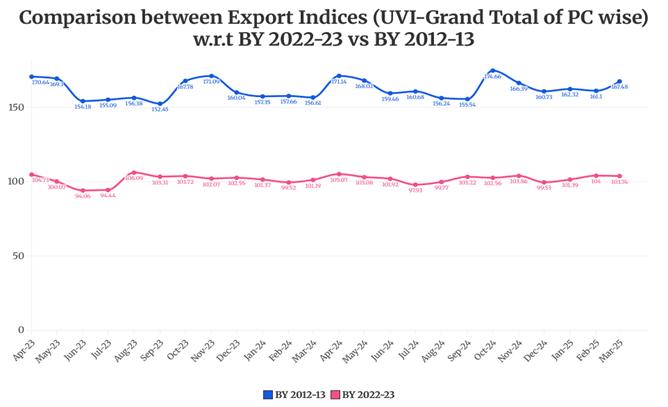
#BY means Base Year.
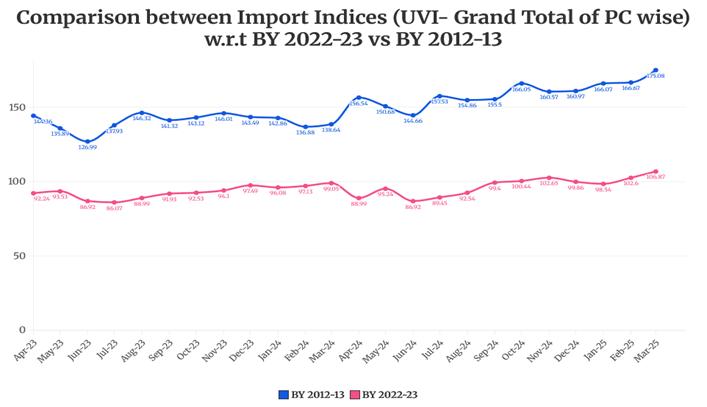
 

#BY means Base Year.

Table: Unit Value Index (UVI) and Quantity Index (QI) during FY 2025-26(Apr-Nov) using FY 2022-23 as base year


Month

Apr_25

May_25

Jun_25

1st Qtr 25-26

Jul_25

Aug_25

Sep_25

2nd Qtr 25-26

Oct_25

Nov_25

Unit Value Index

Export

105.31

99.73

96.31

100.33

99.31

100.55

104.08

101.23

103.78

105.32

Import

92.33

97.97

91.74

94.08

96.34

100.81

108.69

101.93

110.17

106.59

Quantity Index

Export

107.85

104.76

93.88

101.91

103.41

102.64

111.04

105.57

116.19

113.06

Import

138.16

126.61

112.58

125.17

122.47

124.06

126.45

124.32

137.04

121.75

Qtr  means Quarter.

Meaning and interpretation of the Indices

The Unit Value Indices and the Quantity Indices may be interpreted along the following lines.

The Unit Value Index answers the question: What is the growth in the average Unit Value of the items1 traded in the current month with respect to the same month in the Base Year?

So, an Unit Value Index of, say, 120 means that if the items that have been traded in the current month had been traded in the same month of the base year, and if the average price (or unit value) of those items had been Rs.100 in that month of the base year, then the average price (or unit value) of these items in the current month is Rs.120. Or that, there is a 20% increase in the average Unit Value, with respect to the Base Year, of the items that have been traded in the Current Month.

For example, let us suppose 30 items, 10 items each from 3 different Principal Commodities, have been traded in the current month. If these 30 items had been traded in the corresponding month of the base year at an average price of Rs.100, then the average price of these items in the current year is Rs.120.

It is to be noted that there are two successive steps of averaging done here. The first averaging is done over all the items (or ITCHS) of a PC group to arrive at the Index of that PC group. And the second averaging is done over all the PC groups to arrive at the Index at the Grand Total level for all commodities (which is the overall Index for India for a month). In both the stages, a weighted average is taken where the weights are proportional to the importance of the items and the PC groups respectively, and the Laspeyres Formula is used for averaging.

Quantity Indices, say, 200 means that if in the base year on an average 100 units were traded in India in the base year, then in the current year on an average 200 units were traded. However, it must be remembered that averaging quantities are different from averaging prices, since quantities in different units cannot be added directly.

So, the Quantity Indices are calculated by dividing the Value Indices by the Unit Value Indices. For example, if there is an increase in the Value of Export from Rs. 10,000 to Rs. 24,000, then the Value Index is 24000/10000 × 100 = 240. If the Unit Value Index is 120, then the Quantity Index comes to 240/120 × 100 = 200. So, loosely it can be said that, if the value of export has increased 2.4 times and the price of the commodities has increased 1.2 times, then the quantity must have doubled.

However, it may be noted that a very high or low Quantity Index may indicate the presence of Base Effect.

The Interpretation of the Bilateral and Regional Indices can be seen as an extension of the above.

A Unit Value Index of 120 with respect to a country, say Bangladesh, means that if all the items that have been traded with Bangladesh in the current month had been traded in the same month of the base year with the same country, and if the average price (or unit value) of those items had been Rs.100 in that month of the base year, then the average price (or unit value) of these items in the current month is Rs.120.

Similarly, a Quantity Index of 200 with respect to a country, say Bangladesh, means that if in the base year on an average 100 units were traded in India in the base year, then in the current year on an average 200 units were traded.

Comparability of the Indices across time

It is to be noted that the weights in the Index Number formula are fixed across time and there are twelve sets of weights for the twelve months. Hence, comparability of Indices is meaningful only when Indices of same month are compared across years. Different months may attach different weights to the same item, and hence comparing indices of two different months becomes vague and may have little applicability.

Further, the weights of the items that are not present in the trade basket of the current month are distributed to all the items that have been traded in the current month. This distribution is done in proportion to the weights of those items.

For example, let us suppose there are only 3 commodities for trade, say A, B and C. In month May of the Base year, let us suppose that the trade value of A was Rs. 50, B was Rs. 100 and C was Rs. 50. Then the weights assigned to A, B and C in the month of May of the following years would be in the ratio 50 :100 :50. However, in case, C is not traded in the current month, then the weight of C would be distributed proportionately among A and B, again in the ratio 1:2 (since in May the weights of A and B are in the ratio of 50 : 100, i.e., 1 : 2). So, in the current month the weights of A and B would be 3313  and 6623 .

As a result, the weights in any two given months are dependent on exactly the number of items (ITCHS codes) traded in those months. If the items traded are widely different, inference drawn from the comparison of the Indices may be done accordingly. On the other hand, more the similarity in the number of items traded more is the comparability of the two indices.

Net Terms of Trade:

Net Terms of Trade also called commodity Terms of Trade is defined as a ratio of export prices to import prices.

Let say 2022-23 be the base year and 2023-24 be the final year. We express both export and import prices in 2022-23 as 100. Now, suppose that at the end of 2023-24, it is found that the index of export prices decreased to 90 and index of import prices roses to 150. Then the Net Terms of Trade has changed to 90100150100=35 . Then terms of trade as index=35*100=60 . It implies that terms of trade of the country have decreased by about 40% in 2023-24 as compared with 2022-23. It thus shows a deterioration or a worsening of the terms of trade of the country.

If the index of export prices has risen to 150 and that of import prices had risen to 120, then the net terms of trade would have changed to 150120*100=125 . This implies an improvement in the net terms of trade of the country by 25% in 2023-24 over 2022-23.

Gross Terms of Trade:

Gross Terms of Trade is the ratio of physicalquantity of import to physical quantity of export.

Let say 2022-23 be the base year. In that year, the quantities export and import are denoted by 100. Now, suppose that in the year 2023-24, the index of quantity of import was 150 and that of quantity of export was 120. Then the gross terms of trade is given by 150100120100=54,  in terms of percentage =54*100=125 . This implies that there was an improvement of gross terms of trade by 25% in 2023-24 compared to 2022-23.

Income Terms of Trade: Income Terms of Trade is defined as- Net Terms of Trade multiplied by quantity of export.

Topics

Acts Income Tax