

Loading...

βœ•
Top
Help
×

By creating an account you can:

Logo TaxTMI
Call Us / Help / Feedbackβœ•

Contact Us At :

E-mail: [email protected]

Call / WhatsApp at: +91 99117 96707

For more information, Check Contact Us

FAQs :

To know Frequently Asked Questions, Check FAQs

Most Asked Video Tutorials :

For more tutorials, Check Video Tutorials

Submit Feedback/Suggestion :

Email :
Please provide your email address so we can follow up on your feedback.
Category :
Description :
Min 15 characters 0/2000
Make Most of Text Search βœ•
  1. Checkout this video tutorial: How to search effectively on TaxTMI.
  2. Put words in double quotes for exact word search, eg: "income tax"
  3. Avoid noise words such as : 'and, of, the, a'
  4. Sort by Relevance to get the most relevant document.
  5. Press Enter to add multiple terms/multiple phrases, and then click on Search to Search.
  6. Text Search
  7. The system will try to fetch results that contains ALL your words.
  8. Once you add keywords, you'll see a new 'Search In' filter that makes your results even more precise.
  9. Text Search
β•³
Add to...
You have not created any category. Kindly create one to bookmark this item!
βœ•
Create New Category
Hide
Title :
Description :
❮❮ Hide
Default View
Expand ❯❯
Close βœ•
🔎 News - Adv. Search
TEXT SEARCH:

Press 'Enter' to add multiple search terms. Rules for Better Search

Search In:
Main Text + AI Text
  • Main Text
  • Main Text + AI Text
  • AI Text
Category: ?
Categorized by AI
---- All Categories ----
  • ---- All Categories ----
  • Income Tax
  • GST
  • Customs, DGFT & SEZ
  • FEMA & RBI
  • Corp. Laws, SEBI & IBC
  • PMLA, Black Money & ED
  • Budget
  • News and Press Release
  • PTI News
Month:
---- All Months ----
  • ---- All Months ----
  • January
  • February
  • March
  • April
  • May
  • June
  • July
  • August
  • September
  • October
  • November
  • December
Year:
---- All Years ----
  • ---- All Years ----
  • 2026
  • 2025
  • 2024
  • 2023
  • 2022
  • 2021
  • 2020
  • 2019
  • 2018
  • 2017
  • 2016
  • 2015
  • 2014
  • 2013
  • 2012
  • 2011
Sort By: ?
In Sort By 'Default', exact matches for text search are shown at the top, followed by the remaining results in their regular order.
Relevance Default Date
    RBI Strengthens Framework on Unauthorised Electronic Banking Transactions
    RBI, IRDAI and SEBI Intensify Measures to Help Citizens Reclaim Unclaimed Deposits
    I-PAC raids: SC quizzes Bengal govt, says ED officers also have fundamental rights
    Guidance Note – Form 4
    AI Wealthtech Startup Novelty Wealth Raises $1.4M Led by IndiaQuotient to Scale their Wealth Advisory Platform for Indian investors
    Form 4 – Frequently Asked Questions
    ED identified Rs 36,000 crore in cybercrime proceeds in 257 cases till Feb 28: Govt
    Guidance Note – Form 3
    Punjab Governor highlights Aadhaar as key to transparent service delivery
    After Zomato, Swiggy hikes platform fee by 17 pc to Rs 17.58 per order
    Lekhakar Launches End-to-End Accounting Outsourcing Services for Indian SMEs, Reporting 40% Rise in GST and Payroll Compliance Demand
    Form No. 3 – Frequently Asked Questions (FAQs)
    Guidance Note – Form 2
    Iran war halts Marathwada turmeric exports, prices drop in domestic market
    The Banker Media Announces Asia’s Leading Annual Summit for Urban Cooperative Banks in Lucknow
    Form No. 2 – Frequently Asked Questions (FAQs)
    Guidance Note – Form 1
    Form No. 1 – Frequently Asked Questions
    FAQs on Interplay and Transition from the Income Tax Act, 1961 to the Income Tax Act, 2025
    Alkami Expands India Engineering Hub to Support Next Phase of Digital Banking Innovation
❯❯
Maximize Maximize Maximize
0 / 200
Expand Note
Add to Folder

No Folders have been created

+

Are you sure you want to delete "My most important" ?

NOTE:

News
Showing Results for :
Reset Filters
Results Found:
Show All Summaries Hide All Summaries
March 24, 2026
Show AI Summary
Unauthorised electronic banking transactions framework updated with compensation, AI fraud detection, and stronger mule account safeguards.
RBI has revised its framework on unauthorised electronic banking transactions, including a proposed compensation mechanism for small-value fraudulent transactions, to update customer-liability rules in response to technological change. The broader framework also relies on AI-driven fraud detection, mule account surveillance, real-time transaction monitoring, and public financial literacy campaigns to curb cyber fraud and strengthen safe banking practices.
March 24, 2026
Show AI Summary
Unclaimed financial assets: regulators expand digital portals, nomination reforms and simplified claim processes to help rightful claimants trace funds.
Measures by RBI, IRDAI and SEBI simplify identification, tracing and settlement of unclaimed financial assets through claim reforms, digital portals, nomination requirements and awareness drives. RBI has consolidated claim directions, introduced an incentive scheme, supported common application procedures and launched UDGAM; IRDAI and SEBI have adopted similar tracing, documentation and portal-based mechanisms for insurance proceeds and mutual fund amounts. Banks transfer long-inactive balances to the DEA Fund, and a nationwide campaign supported restitution of unclaimed assets to rightful owners.
March 24, 2026
Show AI Summary
Fundamental rights of ED officers shape maintainability debate over alleged obstruction during a money-laundering raid.
Maintainability of the ED's plea was examined in relation to alleged obstruction during a money-laundering raid at the I-PAC office. The issue was whether ED officers, acting in their individual capacity, could invoke fundamental rights under Article 32 and whether the petition had to identify the specific right allegedly violated. Arguments also addressed whether obstruction of statutory duties amounts to a constitutional violation and the relevance of Section 66 of PMLA in the context of the investigation and reporting of related offences.
March 24, 2026
Show AI Summary
Transfer of assets in India reporting requires accountant-certified Form 4, electronic filing, and cross-verification of returned income.
Form 4 is an accountant's report for income attributable to transfer of assets located in India under section 9(10), filed once in a tax year along with the return of income. It captures taxpayer details, transfer particulars, income derived, values of Indian and global assets, valuation methodology, and supporting documents such as valuation reports, financial statements, and sale documents. The form is filed electronically with UDIN and digital signature, and is used for cross-verification of income offered in the return.
March 24, 2026
Show AI Summary
AI wealth intelligence platform scales regulated fee-only advisory for Indian investors with unified financial insights.
A SEBI-RIA licensed wealth management platform has raised seed funding to scale a purpose-trained AI wealth intelligence product for Indian investors. The platform aggregates financial data across banks, brokerages, mutual funds, and other accounts into a unified view of assets, liabilities, portfolio performance, risk exposure, diversification, and concentration, and presents structured, actionable insights for personal finance decision-making. It operates on a zero-commission, fee-only advisory model aligned with investor interests.
March 24, 2026
Show AI Summary
Income attributable to transfer of assets in India requires an accountant's report filed online with UDIN and a valid PAN.
Form 4 is an accountant's report for computing income attributable to transfer of assets located in India, to be filed once in a tax year along with the return of income through the e-filing portal with a valid PAN and UDIN. The form requires supporting valuation, financial, and sale-related documents, cannot be edited after submission, and does not require proof of tax payment at filing, though payment evidence may be needed for return processing.
March 24, 2026
Show AI Summary
Cybercrime investigation coordination under money laundering law expands through data-sharing platforms, FIR access, and victim-centric complaint handling
The Enforcement Directorate has identified proceeds of crime in cybercrime investigations under the Prevention of Money Laundering Act, while sharing information with other law enforcement agencies through nodal officers and under Section 66(2) when relevant contraventions are noticed. It also uses the SAHYOG, Samanvaya and cyber police portal, along with the Inter-operable Criminal Justice System portal, for cybercrime data sharing, analytics and access to FIRs. A standard operating procedure has been issued for complaints through the National Cybercrime Reporting Portal and the Citizen Financial Cyber Fraud Reporting and Management System.
March 24, 2026
Show AI Summary
Zero Coupon Bond compliance reporting under Form 3 requires accountant certification of investment use, timelines, and sinking fund maintenance.
Form 3 under Rule 7 is the accountant's certificate for notified Zero Coupon Bonds issued by infrastructure capital companies, infrastructure capital funds, infrastructure debt funds and public sector companies. It certifies, for each relevant tax year, the amount of bond proceeds actually invested and verifies compliance with the prescribed utilisation timelines, minimum investment thresholds and, for infrastructure debt funds, maintenance of a sinking fund and investment of accrued interest in Government securities. The form is filed electronically with digital signature or electronic verification and includes the accountant's certificate with UDIN where applicable.
March 24, 2026
Show AI Summary
Aadhaar-based service delivery strengthens transparency, direct welfare transfer, and beneficiary targeting across public administration.
Aadhaar is highlighted as a governance instrument for transparent and efficient service delivery, linking citizens to bank accounts and enabling Direct Benefit Transfer so subsidies and financial assistance reach eligible beneficiaries directly. It is described as reducing fraud, eliminating ghost beneficiaries, and improving access to welfare schemes and government services across rural and underserved sections. The text also notes Aadhaar's use in birth registration, healthcare, health insurance claims, property-related matters, agricultural grain procurement, pension distribution, and food security implementation.
March 24, 2026
Show AI Summary
Platform fee increases in food delivery reflect higher operating costs, GST inclusion, and rising delivery expenses.
Food delivery platforms increased the platform fee charged to users on a per-order basis, with the revised charge stated to be inclusive of GST. The fee is a fixed amount added to delivery and restaurant charges and is linked to operating costs, technology maintenance, and customer support. The increase comes alongside comparable revisions by competing services and against the backdrop of rising fuel costs affecting delivery operations.
March 24, 2026
Show AI Summary
Accounting outsourcing services for SMEs expand compliance support across GST, payroll, income tax filing, and financial reporting.
Accounting outsourcing services for SMEs combine bookkeeping, GST compliance, income tax filing, payroll management, accounts payable and receivable support, and financial advisory under a single engagement model. The service package addresses rising demand from small and medium-sized enterprises seeking assistance with GST filing cycles, payroll compliance, audit preparation, and maintenance of accurate financial records while managing business operations. The offering includes monthly reconciliation and financial reporting, GST return filing, input tax credit reconciliation, ITR filing, payroll processing with PF/ESI compliance and TDS on salaries, vendor and debtor tracking, and budgeting and cash flow planning.
March 24, 2026
Show AI Summary
Zero Coupon Bonds compliance certificate must be filed electronically each tax year by eligible issuers.
Form No. 3 is the prescribed accountant's certificate under rule 7 for certifying utilisation of funds raised through notified Zero Coupon Bonds. It is mandatory for each relevant tax year and applies to every issuer of a notified Zero Coupon Bond, including infrastructure capital companies, infrastructure capital funds, infrastructure debt funds, and public sector companies. The certificate must be filed electronically within two months from the end of the relevant tax year and is year-specific, with revision permitted only if the system enables it.
March 24, 2026
Show AI Summary
Zero-coupon bond notification under Rule 7 requires strict filing, investment, rating and listing compliance before tax recognition.
Form 2 is the prescribed application under Rule 7 for infrastructure capital companies, infrastructure capital funds, infrastructure debt funds and public sector companies seeking notification of a proposed zero-coupon bond. Notification is a mandatory pre-condition for the bond to qualify as a zero-coupon bond and to obtain the special tax treatment of discount. The form collects applicant, bond and investment details so the Central Government can verify tenure, credit rating, listing, investment commitments and reporting undertakings.
March 24, 2026
Show AI Summary
Turmeric export disruption hits Marathwada trade as conflict halts shipments and weakens domestic prices.
The conflict involving the US, Israel and Iran has disrupted turmeric exports from Maharashtra's Marathwada region, with shipments to Gulf and African markets reported to have stopped completely. The trade interruption has affected turmeric grown across the region's turmeric belts, including Hingoli, Nanded, Wardha, Parbhani, Yavatmal and Washim. The Vasmat variety from Hingoli received a Geographical Indication tag in 2024, and consignments from Hingoli and adjoining areas are shipped abroad after processing through Tamil Nadu and Kerala.
March 24, 2026
Show AI Summary
AI-driven cooperative banking summit spotlights digital innovation, cybersecurity, regulatory compliance and sector-wide collaboration in urban cooperative banks.
The Bharat Cooperative Banking Summit & Awards 2026 is a three-day forum for urban cooperative banks focused on AI-driven cooperative banking, digital innovation, cybersecurity, regulatory technology, operational resilience and regulatory compliance. It brings together senior leaders, policymakers, regulators, fintech partners and technology providers for collaboration, knowledge exchange and alignment with evolving digital and regulatory expectations. The awards segment recognises excellence in leadership, innovation, governance, financial inclusion, digital transformation and service within the cooperative movement.
March 24, 2026
Show AI Summary
Zero Coupon Bond notification requires mandatory advance filing of Form No. 2 with prescribed details and supporting documents.
Form No. 2 is the prescribed electronic application under rule 7 of the Income-tax Rules for notification of a Zero Coupon Bond under section 2(112) of the Act. Filing is mandatory before issue, must be made at least three months in advance, and is issue-specific. It is to be filed by an infrastructure capital company, infrastructure capital fund, infrastructure debt fund, or public sector company with the required details and supporting annexures.
March 24, 2026
Show AI Summary
Client code modification reporting requires monthly online filing by stock exchanges for cash and derivative transactions.
A monthly statement is required from stock exchanges reporting modified client code transactions in cash and derivative market transactions. The form must be filed online by all stock exchanges through the income tax e-filing portal, and its smart-form format captures basic exchange details. The format also incorporates commodity derivative details previously associated with Form 3BC, which has been rendered redundant, while no other changes are made to the Cash Market and Derivative Market tables.
March 24, 2026
Show AI Summary
Stock exchange reporting rules require monthly filing of client code modification statements through the e-filing portal.
Form No. 1 is a mandatory monthly statement to be furnished by a stock exchange for transactions in which client codes have been modified after registration in the system. It applies to both cash and derivative markets, must be filed within 15 days from the end of each relevant month, and is submitted only online through the Income Tax e-Filing portal. Once filed and acknowledged, it cannot be edited, and submission requires a valid PAN.
March 24, 2026
Show AI Summary
Tax Year transition and repeal savings preserve continuity while the Income-tax Act, 2025 simplifies compliance and reorganises filings.
The Income-tax Act, 2025 replaces the Income-tax Act, 1961 as a streamlined and modernised code, while preserving the underlying tax policy, continuity of pending matters, and the existing compliance architecture. The new Act substitutes the concept of Assessment Year with Tax Year, applies prospectively from 1 April 2026, and continues the old Act for tax years beginning before that date. Transitional provisions preserve rights, liabilities, pending proceedings, tax payments, return filing, reassessment, appeals, deductions, and losses under the repealed Act, while the new Act reorganises forms, withholding provisions, and compliance statements in simplified and consolidated form.
March 24, 2026
Show AI Summary
Anticipatory banking drives India hub expansion for stronger engineering, data, and cloud support across digital banking platforms.
Expansion of a global capability center in India to strengthen engineering, data intelligence and cloud architecture support for a digital sales and service platform used by financial institutions. The India hub is intended to deepen technical capacity for platform development, security, scalability and reliable digital banking delivery, while supporting the company's move toward anticipatory banking through data-driven and AI-enabled capabilities.

News

Back

All News

Showing Results for :
Reset Filters
No Records Found

News

Back

All News

Showing Results for : Reset Filters
Customs, DGFT & SEZ

Directorate General of Commercial Intelligence and Statistics Revises Base Year of Merchandise Trade Indices to FY 2022–23 to Reflect Current Trade Structure and Global Patterns

February 21, 2026

Contents
Summary
Note

Note

-

Bookmark

Print

Print

Merchandise Trade Indices are compiled and published by the Directorate General of Commercial Intelligence and Statistics (DGCI&S), Ministry of Commerce & Industry, to measure changes in the unit values (prices) of India’s exports and imports over time. These indices serve as important indicators of external sector price movements and are widely used for economic analysis, including national accounts compilation and assessment of terms of trade. Over the years, the base year of the indices has been periodically revised to reflect structural changes in India’s trade composition and evolving global trade patterns. The most recent revision updates the base year to FY 2022–23 (2022–23 = 100), replacing the earlier base of FY 2012–13, thereby ensuring that the indices accurately represent the current structure of India’s merchandise trade.

Revision of Base Year of India’s Merchandise Trade Indices to FY 2022–23

The Directorate General of Commercial Intelligence and Statistics (DGCI&S), Ministry of Commerce & Industry, has revised the base year of India’s Merchandise Trade Indices from FY 2012–13 to FY 2022–23 (2022–23 = 100), in view of the structural changes in the economy, shifts in commodity composition, evolving trade patterns, and the need for improved alignment with contemporary macroeconomic indicators.

The revision has been undertaken on the recommendations of a committee constituted by DGCI&S under the Chairmanship of Prof. Nachiketa Chattopadhyay, Professor, Indian Statistical Institute, Kolkata. The Committee examined the existing methodology, data coverage, weighting structure, and compilation practices, and recommended suitable refinements in line with international best practices.

Key Features of the Revised Series (Base: FY 2022–23)

  1. Updated Base Year:
    The new base year FY 2022–23 makes the Indices reflect the current structure of India’s external trade more accurately.
  2. Revised Commodity Basket:
    The coverage and classification of commodities have been reviewed at the Principal Commodity level to better capture emerging and declining trade items.
  3. Revised Weighting Structure:
    Weights have been updated based on trade values of the new base year to reflect the latest value shares in exports and imports.
  4. Improved Methodology:
    Methodological refinements have been introduced in:
    1. Selection of common commodity basket for base year selection (procedure of selection for common commodity basket explained in detail report of the committee).
    2. Treatment of missing unit values (Imputation of missing unit values in base year selection have been explained in detail in the committee report).
  5. Indices Compiled:
    The revised series includes:
    1. Monthly, Quarterly and Annual Indices (Export Unit Value Index,Import Unit Value Index).
    2. Principal Commodity (PC) Classification wise Trade Indices (Export/Import).
    3. Standard International Trade Classification-wise (SITC) Trade Indices.
    4. Broad economic categories-wise (BEC) Trade Indices.
    5. Bilateral and Region-wise Trade Indices of Top 20 Export and Import partner nations of India.
    6. Terms of Trade (Gross terms of trade, Net terms of trade and Income terms of trade).

Rationale for Revision

Over the past decade, India’s trade basket has undergone substantial changes due to emergence of new commodities, technological advancements, Global supply chain restructuring and changes in relative price structures.

The earlier base year (FY 2012–13) no longer adequately reflected the prevailing trade structure. The revision ensures improved relevance, reliability, and analytical usefulness of the Merchandise Trade Indices for policymakers, researchers, and other stakeholders.

Use of the Revised Series

Merchandise Trade Indices compiled by the Directorate General of Commercial Intelligence and Statistics (DGCI&S) are extensively used by key government institutions for economic analysis and policy formulation. The National Accounts Division (NAD) of the Ministry of Statistics and Programme Implementation uses the Export and Import Unit Value Indices as deflators for estimating real exports and imports in GDP compilation. The Reserve Bank of India (RBI) relies on these indices for external sector assessment, balance of payments analysis, and evaluation of price competitiveness. Various Ministries and Government agencies also use them to frame and review trade-related policies and to assess movements in international prices. In addition, academic institutions, research organizations, and economic analysts utilize Merchandise Trade Indices for empirical research, modelling, and analysis of trade dynamics and terms of trade trendson and economic research.

Availability of Data

The revised Merchandise Trade Indices (Base: FY 2022–23) will be released on the official website of DGCI&S. Detailed methodological documentation is available in the Report of the Committee on Revision of Base Year for Merchandise Trade Indices.

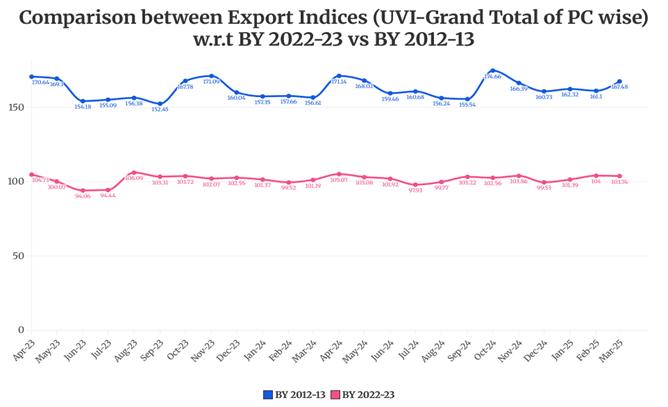
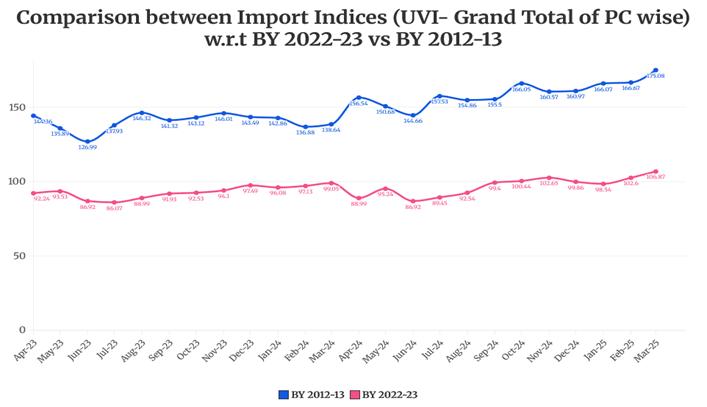
Comparison of the new revised Indices (Base Year: 2022-23) with the already released Indices (Base Year : 2012-13) for 2022-23 and 2023-24 is given below.
#BY means Base Year.
 

#BY means Base Year.

Table: Unit Value Index (UVI) and Quantity Index (QI) during FY 2025-26(Apr-Nov) using FY 2022-23 as base year


Month

Apr_25

May_25

Jun_25

1st Qtr 25-26

Jul_25

Aug_25

Sep_25

2nd Qtr 25-26

Oct_25

Nov_25

Unit Value Index

Export

105.31

99.73

96.31

100.33

99.31

100.55

104.08

101.23

103.78

105.32

Import

92.33

97.97

91.74

94.08

96.34

100.81

108.69

101.93

110.17

106.59

Quantity Index

Export

107.85

104.76

93.88

101.91

103.41

102.64

111.04

105.57

116.19

113.06

Import

138.16

126.61

112.58

125.17

122.47

124.06

126.45

124.32

137.04

121.75

Qtr  means Quarter.

Meaning and interpretation of the Indices

The Unit Value Indices and the Quantity Indices may be interpreted along the following lines.

The Unit Value Index answers the question: What is the growth in the average Unit Value of the items1 traded in the current month with respect to the same month in the Base Year?

So, an Unit Value Index of, say, 120 means that if the items that have been traded in the current month had been traded in the same month of the base year, and if the average price (or unit value) of those items had been Rs.100 in that month of the base year, then the average price (or unit value) of these items in the current month is Rs.120. Or that, there is a 20% increase in the average Unit Value, with respect to the Base Year, of the items that have been traded in the Current Month.

For example, let us suppose 30 items, 10 items each from 3 different Principal Commodities, have been traded in the current month. If these 30 items had been traded in the corresponding month of the base year at an average price of Rs.100, then the average price of these items in the current year is Rs.120.

It is to be noted that there are two successive steps of averaging done here. The first averaging is done over all the items (or ITCHS) of a PC group to arrive at the Index of that PC group. And the second averaging is done over all the PC groups to arrive at the Index at the Grand Total level for all commodities (which is the overall Index for India for a month). In both the stages, a weighted average is taken where the weights are proportional to the importance of the items and the PC groups respectively, and the Laspeyres Formula is used for averaging.

Quantity Indices, say, 200 means that if in the base year on an average 100 units were traded in India in the base year, then in the current year on an average 200 units were traded. However, it must be remembered that averaging quantities are different from averaging prices, since quantities in different units cannot be added directly.

So, the Quantity Indices are calculated by dividing the Value Indices by the Unit Value Indices. For example, if there is an increase in the Value of Export from Rs. 10,000 to Rs. 24,000, then the Value Index is 24000/10000 × 100 = 240. If the Unit Value Index is 120, then the Quantity Index comes to 240/120 × 100 = 200. So, loosely it can be said that, if the value of export has increased 2.4 times and the price of the commodities has increased 1.2 times, then the quantity must have doubled.

However, it may be noted that a very high or low Quantity Index may indicate the presence of Base Effect.

The Interpretation of the Bilateral and Regional Indices can be seen as an extension of the above.

A Unit Value Index of 120 with respect to a country, say Bangladesh, means that if all the items that have been traded with Bangladesh in the current month had been traded in the same month of the base year with the same country, and if the average price (or unit value) of those items had been Rs.100 in that month of the base year, then the average price (or unit value) of these items in the current month is Rs.120.

Similarly, a Quantity Index of 200 with respect to a country, say Bangladesh, means that if in the base year on an average 100 units were traded in India in the base year, then in the current year on an average 200 units were traded.

Comparability of the Indices across time

It is to be noted that the weights in the Index Number formula are fixed across time and there are twelve sets of weights for the twelve months. Hence, comparability of Indices is meaningful only when Indices of same month are compared across years. Different months may attach different weights to the same item, and hence comparing indices of two different months becomes vague and may have little applicability.

Further, the weights of the items that are not present in the trade basket of the current month are distributed to all the items that have been traded in the current month. This distribution is done in proportion to the weights of those items.

For example, let us suppose there are only 3 commodities for trade, say A, B and C. In month May of the Base year, let us suppose that the trade value of A was Rs. 50, B was Rs. 100 and C was Rs. 50. Then the weights assigned to A, B and C in the month of May of the following years would be in the ratio 50 :100 :50. However, in case, C is not traded in the current month, then the weight of C would be distributed proportionately among A and B, again in the ratio 1:2 (since in May the weights of A and B are in the ratio of 50 : 100, i.e., 1 : 2). So, in the current month the weights of A and B would be 3313  and 6623 .

As a result, the weights in any two given months are dependent on exactly the number of items (ITCHS codes) traded in those months. If the items traded are widely different, inference drawn from the comparison of the Indices may be done accordingly. On the other hand, more the similarity in the number of items traded more is the comparability of the two indices.

Net Terms of Trade:

Net Terms of Trade also called commodity Terms of Trade is defined as a ratio of export prices to import prices.

Let say 2022-23 be the base year and 2023-24 be the final year. We express both export and import prices in 2022-23 as 100. Now, suppose that at the end of 2023-24, it is found that the index of export prices decreased to 90 and index of import prices roses to 150. Then the Net Terms of Trade has changed to 90100150100=35 . Then terms of trade as index=35*100=60 . It implies that terms of trade of the country have decreased by about 40% in 2023-24 as compared with 2022-23. It thus shows a deterioration or a worsening of the terms of trade of the country.

If the index of export prices has risen to 150 and that of import prices had risen to 120, then the net terms of trade would have changed to 150120*100=125 . This implies an improvement in the net terms of trade of the country by 25% in 2023-24 over 2022-23.

Gross Terms of Trade:

Gross Terms of Trade is the ratio of physicalquantity of import to physical quantity of export.

Let say 2022-23 be the base year. In that year, the quantities export and import are denoted by 100. Now, suppose that in the year 2023-24, the index of quantity of import was 150 and that of quantity of export was 120. Then the gross terms of trade is given by 150100120100=54,  in terms of percentage =54*100=125 . This implies that there was an improvement of gross terms of trade by 25% in 2023-24 compared to 2022-23.

Income Terms of Trade: Income Terms of Trade is defined as- Net Terms of Trade multiplied by quantity of export.

Topics

Acts Income Tax