

Loading...

Top
Help
×

By creating an account you can:

Logo TaxTMI
Call Us / Help / Feedback

Contact Us At :

E-mail: [email protected]

Call / WhatsApp at: +91 99117 96707

For more information, Check Contact Us

FAQs :

To know Frequently Asked Questions, Check FAQs

Most Asked Video Tutorials :

For more tutorials, Check Video Tutorials

Submit Feedback/Suggestion :

Email :
Please provide your email address so we can follow up on your feedback.
Category :
Description :
Min 15 characters 0/2000
Make Most of Text Search
  1. Checkout this video tutorial: How to search effectively on TaxTMI.
  2. Put words in double quotes for exact word search, eg: "income tax"
  3. Avoid noise words such as : 'and, of, the, a'
  4. Sort by Relevance to get the most relevant document.
  5. Press Enter to add multiple terms/multiple phrases, and then click on Search to Search.
  6. Text Search
  7. The system will try to fetch results that contains ALL your words.
  8. Once you add keywords, you'll see a new 'Search In' filter that makes your results even more precise.
  9. Text Search
Add to...
You have not created any category. Kindly create one to bookmark this item!
Create New Category
Hide
Title :
Description :
❮❮ Hide
Default View
Expand ❯❯
Close ✕
🔎 News - Adv. Search
TEXT SEARCH:

Press 'Enter' to add multiple search terms. Rules for Better Search

Search In:
Main Text + AI Text
  • Main Text
  • Main Text + AI Text
  • AI Text
Category: ?
Categorized by AI
---- All Categories ----
  • ---- All Categories ----
  • Income Tax
  • GST
  • Customs, DGFT & SEZ
  • FEMA & RBI
  • Corp. Laws, SEBI & IBC
  • PMLA, Black Money & ED
  • Budget
  • News and Press Release
  • PTI News
Month:
---- All Months ----
  • ---- All Months ----
  • January
  • February
  • March
  • April
  • May
  • June
  • July
  • August
  • September
  • October
  • November
  • December
Year:
---- All Years ----
  • ---- All Years ----
  • 2026
  • 2025
  • 2024
  • 2023
  • 2022
  • 2021
  • 2020
  • 2019
  • 2018
  • 2017
  • 2016
  • 2015
  • 2014
  • 2013
  • 2012
  • 2011
Sort By: ?
In Sort By 'Default', exact matches for text search are shown at the top, followed by the remaining results in their regular order.
Relevance Default Date
❯❯
Maximize Maximize Maximize
0 / 200
Expand Note
Add to Folder

No Folders have been created

+

Are you sure you want to delete "My most important" ?

NOTE:

News
Showing Results for :
Reset Filters
Results Found:
Show All Summaries Hide All Summaries
March 25, 2026
Show AI Summary
Specified business notification for affordable housing projects requires electronic filing, supporting documents, and compliance verification.
Form 18 is the prescribed application for notification of an affordable housing project as a specified business under section 46. It is required to be furnished electronically by an assessee seeking such notification and captures particulars of the assessee, the specified business, the proposed project, and compliance with prescribed conditions. Supporting documents such as the development agreement, sanction letter, and layout approval are attached to assist verification. The application is examined for compliance before notification may be granted.
March 25, 2026
Show AI Summary
Affordable housing project notification through Form 18 is mandatory for claiming tax benefits under the specified business regime.
Form 18 is the prescribed application for notification of an affordable housing project as a specified business under section 46 of the Income-tax Act, 2025, and filing it is mandatory for availing the tax benefits available under that provision. The form requires the assessee to furnish particulars of the assessee, the specified business, the proposed project, compliance with prescribed conditions, and other project-related details, including project location, unit-wise area particulars, investment, title to land, development agreements, and a declaration certifying correctness of the information furnished.
March 25, 2026
Show AI Summary
Approval for research-linked income-tax benefits through Form No. 17 requires detailed filing, verification, and ongoing annual compliance.
Form No. 17 is the prescribed electronic application for an Indian company and for a research association, university, college or other institution seeking approval under the relevant income-tax framework. It requires verified filing within the prescribed time, detailed particulars of the applicant, research activities, income, expenditure, donations, and supporting documents. The prescribed authority may issue a deficiency notice, and after approval the entity must furnish annual research-related compliance details.
March 25, 2026
Show AI Summary
Form No. 17 approval applications require detailed disclosures, electronic filing, and ongoing compliance for research-related tax recognition.
Form No. 17 is the prescribed electronic application for approval under section 45(3)(b) for a company and section 45(4)(b) for a research association, university, college or other institution. The form requires disclosure of incorporation details, key persons, beneficial owners, registrations, research facilities, research projects, income and expenditure, together with prescribed enclosures and declarations. Approval remains subject to maintenance of books, audit and reporting obligations, compliance with conditions of approval, and the possibility of withdrawal if activities cease, become non-genuine, or are not carried out as required.
March 25, 2026
Show AI Summary
Scientific research donation certificates streamline deduction verification through annual donor-wise reporting, Form 16 linkage, and corrected issuance.
Form 16 serves as the annual donor-wise certificate for contributions made to prescribed institutions for scientific research and is used to support verification of deductions claimed under the Income-tax Act, 2025. The certificate records aggregate donations received during the tax year, is not a receipt for individual transactions, and operates separately from transaction-level acknowledgments issued by the institution. It is linked to Form 15, must be issued once in each tax year on or before 31 May, and may be corrected if errors are found.
March 25, 2026
Show AI Summary
Finance Bill 2026 advances budgetary approval as Lok Sabha passes the measure with government amendments.
Lok Sabha passed the Finance Bill 2026 with 32 government amendments, completing its role in the Budgetary approval process for 2026-27 and sending the Bill to the Rajya Sabha for further consideration. The Budget framework for 2026-27 provides for substantial expenditure and capital outlay, along with projected gross tax revenue, gross borrowing, and a lower fiscal deficit than the current fiscal year.
March 25, 2026
Show AI Summary
Annual donor certificate for scientific research requires electronic FORM 16, separate from receipts and subject to deduction conditions.
Prescribed undertakings or institutions covered by section 45(3) must issue FORM 16 as an annual certificate to donors for sums received for scientific research. The certificate is issued once for the relevant tax year, on or before 31 May immediately following that year, and records the aggregate donation, donor particulars, the institution's approval details, and the relevant clause of section 45(3). FORM 16 is distinct from FORM 15, may be corrected or revised, and does not by itself guarantee deduction to the donor.
March 25, 2026
Show AI Summary
Scientific research donation reporting under Form 15 requires annual filing, donor-wise particulars, and cross-verification of deductions.
Form 15 is a statutory annual information statement for prescribed undertakings or institutions receiving sums for scientific research, social science research or statistical research under the Income-tax Act, 2025. It must be furnished annually by the recipient institution and verified by the person authorised to verify its return of income, on or before 31st May following the relevant tax year. The form captures donor-wise and donation-wise particulars and serves as a primary data source for cross-verification of deductions claimed by donors, without itself conferring any deduction.
March 25, 2026
Show AI Summary
Scientific research donation reporting under FORM 15 requires annual electronic furnishing by the recipient institution.
FORM 15 is a prescribed annual statement to be furnished by a prescribed undertaking or institution in respect of sums received for scientific research during a tax year. It applies to eligible sums received for scientific, social science or statistical research, and not to charitable donations. The obligation lies with the recipient institution, the statement is to be furnished annually on or before 31st May, and it must include donor-wise particulars, approval details, and receipt information. Non-furnishing or incorrect furnishing may affect the donor's deduction and attract statutory consequences.
March 25, 2026
Show AI Summary
In-house R&D approval under Form 14 conditions tax deduction eligibility and links scientific recognition with compliance oversight.
Proposed Form 14 is the statutory approval order for an in-house research and development facility under section 45(2) of the Income-tax Act, 2025. Issued by the Department of Scientific and Industrial Research under Rule 29, it records the company's particulars, the facility details, DSIR recognition, and the grant of approval for the deduction framework. The approval is facility-specific, depends on continued DSIR recognition, and does not by itself establish deduction entitlement.
March 25, 2026
Show AI Summary
In-house research and development approval governs deduction claims subject to DSIR recognition and statutory compliance.
FORM 14 is the prescribed approval order issued by DSIR for a company's in-house research and development facility under section 45(2) read with Rule 29. It formally grants approval, records the scientific research to be undertaken, links the approval with DSIR recognition and the company's application, and supports a deduction claim subject to compliance with statutory conditions. The form is facility-specific, not a filing form, and may be withdrawn for non-compliance or withdrawal of DSIR recognition.
March 25, 2026
Show AI Summary
Scientific research and development audit reporting supports deduction claims through mandatory independent certification and account verification.
Proposed FORM 13 is the annual statutory audit report for an approved in-house scientific research and development facility under section 45(2) of the Income-tax Act, 2025. It is furnished by the company through an independent accountant and provides independent assurance on maintenance of separate accounts, correctness of capital and revenue expenditure, conformity with DSIR guidelines, and linkage with audited financial statements. FORM 13 is a mandatory supporting document for deduction claims and operates with FORM 11, FORM 14 and FORM 12 in the compliance framework.
March 25, 2026
Show AI Summary
In-house R&D audit report defines compliance for deduction claims through separate accounts and certified expenditure.
FORM 13 is the accountant's annual audit report for an approved in-house scientific research and development facility claimed under section 45(2). It certifies maintenance of separate accounts, correctness of expenditure, and conformity with DSIR guidelines, and must be attached with or furnished in support of the company's return of income. The form is a mandatory compliance requirement, but deduction remains subject to verification and assessment.
March 25, 2026
Show AI Summary
Research and development deduction reporting through Form 12 supports technical certification, expenditure verification, and compliance oversight.
Proposed Form 12 is the statutory reporting form through which the prescribed authority, acting under Rule 29, submits findings and certification regarding an approved in-house research and development facility to the jurisdictional Chief Commissioner of Income-tax. It operates within the compliance framework for deduction of expenditure on approved in-house R&D facilities under section 45(2) of the Income-tax Act, 2025 and records evaluation details, eligible expenditure and asset movements for verification of deduction claims.
March 25, 2026
Show AI Summary
Research and development deduction reporting through FORM 12 supports verification of eligible expenditure and compliance oversight.
FORM 12 is a statutory report furnished by the prescribed authority under section 45(2) read with Rule 29 for an approved in-house research and development facility. It is filed with the Chief Commissioner of Income-tax and records the facility's examination, recognition status, and eligible capital and revenue expenditure for verifying deduction claims. The form is not filed by the company and does not itself determine final allowability of deduction, which remains subject to departmental verification during processing or assessment.
March 25, 2026
Show AI Summary
In-house R&D facility approval framework under income tax law requires DSIR cooperation, audit compliance, and ongoing reporting.
FORM 11 sets out the statutory application and agreement framework for approval of in-house research and development facilities under section 45(2) of the Income-tax Act, 2025, read with Rule 29. It applies to eligible companies maintaining or proposing to maintain an in-house R&D facility and requires disclosure of company particulars, a DSIR agreement, and binding undertakings on audit, reporting, asset use, and compliance. Approval is facility-specific and remains subject to continued compliance, with DSIR serving as the prescribed authority for evaluation and oversight.
March 25, 2026
Show AI Summary
In-house research and development approval requires disclosure, audit, and ongoing compliance before deduction can be considered.
Form 11 is the prescribed application under Rule 29 for a company seeking to enter into an agreement with the Department of Scientific and Industrial Research for an in-house research and development facility under section 45(2). It requires disclosure of company particulars, R&D expenditure, facility details, research objectives, and undertakings on maintenance and audit of accounts. The form is generally a one-time approval application, but annual compliance continues through progress reports, audited accounts, and expenditure details. Approval does not itself secure deduction, which depends on statutory conditions, the agreement, and verification.
March 25, 2026
Show AI Summary
Statutory reporting for approved scientific research programmes under FORM 10 strengthens tax oversight and compliance monitoring.
Proposed FORM 10 is the statutory reporting form furnished by the prescribed authority to the Income-tax Department for approved scientific research programmes under section 45(3)(c) of the Income-tax Act, 2025. It functions as the oversight stage after FORM 7 and FORM 8, linking approvals with departmental monitoring of payments, utilisation and deduction claims. The form is furnished electronically to the jurisdictional Chief Commissioner within the prescribed time and records the essential particulars of the approved programme, while not conferring any entitlement on the sponsor or replacing the approval order.
March 25, 2026
Show AI Summary
Scientific research programme approval reporting under tax law supports compliance monitoring, deduction verification, and administrative recordkeeping.
FORM 10 is a statutory report furnished by the prescribed authority in relation to a scientific research programme approved under section 45(3)(c) read with Rule 30. It is a post-approval monitoring instrument, furnished to the Chief Commissioner of Income-tax having jurisdiction over the sponsor within the prescribed time. The form records approval details, programme particulars, conditions of approval, and supports administrative monitoring, compliance verification, and cross-checking of deduction claims. It does not alter or substitute the approval granted under FORM 8.
March 25, 2026
Show AI Summary
Scientific research deduction claims depend on programme-specific Form 9 receipts, approval linkage, and statutory compliance requirements.
Form 9 is a statutory receipt for payments made towards an approved scientific research programme and links the payment stage with the approval granted in Form 8 and the sponsor's deduction claim under section 45(3)(c) of the Income-tax Act, 2025. It is issued by the designated executing institution, records sponsor details, payment particulars, programme information, approved cost, tax years and cumulative receipts, and is programme-specific. The receipt supports but does not itself establish entitlement to deduction, which remains subject to statutory compliance and verification.

News

Back

All News

Showing Results for :
Reset Filters
No Records Found

News

Back

All News

Showing Results for : Reset Filters
Customs, DGFT & SEZ

Directorate General of Commercial Intelligence and Statistics Revises Base Year of Merchandise Trade Indices to FY 2022–23 to Reflect Current Trade Structure and Global Patterns

February 21, 2026

Contents
Summary
Note

Note

-

Bookmark

Print

Print

Merchandise Trade Indices are compiled and published by the Directorate General of Commercial Intelligence and Statistics (DGCI&S), Ministry of Commerce & Industry, to measure changes in the unit values (prices) of India’s exports and imports over time. These indices serve as important indicators of external sector price movements and are widely used for economic analysis, including national accounts compilation and assessment of terms of trade. Over the years, the base year of the indices has been periodically revised to reflect structural changes in India’s trade composition and evolving global trade patterns. The most recent revision updates the base year to FY 2022–23 (2022–23 = 100), replacing the earlier base of FY 2012–13, thereby ensuring that the indices accurately represent the current structure of India’s merchandise trade.

Revision of Base Year of India’s Merchandise Trade Indices to FY 2022–23

The Directorate General of Commercial Intelligence and Statistics (DGCI&S), Ministry of Commerce & Industry, has revised the base year of India’s Merchandise Trade Indices from FY 2012–13 to FY 2022–23 (2022–23 = 100), in view of the structural changes in the economy, shifts in commodity composition, evolving trade patterns, and the need for improved alignment with contemporary macroeconomic indicators.

The revision has been undertaken on the recommendations of a committee constituted by DGCI&S under the Chairmanship of Prof. Nachiketa Chattopadhyay, Professor, Indian Statistical Institute, Kolkata. The Committee examined the existing methodology, data coverage, weighting structure, and compilation practices, and recommended suitable refinements in line with international best practices.

Key Features of the Revised Series (Base: FY 2022–23)

  1. Updated Base Year:
    The new base year FY 2022–23 makes the Indices reflect the current structure of India’s external trade more accurately.
  2. Revised Commodity Basket:
    The coverage and classification of commodities have been reviewed at the Principal Commodity level to better capture emerging and declining trade items.
  3. Revised Weighting Structure:
    Weights have been updated based on trade values of the new base year to reflect the latest value shares in exports and imports.
  4. Improved Methodology:
    Methodological refinements have been introduced in:
    1. Selection of common commodity basket for base year selection (procedure of selection for common commodity basket explained in detail report of the committee).
    2. Treatment of missing unit values (Imputation of missing unit values in base year selection have been explained in detail in the committee report).
  5. Indices Compiled:
    The revised series includes:
    1. Monthly, Quarterly and Annual Indices (Export Unit Value Index,Import Unit Value Index).
    2. Principal Commodity (PC) Classification wise Trade Indices (Export/Import).
    3. Standard International Trade Classification-wise (SITC) Trade Indices.
    4. Broad economic categories-wise (BEC) Trade Indices.
    5. Bilateral and Region-wise Trade Indices of Top 20 Export and Import partner nations of India.
    6. Terms of Trade (Gross terms of trade, Net terms of trade and Income terms of trade).

Rationale for Revision

Over the past decade, India’s trade basket has undergone substantial changes due to emergence of new commodities, technological advancements, Global supply chain restructuring and changes in relative price structures.

The earlier base year (FY 2012–13) no longer adequately reflected the prevailing trade structure. The revision ensures improved relevance, reliability, and analytical usefulness of the Merchandise Trade Indices for policymakers, researchers, and other stakeholders.

Use of the Revised Series

Merchandise Trade Indices compiled by the Directorate General of Commercial Intelligence and Statistics (DGCI&S) are extensively used by key government institutions for economic analysis and policy formulation. The National Accounts Division (NAD) of the Ministry of Statistics and Programme Implementation uses the Export and Import Unit Value Indices as deflators for estimating real exports and imports in GDP compilation. The Reserve Bank of India (RBI) relies on these indices for external sector assessment, balance of payments analysis, and evaluation of price competitiveness. Various Ministries and Government agencies also use them to frame and review trade-related policies and to assess movements in international prices. In addition, academic institutions, research organizations, and economic analysts utilize Merchandise Trade Indices for empirical research, modelling, and analysis of trade dynamics and terms of trade trendson and economic research.

Availability of Data

The revised Merchandise Trade Indices (Base: FY 2022–23) will be released on the official website of DGCI&S. Detailed methodological documentation is available in the Report of the Committee on Revision of Base Year for Merchandise Trade Indices.

Comparison of the new revised Indices (Base Year: 2022-23) with the already released Indices (Base Year : 2012-13) for 2022-23 and 2023-24 is given below.
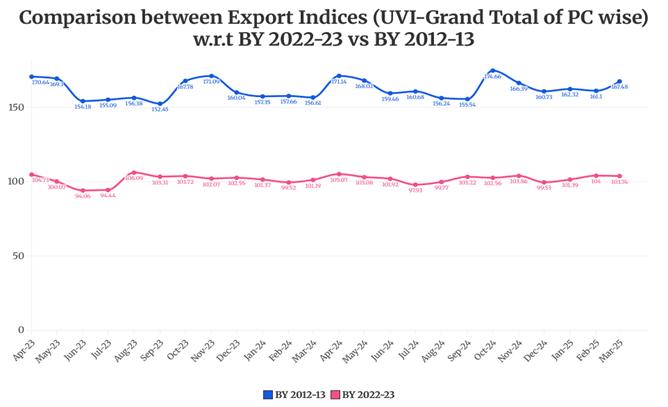
#BY means Base Year.
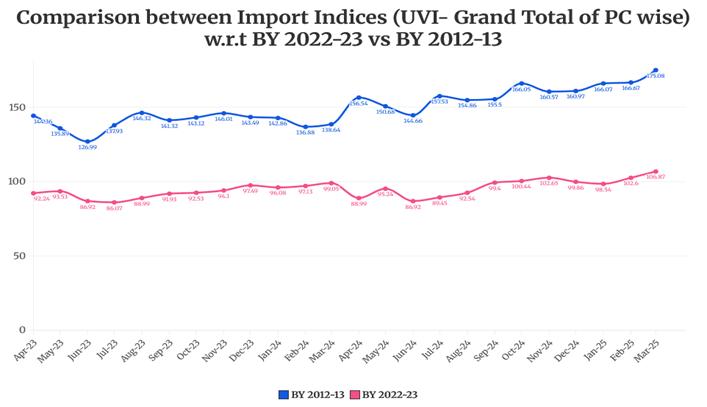
 

#BY means Base Year.

Table: Unit Value Index (UVI) and Quantity Index (QI) during FY 2025-26(Apr-Nov) using FY 2022-23 as base year


Month

Apr_25

May_25

Jun_25

1st Qtr 25-26

Jul_25

Aug_25

Sep_25

2nd Qtr 25-26

Oct_25

Nov_25

Unit Value Index

Export

105.31

99.73

96.31

100.33

99.31

100.55

104.08

101.23

103.78

105.32

Import

92.33

97.97

91.74

94.08

96.34

100.81

108.69

101.93

110.17

106.59

Quantity Index

Export

107.85

104.76

93.88

101.91

103.41

102.64

111.04

105.57

116.19

113.06

Import

138.16

126.61

112.58

125.17

122.47

124.06

126.45

124.32

137.04

121.75

Qtr  means Quarter.

Meaning and interpretation of the Indices

The Unit Value Indices and the Quantity Indices may be interpreted along the following lines.

The Unit Value Index answers the question: What is the growth in the average Unit Value of the items1 traded in the current month with respect to the same month in the Base Year?

So, an Unit Value Index of, say, 120 means that if the items that have been traded in the current month had been traded in the same month of the base year, and if the average price (or unit value) of those items had been Rs.100 in that month of the base year, then the average price (or unit value) of these items in the current month is Rs.120. Or that, there is a 20% increase in the average Unit Value, with respect to the Base Year, of the items that have been traded in the Current Month.

For example, let us suppose 30 items, 10 items each from 3 different Principal Commodities, have been traded in the current month. If these 30 items had been traded in the corresponding month of the base year at an average price of Rs.100, then the average price of these items in the current year is Rs.120.

It is to be noted that there are two successive steps of averaging done here. The first averaging is done over all the items (or ITCHS) of a PC group to arrive at the Index of that PC group. And the second averaging is done over all the PC groups to arrive at the Index at the Grand Total level for all commodities (which is the overall Index for India for a month). In both the stages, a weighted average is taken where the weights are proportional to the importance of the items and the PC groups respectively, and the Laspeyres Formula is used for averaging.

Quantity Indices, say, 200 means that if in the base year on an average 100 units were traded in India in the base year, then in the current year on an average 200 units were traded. However, it must be remembered that averaging quantities are different from averaging prices, since quantities in different units cannot be added directly.

So, the Quantity Indices are calculated by dividing the Value Indices by the Unit Value Indices. For example, if there is an increase in the Value of Export from Rs. 10,000 to Rs. 24,000, then the Value Index is 24000/10000 × 100 = 240. If the Unit Value Index is 120, then the Quantity Index comes to 240/120 × 100 = 200. So, loosely it can be said that, if the value of export has increased 2.4 times and the price of the commodities has increased 1.2 times, then the quantity must have doubled.

However, it may be noted that a very high or low Quantity Index may indicate the presence of Base Effect.

The Interpretation of the Bilateral and Regional Indices can be seen as an extension of the above.

A Unit Value Index of 120 with respect to a country, say Bangladesh, means that if all the items that have been traded with Bangladesh in the current month had been traded in the same month of the base year with the same country, and if the average price (or unit value) of those items had been Rs.100 in that month of the base year, then the average price (or unit value) of these items in the current month is Rs.120.

Similarly, a Quantity Index of 200 with respect to a country, say Bangladesh, means that if in the base year on an average 100 units were traded in India in the base year, then in the current year on an average 200 units were traded.

Comparability of the Indices across time

It is to be noted that the weights in the Index Number formula are fixed across time and there are twelve sets of weights for the twelve months. Hence, comparability of Indices is meaningful only when Indices of same month are compared across years. Different months may attach different weights to the same item, and hence comparing indices of two different months becomes vague and may have little applicability.

Further, the weights of the items that are not present in the trade basket of the current month are distributed to all the items that have been traded in the current month. This distribution is done in proportion to the weights of those items.

For example, let us suppose there are only 3 commodities for trade, say A, B and C. In month May of the Base year, let us suppose that the trade value of A was Rs. 50, B was Rs. 100 and C was Rs. 50. Then the weights assigned to A, B and C in the month of May of the following years would be in the ratio 50 :100 :50. However, in case, C is not traded in the current month, then the weight of C would be distributed proportionately among A and B, again in the ratio 1:2 (since in May the weights of A and B are in the ratio of 50 : 100, i.e., 1 : 2). So, in the current month the weights of A and B would be 3313  and 6623 .

As a result, the weights in any two given months are dependent on exactly the number of items (ITCHS codes) traded in those months. If the items traded are widely different, inference drawn from the comparison of the Indices may be done accordingly. On the other hand, more the similarity in the number of items traded more is the comparability of the two indices.

Net Terms of Trade:

Net Terms of Trade also called commodity Terms of Trade is defined as a ratio of export prices to import prices.

Let say 2022-23 be the base year and 2023-24 be the final year. We express both export and import prices in 2022-23 as 100. Now, suppose that at the end of 2023-24, it is found that the index of export prices decreased to 90 and index of import prices roses to 150. Then the Net Terms of Trade has changed to 90100150100=35 . Then terms of trade as index=35*100=60 . It implies that terms of trade of the country have decreased by about 40% in 2023-24 as compared with 2022-23. It thus shows a deterioration or a worsening of the terms of trade of the country.

If the index of export prices has risen to 150 and that of import prices had risen to 120, then the net terms of trade would have changed to 150120*100=125 . This implies an improvement in the net terms of trade of the country by 25% in 2023-24 over 2022-23.

Gross Terms of Trade:

Gross Terms of Trade is the ratio of physicalquantity of import to physical quantity of export.

Let say 2022-23 be the base year. In that year, the quantities export and import are denoted by 100. Now, suppose that in the year 2023-24, the index of quantity of import was 150 and that of quantity of export was 120. Then the gross terms of trade is given by 150100120100=54,  in terms of percentage =54*100=125 . This implies that there was an improvement of gross terms of trade by 25% in 2023-24 compared to 2022-23.

Income Terms of Trade: Income Terms of Trade is defined as- Net Terms of Trade multiplied by quantity of export.

Topics

Acts Income Tax