

Loading...

Top
Help
×

By creating an account you can:

Logo TaxTMI
Call Us / Help / Feedback

Contact Us At :

E-mail: [email protected]

Call / WhatsApp at: +91 99117 96707

For more information, Check Contact Us

FAQs :

To know Frequently Asked Questions, Check FAQs

Most Asked Video Tutorials :

For more tutorials, Check Video Tutorials

Submit Feedback/Suggestion :

Email :
Please provide your email address so we can follow up on your feedback.
Category :
Description :
Min 15 characters 0/2000
Make Most of Text Search
  1. Checkout this video tutorial: How to search effectively on TaxTMI.
  2. Put words in double quotes for exact word search, eg: "income tax"
  3. Avoid noise words such as : 'and, of, the, a'
  4. Sort by Relevance to get the most relevant document.
  5. Press Enter to add multiple terms/multiple phrases, and then click on Search to Search.
  6. Text Search
  7. The system will try to fetch results that contains ALL your words.
  8. Once you add keywords, you'll see a new 'Search In' filter that makes your results even more precise.
  9. Text Search
Add to...
You have not created any category. Kindly create one to bookmark this item!
Create New Category
Hide
Title :
Description :
❮❮ Hide
Default View
Expand ❯❯
Close ✕
🔎 News - Adv. Search
TEXT SEARCH:

Press 'Enter' to add multiple search terms. Rules for Better Search

Search In:
Main Text + AI Text
  • Main Text
  • Main Text + AI Text
  • AI Text
Category: ?
Categorized by AI
---- All Categories ----
  • ---- All Categories ----
  • Income Tax
  • GST
  • Customs, DGFT & SEZ
  • FEMA & RBI
  • Corp. Laws, SEBI & IBC
  • PMLA, Black Money & ED
  • Budget
  • News and Press Release
  • PTI News
Month:
---- All Months ----
  • ---- All Months ----
  • January
  • February
  • March
  • April
  • May
  • June
  • July
  • August
  • September
  • October
  • November
  • December
Year:
---- All Years ----
  • ---- All Years ----
  • 2026
  • 2025
  • 2024
  • 2023
  • 2022
  • 2021
  • 2020
  • 2019
  • 2018
  • 2017
  • 2016
  • 2015
  • 2014
  • 2013
  • 2012
  • 2011
Sort By: ?
In Sort By 'Default', exact matches for text search are shown at the top, followed by the remaining results in their regular order.
Relevance Default Date
    The US and Canada could pull back from an all-out trade war. It's not clear that they will
    Indian Community in Japan Playing Key Role in Strengthening India-Japan Ties: Commerce and Industry Minister Shri Piyush Goyal
    Union Minister of Commerce and Industry Shri Piyush Goyal Chairs India-Japan Industry Roundtable on Semiconductors and Artificial Intelligence in Toky...
    National Traders’ Welfare Board Holds 100th VC Meeting to Strengthen Engagement with Traders Across the Country
    CCI approves acquisition of 100% share capital of Tao Digital Solutions by Cyient Ltd
    CCI approves acquisition of 100% stake in Kestrel Coal Group Pty Ltd. by Yancoal Australia from certain sellers
    HC bench releases Skoda Volkswagen USD 1.4 billion tax case sans verdict; matter to be heard afresh
    Canada strikes back at US with retaliatory tariffs as trade war escalates
    Rupee rises 26 paise to close at 95.44 against US dollar
    Economy shows resilience to global headwinds with buoyant domestic demand: RBI bulletin
    Goyal promises BIS certification relief for high-tech sector firms
    IICA Conducts inaugural session of 11th Batch of its Certified CSR Professional Programme
    Net Profit of Regional Rural Banks (RRBs) Rises to Record ₹10,176 Crore, Total Business Cross ₹13.5 Lakh Crore in FY 2025-26
    UP Cong chief writes to PM Modi on ethanol policy, sugar prices
    Economy shows notable resilience despite global headwinds: RBI bulletin
    Sugar prices rise by nearly Re 1 per kg to about Rs 64
    Trump says he's considering renaming Lake Ontario as 'Lake America' as trade war with escalates
    Flash Report on Central Sector Infrastructure Projects worth ₹150 crore and above
    HP minister warns orchardists against spurious PGRs sold in open market
    NEWS HIGHLIGHTS
❯❯
Maximize Maximize Maximize
0 / 200
Expand Note
Add to Folder

No Folders have been created

+

Are you sure you want to delete "My most important" ?

NOTE:

News
Showing Results for :
Reset Filters
Results Found:
Show All Summaries Hide All Summaries
August 26, 2026
Show AI Summary
Reciprocal trade tariffs intensify as negotiations confront market access, cultural protections, industrial safeguards, and sovereignty concerns.
US-Canada tariff escalation involves reciprocal import duties following failed negotiations over market access and trade in dairy, alcoholic beverages, automobiles, steel, aluminium and softwood lumber. United States tariff action relies on a rarely used trade-law power permitting duties against countries considered to discriminate against American businesses, without a prior investigation or stated time limit. Negotiations also raised concerns about protection of major industries, cultural protections and Canada's freedom to conclude trade agreements with other countries.
August 26, 2026
Show AI Summary
Diaspora engagement supports skilled mobility, investment links, remittances, and citizen welfare while encouraging compliance with local laws.
Indian diaspora engagement in Japan supports bilateral goodwill, business links, investment opportunities and people-to-people ties. Skilled Indian professionals are encouraged to understand local requirements, learn Japanese language and culture, and pursue opportunities in healthcare, trades, engineering, artificial intelligence, accountancy and maritime work. Diaspora members are also encouraged to maintain connections with India, contribute through digital education and knowledge-sharing, and comply with local laws and regulations. Remittances and government support for citizens' welfare, safety and crisis assistance abroad are recognised as important aspects of diaspora engagement.
August 26, 2026
Show AI Summary
Semiconductor and AI cooperation advances through industry engagement, investment facilitation, and accelerated economic partnership review.
India-Japan cooperation in semiconductors and artificial intelligence is being strengthened through industry engagement, investment facilitation, technology partnerships and an economic-security-oriented framework. India's semiconductor strategy covers chip design, machinery and materials, fabrication, ATMP/OSAT, research, and talent development, supported by Semicon India initiatives. Bilateral engagement also seeks to address industry concerns, expand manufacturing and innovation partnerships, and accelerate review of the Comprehensive Economic Partnership Agreement to reflect emerging economic opportunities.
August 26, 2026
Show AI Summary
Virtual trader engagement platform strengthens weekly grievance feedback, policy information sharing, and institutional dialogue between government and trading communities.
The Virtual Conference Interaction Meetings provide a weekly, accessible forum for retail traders to engage with the Government, receive information on relevant schemes, policies and reforms, and submit grievances and suggestions. The platform enables recurring concerns to be identified and communicated to concerned Ministries and Departments for consideration and redressal. It seeks to strengthen institutionalised dialogue, feedback, transparency, trust and cooperation between the Government and the trader community.
August 26, 2026
Show AI Summary
Competition clearance for full acquisition permits Cyient to acquire Tao Digital Solutions, a global digital transformation and technology services provider.
Competition Commission of India approved Cyient Limited's acquisition of 100% of Tao Digital Solutions Inc.'s share capital from its existing shareholders. The full share capital acquisition transfers complete ownership of Tao Digital Solutions to Cyient. Tao Digital Solutions provides global digital transformation and technology services, including product engineering, managed services, cybersecurity, payments, digitization and AI, cloud services, and data services, and operates in India through its wholly owned subsidiary, Tao Digital India Private Limited.
August 26, 2026
Show AI Summary
Competition clearance for full coal-sector acquisition addresses limited Indian market links through metallurgical and thermal coal sales.
Competition approval covers Yancoal Australia Limited's acquisition of 100% equity interest and warrants in Kestrel Coal Group Pty Ltd. The target holds an 80% interest in the Kestrel Joint Venture, which operates a Queensland coal mine producing principally metallurgical coal and a smaller volume of thermal coal. Neither the acquirer nor the target has a physical presence in India. Their Indian nexus is limited to coal exports and the joint venture's sales of metallurgical coal into India.
August 25, 2026
Show AI Summary
Customs classification of unassembled vehicle imports requires fresh hearing after reserved tax challenge was released without verdict.
The dispute concerns customs classification of imported unassembled vehicle parts. Customs authorities allege that parts imported in separate shipments should have been declared as completely knocked down (CKD) units, attracting the higher duty applicable to CKD imports, rather than as individual components subject to lower duty. The manufacturer contests the resulting customs demand. Proceedings have been released for fresh hearing before the regular indirect-tax writ bench, with status quo maintained for four weeks.
August 25, 2026
Show AI Summary
Retaliatory tariffs on imported goods escalate trade measures, targeting key sectors while maintaining support for affected domestic businesses.
Canada has imposed retaliatory tariffs on United States-origin industrial and consumer goods following increased United States tariffs on Canadian goods. Effective 8 September, the measures apply at rates of 15%, 25% and 50% across more than 700 products, including steel, aluminium, appliances, dairy products, seafood, furniture, clothing, pulp and paper, and electronics. Existing countertariffs on automobiles remain in force. The measures seek to protect domestic businesses and reduce imports, supported by assistance for affected workers and businesses amid risks to integrated cross-border supply chains.
August 25, 2026
Show AI Summary
Foreign-exchange market intervention and lower crude prices supported rupee appreciation, while USD/INR remained range-bound amid shifting dollar conditions.
Foreign-exchange market conditions supported rupee appreciation against the US dollar, driven by stronger domestic equity markets, a weaker US dollar and lower crude oil prices. The USD/INR pair remained broadly range-bound, with oil-price movements and Reserve Bank intervention identified as key near-term influences. The special USD-INR foreign-exchange swap facility for FCNR(B) deposits, overseas foreign-currency borrowings and external commercial borrowings mobilised substantial foreign-exchange inflows.
August 25, 2026
Show AI Summary
Section 301 tariffs may have lower impact where major exports remain outside their scope amid resilient domestic demand.
Economic resilience is attributed to buoyant domestic demand, increased manufacturing and services activity, improving liquidity conditions, credit growth, investment activity and rebounding foreign capital inflows. Recovery in the southwest monsoon improved kharif sowing and reservoir storage, partly mitigating agricultural-sector risks. US Section 301 tariffs are expected to have a comparatively lower effect because major Indian exports to the United States, including smartphones, petroleum products and pharmaceuticals, remain outside their scope. Foreign direct investment improved with higher gross inflows, while outward foreign direct investment continued to decline.
August 25, 2026
Show AI Summary
BIS certification exemptions may be structured for high-tech manufacturers to ensure timely equipment imports and support domestic manufacturing operations.
Mandatory Bureau of Indian Standards (BIS) certification requirements for equipment and components used by high-technology manufacturers may be addressed through a proposed exemption framework. Possible exemptions may be structured at the company, industry, product, project or bulk level to support timely availability of imported equipment, goods and services for manufacturing operations. The approach is directed at high-technology industries generally, particularly semiconductor and artificial intelligence sectors, while addressing delays associated with mandatory certification and complex procedures for specialised imported parts and equipment.
August 25, 2026
Show AI Summary
Corporate social responsibility should prioritise measurable community outcomes, transparency, capable implementing agencies, and strategic integration with sustainability objectives.
Corporate social responsibility should prioritise measurable community outcomes rather than expenditure alone. Effective CSR depends on community-responsive design, capable implementing agencies, rigorous monitoring, social audits, and transparent use of technology and data. Public sector enterprises may use thematic priorities, convergence with government programmes, and institutional collaboration to replace isolated interventions with strategic CSR. CSR capacity building encompasses legal and regulatory frameworks, governance, project planning, impact assessment, reporting, ESG and the Social Stock Exchange.
August 25, 2026
Show AI Summary
Regional rural bank performance highlights improved profitability, asset quality, priority-sector lending, financial inclusion, and digital banking expansion.
Regional Rural Banks achieved prescribed priority-sector lending targets and sub-targets, expanded financial inclusion through new Pradhan Mantri Jan Dhan Yojana accounts, and recorded improvement in profitability, asset quality, and credit-deposit ratio. Digital banking adoption is to be accelerated to improve operational efficiency, customer experience, and banking access in rural and remote areas. Sponsor Banks are expected to strengthen information-technology infrastructure and support increased area-specific credit flows and innovative lending.
August 25, 2026
Show AI Summary
Ethanol-blended fuel policy faces calls for consumer-focused review amid sugar supply pressures and older-vehicle compatibility concerns.
Consumer-focused review of the ethanol-blended fuel policy is sought because higher ethanol diversion may affect domestic sugar availability and prices, potentially requiring sugar imports that could reduce claimed foreign-exchange savings from lower petroleum imports. The review should address ethanol and sugar production, domestic prices, imports, and consumer, environmental and economic concerns. Availability of lower-blend fuel alongside E20 is advocated for owners of older vehicles, with consumer choice between E10 and E20 supporting a comprehensive reassessment.
August 25, 2026
Show AI Summary
Economic resilience remains supported by domestic demand, manufacturing, liquidity and capital inflows despite external trade and geopolitical risks.
Economic resilience is attributed to buoyant domestic demand, sustained manufacturing and services activity, and double-digit merchandise trade growth. Improved southwest monsoon conditions supported kharif sowing and partly reduced agricultural risks, although geopolitical frictions and fresh United States tariffs remained external risks. Supply-side pressures raised consumer price inflation, while stable core inflation indicated limited cost pass-through. Easing liquidity, credit growth, investment activity and rebounding foreign capital inflows supported financial and external-sector conditions.
August 25, 2026
Show AI Summary
Sugar price controls combine raw sugar imports, stockholding limits, and export restrictions to curb retail inflation.
Sugar market intervention combines permitted imports of raw sugar, stockholding limits for dealers and bulk consumers, and an existing export ban to address sharp increases in retail and wholesale prices. Limits on inventories held by trade participants and large industrial consumers are intended to curb speculation and hoarding. Although ex-mill rates declined after the import decision and anti-hoarding measures, the reduction had not yet translated fully into retail prices. The measures seek to supplement domestic availability and restrain practices that may intensify consumer-price increases.
August 25, 2026
Show AI Summary
Tariff escalation drives retaliatory planning, industry protection measures, supply-chain uncertainty, and proposed symbolic geographic renaming amid cross-border trade tensions.
United States-Canada trade tensions have intensified after tariffs were imposed on Canadian goods following unsuccessful bilateral talks. Canada is expected to pursue retaliatory measures, potentially using targeted action to protect workers and businesses rather than matching tariffs directly. Further tariff threats concern vehicles, auto parts and steel. Integrated cross-border supply chains in automotive, energy, agriculture and manufacturing face increased costs and consumer-price uncertainty. Consideration of renaming Lake Ontario as "Lake America" has also been linked to the escalating dispute.
August 25, 2026
Show AI Summary
Central infrastructure monitoring through PAIMANA-PROJ tracks implementation progress, sectoral priorities, completed works, and integration of newly monitored projects.
PAIMANA-PROJ monitors Central Sector infrastructure projects costing Rs. 150 crore and above across 17 Ministries and Departments. As of July 2026, 1,775 projects with a revised cost of Rs. 37.11 lakh crore were under monitoring, with cumulative expenditure of Rs. 19.26 lakh crore. Transport and Logistics formed the largest monitored sector, followed by Energy. The portfolio included mega and major projects at varying physical and financial completion stages. PAIMANA-CRIP serves as the central infrastructure-project data repository, with most data updated through APIs.
August 25, 2026
Show AI Summary
Plant growth regulator quality controls require farmer awareness, licensed sales, quarantine compliance, and protection against uncertified orchard inputs.
Plant Growth Regulator quality control seeks to protect farmers and orchardists from spurious products sold in the open market. Licensed pesticide and fungicide outlets receive application schedules, while farmer awareness is stressed due to purchases of cheaper PGRs that may not achieve expected results. Rootstock imports require quarantine clearance, and uncertified rootstock purchased from the market is associated with disease spread in orchards. Regulatory measures include direct departmental sale of branded chemicals, promotion of weather-based crop insurance, and demands concerning minimum support pricing and Market Intervention Scheme documentation.
August 25, 2026
Show AI Summary
Anti-conversion compliance prompts voluntary prayer declarations, alongside food-safety oversight and enforcement against demolition, liquor, and cyber-fraud allegations.
Maharashtra's anti-conversion law has commenced, and churches across the Mumbai Metropolitan Region have sought written self-declarations confirming voluntary prayer attendance without pressure. Food-safety oversight requires cleaning of cricket association eateries before a further inspection. Enforcement matters include investigation into unauthorised shop demolitions allegedly involving misuse of a municipal corporation's name, arrests connected with spurious-liquor manufacture, and a cyber-fraud network allegedly using mule accounts to launder proceeds. A retired High Court judge has been appointed as Lokayukta.

News

Back

All News

Showing Results for :
Reset Filters
No Records Found

News

Showing Results for : Reset Filters

FROM STABILITY TO NEW FRONTIERS, INDIA’S SERVICES EXPORTS GROWTH MORE THAN DOUBLED FROM 7.6% IN THE PRE-PANDEMIC PERIOD (FY16-FY20) TO 14% DURING FY23-FY25

January 29, 2026

Contents
Summary
Note

Note

-

Bookmark

Print

Print

THE FY26 WITNESSED ACROSS-THE-BOARD EXPANSION IN SERVICES. BUOYANT GROWTH IN THE SERVICES SECTOR AT 9.1% HAS BEEN THE MAJOR DRIVER FOR GVA

MEDIA, ENTERTAINMENT AND SPACE TECHNOLOGIES EMERGE AS NEW GROWTH FRONTIERS OF SERVICES SECTOR

ORANGE ECONOMY, OCEAN COMMERCIALISATION, DATA CENTERS, CONCERT ECONOMY, DEVELOPMENT TO ENSURE SERVICES REMAIN POWERFUL ENGINE OF GROWTH IN YEARS AHEAD

India’s Services sector has become the principal engine of economic growth, resilience, and structural transformation. Against a backdrop of global uncertainty and subdued global industrial activity, the sector has emerged as a stabilising force, contributing more than half of India’s Gross Value Added (GVA) and serving as a major driver of exports and employment.

India is the world’s seventh-largest exporter of services, with its share in global services trade more than doubling from 2% in 2005 to 4.3% in 2024. “The Services sector, acting as a high-growth, low-volatility anchor, marked 7-8% growth year after year, in sharp contrast to the more pronounced cyclical fluctuations observed in agriculture and industry,” states the Economic Survey 2025-26 tabled in the Parliament today by Union Minister for Finance and Corporate Affairs, Smt. Nirmala Sitharaman. 

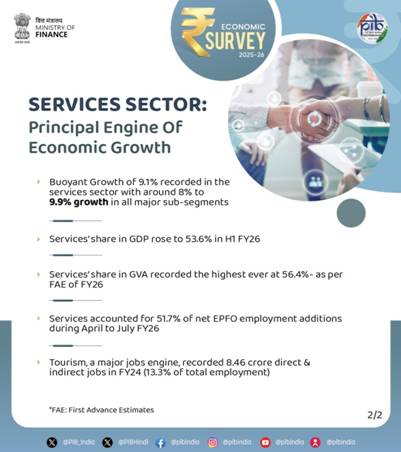
The FY26 witnessed across-the-board expansion in services. Buoyant Growth in the Services Sector at 9.1% has been the major driver for GVA growth in the First Advance Estimates (FAE) for FY 26, with around 8% to 9.9% growth in all major sub-segments.

GLOBAL TRENDS & INDIA’S EXPERIENCE:

The COVID-19 pandemic severely disrupted contact-intensive services, such as tourism, hospitality, and transport, while accelerating the expansion of digitally delivered services, including IT, finance, and professional services. In 2024, the share of services trade in GDP rose relative to pre-pandemic levels, signaling a gradual, though uneven, rebalancing of global trade towards services.

This growing role of services in global trade has been mirrored by a corresponding shift in capital allocation. Services accounted for an average 53.5% of global FDI during 2022-2024, up from 50.9% in the pre-pandemic period, with inflows becoming increasingly concentrated. Energy and gas supply, information and communication, construction, and transportation together absorbed over 88% of services FDI, compared to 75.5% in pre-pandemic era.
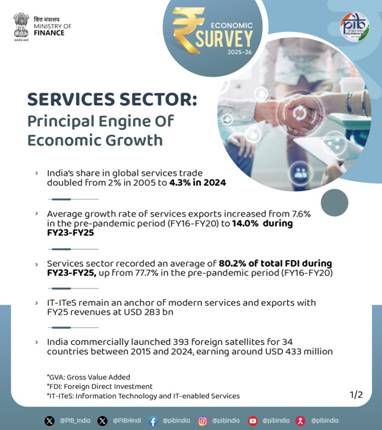
India’s experience broadly mirrors global trends. Services-sector FDI was 80.2% of total FDI during FY23-FY25, up from 77.7% in the pre-pandemic period (FY16-FY20). These inflows went to information and communication services (25.8%) and professional services (23.8%), reflecting our strength in digital and knowledge-intensive activities; along with Finance and insurance (14.2%), energy and gas (12.8%), and trading (12.2%), these segments accounted for nearly 89% of services FDI, highlighting the dominance of digital, skill-intensive, and infrastructure-linked services in India’s investment profile.

The Economic Survey data reveals that ‘financial, real estate, and professional services’ sector remains the key driver of service growth supported by sustained demand for credit, business services, and real estate-linked activities. ‘Public administration, defence and other services’ have also continued to expand at a pace above pre-pandemic trends, underpinned by steady public spending and service delivery. In contrast, ‘trade, hospitality, transport, communication and related services’ have seen a more gradual normalisation, with growth broadly close to pre-pandemic averages.

Average growth in Services exports more than doubled from 7.6% in the pre-pandemic period (FY16-FY20) to 14% in FY23-FY25, reflecting strong and broad-based global demand for Indian services. Despite competitive conditions in global services markets and heightened policy uncertainty, services export growth moderated to 8% during FY26 (April-November).

Software services, accounting for over 40% of total services exports, remain the primary growth driver, expanding at an average rate of 13.5% per cent during FY23-FY25 compared to 4.7% in FY16-FY20, supported by strong global demand for digital services. Professional and management consulting emerged as the second-largest contributor, growing at 25.9%, resulting in an increase in their share from 10.5% in FY16- FY20 to 18.3% in FY23-FY25.

India’s Services exports share in GDP averaged 9.7% during FY23-FY25, up from 7.4% in the pre-pandemic period. Amid subdued global goods trade due to policy uncertainty and geopolitical disruptions, services exports have provided a critical buffer. This role has strengthened further in H1 FY26, with the share of services exports in GDP rising to 10%, from 9.7% in H1 FY25.

NITI Aayog’s findings on state-level and sector-level dynamics says that states like Karnataka, Maharashtra, Tamil Nadu and Telangana together account for nearly 40% of services output, driven by modern, high-productivity services such as IT, finance and professional services, resulting in a concentration of output in highly urbanised states, particularly in southern India. At the same time, important contrasts persist. Bihar, despite low per capita income, derives 58.7% of its GVA from services, largely from low-value-added activities. Kerala, with 64.3% of GSVA from services, remains reliant on traditional segments such as trade, tourism and real estate. In some cases, the services share declined, challenging the notion of one-way transition towards services: Odisha’s services share declined from 38.5% to 34.9%, while Assam’s fell from 46.5% to 34.3% over the period.

SERVICES: KEY EMPLOYMENT DRIVER

The Economic Survey noted that as per PLFS data for the first two quarters of FY26, the share of services in urban employment rose to 61.9%, marginally higher than the FY21- FY22 average of 61.7%, during a period marked by relatively strong services-sector hiring during the pandemic. Consistent with this, EPFO data for April-July FY26 indicate sustained formal job creation, with services accounting for 51.7% of net employment additions, led by expert services, trading and commercial establishments, and cleaning services.

Over 2011-2024, employment elasticity in services stood at 0.43, rising to 0.63 in the post-COVID recovery phase, second only to construction, underscoring the sector’s role as a labour shock absorber.
SUB-SECTORAL PERFORMANCE AND DRIVERS:

Services are getting increasingly integrated into manufacturing through activities such as design, R&D, logistics, software development, and professional services, reflecting the growing “Servicification” of production systems. This is evident in products such as smart devices, automobile, medical equipments/ wearables etc. International experience suggests that this integration is a crucial channel for enhancing value addition, export competitiveness, and employment.

The Economic Survey has revealed that in FY24, travel and tourism contributed 5.22% to GDP, close to pre-pandemic levels, supporting an estimated 8.46 crore direct and indirect jobs (about 13.3% of total employment). Consistent with this growth, foreign exchange earnings from

tourism rose to USD 35.0 billion in 2024, up 8.8% from 2023. Domestic tourism remained the backbone of the sector, with visits increasing by about 17.5% in 2024 over the previous year and by nearly 52.7% during Jan-Sept 2025 compared with the corresponding period last year.

International Tourist Arrivals (ITAs), including foreign tourist arrivals (FTAs) and arrivals of non-resident Indians (NRIs), rose to 20.57 million, an increase of 8.9% over 2023. Growing faster than leisure tourism, Medical and wellness tourism is emerging as a high-potential niche, offering high-value and non-seasonal tourism.

In FY25, the IT and IT-enabled services (IT-ITeS) sector reinforced India’s position as a global technology and innovation hub, supported by continued revenue growth, a rising role of Global Capability Centres (GCCs), and deeper engagement in higher-value, complex technology activities. Nasscom estimates IT&ITeS industry revenues at USD 283 billion in FY25, (including hardware) a year-on-year growth of 5.1% as against 3.9% in FY24. With 1,700+ Global Capability Centres (GCCs) employing about 19 lakh professionals, GCCs are expanding into product, engineering, analytics, cyber-security and AI-enabled functions.

India’s data centre capacity is projected to reach about 8 GW by 2030 from about 1.4GW as of Q2 of 2025. Despite generating nearly 20% of the world’s data, India hosts only about 3% of global data centres, around 150 out of 11,000 worldwide, according to Nasscom, addressing structural constraints such as energy shortages will be critical for India to position itself as a global AI data centre hub.

India’s technology Start-Up ecosystem, the world’s third largest, now comprises about 32,000-35,000 Start-Ups, with over 2,000 added in CY25, including over 900 funded start-ups in CY25. Within this, the Generative AI segment has expanded rapidly, with active GenAI startups rising more than threefold from about 240 in first half of CY24 to over 890 in first half of CY25.

Accounting for around 2% of the global space market valued at about USD 8.4 billion, India commercially launched 393 foreign satellites for 34 countries between 2015 and 2024, earning around USD 433 million, reflecting its cost-effective and reliable capabilities. India’s space sector has emerged as a fast-growing, technology-intensive and increasingly commercial segment of the services economy.

The media and entertainment (M&E) sector has become a significant component of India’s services economy, spanning audio-visual production, broadcasting, digital content, animation and gaming, advertising, and live entertainment. Industry estimates place the sector’s size at around ₹2.5 trillion in 2024, driven by rising incomes, rapid internet penetration and a large domestic market. Digital media emerged as the primary growth engine, contributing approximately one-third of the sector's total revenues. The live-events eco-system part of the Orange Economy and its related tourism spill over is the emerging major trend in the sector.   VII.13: Snapshot of GenAI startups landscape

WAY FORWARD:

The Survey lauds notable progress in all the sub sectors of the Services sector, and cautions on important factors on which their growth with depend. Like, for IT and IT-enabled services, the sector’s future hinges on timely re-skilling, the wider diffusion of digital technologies, and the creation of a supportive policy environment for innovation and scaling.

Tourism requires the creation of niche segments, such as long-distance hiking trails, and a national marina development policy to unlock the blue economy. Space and ocean services are poised for rapid expansion through commercialisation and public-private partnerships.

Topics

Acts Income Tax
