

Loading...

Top
Help
×

By creating an account you can:

Logo TaxTMI
Call Us / Help / Feedback

Contact Us At :

E-mail: [email protected]

Call / WhatsApp at: +91 99117 96707

For more information, Check Contact Us

FAQs :

To know Frequently Asked Questions, Check FAQs

Most Asked Video Tutorials :

For more tutorials, Check Video Tutorials

Submit Feedback/Suggestion :

Email :
Please provide your email address so we can follow up on your feedback.
Category :
Description :
Min 15 characters 0/2000
Make Most of Text Search
  1. Checkout this video tutorial: How to search effectively on TaxTMI.
  2. Put words in double quotes for exact word search, eg: "income tax"
  3. Avoid noise words such as : 'and, of, the, a'
  4. Sort by Relevance to get the most relevant document.
  5. Press Enter to add multiple terms/multiple phrases, and then click on Search to Search.
  6. Text Search
  7. The system will try to fetch results that contains ALL your words.
  8. Once you add keywords, you'll see a new 'Search In' filter that makes your results even more precise.
  9. Text Search
Add to...
You have not created any category. Kindly create one to bookmark this item!
Create New Category
Hide
Title :
Description :
❮❮ Hide
Default View
Expand ❯❯
Close ✕
🔎 News - Adv. Search
TEXT SEARCH:

Press 'Enter' to add multiple search terms. Rules for Better Search

Search In:
Main Text + AI Text
  • Main Text
  • Main Text + AI Text
  • AI Text
Category: ?
Categorized by AI
---- All Categories ----
  • ---- All Categories ----
  • Income Tax
  • GST
  • Customs, DGFT & SEZ
  • FEMA & RBI
  • Corp. Laws, SEBI & IBC
  • PMLA, Black Money & ED
  • Budget
  • News and Press Release
  • PTI News
Month:
---- All Months ----
  • ---- All Months ----
  • January
  • February
  • March
  • April
  • May
  • June
  • July
  • August
  • September
  • October
  • November
  • December
Year:
---- All Years ----
  • ---- All Years ----
  • 2026
  • 2025
  • 2024
  • 2023
  • 2022
  • 2021
  • 2020
  • 2019
  • 2018
  • 2017
  • 2016
  • 2015
  • 2014
  • 2013
  • 2012
  • 2011
Sort By: ?
In Sort By 'Default', exact matches for text search are shown at the top, followed by the remaining results in their regular order.
Relevance Default Date
    ED arrests ex-panchayat CEO who allotted govt funds for fake marriages during COVID lockdown
    Goyal blames market conditions for Jet Airways' downfall; ED says he 'bled airline to death'
    Rupee rises 8 paise to close at 94.43 against US dollar
    NSE gets regulatory nod for Rs 30,000 cr IPO, the biggest so far
    Sensex rebounds 362 pts, snaps 4-day losses on strong rally in metal, oil shares
    Forex kitty jumps USD 11.47 bn to fresh all-time high of USD 740.8 bn
    NSE gets Sebi nod for Rs 30,000-cr IPO, one of India's largest public issues
    'Policing the Republic': Book traces history of personal security, from Pharaohs to presidents
    Rupee rises 5 paise to 94.46 against US dollar in early trade
    No sensitivity of India compromised in trade pact with US: Goyal
    About 100 highway plazas used illegal apps to collect toll from vehicles not bearing FASTag stickers: ED
    CBI conducts course on financial crimes for officers from ITEC-member countries
    Delhi workers welfare board blacklists firm for over 20,000 'unauthorised' Aadhaar transactions
    Rupee rises 22 paise to close at 94.51 against US dollar
    Electrifying India's vehicles can cut its import bill by USD 125 billion by 2050: Study
    Loans to go beyond SHGs, women to get access to credit to expand livelihoods: Union minister Chouhan
    MIDC's role not just selling plots, but creation of conducive environment for development: CEO
    Decentro Wins Three Industry Honours for Fintech Infrastructure Innovation and Leadership in 2026
    Marching ahead with Responsibility and Growth - Keynote Address[Contributions by RBI colleague Shri Mohammed Majidullah, General Manager] delivered by...
    CCI directs Trustees’ Association of India, IDBI Trusteeship Services Ltd, Axis Trustee Services and SBI CAP Trustee Company to cease and desist fro...
❯❯
Maximize Maximize Maximize
0 / 200
Expand Note
Add to Folder

No Folders have been created

+

Are you sure you want to delete "My most important" ?

NOTE:

News
Showing Results for :
Reset Filters
Results Found:
Show All Summaries Hide All Summaries
September 4, 2026
Show AI Summary
Money laundering allegations over fraudulent marriage-assistance disbursements prompted investigation into false credentials and ineligible beneficiary payments.
Alleged money laundering arose from fraudulent disbursement of marriage-assistance funds intended for daughters of registered construction workers. The allegations include approvals and releases for suspicious marriage cases, use of bank accounts opened or misused on false credentials, multiple cash withdrawals, and extension of benefits to ineligible persons. Investigation under the Prevention of Money Laundering Act followed an economic-offences FIR concerning suspected misuse of the welfare scheme.
September 4, 2026
Show AI Summary
Money-laundering allegations: discharge plea attributes airline's financial collapse to macroeconomic conditions and denies loan siphoning through sales agents.
Money-laundering proceedings arising from alleged bank fraud concern claims that loans advanced to an airline were siphoned off. The discharge application attributes the airline's financial collapse to adverse macroeconomic conditions rather than fraudulent conduct or laundering, denies diversion through General Sales Agents, and maintains that related payments were board-approved and disclosed. It also contests the treatment of the bank's outstanding claim as funds received by the founder, while the investigating agency alleges systemic fraud, loan diversion and laundering.
September 4, 2026
Show AI Summary
Foreign exchange market conditions supported rupee appreciation, while oil prices and geopolitical tensions limited potential gains.
Foreign exchange market conditions supported the rupee's appreciation by 8 paise to 94.43 against the US dollar, aided by positive domestic equity markets, improved risk appetite, foreign capital inflows and foreign institutional buying. Reserve Bank of India intervention was also cited as support. Elevated crude oil prices, safe-haven dollar demand and United States-Iran tensions were identified as factors limiting further gains. India's foreign exchange reserves increased to a new all-time high during the relevant reporting week.
September 4, 2026
Show AI Summary
Offer-for-sale IPO clearance enables existing exchange shareholders to monetise holdings, while sale proceeds remain outside the exchange.
Regulatory clearance permits the National Stock Exchange to proceed with an initial public offering structured wholly as an offer for sale by existing shareholders. The proposed issue does not raise fresh capital, and sale proceeds will accrue to the selling shareholders rather than the exchange. Revised offer documents were required after addition of a selling shareholder, triggering a fresh public-feedback period. The offering follows settlement of co-location and dark-fibre matters and governance and compliance measures addressing regulatory concerns.
September 4, 2026
Show AI Summary
Equity market resilience was tempered by profit booking, geopolitical tensions, global rate expectations and domestic liquidity.
Equity markets registered a recovery after four consecutive losing sessions, led by buying in metal, private banking, oil and gas, housing finance, telecommunication, insurance, commodities and financial services shares. The benchmark equity index closed higher, while the broader index recorded a modest gain after retreating from an intraday level above the psychological threshold during the newly introduced Closing Auction Session. Investor sentiment was supported by easing interest-rate concerns, strong earnings momentum, resilient economic growth and domestic demand, but was constrained by profit booking, geopolitical tensions and crude-oil price risks.
September 4, 2026
Show AI Summary
Forex reserve management reflects rising foreign currency assets and gold holdings, alongside marginal declines in SDRs and IMF reserve position.
India's foreign exchange reserves increased to a fresh all-time high, supported principally by higher foreign currency assets and gold reserves. Reserve accumulation has continued after concessional foreign-exchange swap initiatives introduced amid local-currency depreciation. Foreign currency assets, expressed in United States dollar terms, also reflect valuation effects from movements in currencies such as the euro, pound and yen. Special drawing rights and the reserve position with the International Monetary Fund declined marginally.
September 4, 2026
Show AI Summary
IPO regulatory clearance enables further public issue preparations, with existing shareholders proposing a complete offer for sale.
SEBI's final observations on the proposed initial public offering enable the National Stock Exchange to undertake further public-issue preparations, subject to applicable regulatory requirements. The proposed issue is structured entirely as an offer for sale, under which existing shareholders would divest a portion of their holdings rather than the exchange issuing new shares. The draft red herring prospectus contemplates sale of 14.89 crore shares, representing nearly 6 per cent of the exchange's stake.
September 4, 2026
Show AI Summary
Personal security frameworks evolved from elite guards into intelligence-led protection systems, while VIP culture can distort their necessity.
Personal security evolved from elite guards into structured systems combining physical protection, intelligence, technology and specialised protocols. Prime Ministerial security in India was reorganised after the 1984 assassination of Prime Minister Indira Gandhi by her bodyguards. A commission recommended a single protective agency, leading to the formation of the Special Protection Group in 1985. Statutory parameters introduced in 1988 sought to rationalise and scientifically streamline protection arrangements. Advanced technology, training, intelligence and protocols do not eliminate personal-protection vulnerabilities, and security is characterised as a necessity rather than a status symbol.
September 4, 2026
Show AI Summary
Rupee exchange-rate movement reflects foreign-currency deposit inflows, central-bank intervention, oil-price risks and changing market risk appetite.
Foreign-exchange liquidity measures, including a special central-bank programme for foreign-currency deposits, generated substantial inflows that supported the rupee. Inflows from foreign-currency deposits, overseas foreign-currency borrowings and external commercial borrowings strengthened market conditions. Rupee appreciation was also supported by foreign equity inflows and risk appetite, but remained vulnerable to higher crude-oil prices, US-Iran tensions, safe-haven demand for the US dollar and possible disruption to oil flows through the Strait of Hormuz.
September 3, 2026
Show AI Summary
Trade agreement consultations safeguard farmer, worker, MSME and sectoral sensitivities while phased bilateral tariff negotiations continue.
India-US bilateral trade agreement negotiations are being pursued on the stated basis that Indian sensitivities will not be compromised. The agreement's text remains non-public, while the government position identifies farmers, fishers, micro, small and medium enterprises, workers, handloom and handicrafts sectors, and the automobile industry as protected considerations. The arrangement is described as a first tranche, with further engagement contemplated following changes in the United States tariff landscape.
September 3, 2026
Show AI Summary
Unauthorised toll collection apps allegedly generated fake receipts, concealed non-FASTag collections, and triggered a money-laundering investigation.
Unauthorised digital applications allegedly enabled toll collection from vehicles without FASTag stickers outside the official reporting system. Mobdata and Any were allegedly used to generate unauthorised or fake toll receipts, conceal collections from NHAI, and monitor such collections through dedicated portals. A PMLA investigation followed an FIR alleging fraudulent toll collection, with digital forensic material indicating use of the mechanism across around 100 toll plazas. Searches resulted in seizure of financial and digital records and freezing of bank accounts.
September 3, 2026
Show AI Summary
Economic offence investigations: cross-border training strengthens officers' practical skills in investigation, prosecution, procedures, and handling complex financial crimes.
Capacity-building training under the Indian Technical and Economic Cooperation programme equipped officers from member countries with practical skills for investigating economic offences. It covered varied forms of financial and economic crime, cross-border impact, challenges in investigation and prosecution, standard operating procedures, and investigative best practices. The specialised law-enforcement engagement aims to strengthen international cooperation and investigative capacity in economic-offence matters.
September 3, 2026
Show AI Summary
Unauthorised Aadhaar credential use triggers blacklisting and procurement debarment following alleged post-termination enrolment and update transactions.
Alleged unauthorised use of Aadhaar Registrar/EA Code credentials after termination of an operational engagement led the Delhi Construction and Other Workers Welfare Board to blacklist MDS Solution Pvt Ltd. UIDAI communication indicated that Aadhaar-related activity allegedly continued after cancellation through the Board's credentials. The Board lodged a police complaint, barred the firm from its tenders, procurement processes, empanelment and contract awards, and recommended consideration of action under applicable rules and policies.
September 3, 2026
Show AI Summary
FCNR(B) deposits strengthen foreign-exchange liquidity and support rupee appreciation alongside foreign portfolio inflows into government securities.
Foreign-currency inflows through FCNR(B) deposits, overseas foreign-currency borrowings and external commercial borrowings strengthened foreign-exchange liquidity and supported appreciation of the rupee against the US dollar. Foreign portfolio investment in government securities was linked to the abolition of withholding tax and long-term capital gains tax on such investment. Currency-market conditions were also influenced by foreign institutional equity purchases, global risk appetite, crude-oil prices and geopolitical tensions.
September 3, 2026
Show AI Summary
Electric vehicle adoption can reduce transport import dependence while domestic battery manufacturing increases projected long-term savings.
Electric-vehicle adoption across road-transport segments is projected to reduce dependence on imported petrol and diesel, notwithstanding continuing battery imports. Accelerated electrification could reduce vehicle-related import expenditure substantially by 2050 because reduced oil imports are expected to exceed battery-import costs. Domestic cell-manufacturing capacity may further increase savings by combining rapid vehicle electrification with battery localisation.
September 3, 2026
Show AI Summary
Women's livelihood credit access will extend beyond self-help groups through standardised loan formalities and coordinated banking support.
Women's access to credit for livelihood expansion is to extend beyond Self-Help Groups to individual women members. Loan accessibility concerns include distance from bank branches, repeated visits to complete formalities, and inconsistent banking procedures. Regular State Rural Livelihood Mission meetings, bank participation, training, helplines, process improvements and coordination with bankers are intended to reduce barriers. Loan formalities are to be standardised across banks through a uniform process involving RBI and NABARD.
September 3, 2026
Show AI Summary
Industrial development facilitation prioritises infrastructure, services, policy utilisation, and dry-port trade connectivity for businesses and agro-based farmers.
Industrial development facilitation extends beyond allocation of industrial plots to infrastructure development, services, and a favourable business environment. Industry-support policies seek to encourage participation by entrepreneurs, promote growth across sectors, and improve investment conditions without distinction between small and large enterprises. Dry-port infrastructure strengthens national and international trade connectivity, supporting import and export expansion for industrial and agro-based businesses.
September 3, 2026
Show AI Summary
Regulated fintech infrastructure recognition highlights integrated payment, identity and collections capabilities across embedded financial product delivery.
Decentro operates an integrated fintech infrastructure platform combining payment acceptance, identity verification, banking and AI-led collections through a unified integration layer. It holds Payment Aggregator authorisations for online and physical payments, a Payment Service Provider licence through its GIFT City entity, and certification for offline identity-verification workflows. These capabilities support embedded financial products, payment acceptance, lending collections and related financial workflows for enterprise users.
September 3, 2026
Show AI Summary
Responsible NBFC and HFC growth requires technology-enabled inclusion, proportionate regulation, sound governance, liquidity discipline, customer protection and cyber resilience.
NBFCs and HFCs can complement bank-led credit delivery through last-mile reach, sector-specific expertise, digital infrastructure, consent-based data sharing and cash-flow-based underwriting. Sustainable growth requires strong liquidity risk management, governance, compliance culture, diversified funding, stress testing, early-warning systems, dynamic provisioning and sound underwriting standards. Proportionate scale-based regulation, digital lending standards and a substance-over-form approach seek to support innovation while preserving financial stability. Customer protection, responsible lending, grievance redressal, fair recovery conduct, cyber resilience and protection of customer data remain essential.
September 3, 2026
Show AI Summary
Debenture trusteeship fee fixing constitutes cartelisation by constraining independent pricing and restricting service availability in the market.
Collective minimum-fee fixing for debenture trusteeship services prevented trustees from making independent commercial pricing decisions and constituted cartelisation. Prescription of a benchmark fee limited and controlled the supply or market for such services by directing association members and non-members not to serve debenture issuers below that fee. The conduct contravened Section 3(3)(a) and Section 3(3)(b) read with Section 3(1) of the Competition Act, 2002.

News

Back

All News

Showing Results for :
Reset Filters
No Records Found

News

Showing Results for : Reset Filters

FROM STABILITY TO NEW FRONTIERS, INDIA’S SERVICES EXPORTS GROWTH MORE THAN DOUBLED FROM 7.6% IN THE PRE-PANDEMIC PERIOD (FY16-FY20) TO 14% DURING FY23-FY25

January 29, 2026

Contents
Summary
Note

Note

-

Bookmark

Print

Print

THE FY26 WITNESSED ACROSS-THE-BOARD EXPANSION IN SERVICES. BUOYANT GROWTH IN THE SERVICES SECTOR AT 9.1% HAS BEEN THE MAJOR DRIVER FOR GVA

MEDIA, ENTERTAINMENT AND SPACE TECHNOLOGIES EMERGE AS NEW GROWTH FRONTIERS OF SERVICES SECTOR

ORANGE ECONOMY, OCEAN COMMERCIALISATION, DATA CENTERS, CONCERT ECONOMY, DEVELOPMENT TO ENSURE SERVICES REMAIN POWERFUL ENGINE OF GROWTH IN YEARS AHEAD

India’s Services sector has become the principal engine of economic growth, resilience, and structural transformation. Against a backdrop of global uncertainty and subdued global industrial activity, the sector has emerged as a stabilising force, contributing more than half of India’s Gross Value Added (GVA) and serving as a major driver of exports and employment.

India is the world’s seventh-largest exporter of services, with its share in global services trade more than doubling from 2% in 2005 to 4.3% in 2024. “The Services sector, acting as a high-growth, low-volatility anchor, marked 7-8% growth year after year, in sharp contrast to the more pronounced cyclical fluctuations observed in agriculture and industry,” states the Economic Survey 2025-26 tabled in the Parliament today by Union Minister for Finance and Corporate Affairs, Smt. Nirmala Sitharaman. 

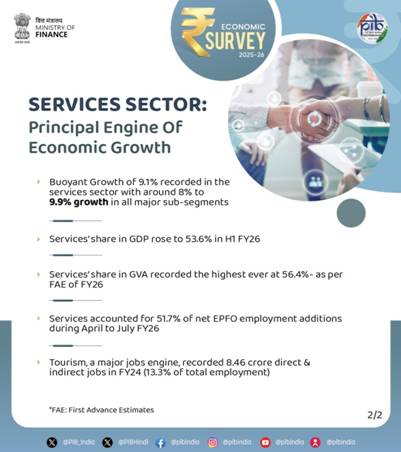
The FY26 witnessed across-the-board expansion in services. Buoyant Growth in the Services Sector at 9.1% has been the major driver for GVA growth in the First Advance Estimates (FAE) for FY 26, with around 8% to 9.9% growth in all major sub-segments.

GLOBAL TRENDS & INDIA’S EXPERIENCE:

The COVID-19 pandemic severely disrupted contact-intensive services, such as tourism, hospitality, and transport, while accelerating the expansion of digitally delivered services, including IT, finance, and professional services. In 2024, the share of services trade in GDP rose relative to pre-pandemic levels, signaling a gradual, though uneven, rebalancing of global trade towards services.

This growing role of services in global trade has been mirrored by a corresponding shift in capital allocation. Services accounted for an average 53.5% of global FDI during 2022-2024, up from 50.9% in the pre-pandemic period, with inflows becoming increasingly concentrated. Energy and gas supply, information and communication, construction, and transportation together absorbed over 88% of services FDI, compared to 75.5% in pre-pandemic era.
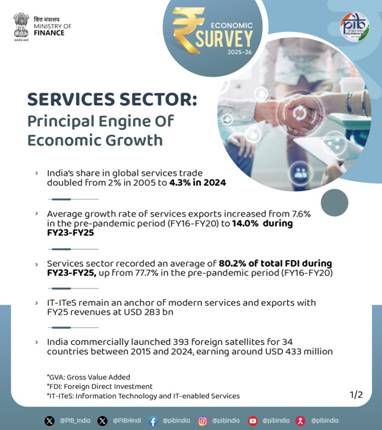
India’s experience broadly mirrors global trends. Services-sector FDI was 80.2% of total FDI during FY23-FY25, up from 77.7% in the pre-pandemic period (FY16-FY20). These inflows went to information and communication services (25.8%) and professional services (23.8%), reflecting our strength in digital and knowledge-intensive activities; along with Finance and insurance (14.2%), energy and gas (12.8%), and trading (12.2%), these segments accounted for nearly 89% of services FDI, highlighting the dominance of digital, skill-intensive, and infrastructure-linked services in India’s investment profile.

The Economic Survey data reveals that ‘financial, real estate, and professional services’ sector remains the key driver of service growth supported by sustained demand for credit, business services, and real estate-linked activities. ‘Public administration, defence and other services’ have also continued to expand at a pace above pre-pandemic trends, underpinned by steady public spending and service delivery. In contrast, ‘trade, hospitality, transport, communication and related services’ have seen a more gradual normalisation, with growth broadly close to pre-pandemic averages.

Average growth in Services exports more than doubled from 7.6% in the pre-pandemic period (FY16-FY20) to 14% in FY23-FY25, reflecting strong and broad-based global demand for Indian services. Despite competitive conditions in global services markets and heightened policy uncertainty, services export growth moderated to 8% during FY26 (April-November).

Software services, accounting for over 40% of total services exports, remain the primary growth driver, expanding at an average rate of 13.5% per cent during FY23-FY25 compared to 4.7% in FY16-FY20, supported by strong global demand for digital services. Professional and management consulting emerged as the second-largest contributor, growing at 25.9%, resulting in an increase in their share from 10.5% in FY16- FY20 to 18.3% in FY23-FY25.

India’s Services exports share in GDP averaged 9.7% during FY23-FY25, up from 7.4% in the pre-pandemic period. Amid subdued global goods trade due to policy uncertainty and geopolitical disruptions, services exports have provided a critical buffer. This role has strengthened further in H1 FY26, with the share of services exports in GDP rising to 10%, from 9.7% in H1 FY25.

NITI Aayog’s findings on state-level and sector-level dynamics says that states like Karnataka, Maharashtra, Tamil Nadu and Telangana together account for nearly 40% of services output, driven by modern, high-productivity services such as IT, finance and professional services, resulting in a concentration of output in highly urbanised states, particularly in southern India. At the same time, important contrasts persist. Bihar, despite low per capita income, derives 58.7% of its GVA from services, largely from low-value-added activities. Kerala, with 64.3% of GSVA from services, remains reliant on traditional segments such as trade, tourism and real estate. In some cases, the services share declined, challenging the notion of one-way transition towards services: Odisha’s services share declined from 38.5% to 34.9%, while Assam’s fell from 46.5% to 34.3% over the period.

SERVICES: KEY EMPLOYMENT DRIVER

The Economic Survey noted that as per PLFS data for the first two quarters of FY26, the share of services in urban employment rose to 61.9%, marginally higher than the FY21- FY22 average of 61.7%, during a period marked by relatively strong services-sector hiring during the pandemic. Consistent with this, EPFO data for April-July FY26 indicate sustained formal job creation, with services accounting for 51.7% of net employment additions, led by expert services, trading and commercial establishments, and cleaning services.

Over 2011-2024, employment elasticity in services stood at 0.43, rising to 0.63 in the post-COVID recovery phase, second only to construction, underscoring the sector’s role as a labour shock absorber.
SUB-SECTORAL PERFORMANCE AND DRIVERS:

Services are getting increasingly integrated into manufacturing through activities such as design, R&D, logistics, software development, and professional services, reflecting the growing “Servicification” of production systems. This is evident in products such as smart devices, automobile, medical equipments/ wearables etc. International experience suggests that this integration is a crucial channel for enhancing value addition, export competitiveness, and employment.

The Economic Survey has revealed that in FY24, travel and tourism contributed 5.22% to GDP, close to pre-pandemic levels, supporting an estimated 8.46 crore direct and indirect jobs (about 13.3% of total employment). Consistent with this growth, foreign exchange earnings from

tourism rose to USD 35.0 billion in 2024, up 8.8% from 2023. Domestic tourism remained the backbone of the sector, with visits increasing by about 17.5% in 2024 over the previous year and by nearly 52.7% during Jan-Sept 2025 compared with the corresponding period last year.

International Tourist Arrivals (ITAs), including foreign tourist arrivals (FTAs) and arrivals of non-resident Indians (NRIs), rose to 20.57 million, an increase of 8.9% over 2023. Growing faster than leisure tourism, Medical and wellness tourism is emerging as a high-potential niche, offering high-value and non-seasonal tourism.

In FY25, the IT and IT-enabled services (IT-ITeS) sector reinforced India’s position as a global technology and innovation hub, supported by continued revenue growth, a rising role of Global Capability Centres (GCCs), and deeper engagement in higher-value, complex technology activities. Nasscom estimates IT&ITeS industry revenues at USD 283 billion in FY25, (including hardware) a year-on-year growth of 5.1% as against 3.9% in FY24. With 1,700+ Global Capability Centres (GCCs) employing about 19 lakh professionals, GCCs are expanding into product, engineering, analytics, cyber-security and AI-enabled functions.

India’s data centre capacity is projected to reach about 8 GW by 2030 from about 1.4GW as of Q2 of 2025. Despite generating nearly 20% of the world’s data, India hosts only about 3% of global data centres, around 150 out of 11,000 worldwide, according to Nasscom, addressing structural constraints such as energy shortages will be critical for India to position itself as a global AI data centre hub.

India’s technology Start-Up ecosystem, the world’s third largest, now comprises about 32,000-35,000 Start-Ups, with over 2,000 added in CY25, including over 900 funded start-ups in CY25. Within this, the Generative AI segment has expanded rapidly, with active GenAI startups rising more than threefold from about 240 in first half of CY24 to over 890 in first half of CY25.

Accounting for around 2% of the global space market valued at about USD 8.4 billion, India commercially launched 393 foreign satellites for 34 countries between 2015 and 2024, earning around USD 433 million, reflecting its cost-effective and reliable capabilities. India’s space sector has emerged as a fast-growing, technology-intensive and increasingly commercial segment of the services economy.

The media and entertainment (M&E) sector has become a significant component of India’s services economy, spanning audio-visual production, broadcasting, digital content, animation and gaming, advertising, and live entertainment. Industry estimates place the sector’s size at around ₹2.5 trillion in 2024, driven by rising incomes, rapid internet penetration and a large domestic market. Digital media emerged as the primary growth engine, contributing approximately one-third of the sector's total revenues. The live-events eco-system part of the Orange Economy and its related tourism spill over is the emerging major trend in the sector.   VII.13: Snapshot of GenAI startups landscape

WAY FORWARD:

The Survey lauds notable progress in all the sub sectors of the Services sector, and cautions on important factors on which their growth with depend. Like, for IT and IT-enabled services, the sector’s future hinges on timely re-skilling, the wider diffusion of digital technologies, and the creation of a supportive policy environment for innovation and scaling.

Tourism requires the creation of niche segments, such as long-distance hiking trails, and a national marina development policy to unlock the blue economy. Space and ocean services are poised for rapid expansion through commercialisation and public-private partnerships.

Topics

Acts Income Tax