

Loading...

Top
Help
×

By creating an account you can:

Logo TaxTMI
Call Us / Help / Feedback

Contact Us At :

E-mail: [email protected]

Call / WhatsApp at: +91 99117 96707

For more information, Check Contact Us

FAQs :

To know Frequently Asked Questions, Check FAQs

Most Asked Video Tutorials :

For more tutorials, Check Video Tutorials

Submit Feedback/Suggestion :

Email :
Please provide your email address so we can follow up on your feedback.
Category :
Description :
Min 15 characters 0/2000
Make Most of Text Search
  1. Checkout this video tutorial: How to search effectively on TaxTMI.
  2. Put words in double quotes for exact word search, eg: "income tax"
  3. Avoid noise words such as : 'and, of, the, a'
  4. Sort by Relevance to get the most relevant document.
  5. Press Enter to add multiple terms/multiple phrases, and then click on Search to Search.
  6. Text Search
  7. The system will try to fetch results that contains ALL your words.
  8. Once you add keywords, you'll see a new 'Search In' filter that makes your results even more precise.
  9. Text Search
Add to...
You have not created any category. Kindly create one to bookmark this item!
Create New Category
Hide
Title :
Description :
❮❮ Hide
Default View
Expand ❯❯
Close ✕
🔎 News - Adv. Search
TEXT SEARCH:

Press 'Enter' to add multiple search terms. Rules for Better Search

Search In:
Main Text + AI Text
  • Main Text
  • Main Text + AI Text
  • AI Text
Category: ?
Categorized by AI
---- All Categories ----
  • ---- All Categories ----
  • Income Tax
  • GST
  • Customs, DGFT & SEZ
  • FEMA & RBI
  • Corp. Laws, SEBI & IBC
  • PMLA, Black Money & ED
  • Budget
  • News and Press Release
  • PTI News
Month:
---- All Months ----
  • ---- All Months ----
  • January
  • February
  • March
  • April
  • May
  • June
  • July
  • August
  • September
  • October
  • November
  • December
Year:
---- All Years ----
  • ---- All Years ----
  • 2026
  • 2025
  • 2024
  • 2023
  • 2022
  • 2021
  • 2020
  • 2019
  • 2018
  • 2017
  • 2016
  • 2015
  • 2014
  • 2013
  • 2012
  • 2011
Sort By: ?
In Sort By 'Default', exact matches for text search are shown at the top, followed by the remaining results in their regular order.
Relevance Default Date
    Sugar prices rise again by Re 1 per kg to Rs 65 in retail market
    SIDBI organizes a conclave of the Heads of Regional Rural Banks (RRBs) on expanding SIDBI-RRB MSME Co-Lending arrangement
    SC sets aside show cause notice to Tata Steel over input tax credit availed during FY19-23
    HC flags fraudulent use of Aadhaar by infiltrators to get Indian citizenship; calls for action
    IVCA Welcomes Consultative Approach on Draft FEMA NDI Rules
    India to be among top 5 Nestle markets in coming years, a major export hub : Global CEO
    Build Credit Awareness with a Free Credit Score Check from Bajaj Finance
    CARD91 Introduces Five-Point Credit Lifecycle Consistency Framework for Credit Line on UPI
    RBI's Proposed Shift from Revolving Credit to Term Loans: SwiffyLabs Lending Platform Already Supports the New Construct
    The US and Canada could pull back from an all-out trade war. It's not clear that they will
    Indian Community in Japan Playing Key Role in Strengthening India-Japan Ties: Commerce and Industry Minister Shri Piyush Goyal
    Union Minister of Commerce and Industry Shri Piyush Goyal Chairs India-Japan Industry Roundtable on Semiconductors and Artificial Intelligence in Toky...
    National Traders’ Welfare Board Holds 100th VC Meeting to Strengthen Engagement with Traders Across the Country
    CCI approves acquisition of 100% share capital of Tao Digital Solutions by Cyient Ltd
    CCI approves acquisition of 100% stake in Kestrel Coal Group Pty Ltd. by Yancoal Australia from certain sellers
    HC bench releases Skoda Volkswagen USD 1.4 billion tax case sans verdict; matter to be heard afresh
    Canada strikes back at US with retaliatory tariffs as trade war escalates
    Rupee rises 26 paise to close at 95.44 against US dollar
    Economy shows resilience to global headwinds with buoyant domestic demand: RBI bulletin
❯❯
Maximize Maximize Maximize
0 / 200
Expand Note
Add to Folder

No Folders have been created

+

Are you sure you want to delete "My most important" ?

NOTE:

News
Showing Results for :
Reset Filters
Results Found:
Show All Summaries Hide All Summaries
August 26, 2026
Show AI Summary
Sugar price-control measures combine raw-sugar imports, stockholding limits and export restrictions to curb retail price pressures.
Sugar price-control measures combine authorised raw-sugar imports, stockholding limits for dealers and bulk consumers, and an existing export prohibition to address elevated domestic prices. Imports are permitted within the specified period, while stockholding restrictions seek to curb speculation and hoarding. Retail prices continued to rise despite lower ex-mill prices, and the regulatory approach focuses on augmenting supply, limiting stock accumulation, and preventing export-related pressure on domestic availability.
August 26, 2026
Show AI Summary
Alternative dispute resolution enabled settlement of long-pending disputes, alongside reporting on court administration and regulatory compliance concerns.
Legal developments include resolution of long-pending tenancy, commercial and property disputes through a special Lok Adalat mechanism, including a digitally signed international settlement. Other matters concern a challenge to a riot-related murder conviction, allegations of administrative irregularities and selective case listing, fast-track court pendency, cancellation of a recruitment process following suspected examination malpractice, fraudulent identity documents used to claim citizenship, medical-qualification standards, and opposition to uranium exploration and mining.
August 26, 2026
Show AI Summary
MSME co-lending supports digital paperless credit delivery through rural banks for underserved rural and semi-urban enterprises.
SIDBI-RRB MSME co-lending arrangement is proposed for expansion to increase credit access for micro, small and medium enterprises in rural and semi-urban areas. The arrangement combines SIDBI's understanding of MSME credit requirements with Regional Rural Banks' local reach. SIDBI's Co-Lending Origination Platform provides an end-to-end digital credit process intended to enable faster, paperless loan processing, in-principle sanction communication, documentation and direct account disbursement without branch visits.
August 26, 2026
Show AI Summary
Input tax credit mismatch alone cannot support fraud-based GST demand without an assessing officer's recorded satisfaction of fraud or suppression.
Section 74 GST demand proceedings require the assessing officer's independent satisfaction of fraud, wilful misstatement or suppression of facts. An input tax credit mismatch or alleged short payment alone cannot establish these conditions. Unsupported assertions of suppression for invoking extended limitation are insufficient, and audit objections cannot replace the assessing officer's satisfaction. A show cause-cum-demand notice lacking factual allegations of a deliberate device to evade tax or avail excess input tax credit is vulnerable.
August 26, 2026
Show AI Summary
Fraudulent Aadhaar procurement exposes identity-verification gaps and prompts disclosure, expedited investigation, deportation, and statutory review measures.
Fraudulent procurement of Aadhaar and other identity documents by foreign nationals who infiltrate borders may undermine identity verification, immigration control and national security. Coordinated action is required to trace and deport such persons, prevent re-entry, strengthen document verification, and complete investigations without delay. Amendments to the Aadhaar Act are to be considered to assist investigating agencies, while a dedicated procedure is required to address border infiltration and human trafficking. Aadhaar enrolment records are to be supplied to police, followed by timely deportation proceedings.
August 26, 2026
Show AI Summary
Foreign investment liberalisation proposals receive industry support, subject to preserving AIF treatment, grandfathering, and prospective application.
Proposed foreign-investment liberalisation, including treatment of stakes below 10 per cent and a greater role for market forces in valuation, is welcomed. Preservation of the existing treatment of Alternative Investment Funds under the IOCC framework is emphasised, together with grandfathering of transactions and funds undertaken under the current regulatory position. Newly introduced requirements should operate prospectively to support a simpler, predictable and investment-friendly foreign-investment framework.
August 26, 2026
Show AI Summary
India market expansion guides Nestle 's volume-led growth, export-hub development and long-term investment without compromising product quality.
Nestle 's India strategy focuses on volume-led growth, wider consumer reach, portfolio development, efficiency improvements and sustained long-term investment. Growth is intended to combine increased household penetration with pricing, premiumisation, affordability and value offerings. India is also intended to develop further as a production and export hub for global markets, supported by manufacturing capacity and expanding overseas supplies. Product quality and consumer interests remain constraints on the pace of expansion.
August 26, 2026
Show AI Summary
Credit awareness through regular score and report review supports responsible borrowing, error detection, and informed credit management.
Free online access to the Credit Pulse Report is available through the Bajaj Finance website. Users verify their registered mobile number through OTP authentication, provide identifying particulars including PAN and date of birth, and then view the available credit score. The report may be reviewed and downloaded to examine repayment history, active credit accounts, recent enquiries and other recorded credit information. Periodic review can help identify unfamiliar accounts, inaccurate repayment records, overdue amounts, unupdated information and changes in credit utilisation.
August 26, 2026
Show AI Summary
Credit lifecycle consistency requires facility-specific treatment so UPI-linked credit records, repayments and customer obligations remain aligned.
CARD91's Credit Lifecycle Consistency Framework calls for facility-specific treatment of Credit Line on UPI transactions and continuing credit events. Credit limits, outstanding balances, repayments, refunds, reversals and EMI conversions should be accurately connected to the relevant customer account and applied according to the underlying facility's terms. Bank policy, customer consent, transaction controls and portfolio actions should remain aligned. Customer-facing applications, statements and alerts should consistently reflect available credit, outstanding obligations and repayment schedules, while disputes and manual corrections follow documented, reviewable processes.
August 26, 2026
Show AI Summary
Non-revolving credit lines require term-loan structures supporting multiple drawdowns without replenishing sanctioned limits for NBFC lending products.
Proposed restrictions on revolving credit facilities for most NBFCs would generally require credit products to operate as term loans, rather than facilities in which principal repayment automatically restores the available borrowing limit. Compliance may require technology capable of managing multiple drawdowns within an approved sanction, separate repayment schedules, amortisation and servicing workflows, while preventing repaid principal from replenishing the sanctioned limit.
August 26, 2026
Show AI Summary
Reciprocal trade tariffs intensify as negotiations confront market access, cultural protections, industrial safeguards, and sovereignty concerns.
US-Canada tariff escalation involves reciprocal import duties following failed negotiations over market access and trade in dairy, alcoholic beverages, automobiles, steel, aluminium and softwood lumber. United States tariff action relies on a rarely used trade-law power permitting duties against countries considered to discriminate against American businesses, without a prior investigation or stated time limit. Negotiations also raised concerns about protection of major industries, cultural protections and Canada's freedom to conclude trade agreements with other countries.
August 26, 2026
Show AI Summary
Diaspora engagement supports skilled mobility, investment links, remittances, and citizen welfare while encouraging compliance with local laws.
Indian diaspora engagement in Japan supports bilateral goodwill, business links, investment opportunities and people-to-people ties. Skilled Indian professionals are encouraged to understand local requirements, learn Japanese language and culture, and pursue opportunities in healthcare, trades, engineering, artificial intelligence, accountancy and maritime work. Diaspora members are also encouraged to maintain connections with India, contribute through digital education and knowledge-sharing, and comply with local laws and regulations. Remittances and government support for citizens' welfare, safety and crisis assistance abroad are recognised as important aspects of diaspora engagement.
August 26, 2026
Show AI Summary
Semiconductor and AI cooperation advances through industry engagement, investment facilitation, and accelerated economic partnership review.
India-Japan cooperation in semiconductors and artificial intelligence is being strengthened through industry engagement, investment facilitation, technology partnerships and an economic-security-oriented framework. India's semiconductor strategy covers chip design, machinery and materials, fabrication, ATMP/OSAT, research, and talent development, supported by Semicon India initiatives. Bilateral engagement also seeks to address industry concerns, expand manufacturing and innovation partnerships, and accelerate review of the Comprehensive Economic Partnership Agreement to reflect emerging economic opportunities.
August 26, 2026
Show AI Summary
Virtual trader engagement platform strengthens weekly grievance feedback, policy information sharing, and institutional dialogue between government and trading communities.
The Virtual Conference Interaction Meetings provide a weekly, accessible forum for retail traders to engage with the Government, receive information on relevant schemes, policies and reforms, and submit grievances and suggestions. The platform enables recurring concerns to be identified and communicated to concerned Ministries and Departments for consideration and redressal. It seeks to strengthen institutionalised dialogue, feedback, transparency, trust and cooperation between the Government and the trader community.
August 26, 2026
Show AI Summary
Competition clearance for full acquisition permits Cyient to acquire Tao Digital Solutions, a global digital transformation and technology services provider.
Competition Commission of India approved Cyient Limited's acquisition of 100% of Tao Digital Solutions Inc.'s share capital from its existing shareholders. The full share capital acquisition transfers complete ownership of Tao Digital Solutions to Cyient. Tao Digital Solutions provides global digital transformation and technology services, including product engineering, managed services, cybersecurity, payments, digitization and AI, cloud services, and data services, and operates in India through its wholly owned subsidiary, Tao Digital India Private Limited.
August 26, 2026
Show AI Summary
Competition clearance for full coal-sector acquisition addresses limited Indian market links through metallurgical and thermal coal sales.
Competition approval covers Yancoal Australia Limited's acquisition of 100% equity interest and warrants in Kestrel Coal Group Pty Ltd. The target holds an 80% interest in the Kestrel Joint Venture, which operates a Queensland coal mine producing principally metallurgical coal and a smaller volume of thermal coal. Neither the acquirer nor the target has a physical presence in India. Their Indian nexus is limited to coal exports and the joint venture's sales of metallurgical coal into India.
August 25, 2026
Show AI Summary
Customs classification of unassembled vehicle imports requires fresh hearing after reserved tax challenge was released without verdict.
The dispute concerns customs classification of imported unassembled vehicle parts. Customs authorities allege that parts imported in separate shipments should have been declared as completely knocked down (CKD) units, attracting the higher duty applicable to CKD imports, rather than as individual components subject to lower duty. The manufacturer contests the resulting customs demand. Proceedings have been released for fresh hearing before the regular indirect-tax writ bench, with status quo maintained for four weeks.
August 25, 2026
Show AI Summary
Retaliatory tariffs on imported goods escalate trade measures, targeting key sectors while maintaining support for affected domestic businesses.
Canada has imposed retaliatory tariffs on United States-origin industrial and consumer goods following increased United States tariffs on Canadian goods. Effective 8 September, the measures apply at rates of 15%, 25% and 50% across more than 700 products, including steel, aluminium, appliances, dairy products, seafood, furniture, clothing, pulp and paper, and electronics. Existing countertariffs on automobiles remain in force. The measures seek to protect domestic businesses and reduce imports, supported by assistance for affected workers and businesses amid risks to integrated cross-border supply chains.
August 25, 2026
Show AI Summary
Foreign-exchange market intervention and lower crude prices supported rupee appreciation, while USD/INR remained range-bound amid shifting dollar conditions.
Foreign-exchange market conditions supported rupee appreciation against the US dollar, driven by stronger domestic equity markets, a weaker US dollar and lower crude oil prices. The USD/INR pair remained broadly range-bound, with oil-price movements and Reserve Bank intervention identified as key near-term influences. The special USD-INR foreign-exchange swap facility for FCNR(B) deposits, overseas foreign-currency borrowings and external commercial borrowings mobilised substantial foreign-exchange inflows.
August 25, 2026
Show AI Summary
Section 301 tariffs may have lower impact where major exports remain outside their scope amid resilient domestic demand.
Economic resilience is attributed to buoyant domestic demand, increased manufacturing and services activity, improving liquidity conditions, credit growth, investment activity and rebounding foreign capital inflows. Recovery in the southwest monsoon improved kharif sowing and reservoir storage, partly mitigating agricultural-sector risks. US Section 301 tariffs are expected to have a comparatively lower effect because major Indian exports to the United States, including smartphones, petroleum products and pharmaceuticals, remain outside their scope. Foreign direct investment improved with higher gross inflows, while outward foreign direct investment continued to decline.

News

Back

All News

Showing Results for :
Reset Filters
No Records Found

News

Back

All News

Showing Results for : Reset Filters

EDUCATION THE CORE PILLAR OF HUMAN CAPITAL AND CENTRAL TO SHAPING THE NATION’S GROWTH PATH TOWARDS VIKSIT BHARAT @2047 : ECONOMIC SURVEY 2025-2026

January 29, 2026

Contents
Summary
Note

Note

-

Bookmark

Print

Print

ACHIEVEMENTS IN EDUCATION MARKED BY ENHANCED LITERACY RATES, INCREASING ENROLMENT IN SCHOOLS AND HIGHER EDUCATION INSTITUTIONS, PROVISION OF VOCATIONAL EDUCATION AVENUES, SAYS THE SURVEY

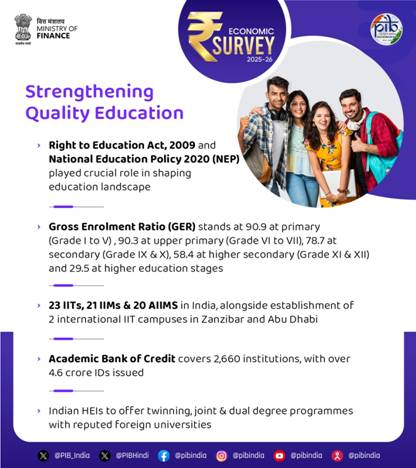
GROSS ENROLMENT RATIO (GER) REACHES AT 90.9 FOR PRIMARY STAGE AND 90.3 FOR UPPER PRIMARY STAGE

INDIA NOW HAS 23 IITS, 21 IIMS, AND 20 AIIMS, ALONGSIDE TWO INTERNATIONAL IIT CAMPUSES IN ZANZIBAR AND ABU DHABI

ACADEMIC BANK OF CREDIT COVERS 2660 INSTITUTIONS, WITH OVER 4.6 CRORE IDs ISSUED

FLEXIBLE ENTRY-EXIT PATHWAYS AND BIANNUAL ADMISSIONS INTRODUCED BY 153 UNIVERSITIES TO ACHIEVE THE NEP TARGET OF 50 % GER BY 2035

INDIAN HEIs TO OFFER TWINNING, JOINT, AND DUAL DEGREE PROGRAMMES WITH REPUTED FOREIGN UNIVERSITIES, WHILE 15 FOREIGN HEIs ARE EXPECTED TO SET UP CAMPUSES IN INDIA

STRUCTURED SKILLING PATHWAYS IN SECONDARY SCHOOLS TO PROVIDE EARLY EXPOSURE TO EMPLOYABLE COMPETENCIES, SAYS ECONOMIC SURVEY 2025-2026

In the education space, progress in school and higher education has been at the back of enhanced quality and access through community engagement, effective assessments, improved accountability, and stronger alignment between education and skill requirements states the Economic Survey 2025-2026 tabled in Parliament today by Union Minister of Finance and Corporate Affairs, Smt. Nirmala Sitharaman .

According to the Survey, the achievements in the education space have been marked by enhanced literacy rates, increasing enrolment in schools and higher education institutions, provision of vocational education avenues, etc. The Right to Education Act 2009 and the National Education Policy 2020 (NEP) have played a crucial role in shaping the education landscape by expanding access to quality education universally, promoting equity, and driving innovation in teaching and learning.

India has made notable gains in school enrolment by strengthening infrastructure and teacher capacity, with schemes like Poshan Shakti Nirman and Samagra Shiksha Abhiyan promoting access and equity. Gross Enrolment Ratio (GER) are 90.9 at the primary stage (Grade I to V), 90.3 at the upper primary (Grade VI to VIII), 78.7 at the secondary stage (Grade IX and X) and 58.4 at the higher secondary stage (Grade XI and XII).

Progress in school education

School education forms the foundation of human capital and is central to shaping the nation’s growth path towards Viksit Bharat @2047. Experiences from fast-growing Asian economies clearly demonstrate that consistent investments in education, skills development, and technology can significantly enhance productivity, foster innovation, and accelerate economic transformation.

To fully convert its vast human resource base into high-quality human capital, India needs to raise its Expected Years of Schooling (EYS) to 15-year set by NEP’s 5+3+3+4 schooling structure for ages 3-18. This requires a holistic, lifecycle approach that encompasses early childhood education, foundational literacy and numeracy (FLN), universal secondary schooling, and the seamless integration of vocational and digital skills.

To achieve the goals of NEP, the government launched school-level schemes such as the Sarv Shiksha Abhiyan, ULLAS, PM-SHRI(PM-Schools for Rising India), PM POSHAN (PM Poshan Shakti Nirman) and initiatives, such as PARAKH, Vidya Pravesh, DIKSHA (Digital Infrastructure for Knowledge Sharing), NIPUN Bharat Mission and Atal Tinkering Labs.In school education, the policy emphasises Early Childhood Care and Education (ECCE), FLN, reducing dropouts, ensuring universal access, revamping curriculum and pedagogy, strengthening teacher capacity, promoting equity, and improving quality.

School infrastructure

India operates one of the world’s largest school systems, serving 24.69 crore students across 14.71 lakh schools, supported by over 1.01 crore teachers (UDISE+ 2024-25). Aligned with the NEP goal of achieving a 100 per cent gross enrolment ratio (GER) from pre-primary to secondary education by 2030, steady progress has been observed across all school levels.

GER scores, as per NEP academic structure, are 95.4 at the preparatory stage (Grade III to Grade V), 90.3 at the middle stage (Grade VI to Grade VIII), and 68.5 at the secondary stage (Grade IX to Grade XII).  Various Government of India schemes have been instrumental in improving the GER . These include setting up of 13,076 PM shri Schools in 33 states / UTs, Co-location of Anganwadi Centres in 2,99,544 Schools to create a unified and strengthened Early childhood Care and Education (ECCE)  system for universal access to high quality learning. Schemes like Jaadui Pitara, e Jaaduai pitara, Kitab Ek Padhe Anek and Bhartiya Bhasha Pustak Scheme has made teaching material available to children in local languages 

India has made notable gains in school enrolment by strengthening infrastructure and teacher capacity, with schemes like Poshan Shakti Nirman and Samagra Shiksha Abhiyan promoting access and equity. Improving infrastructure, teacher skills through strengthened DIETs (District Institute of Education & Training), and SCERTs (State Council of Educational Research and Training), and involving parents and communities in governance can create an inclusive, learner focused environment. Combining these strategies with curriculum and assessment reforms aligned with NEP and the use of digital platforms such as PM e-Vidya can provide high-quality, equitable education, even in remote areas.
Improvement in learning outcomes

Since 2001, National Achievement Surveys (NAS) conducted by the National Council of Educational Research and Training (NCERT) have provided valuable insights into the school education system. Building on this and with a focus on competency-based learning, PARAKH (Performance Assessment, Review, and Analysis of Knowledge for Holistic Development) Rashtriya Sarvekshan 2024 was launched. The PARAKH 2024 findings inform that Grade III results show promising recovery post-COVID. Compared to NAS 2021 and 2017, Grade III proficiency levels have rebounded significantly, with 65 per cent of students proficient in Mathematics (up from 42 per cent in 2021) and 57 per cent in Language (up from 39 per cent).

School-to-skill pathways

Embedding structured skilling pathways in secondary schools can make education more relevant, provide early exposure to employable competencies, and transform schools into hubs of lifelong learning. The PLFS 2023-24 highlights the limited coverage of training, with only 0.97 per cent of 14-18-year-olds having received institutional skilling while nearly 92 per cent have none. Addressing this gap is crucial for leveraging India’s demographic dividend. Skill education in schools would equip young people with market-aligned skills, particularly in the service sector, which absorbs over half of the formally trained youth, while reducing dropouts by linking education to economic opportunities.

Higher education

The number of higher education institutions (HEIs) has increased from 51,534 in 2014-15 to 70,018 as of June 2025.  This increase is marked by substantial growth in universities and colleges. The number of premier higher education institutions (HEIs) has expanded significantly between 2014-15 and 2024-25. It now stands at 23 IITs, 21 IIMs, and 20 AIIMS, alongside the establishment of two international IIT campuses in Zanzibar and Abu Dhabi.

The All-India Survey on Higher Education (AISHE), 2022-23 (Provisional), reports an increase in student enrolment from 4.33 crore in 2021-22 to 4.46 crore in 2022-23.

Under the NEP, the higher education system has undergone several reforms. The National Credit Framework (NCrF), which aims to blend academic and skills-based learning, has been adopted by 170 universities. The Academic Bank of Credit covers 2,660 HEIs, with over 4.6 crore IDs issued, including 2.2 crore APAAR IDs with credits.

 Flexible entry-exit pathways and biannual admissions have been introduced by 153 universities to achieve the NEP target of 50 per cent GER by 2035.

 Aligned with the NEP  to build robust R&D capacity, Anusandhan National Research Foundation have been established to nurture a research-driven culture across universities, colleges, and research institutions nationwide.

To improve the quality of technical education, the Multidisciplinary Education and Research Improvement in Technical Education (MERITE) Scheme has been approved recently for 275 technical institutions, including 175 engineering colleges and 100 polytechnics.

Industry-academia integration in STEM education

The NEP aims to integrate vocational training with general education and to encourage collaboration between industry and academia within HEIs. Industry-academia linkages in the higher education sphere have traditionally emphasised research collaborations, such as joint research, consulting, and technology transfer. One such measure is the introduction of the ‘Professor of Practice’ (PoP) category at HEIs by the UGC and the AICTE. The PoP concept allows industry professionals to bring real world practices and experiences into the classroom and also augment faculty resources in HEIs. Complementing this, the AICTE-Industry Fellowship Programme aims to bridge the gap between academia and industry through active faculty engagement.

Internationalisation of Higher Education

NEP aims at ‘Internationalisation’ of higher education by making the Indian education system self-reliant and comparable to global standards and norms, enabling it to attract more students from abroad and reduce outbound student migration.

UGC issued the Regulations on Academic Collaboration between Indian and Foreign Higher Educational Institutions, 2022, enabling Indian HEIs to offer twinning, joint, and dual degree programmes with reputed foreign universities. Further, 100 per cent foreign direct investment (FDI) is allowed in higher education. These efforts are reinforced by the UGC (Setting Up and Operation of Campuses of Foreign Higher Educational Institutions in India) Regulations, 2023, under which 15 foreign HEIs are expected to set up campuses in India.

India’s policy ecosystem for internationalisation has become more enabling, with the introduction of the NEP, updated UGC guidelines, regulations for academic collaboration and mutual recognition of qualifications, and permissions for foreign branch campuses, including those in GIFT City.

India's education sectors require unwavering focus to unlock the nation's true potential through integrated, accountable, and adaptive policy frameworks to build a future ready workforce.

Topics

Acts Income Tax