 TaxTMI
 Login
 TaxTMI
Login
Loading...
Press 'Enter' to add multiple search terms. Rules for Better Search

Press 'Enter' after typing page number.
Press 'Enter' after typing page number.


No Folders have been created
Are you sure you want to delete "My most important" ?
NOTE:
Press 'Enter' after typing page number.
Press 'Enter' after typing page number.

All News
Press 'Enter' after typing page number.
All News

Note

Bookmark

Share


ACHIEVEMENTS IN EDUCATION MARKED BY ENHANCED LITERACY RATES, INCREASING ENROLMENT IN SCHOOLS AND HIGHER EDUCATION INSTITUTIONS, PROVISION OF VOCATIONAL EDUCATION AVENUES, SAYS THE SURVEY
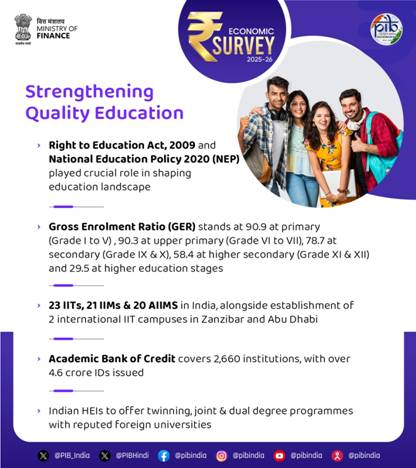
GROSS ENROLMENT RATIO (GER) REACHES AT 90.9 FOR PRIMARY STAGE AND 90.3 FOR UPPER PRIMARY STAGE
INDIA NOW HAS 23 IITS, 21 IIMS, AND 20 AIIMS, ALONGSIDE TWO INTERNATIONAL IIT CAMPUSES IN ZANZIBAR AND ABU DHABI
ACADEMIC BANK OF CREDIT COVERS 2660 INSTITUTIONS, WITH OVER 4.6 CRORE IDs ISSUED
FLEXIBLE ENTRY-EXIT PATHWAYS AND BIANNUAL ADMISSIONS INTRODUCED BY 153 UNIVERSITIES TO ACHIEVE THE NEP TARGET OF 50 % GER BY 2035
INDIAN HEIs TO OFFER TWINNING, JOINT, AND DUAL DEGREE PROGRAMMES WITH REPUTED FOREIGN UNIVERSITIES, WHILE 15 FOREIGN HEIs ARE EXPECTED TO SET UP CAMPUSES IN INDIA
STRUCTURED SKILLING PATHWAYS IN SECONDARY SCHOOLS TO PROVIDE EARLY EXPOSURE TO EMPLOYABLE COMPETENCIES, SAYS ECONOMIC SURVEY 2025-2026
In the education space, progress in school and higher education has been at the back of enhanced quality and access through community engagement, effective assessments, improved accountability, and stronger alignment between education and skill requirements states the Economic Survey 2025-2026 tabled in Parliament today by Union Minister of Finance and Corporate Affairs, Smt. Nirmala Sitharaman .
According to the Survey, the achievements in the education space have been marked by enhanced literacy rates, increasing enrolment in schools and higher education institutions, provision of vocational education avenues, etc. The Right to Education Act 2009 and the National Education Policy 2020 (NEP) have played a crucial role in shaping the education landscape by expanding access to quality education universally, promoting equity, and driving innovation in teaching and learning.
India has made notable gains in school enrolment by strengthening infrastructure and teacher capacity, with schemes like Poshan Shakti Nirman and Samagra Shiksha Abhiyan promoting access and equity. Gross Enrolment Ratio (GER) are 90.9 at the primary stage (Grade I to V), 90.3 at the upper primary (Grade VI to VIII), 78.7 at the secondary stage (Grade IX and X) and 58.4 at the higher secondary stage (Grade XI and XII).
Progress in school education
School education forms the foundation of human capital and is central to shaping the nation’s growth path towards Viksit Bharat @2047. Experiences from fast-growing Asian economies clearly demonstrate that consistent investments in education, skills development, and technology can significantly enhance productivity, foster innovation, and accelerate economic transformation.
To fully convert its vast human resource base into high-quality human capital, India needs to raise its Expected Years of Schooling (EYS) to 15-year set by NEP’s 5+3+3+4 schooling structure for ages 3-18. This requires a holistic, lifecycle approach that encompasses early childhood education, foundational literacy and numeracy (FLN), universal secondary schooling, and the seamless integration of vocational and digital skills.
To achieve the goals of NEP, the government launched school-level schemes such as the Sarv Shiksha Abhiyan, ULLAS, PM-SHRI(PM-Schools for Rising India), PM POSHAN (PM Poshan Shakti Nirman) and initiatives, such as PARAKH, Vidya Pravesh, DIKSHA (Digital Infrastructure for Knowledge Sharing), NIPUN Bharat Mission and Atal Tinkering Labs.In school education, the policy emphasises Early Childhood Care and Education (ECCE), FLN, reducing dropouts, ensuring universal access, revamping curriculum and pedagogy, strengthening teacher capacity, promoting equity, and improving quality.
School infrastructure
India operates one of the world’s largest school systems, serving 24.69 crore students across 14.71 lakh schools, supported by over 1.01 crore teachers (UDISE+ 2024-25). Aligned with the NEP goal of achieving a 100 per cent gross enrolment ratio (GER) from pre-primary to secondary education by 2030, steady progress has been observed across all school levels.
GER scores, as per NEP academic structure, are 95.4 at the preparatory stage (Grade III to Grade V), 90.3 at the middle stage (Grade VI to Grade VIII), and 68.5 at the secondary stage (Grade IX to Grade XII). Various Government of India schemes have been instrumental in improving the GER . These include setting up of 13,076 PM shri Schools in 33 states / UTs, Co-location of Anganwadi Centres in 2,99,544 Schools to create a unified and strengthened Early childhood Care and Education (ECCE) system for universal access to high quality learning. Schemes like Jaadui Pitara, e Jaaduai pitara, Kitab Ek Padhe Anek and Bhartiya Bhasha Pustak Scheme has made teaching material available to children in local languages
India has made notable gains in school enrolment by strengthening infrastructure and teacher capacity, with schemes like Poshan Shakti Nirman and Samagra Shiksha Abhiyan promoting access and equity. Improving infrastructure, teacher skills through strengthened DIETs (District Institute of Education & Training), and SCERTs (State Council of Educational Research and Training), and involving parents and communities in governance can create an inclusive, learner focused environment. Combining these strategies with curriculum and assessment reforms aligned with NEP and the use of digital platforms such as PM e-Vidya can provide high-quality, equitable education, even in remote areas.
Improvement in learning outcomes
Since 2001, National Achievement Surveys (NAS) conducted by the National Council of Educational Research and Training (NCERT) have provided valuable insights into the school education system. Building on this and with a focus on competency-based learning, PARAKH (Performance Assessment, Review, and Analysis of Knowledge for Holistic Development) Rashtriya Sarvekshan 2024 was launched. The PARAKH 2024 findings inform that Grade III results show promising recovery post-COVID. Compared to NAS 2021 and 2017, Grade III proficiency levels have rebounded significantly, with 65 per cent of students proficient in Mathematics (up from 42 per cent in 2021) and 57 per cent in Language (up from 39 per cent).
School-to-skill pathways
Embedding structured skilling pathways in secondary schools can make education more relevant, provide early exposure to employable competencies, and transform schools into hubs of lifelong learning. The PLFS 2023-24 highlights the limited coverage of training, with only 0.97 per cent of 14-18-year-olds having received institutional skilling while nearly 92 per cent have none. Addressing this gap is crucial for leveraging India’s demographic dividend. Skill education in schools would equip young people with market-aligned skills, particularly in the service sector, which absorbs over half of the formally trained youth, while reducing dropouts by linking education to economic opportunities.
Higher education
The number of higher education institutions (HEIs) has increased from 51,534 in 2014-15 to 70,018 as of June 2025. This increase is marked by substantial growth in universities and colleges. The number of premier higher education institutions (HEIs) has expanded significantly between 2014-15 and 2024-25. It now stands at 23 IITs, 21 IIMs, and 20 AIIMS, alongside the establishment of two international IIT campuses in Zanzibar and Abu Dhabi.
The All-India Survey on Higher Education (AISHE), 2022-23 (Provisional), reports an increase in student enrolment from 4.33 crore in 2021-22 to 4.46 crore in 2022-23.
Under the NEP, the higher education system has undergone several reforms. The National Credit Framework (NCrF), which aims to blend academic and skills-based learning, has been adopted by 170 universities. The Academic Bank of Credit covers 2,660 HEIs, with over 4.6 crore IDs issued, including 2.2 crore APAAR IDs with credits.
Flexible entry-exit pathways and biannual admissions have been introduced by 153 universities to achieve the NEP target of 50 per cent GER by 2035.
Aligned with the NEP to build robust R&D capacity, Anusandhan National Research Foundation have been established to nurture a research-driven culture across universities, colleges, and research institutions nationwide.
To improve the quality of technical education, the Multidisciplinary Education and Research Improvement in Technical Education (MERITE) Scheme has been approved recently for 275 technical institutions, including 175 engineering colleges and 100 polytechnics.
Industry-academia integration in STEM education
The NEP aims to integrate vocational training with general education and to encourage collaboration between industry and academia within HEIs. Industry-academia linkages in the higher education sphere have traditionally emphasised research collaborations, such as joint research, consulting, and technology transfer. One such measure is the introduction of the ‘Professor of Practice’ (PoP) category at HEIs by the UGC and the AICTE. The PoP concept allows industry professionals to bring real world practices and experiences into the classroom and also augment faculty resources in HEIs. Complementing this, the AICTE-Industry Fellowship Programme aims to bridge the gap between academia and industry through active faculty engagement.
Internationalisation of Higher Education
NEP aims at ‘Internationalisation’ of higher education by making the Indian education system self-reliant and comparable to global standards and norms, enabling it to attract more students from abroad and reduce outbound student migration.
UGC issued the Regulations on Academic Collaboration between Indian and Foreign Higher Educational Institutions, 2022, enabling Indian HEIs to offer twinning, joint, and dual degree programmes with reputed foreign universities. Further, 100 per cent foreign direct investment (FDI) is allowed in higher education. These efforts are reinforced by the UGC (Setting Up and Operation of Campuses of Foreign Higher Educational Institutions in India) Regulations, 2023, under which 15 foreign HEIs are expected to set up campuses in India.
India’s policy ecosystem for internationalisation has become more enabling, with the introduction of the NEP, updated UGC guidelines, regulations for academic collaboration and mutual recognition of qualifications, and permissions for foreign branch campuses, including those in GIFT City.
India's education sectors require unwavering focus to unlock the nation's true potential through integrated, accountable, and adaptive policy frameworks to build a future ready workforce.

