 TaxTMI
 Login
 TaxTMI
Login
Loading...
Press 'Enter' to add multiple search terms. Rules for Better Search

Press 'Enter' after typing page number.
Press 'Enter' after typing page number.


No Folders have been created
Are you sure you want to delete "My most important" ?
NOTE:
Press 'Enter' after typing page number.
Press 'Enter' after typing page number.

All News
Press 'Enter' after typing page number.
All News

Note

Bookmark

Share


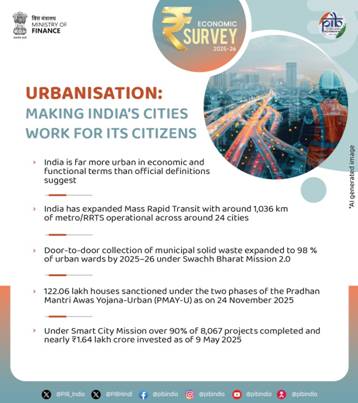
INDIA HAS EXPANDED MASS RAPID TRANSIT WITH AROUND 1,036 KM OF METRO/RRTS OPERATIONAL ACROSS AROUND 24 CITIES
DOOR-TO-DOOR COLLECTION OF MUNICIPAL SOLID WASTE (MSW) EXPANDED TO 98 PER CENT OF URBAN WARDS BY 2025–26
122.06 LAKH HOUSES HAVE BEEN SANCTIONED UNDER THE TWO PHASES OF THE PRADHAN MANTRI AWAS YOJANA – URBAN (PMAY-U)
FUTURE URBAN POLICY MUST PRIORITISE SYSTEM PERFORMANCE OVER STANDALONE PROJECTS, SAYS ECONOMIC SURVEY
“India’s cities are not merely places of residence but function as critical economic infrastructure. Density and proximity generate agglomeration economies that raise productivity, deepen labour markets, and enable innovation. The economic role of cities is therefore central to India’s growth trajectory,” said the Economic Survey 2025-26 tabled in Parliament today by Union Minister for Finance and Corporate Affairs Smt. Nirmala Sitharaman.
Economic Survey 2025-26 underlined that India is already deeply urban in economic terms, with the majority of its national output generated in cities and in urban areas. The task now is to make that urbanisation work better for citizens in tangible and intangible ways.
The survey positioned cities as economic assets that require deliberate investment and strategic planning. It stated that recognisation of cities as economic infrastructure is a necessary first step toward aligning public policy, fiscal priorities, and planning frameworks with India’s development trajectory.
CITIES ARE GROWTH ENGINES
According to Economic Survey 2025-26, India is far more urban in economic and functional terms than official definitions suggest. Based on satellite data from the Global Human Settlements Layer (GHSL) of the Group on Earth Observations at the European Commission, India was 63 per cent urban in 2015, which is nearly double the urbanisation rate reported in the 2011 Census.
Economic Survey maintained that the World Bank also estimated that by 2036, India’s towns and cities will be home to 600 million people, or 40 per cent of the population, up from 31 per cent in 2011, with urban areas contributing almost 70 per cent to GDP.
MOBILITY
Economic Survey 2025-26 stated that India has materially expanded mass rapid transit system over the last decade. As of 2025, around 1,036 km of Metro/RRTS are operational across around 24 cities, with further corridors under construction.
Economic Survey also mentioned that the Government has launched PM e-Bus Sewa to strengthen city bus operations with 10,000 e-buses on a Public-Private Partnership (PPP) model, backed by ₹20,000 crore central assistance and a Payment Security Mechanism (PSM) to assure operator cashflows. During the FY 25, 7,293 e-buses have been approved across 14 States and 4 UTs, ₹983.75 crore sanctioned for depot and behind the meter power infrastructure, and ₹437.5 crore has already been disbursed
To further improve outcomes, Economic Survey 2025-26 suggested augmentation and digitisation of bus fleets, finance-first e-bus deployment, mainstreaming last-mile and shared mobility, operationalisation of Transit-oriented Development (TOD) and value capture around stations.
URBAN CLEANLINESS
Economic Survey 2025-26 highlighted that over the past decade, the central government has undertaken one of the most ambitious and largest sanitation and waste management programmes globally under the Swachh Bharat Mission -Urban (SBM–U), complemented by investments under the Atal Mission for Rejuvenation and Urban Transformation (AMRUT) and AMRUT 2.0. These measures have yielded visible gains in sanitation outcomes, with the most notable being the elimination of open defecation across all cities.
Door-to-door collection of municipal solid waste (MSW), which was negligible in 2014–15, has expanded to 98 per cent of urban wards by 2025–26, supported by a fleet of over 2.5 lakh waste collection vehicles nationwide, according to the survey.
CITY UPGRADATION THROUGH TECHNOLOGY ADOPTION
The Survey stated that as of 9 May 2025, cities under the Smart Cities Mission (SCM) had completed a substantial majority of planned projects — including smart roads, cycle tracks, command and control centres, upgraded water and sewerage networks, and vibrant public spaces with over 90 per cent of the roughly 8,067 projects completed and nearly ₹1.64 lakh crore invested.
The Government’s interventions to support affordable housing in urban areas including direct tax and GST benefits, inclusion in priority sector lending and provision of infrastructure status, amongst others. Under the two phases of the Pradhan Mantri Awas Yojana – Urban (PMAY-U), a total of 122.06 lakh houses have been sanctioned, of which 96.02 lakh have been completed/delivered to the beneficiaries across the country as on 24.11.2025.
Survey explained that the Pradhan Mantri Street Vendor’s Atmanirbhar Nidhi (PM SVANidhi) has played a central role in restoring and strengthening the livelihoods of urban street vendors (SV).
The Survey stated that aligning mandates, clarifying ownership of outcomes, and insulating routine enforcement from ad-hoc intervention are therefore central to making rule certainty credible in everyday urban governance.
PLANNING, GOVERNANCE AND FINANCING
The Government of India has taken a series of concerted efforts to address the financing requirements of city and urban development. The Urban Infrastructure Development Fund (UIDF), announced in the Union Budget 2023–24 with an initial outlay of ₹10,000 crore, was designed as a revolving fund routed through financial institutions to support Tier-2 and Tier-3 cities that lack creditworthiness but have viable infrastructure projects, said the Economic Survey 2025-26.
The Economic Survey tabled in Parliament today proposed that every million-plus city should be required to prepare a statutory 20-year City Spatial and Economic Plan, updated every five years, with three non-negotiable elements:
SYSTEM-BASED CIVIC-SENSE AWARENESS
The survey stated that communication should reinforce predictable systems rather than substitute for them. Simple, local, and repetitive messaging focused on a small set of high-impact behaviours works best when delivered at the point of action.
CONCLUSION
Future urban policy must prioritise system performance over standalone projects—integrating housing, mobility, sanitation, climate resilience, and finance—while designing liveable, climate-ready cities that support inclusion and long-term economic efficiency.
The Economic Survey 2025- 26 said that the promise of building India’s urban future lies in making our cities economically dynamic, socially inclusive, environmentally sustainable and institutionally capable.

