 TaxTMI
 Login
 TaxTMI
Login
Loading...
Press 'Enter' to add multiple search terms. Rules for Better Search

Press 'Enter' after typing page number.
Press 'Enter' after typing page number.


No Folders have been created
Are you sure you want to delete "My most important" ?
NOTE:
Press 'Enter' after typing page number.
Press 'Enter' after typing page number.

All News
Press 'Enter' after typing page number.
All News

Note

Bookmark

Share


Focussed Implementation of State-specific Action Plans, large-scale deployment of Crop Residue Management Machinery and Strict Enforcement Measures by CAQM yields results
Sustained Improvement in Overall Air Quality expected in the region, in years to come
The paddy harvesting season 2025 has come to an end, witnessing a decline in farm fire incidents across Punjab and Haryana. With this the period of official recording, monitoring and assessment of paddy stubble burning events also concluded. The process is carried out annually from 15th September to 30th November as per the standard protocol developed by ISRO.
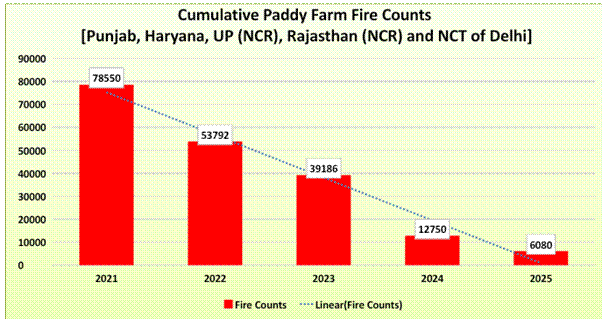
There has been a steady reduction recorded in recent years under the Commission for Air Quality Management’s (CAQM) coordinated framework to curb paddy stubble burning incidents in the region. While meteorological conditions also influence air quality scenario in Delhi-NCR, the substantial reduction in farm fires this season has considerably limited the potential episodic deterioration driven by stubble-burning contributions.
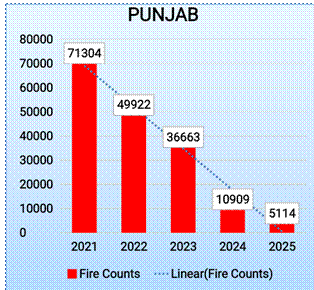
Lowest number of fire counts were recorded during the paddy harvesting season of 2025. Punjab recorded 5,114 such incidents. This reflects a reduction of 53% over 2024, 86% over 2023, 90% over 2022, and 93% over 2021.
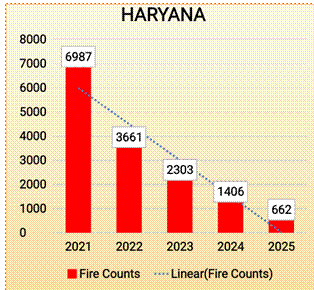
Likewise, Haryana maintained its performance as well, logging 662 farm fire incidents this year. The State registered a 53% reduction from 2024, 71% reduction from 2023, 81% from 2022 and 91% from 2021. These numbers represent the most significant decline achieved since CAQM began monitoring State-specific crop residue management measures as per their Action Plans.
This decline in Punjab and Haryana has been driven by the implementation of State and District-specific Action Plans, large-scale deployment of crop residue management machinery, and strict enforcement measures. Further, the factors that contributed in the drop were strengthened ex-situ utilisation of paddy straw, including biomass-based energy generation, use in industrial boilers, production of bio-ethanol, mandating use of paddy straw pellets/briquettes for co-firing in Thermal Power Plants/ brick kilns, while also in packaging and various other commercial applications.
The Commission ensured persistent coordination between the State Agriculture Departments, District administrations, and timely corrective action, wherever significant fire events were reported. Ground-level inspection and enforcement by flying squads/ Parali Protection Force/ field officers, continuous monitoring by teams deployed across hotspot Districts, focused IEC campaigns and awareness programs for farmers, also played a crucial role. Further, a dedicated CAQM Cell has been established in Chandigarh, mandated to focus on round-the-year monitoring of paddy stubble management and related pollution activities.
With consistent and strengthened implementation and targeting of complete elimination of paddy straw burning in Punjab, Haryana, and NCR States, sustained improvement in the overall air quality of the region is expected during the coming years.
*****
VM/SK

