 TaxTMI
 Login
 TaxTMI
Login
Loading...
Press 'Enter' to add multiple search terms. Rules for Better Search

Press 'Enter' after typing page number.
Press 'Enter' after typing page number.


No Folders have been created
Are you sure you want to delete "My most important" ?
NOTE:
Press 'Enter' after typing page number.
Press 'Enter' after typing page number.

All News
Press 'Enter' after typing page number.
All News

Note

Bookmark

Share


The three-day gathering brought together senior policymakers, economists, industry leaders and scholars to examine pathways to resilient, inclusive growth amid heightened global uncertainty
The Institute of Economic Growth (IEG), in partnership with the Ministry of Finance, successfully concluded the Fourth Kautilya Economic Conclave (KEC 2025), a three-day gathering that brought together senior policymakers, economists, industry leaders and scholars to examine pathways to resilient, inclusive growth amid heightened global uncertainty.
The KEC 2025 was inaugurated on 3rd October by Union Minister for Finance and Corporate Affairs Smt. Nirmala Sitharaman. In her address, the Union Finance Minister emphasised that India's rise as a stabilising force in the present turbulent times is neither accidental nor transient; instead, it results from a powerful combination of factors.
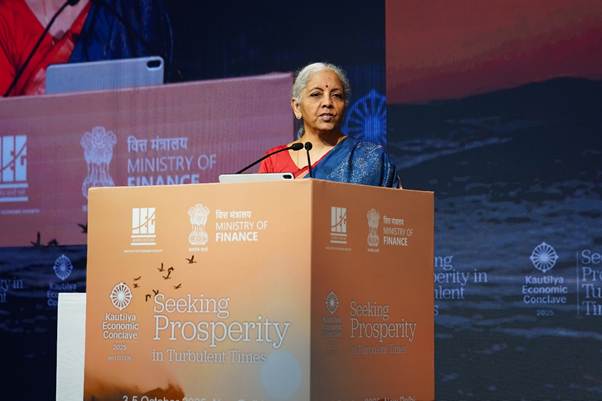
FM Smt. Sitharaman highlighted the consistent efforts of the government over the last decade towards fiscal consolidation, improved quality of capital expenditure, and reining in inflationary pressures, and remarked that with the steady share of consumption and investment in the overall GDP over the years, India's growth is firmly anchored in its domestic factors, which minimises the impact of external shocks on overall growth.
Over three days, participants engaged in intense deliberations across plenary sessions, interactive panels, and special lectures. The sessions on macroeconomic resilience emphasised the importance of stable inflation management, exchange rate discipline, and safeguarding financial stability against global fluctuations in oil and commodity prices. The debate on digital public infrastructure and technology showcased India’s leadership in building inclusive systems, with discussions on artificial intelligence, 5G communications, and digital finance pointing to new avenues for international cooperation.
Trade and global fragmentation formed another strand of discussion, with experts examining the challenges posed by protectionist trends and the re-wiring of supply chains. Sessions on legal and regulatory reforms drew attention to India’s business environment, with panellists urging a modernised regulatory framework and reduced compliance costs to attract long-term foreign investment.
Equally significant were discussions on sustainable finance and climate change. Policymakers and financial leaders debated the potential of green bonds, carbon markets, and blended finance mechanisms to unlock the capital required for India’s energy transition and climate adaptation goals. Demographers and social scientists, meanwhile, examined ongoing demographic transition across the globe, drawing attention to the twin challenges of ageing populations in advanced economies and the youth bulge in parts of the developing world.
The KEC 2025 also featured a special address by Mr. Jean-Claude Trichet, former President of the European Central Bank, on “What Europe Can Learn from the Indian Federation,” drawing lessons from India’s federal fiscal architecture for Europe’s integration challenges.
The event concluded on 5th October with an address by Dr. S. Jaishankar, Union Minister of External Affairs, who reflected on India’s external economic posture in a fragmenting world.
He stressed the integration of economic policy with foreign policy, noting that in times of global uncertainty, strong domestic fundamentals and strategic partnerships must go hand in hand.
Shri Jyotiraditya Scindia, Union Minister of Communications and Minister for Development of North Eastern Region, delivered an address on ‘Emerging Technologies’ on the penultimate day of the conclave.
The key message of the KEC 2025 was clear; India’s growth story remains robust, but sustaining higher growth over the long run will require further structural reforms, while strengthening external partnerships. India’s role in global economic governance is set to expand, with its experience in building digital infrastructure, pursuing federal fiscal balance, and managing demographic transitions offering valuable lessons to the world.
The KEC 2025 had the participation of the highest echelons of Government. Dr. P.K. Mishra and Shri Shaktikanta Das, Principal Secretaries to the Prime Minister, lent their perspectives on India’s reform trajectory. Shri Vikram Misri, Foreign Secretary, also deliberated in another session at the KEC 2025.
The financial architecture discussions were enriched by the presence of Shri Sanjay Malhotra, Governor, Reserve Bank of India. Their interventions, together with those of international economists, central bankers, and industry leaders, underscored the KEC 2025’s role as a forum where India’s governance priorities intersect with global thought leadership.
Since its inception in 2022, the Kautilya Economic Conclave has emerged as a premier platform jointly convened by the Institute of Economic Growth and the Ministry of Finance. It serves as a bridge between scholarship and policy, combining India’s lived experience with global perspectives. The 2025 edition reaffirmed the Conclave’s growing stature as a forum for serious, high-level dialogue on navigating the complexities of today’s world economy.

