Loading...

Top
Help
×

By creating an account you can:

Logo TaxTMI
Call Us / Help / Feedback

Contact Us At :

E-mail: [email protected]

Call / WhatsApp at: +91 99117 96707

For more information, Check Contact Us

FAQs :

To know Frequently Asked Questions, Check FAQs

Most Asked Video Tutorials :

For more tutorials, Check Video Tutorials

Submit Feedback/Suggestion :

Email :
Please provide your email address so we can follow up on your feedback.
Category :
Description :
Min 15 characters 0/2000
Make Most of Text Search
  1. Checkout this video tutorial: How to search effectively on TaxTMI.
  2. Put words in double quotes for exact word search, eg: "income tax"
  3. Avoid noise words such as : 'and, of, the, a'
  4. Sort by Relevance to get the most relevant document.
  5. Press Enter to add multiple terms/multiple phrases, and then click on Search to Search.
  6. Text Search
  7. The system will try to fetch results that contains ALL your words.
  8. Once you add keywords, you'll see a new 'Search In' filter that makes your results even more precise.
  9. Text Search
Add to...
You have not created any category. Kindly create one to bookmark this item!
Create New Category
Hide
Title :
Description :
❮❮ Hide
Default View
Expand ❯❯
Close ✕
🔎 News - Adv. Search
TEXT SEARCH:

Press 'Enter' to add multiple search terms. Rules for Better Search

Search In:
Main Text + AI Text
  • Main Text
  • Main Text + AI Text
  • AI Text
Category: ?
Categorized by AI
---- All Categories ----
  • ---- All Categories ----
  • Income Tax
  • GST
  • Customs, DGFT & SEZ
  • FEMA & RBI
  • Corp. Laws, SEBI & IBC
  • PMLA, Black Money & ED
  • Budget
  • News and Press Release
  • PTI News
Month:
---- All Months ----
  • ---- All Months ----
  • January
  • February
  • March
  • April
  • May
  • June
  • July
  • August
  • September
  • October
  • November
  • December
Year:
---- All Years ----
  • ---- All Years ----
  • 2026
  • 2025
  • 2024
  • 2023
  • 2022
  • 2021
  • 2020
  • 2019
  • 2018
  • 2017
  • 2016
  • 2015
  • 2014
  • 2013
  • 2012
  • 2011
Sort By: ?
In Sort By 'Default', exact matches for text search are shown at the top, followed by the remaining results in their regular order.
Relevance Default Date
    After nine years at helm, N Chandra to exit Tata Sons amid expansion, governance standoff
    RBI invites comments on the Draft “Reserve Bank of India (Interest Rates on Loans and Advances) Directions, 2026”
    Sensex falls 188 pts amid elevated crude oil prices; Tata Group stocks decline after N Chandra's exit
    SJM urges govt to stand firm against US tariff pressure, calls for boycott of American products
    Union Minister of Commerce and Industry Shri Piyush Goyal Calls for Fair Trading Practices and Taking ‘Make in India’ from Local to Global
    Union Minister for Finance & Corporate Affairs Smt. Nirmala Sitharaman delivers keynote address at Seminar on “Role of the New Development Bank in M...
    Delhi HC halts processing of IT-returns of Supreme Court, high court judges
    Over 36,000 firms shut operations in Maharashtra in 5 yrs; Oppn claims graft, govt interference
    Powering India's Energy Freedom
    Fourth Session of the India-Namibia Joint Trade Committee held in New Delhi
    Winning in the AI Era: The New Playbook for Indian Banks - Inaugural Address by Shri Sanjay Malhotra, Governor, Reserve Bank of India at the FIBAC 202...
    Assam Cabinet okays funds for land acquisition for Guwahati satellite city
    ED arrests Chhattisgarh Congress leader in liquor 'scam' case; sent to 7 days' custody
    Sales Tax Assistant Commissioner arrested for demanding bribe of Rs 8 lakh
    Net direct tax kitty grows 23 pc to Rs 8.11 lakh cr on slower refunds, higher non-corp taxes
    Delhi court sets aside summon order in cheque bounce case
    BRICS grouping discussing linking CBDCs, fast payment systems: RBI Guv Malhotra
    PM GatiShakti National Master Plan Enables Integrated and Coordinated Infrastructure Planning
    GeM Strengthens Participation of MSMEs, Startups, Women Entrepreneurs and SHGs
    Net direct tax collection grows 23 pc to Rs 8.11 lakh cr so far this fiscal
❯❯
Maximize Maximize Maximize
0 / 200
Expand Note
Add to Folder

No Folders have been created

+

Are you sure you want to delete "My most important" ?

NOTE:

News
Showing Results for :
Reset Filters
Results Found:
Show All Summaries Hide All Summaries
August 12, 2026
Show AI Summary
Holding-company governance succession follows leadership departure, requiring transition planning amid unresolved strategy, capital allocation, board representation and listing questions.
Tata Sons' leadership succession and governance framework have become central following the chairman's decision not to seek reappointment when his term ends in February 2027. The board has been asked to decide on a successor promptly. Unresolved matters include the strategic roadmap, losses and capital requirements in newer businesses, board representation, capital allocation, an exit route for the Shapoorji Pallonji Group, and the possible listing of Tata Sons. Future leadership must manage these issues while improving returns from investment-intensive businesses and maintaining established operations.
August 12, 2026
Show AI Summary
Interest-rate regulation for loans and advances proposes harmonised fixed and floating loan-pricing principles across regulated entities.
Interest-rate regulation for loans and advances is proposed to be harmonised across all regulated entities through a principles-based framework for fixed-rate and floating-rate loans. The framework would be calibrated to each entity's nature, complexity and scale, while supporting monetary policy transmission, credit-risk-based pricing, and fair, non-discriminatory borrower treatment. It addresses divergent commercial-bank practices in determining the marginal cost of funds-based lending rate and its components, alongside limited regulatory coverage of fixed-rate loans. Separate final directions are intended for each category of regulated entity after consideration of feedback.
August 12, 2026
Show AI Summary
Elevated crude oil prices and Tata leadership transition drove broad equity market selling amid inflation concerns.
Indian equity markets declined amid elevated crude oil prices, inflation concerns and broad risk-off selling. Tata Group shares, particularly TCS, came under pressure after N. Chandrasekaran announced that he would not seek reappointment as Tata Sons Chairman when his current term ends. Crude oil prices approaching the USD 90-per-barrel level affected investor confidence because of potential inflationary effects, while uncertainty over United States-Iran negotiations and Strait of Hormuz shipping disruptions added to global energy market concerns.
August 12, 2026
Show AI Summary
Trade sovereignty and energy security underpin calls to resist tariff pressure and protect sensitive sectors in bilateral negotiations.
Trade sovereignty and energy security are advanced as grounds for resisting tariff pressure linked to Indian purchases of Russian crude. Bilateral trade negotiations should proceed through equality, reciprocity and mutual respect without compromising agriculture, dairy, energy security or strategic autonomy. Concerns are also raised over removal of e-commerce inventory restrictions for foreign direct investment and over proposed Merchant Discount Rate charges on UPI transactions. Withdrawal of the inventory measure and opposition to payment-provider charges are urged, alongside possible restrictions on United States technology and social-media companies and consumer boycotts of American goods and services.
August 12, 2026
Show AI Summary
Fair trading practices and circular production are promoted to strengthen Make in India and expand global market participation.
Trade and industrial policy messaging encourages businesses to digitise operations, adopt good manufacturing practices, follow fair trading practices, and promote recycling, reuse and a circular economy. Nine free trade agreements are identified as creating preferential market-access opportunities for Indian industry and businesses. MSMEs, entrepreneurs, farmers, fishermen, workers and the services sector are encouraged to expand Indian products and services globally, improve competitiveness through scale, and strengthen the quality, design and brand value associated with Make in India.
August 12, 2026
Show AI Summary
Private capital mobilisation requires credible long-term frameworks, risk-sharing mechanisms, and multilateral partnerships to strengthen infrastructure investment.
Private capital mobilisation in infrastructure and development finance depends on credible long-term frameworks, investor confidence, project bankability, and balanced risk allocation. Public capital is intended to catalyse rather than replace private investment. Key financing mechanisms include Viability Gap Funding, the Hybrid Annuity Model, credit enhancement, and Infrastructure Investment Trusts. Long-term investment visibility and coordinated connectivity are supported through the National Infrastructure Pipeline and PM Gati Shakti framework, alongside investment measures for freight, rail, waterways, and coastal cargo.
August 12, 2026
Show AI Summary
Judicial allowance exemptions under the new tax regime remain disputed, with return processing and resulting demands kept in abeyance.
Tax treatment of specified judicial allowances under the new income-tax regime is disputed. Statutory service-condition provisions are asserted to exclude allowances, including official residence, conveyance, sumptuary allowance and leave travel concession, from income computation and to override the Income-tax Act. Pending consideration, affected judges may show these amounts as receipts not in the nature of income, and their returns are not to be processed further. Any resulting demand remains in abeyance, while refundable amounts are withheld subject to the pending proceedings.
August 12, 2026
Show AI Summary
Corporate closure data highlights worker-claim treatment through insolvency adjudication and liquidation priority, while affected-worker information remains unmaintained.
Corporate closure data recorded 36,211 private companies in Maharashtra as liquidated, dissolved or struck off during the preceding five financial years. Central information is not maintained on workers affected by closures or special rehabilitation packages. In corporate insolvency resolution, employee and worker claims are adjudicated under orders of the adjudicating authority. In winding-up or liquidation, the liquidator deals with pending wages and other admissible statutory dues, subject to available funds and the statutory order of priority.
August 12, 2026
Show AI Summary
Compressed biogas development converts organic waste into cleaner fuel, rural income and reduced dependence on imported fossil fuels.
CBG development is presented as a route for converting agricultural and organic waste into biomethane, bio-fertiliser and briquettes while reducing fossil-fuel imports, crop-residue burning and waste-management burdens. NexGen Energia's asset-light land-partner model uses landowner-provided sites while the company designs, installs and operates plants, including gas upgrading and offtake logistics. Anaerobic digestion and alternative gas-purification technologies support use of agricultural residue, food waste, manure and distillery effluent. Expansion is linked to the GOBARdhan National Circular Bioenergy Scheme, despite capital, feedstock-aggregation and commissioning constraints.
August 12, 2026
Show AI Summary
Bilateral trade cooperation advances through investment focal points, services and health working groups, and planned preferential trade agreement negotiations.
India-Namibia economic cooperation is being progressed through agreed follow-up mechanisms focused on value addition, investment facilitation and sectoral collaboration. Investment focal points have been designated, and a Services Working Group is to prepare a work plan for the Joint Trade Committee. Priority areas include health and pharmaceuticals, critical-mineral processing, gems and jewellery, digital payments, FinTech, railways, renewable energy and green hydrogen. Terms of Reference for the India-SACU preferential trade agreement were finalised, with negotiations to begin after signature and conclude within one year.
August 12, 2026
Show AI Summary
AI governance in banking requires explainability, board accountability, rigorous testing, vendor controls and meaningful human oversight for customer-facing decisions.
AI adoption in banking should be governed through a principles-based and proportionate framework that aligns innovation with financial stability, customer protection and accountability. Banks should maintain inventories of AI systems, adopt board-approved governance policies, ensure explainability for material lending and fraud decisions, conduct periodic red-teaming and stress testing, and preserve meaningful human oversight. Key risks include opacity, bias, vendor concentration, third-party dependence, data misuse, cyber vulnerability and loss of institutional accountability. Vendor arrangements require audit and explanation rights and credible exit plans.
August 11, 2026
Show AI Summary
Land acquisition funding and regulatory approvals advance satellite-city development, tax relief, identity enrolment, employment verification, and jail reform.
Assam Cabinet approvals include first-phase funding for land acquisition and development of the Aerotropolis Satellite City Project and a lease deed for a hotel supporting the Jagiroad semiconductor ecosystem. Measures also provide Aadhaar enrolment relaxation for Moran and Matak communities, zero agricultural tax up to the prescribed net-income threshold, OBC Non-Creamy Layer certificates, and trainee and graduate-assistance funding. Government jobs will be provisionally held pending police verification, with automatic confirmation where no report is submitted within six months. Jail rules will be amended to promote non-discrimination, sanitation, security and fair work allocation.
August 11, 2026
Show AI Summary
Money-laundering investigation into alleged liquor-sale proceeds led to arrest and custodial questioning amid contested political allegations.
Money-laundering investigation concerning an alleged liquor scam led to the Enforcement Directorate's arrest of Ramgopal Agrawal and seven days' custodial remand under the Prevention of Money Laundering Act. The agency alleged his connection with proceeds of crime, non-attendance despite multiple summonses, and evasiveness during questioning. Allegations concern purported control of the state excise department, illegal liquor sales, and sharing of commissions. The Congress has denied the allegations and described the investigation as politically motivated.
August 11, 2026
Show AI Summary
GST inquiry closure bribery allegations prompted anti-corruption proceedings against a Sales Tax officer under corruption law.
Alleged bribery in GST inquiry closure led to the arrest of a Sales Tax Assistant Commissioner after a scrap trader complained of a demand for illegal gratification to close an inquiry initiated through a GST show-cause notice. Anti-corruption officials reportedly verified the allegation through intermediaries, during which the officer allegedly agreed to accept payment for closing the matter. A criminal case was registered under the Prevention of Corruption Act, with further investigation ongoing.
August 11, 2026
Show AI Summary
Direct tax collection growth reflected stronger non-corporate taxes and securities transaction tax receipts alongside slower refund issuances.
Net direct tax collections increased by 23 per cent to over Rs 8.11 lakh crore through August 10, driven by higher non-corporate tax collections and slower refund growth. Gross direct tax collections grew by 19.75 per cent to about Rs 9.55 lakh crore. Net corporate tax collections rose about 20 per cent, net non-corporate tax collections rose 23 per cent, and Securities Transaction Tax collections increased 51 per cent. Refund issuances grew by 3.8 per cent year-on-year.
August 11, 2026
Show AI Summary
Vicarious liability in cheque dishonour cases cannot attach to trust associates without statutory status or transaction-specific involvement.
Vicarious criminal liability for cheque dishonour under section 141 of the Negotiable Instruments Act does not extend to a trust, because a trust is not a juristic person. A person cannot be summoned merely for alleged active involvement in a trust where the person was neither drawer nor signatory of the cheques, trustee, office-bearer, authorised account operator, guarantor, or executor of transaction documents.
August 11, 2026
Show AI Summary
Cross-border payment integration through CBDCs and fast payment systems remains under BRICS discussion to reduce transfer costs.
Cross-border payment integration is under discussion through potential linkages between central bank digital currencies and fast payment systems, including UPI-type platforms. These approaches seek faster and less costly trade and remittance transfers, particularly retail payments, but remain at a discussion stage. Rupee internationalisation is also being pursued through central-bank memorandums of understanding for bilateral trade settlement in local currencies, with existing arrangements covering Indonesia, Maldives, Mauritius and the UAE.
August 11, 2026
Show AI Summary
Integrated infrastructure planning under PM GatiShakti coordinates project evaluation, multimodal connectivity, geospatial data use, and decentralized implementation.
PM GatiShakti National Master Plan provides an integrated, data-driven infrastructure planning framework using geospatial data, satellite imagery and API integration. Project approval, implementation and funding remain with the respective Central Ministries, Departments and States or Union Territories under their own plans and budgetary provisions; the framework sets no separate budgetary allocation or quantified targets. The Network Planning Group evaluates critical Central Government projects at the planning stage for multimodality, synchronisation, last-mile connectivity, comprehensive local development and coordinated decision-making.
August 11, 2026
Show AI Summary
MSME procurement through GeM has expanded alongside analytics-driven controls against suspicious bidding, collusion, and vendor misconduct.
GeM uses AI/ML analytics to detect order splitting, suspicious bidding, abnormal pricing, repeated participation and potential buyer-seller collusion. Flagged cases are placed before buyer organisations for review and action, while suspected cartels are assessed through digital-footprint, pricing and bid-timing indicators. Its Incident Management framework addresses false documents, fraud, collusive behaviour and other misconduct through administrative measures, including suspension. Anti-competitive conduct and cartel formation are Severe/Grave deviations, with proven cases attracting suspension for up to 365 days.
August 11, 2026
Show AI Summary
Direct tax collections show stronger corporate, non-corporate and securities transaction tax receipts, alongside increased refunds during the fiscal period.
Net direct tax collections grew by 23.09 per cent to over Rs 8.11 lakh crore up to August 10 of the current fiscal year, while gross direct tax collections increased by 19.75 per cent to about Rs 9.55 lakh crore. Corporate tax, non-corporate tax including personal income tax, and Securities Transaction Tax receipts recorded growth. Refunds issued between April 1 and August 10 also rose over the corresponding earlier period. Direct tax collections are budgeted at Rs 26.97 lakh crore for the fiscal year.

News

Back

All News

Showing Results for :
Reset Filters
No Records Found

News

Back

All News

Showing Results for : Reset Filters

India-European Free Trade Association Trade and Economic Partnership Agreement (TEPA) to come into effect on 01 October 2025

September 30, 2025

Contents
Summary
Note

Note

-

Bookmark

Print

Print

TEPA offers binding commitment of $100 bn investment and 1 million direct jobs in the next 15 years

TEPA to stimulate services exports in sectors such as IT, business services, education, audio-visual etc

TEPA provides Mutual Recognition Agreements in Professional Services like nursing, chartered accountants, architects etc

India-European Free Trade Association(EFTA) Trade and Economic Partnership Agreement (TEPA) will come into effect on 01 October 2025. The agreement was signed on 10th March 2024 at New Delhi.TEPA is a modern and ambitious agreement that incorporates, for the first time in any Free Trade Agreement (FTA) signed by India, a commitment linked to investment and job creation. 

The agreement comprises of 14 chapters with main focus on market access related to goods, rules of origin, trade facilitation, trade remedies, sanitary and phytosanitary measures, technical barriers to trade, investment promotion, market access on services, intellectual property rights, trade and sustainable development and other legal and horizontal provisions.

The EFTA’s market access offer under TEPA covers 100% of non-agri products and tariff concession on Processed Agricultural Products (PAP)Sensitivity related to PLI in sectors such as pharma, medical devices & processed food etc. have been taken while extending offers.

The agreement goes beyond goods and services and committed to promote investments with the aim to increase the stock of foreign direct investments by USD 100 billion in India in the next 15 years, and to facilitate the generation of 1 million direct employment in India, through such investments.

Key features of the agreement

EFTA is an important regional group, with several growing opportunities for enhancing international trade in goods and services. EFTA is one important economic block out of the three (other two - EU &UK) in Europe. Among EFTA countries, Switzerland is the largest trading partner of India followed by Norway.

The TEPA will empower India’s exporters by providing access to specialized inputs and create conducive trade and investment environment. This would boost exports of Indian made goods as well as provide opportunities for services sector to access more markets.

Investment and Employment Commitments

As per Article 7.1 of TEPA, the EFTA States shall aim to increase foreign direct investment (FDI) from their investors into India by USD 50 billion within 10 years from the entry into force of the Agreement, and an additional USD 50 billion in the succeeding 5 years, amounting to a total of USD 100 billion over 15 years. Concurrently, the EFTA States shall aim to facilitate the generation of 1 million direct jobs in India resulting from these investment inflows.

This investment commitment explicitly excludes foreign portfolio investment (FPI), focusing on long-term capital for productive capacity building. 

Market Access for Goods

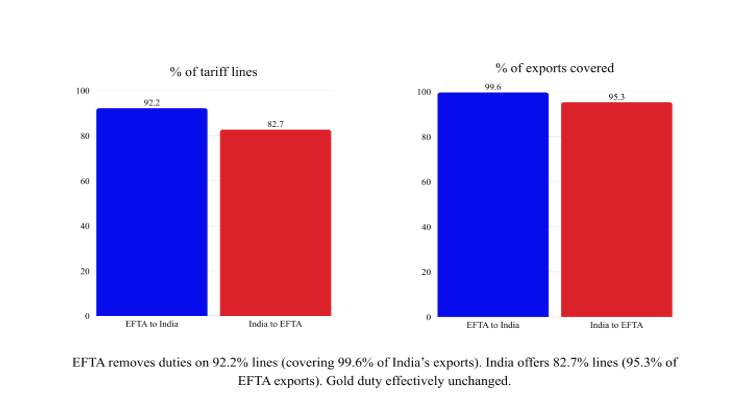
Under TEPA, EFTA has offered 92.2% of tariff lines encompassing 99.6% of India’s exports. Includes 100% of non-agricultural products and tariff concessions on Processed Agricultural Products (PAP).

India’s offer to EFTA covers 82.7% of tariff lines, accounting for 95.3% of EFTA exports. Over 80% of these imports are Gold, with no change in effective duty on Gold. Sensitive sectors protected, including pharma, medical devices, processed food, dairy, soya, coal, and sensitive agricultural products.
Boost for Services and Mobility

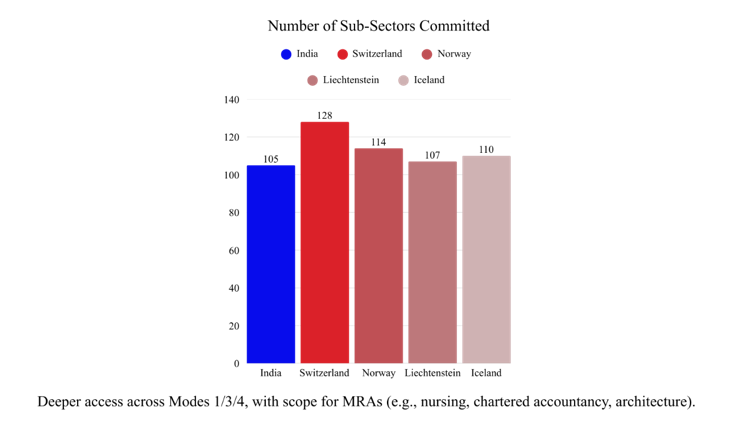
India has offered commitments in 105 sub-sectors. EFTA commitments: 128 (Switzerland), 114 (Norway), 107 (Liechtenstein), 110 (Iceland). TEPA enables Mutual Recognition Agreements (MRAs) in professional services such as nursing, chartered accountancy, and architecture

TEPA presents stronger opportunities in IT, business services, cultural and recreational services, education, and audio-visual services.

Improved access via: Mode 1: Digital delivery of services, Mode 3: Commercial presence and Mode 4: Greater certainty for entry and temporary stay of key personnel.

Intellectual Property Rights
TEPA ensures IPR commitments at TRIPS level. The IPR chapter with Switzerland has high standard for IPR, shows the robust IPR regime. India’s interests in generic medicines and concerns related to evergreening of patents have been fully addressed.

Sustainable and Inclusive Development
TEPA emphasizes sustainable development, inclusive growth, social progress, and environmental protection. It will foster transparency, efficiency, simplification, harmonization, and consistency in trade procedures.

Employment, Skills and Technology Collaboration
TEPA would accelerate creation of large number of direct jobs for India’s young aspirational workforce in next 15 years in India, including better facilities for vocational and technical training. TEPA also facilitates technology collaboration and access to world leading technologies in precision engineering, health sciences, renewable energy, Innovation and Research & Development.

Sector wise gains under TEPA
The India-EFTA Trade and economic Partnership Agreement unlock opportunities across wide range of industries. With EFTA’s offer covering 92% of tariff lines, Indian exporters in sectors like machinery, organic chemicals, textiles, and processed foods will enjoy significantly improved access to EFTA markets though TEPA. This will enhance competitiveness, reduce compliance costs and accelerate access to EFTA market.

Agriculture and Allied Goods

  • India’s exports to EFTA are concentrated, with Guar Gum accounting for over 70% of the export basket in 2024-25. Other exports include processed vegetables, basmati rice, pulses, fresh fruits, cereal preparations, and grapes.
  • Norway and Switzerland together account for over 99% of India’s agri-exports to EFTA.
  • India’s exports to EFTA stood at USD 72.37 million in 2024, contributing 0.41% of EFTA’s total imports. This agreement is expected to reduce tariff barriers and expand India’s share in key commodities.
  • Expected Gains: Based on trade patterns and FTA tariff concessions, the following categories are high-opportunity sectors for India:
  • Processed Food Products – biscuits, confectionery, chocolate, malt extracts, sauces, and miscellaneous food preparations.
  •  Rice (Basmati & Non-Basmati) – tariff elimination enhances competitiveness against Italy, Thailand, and Pakistan.
  • Guar Gum & Pulses – where India already has strong presence, FTA will secure larger market share.
  • Fresh Grapes, Mangoes, Vegetables, and Millets – tariff concessions improve market entry and positioning.
  • Cashew Kernels and Other Nuts – demand in EFTA is large, and India can scale exports.
  • Country Specific Gains: -

EFTA Nations

Products / HS Codes

Tariff Concessions / Opportunities

Switzerland

Food Preparations

Tariffs up to 127.5 CHF/100 kg eliminated; scope for Indian exports

Confectionery, Biscuits

Duty cuts create opportunities in processed foods

Fresh Grapes

Tariffs up to 272 CHF/100 kg eliminated

Nuts & Seeds, Fresh Vegetables

Zero tariffs post FTA, boosting competitiveness

Norway

Food Preparations, Condiments

Duty-free access on several tariff lines

Rice

Tariff reductions (non-feed purposes) open new markets

Processed Vegetables & Fruits

Duty-free access on selected lines

Biscuits, Malt Extracts, Beverages

Tariff relief improves access for Indian brands

Iceland

Processed Foods

High MFN tariffs (up to 97 ISK/kg) cut to zero

Chocolate & Confectionery

Duties eliminated; strong potential for processed food exports

Fresh/Chilled Vegetables

Tariff elimination

Coffee

  • EFTA member countries viz., Switzerland (USD 145 million), Norway (USD 27 million) and Iceland (USD 3 million) together import coffee valued at USD 175 million, which is about 3% of the global coffee imports.
  • EFTA has offered Import Duty of 0% on all the HS lines pertaining to Coffee.
  • Switzerland and Norway are high-value markets with strong demand for high quality coffee.
  • TEPA provide most favorable market access to Indian Coffees in EFTA market.
  • TEPA may help the coffee exporters to access the premium markets in Switzerland, Norway and Iceland with the opportunity for positioning India’s high-quality shade grown, handpicked and sun-dried coffees in EFTA market.

Tea

  • EFTA has a combined tea market size of around 3.0 million kg.
  • In the post-TEPA period, the average unit export price realization has risen appreciably ($6.77/kg in 2024-25 vis-à-vis $5.93/kg in 2023-24).

Marine Products

  • Norway: Exemption of duty of upto 13.16% from fish/shrimp feed. This will make Indian products competitive and enhance the export of fish feed and raw materials for fish/shrimp feed from India to Norway
  • Iceland: Tariff Elimination of upto 10% on Frozen, Prepared and preserved shrimps and prawns, squid and Cuttlefish and upto 55% on fish feed.
  • Switzerland: Zero Duty on Fats and oils of fish (other than liver oil)
  • TEPA will provide an opportunity to increase the export of the Marine products in addition to frozen shrimps from India to EFTA countries.
  • This is expected to increase the exports to USD 3.50 million in coming years.

Textiles and Clothing

  • India’s textiles and apparel exports to the EFTA stood at USD 0.13 billion in 2024.
  • Given India’s total global textiles exports were USD 36.71 billion in 2024, TEPA offers opportunity to capture the untapped market by leveraging tariff concessions.

Leather and Footwear

  • The MFN is 0% in EFTA countries for leathers and footwear, an advantage to continue Post TEPA implementation.
  • TEPA consolidates and guarantees this preferential treatment, providing long-term certainty and stability for exporters.

Sports Goods and Toys

  • TEPA would bring zero-duty access for a large share of tariff lines, enhancing competitiveness for Indian exporters.
  • Streamlined conformity assessment, mutual recognition of standards (MRAs), and simplified CE marking compliance under TEPA to lower compliance costs for exporters.

Engineering Goods

  • India’s engineering exports to the EFTA reached US$ 315.2 million in FY 2024–25, marking an 18% growth over the previous fiscal year.
  • Norway and Switzerland remain the largest destinations, accounting for almost 99% of total exports.
  • TEPA will provide enhanced market access and tariff concessions to boost competitiveness and open new opportunities for Indian engineering exporters across high-value sectors.
  • Significant Market Potential exists in electric machinery, aluminum products, AC/refrigeration machinery, bicycle and copper products highlighting diversification and potential for growth in sustainable, precision engineering, energy-efficient and infrastructure-related goods.

Gems and Jewellery

  • Gems & Jewellery exports enjoy duty-free access in EFTA markets- a preferential treatment that will continue under TEPA.
  • Country wise Market potential for Gems & Jewellery Sector include:
  • Iceland: Gold jewellery, silver jewellery, and imitation jewellery.
  • Norway: Cut and polished natural diamonds, gold jewellery, silver jewellery, and imitation jewellery.
  • Switzerland: Cut and polished natural diamonds, gold jewellery, and polished rubies, sapphires, and emeralds.

Electronics and Software

  • With a $100 billion investment commitment and preferential access to high-income European markets, TEPA offers a strategic springboard for India’s electronics sector—especially MSMEs and OEMs seeking global scale.
  • Country-wise Electronics Export Potential
  • Switzerland: Medical electronics (diagnostic devices, wearables), Smart sensors and embedded systems, Secure communication modules (for fintech and banking)

Strategic Edge: Leverage TEPA’s IPR chapter to protect proprietary tech

  • Norway: EV components and battery management systems, Marine electronics (navigation, sonar, IoT buoys), Smart grid and energy monitoring devices

        Strategic Edge: Align with Norway’s climate tech goals and public procurement Channels

  • Iceland: Compact medical devices and diagnostics, Smart home and energy-efficient electronics, educational tech hardware (tablets, sensors)

        Strategic Edge: Target niche distributors and public health initiatives

  • Liechtenstein: Industrial control systems, Secure embedded electronics for banking, High-precision components for OEMs

       Strategic Edge: Position India as a reliable EMS partner for European OEMs.

Chemicals and Allied Products

  • On the market access front, EFTA has offered zero or reduced tariffs on more than 95% of India’s exports, including a wide range of chemical products. India, in turn, has granted market access to nearly 80% of its tariff lines covering 95% of EFTA’s exports.
  • TEPA also incorporates product-specific rules of origin, certificates of origin, and movement certificates (EUR.1), ensuring greater transparency and simplifying compliance for exporters, especially in the chemical and pharmaceutical sectors.
  • Pre-FTA, certain chemical sector products faced tariffs of up to 54% (Source: Trademap), but post-FTA, these tariffs will be eliminated, increasing the reach of Indian chemical products in the EFTA bloc.
  • Exports of CAPEXIL products to EFTA are expected to expand gradually from USD 49.41 million to around USD 65–70 million in the post-FTA period, with notable gains anticipated in pet food, rubber products, paper, stone/ceramic items, and glassware.

Plastics and Shellac based products

  • TEPA offers Indian plastic exporters significant opportunities to diversify away from high-tariff markets such as the USA and strengthen their presence in high-value EFTA markets. With zero tariffs and improved trade facilitation, India’s exports across diverse panels are expected to achieve steady growth, supported by vast untapped potential in Switzerland and Norway.
  • TEPA can significantly strengthen India’s position in high-value botanical and forest product markets, while also attracting investments and supporting small exporters.

    Gains in the Services sector
  • The services sector, contributing nearly 55% of India’s Gross Value Added (GVA), stands to gain significantly from TEPA. India has offered commitments in 105 sub-sectors to the EFTA while securing enhanced access in 128 sub-sectors from Switzerland, 114 from Norway, 107 from Liechtenstein, and 110 from Iceland.  
  • TEPA is expected to boost India’s services exports in areas of core strength such as IT and business services, cultural and recreational services, education, and audio-visual services.
  •  EFTA’s Services offers better access through digital delivery of Services (Mode 1), commercial presence (Mode 3) and improved commitments and certainty for entry and temporary stay of key personnel (Mode 4).
  •  Additionally, TEPA includes provisions for Mutual Recognition Agreements (MRAs) in professional services such as nursing, chartered accountancy, and architecture, creating new avenues for Indian professionals in EFTA markets.

INVESTMENT PROMOTION

  • EFTA has committed to promote investments with the aim to increase the foreign direct investments by USD 100 billion ((equivalent to Rs 8 Lakh crore as per present exchange rate) in India in the next 15 years -a major boost to “Make in India”.
  • Dedicated EFTA Desk has been operational since Feb 2025, as a single-window mechanism for investment facilitation to support EFTA businesses in investing, expanding, and establishing operations in India.
  • The India-EFTA Desk to drive investment in renewable energy, life sciences, engineering, and digital transformation, while streamlining regulatory processes for EFTA businesses.
  • TEPA will facilitate joint ventures, SME collaborations, and technology partnerships, with the Desk streamlining regulatory navigation for EFTA businesses.
  • The Desk will also act as the primary channel for fostering continuous business-government dialogue, ensuring continuous engagement between India and EFTA partners.

    India Protects what Matters
  • India has safeguarded its sensitive sectors such as dairy, soya, coal and sensitive agricultural products.
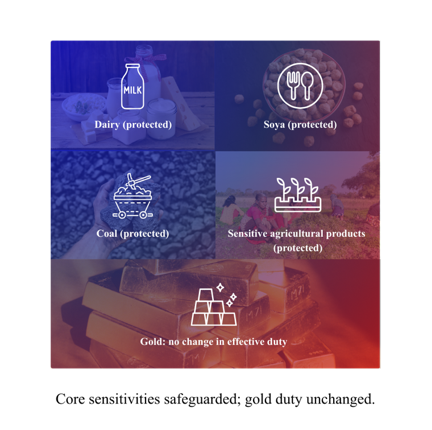
  • India has opened 82.7% tariff 82.7% of its tariff lines which covers 95.3% of EFTA exports of which more than 80% import is Gold.
  • Strategically important products- particularly that where domestic capacity is being built under flagship initiatives like Make in India and PLI – Concessions provided over period of 5,7 or even 10 years with gradual tariff reduction.

Conclusion

The India–EFTA Trade and Economic Partnership Agreement (TEPA) marks a historic milestone, establishing India’s first FTA with four developed European nations and committing USD 100 billion in investments and 1 million direct jobs over 15 years. TEPA enhances market access for goods and services, strengthens intellectual property rights, and fosters sustainable, inclusive development, while supporting Make in India and Atmanirbhar Bharat initiatives.

Complementing this, the India–EFTA Desk has been inaugurated as a single-window platform to facilitate EFTA investments in renewable energy, life sciences, engineering, and digital transformation, while fostering joint ventures, SME collaborations, and technology partnerships.

TEPA is a “model agreement” and reaffirms India’s readiness to build a robust future with EFTA.

References:

Ministry of Commerce and Industry

Topics

Acts Income Tax
