TEPA offers binding commitment of $100 bn investment and 1 million direct jobs in the next 15 years
TEPA to stimulate services exports in sectors such as IT, business services, education, audio-visual etc
TEPA provides Mutual Recognition Agreements in Professional Services like nursing, chartered accountants, architects etc
India-European Free Trade Association(EFTA) Trade and Economic Partnership Agreement (TEPA) will come into effect on 01 October 2025. The agreement was signed on 10th March 2024 at New Delhi.TEPA is a modern and ambitious agreement that incorporates, for the first time in any Free Trade Agreement (FTA) signed by India, a commitment linked to investment and job creation.
The agreement comprises of 14 chapters with main focus on market access related to goods, rules of origin, trade facilitation, trade remedies, sanitary and phytosanitary measures, technical barriers to trade, investment promotion, market access on services, intellectual property rights, trade and sustainable development and other legal and horizontal provisions.
The EFTA’s market access offer under TEPA covers 100% of non-agri products and tariff concession on Processed Agricultural Products (PAP). Sensitivity related to PLI in sectors such as pharma, medical devices & processed food etc. have been taken while extending offers.
The agreement goes beyond goods and services and committed to promote investments with the aim to increase the stock of foreign direct investments by USD 100 billion in India in the next 15 years, and to facilitate the generation of 1 million direct employment in India, through such investments.
Key features of the agreement
EFTA is an important regional group, with several growing opportunities for enhancing international trade in goods and services. EFTA is one important economic block out of the three (other two - EU &UK) in Europe. Among EFTA countries, Switzerland is the largest trading partner of India followed by Norway.
The TEPA will empower India’s exporters by providing access to specialized inputs and create conducive trade and investment environment. This would boost exports of Indian made goods as well as provide opportunities for services sector to access more markets.
Investment and Employment Commitments
As per Article 7.1 of TEPA, the EFTA States shall aim to increase foreign direct investment (FDI) from their investors into India by USD 50 billion within 10 years from the entry into force of the Agreement, and an additional USD 50 billion in the succeeding 5 years, amounting to a total of USD 100 billion over 15 years. Concurrently, the EFTA States shall aim to facilitate the generation of 1 million direct jobs in India resulting from these investment inflows.
This investment commitment explicitly excludes foreign portfolio investment (FPI), focusing on long-term capital for productive capacity building.
Market Access for Goods
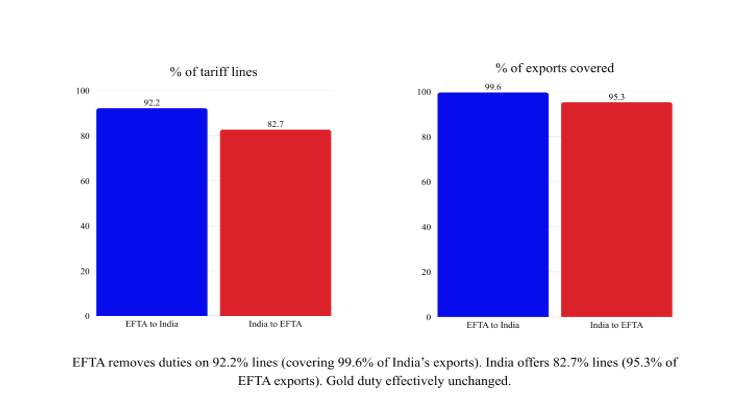
Under TEPA, EFTA has offered 92.2% of tariff lines encompassing 99.6% of India’s exports. Includes 100% of non-agricultural products and tariff concessions on Processed Agricultural Products (PAP).
India’s offer to EFTA covers 82.7% of tariff lines, accounting for 95.3% of EFTA exports. Over 80% of these imports are Gold, with no change in effective duty on Gold. Sensitive sectors protected, including pharma, medical devices, processed food, dairy, soya, coal, and sensitive agricultural products.
Boost for Services and Mobility
India has offered commitments in 105 sub-sectors. EFTA commitments: 128 (Switzerland), 114 (Norway), 107 (Liechtenstein), 110 (Iceland). TEPA enables Mutual Recognition Agreements (MRAs) in professional services such as nursing, chartered accountancy, and architecture
TEPA presents stronger opportunities in IT, business services, cultural and recreational services, education, and audio-visual services.
Improved access via: Mode 1: Digital delivery of services, Mode 3: Commercial presence and Mode 4: Greater certainty for entry and temporary stay of key personnel.
Intellectual Property Rights
TEPA ensures IPR commitments at TRIPS level. The IPR chapter with Switzerland has high standard for IPR, shows the robust IPR regime. India’s interests in generic medicines and concerns related to evergreening of patents have been fully addressed.
Sustainable and Inclusive Development
TEPA emphasizes sustainable development, inclusive growth, social progress, and environmental protection. It will foster transparency, efficiency, simplification, harmonization, and consistency in trade procedures.
Employment, Skills and Technology Collaboration
TEPA would accelerate creation of large number of direct jobs for India’s young aspirational workforce in next 15 years in India, including better facilities for vocational and technical training. TEPA also facilitates technology collaboration and access to world leading technologies in precision engineering, health sciences, renewable energy, Innovation and Research & Development.
Sector wise gains under TEPA
The India-EFTA Trade and economic Partnership Agreement unlock opportunities across wide range of industries. With EFTA’s offer covering 92% of tariff lines, Indian exporters in sectors like machinery, organic chemicals, textiles, and processed foods will enjoy significantly improved access to EFTA markets though TEPA. This will enhance competitiveness, reduce compliance costs and accelerate access to EFTA market.
Agriculture and Allied Goods
- India’s exports to EFTA are concentrated, with Guar Gum accounting for over 70% of the export basket in 2024-25. Other exports include processed vegetables, basmati rice, pulses, fresh fruits, cereal preparations, and grapes.
- Norway and Switzerland together account for over 99% of India’s agri-exports to EFTA.
- India’s exports to EFTA stood at USD 72.37 million in 2024, contributing 0.41% of EFTA’s total imports. This agreement is expected to reduce tariff barriers and expand India’s share in key commodities.
- Expected Gains: Based on trade patterns and FTA tariff concessions, the following categories are high-opportunity sectors for India:
- Processed Food Products – biscuits, confectionery, chocolate, malt extracts, sauces, and miscellaneous food preparations.
- Rice (Basmati & Non-Basmati) – tariff elimination enhances competitiveness against Italy, Thailand, and Pakistan.
- Guar Gum & Pulses – where India already has strong presence, FTA will secure larger market share.
- Fresh Grapes, Mangoes, Vegetables, and Millets – tariff concessions improve market entry and positioning.
- Cashew Kernels and Other Nuts – demand in EFTA is large, and India can scale exports.
- Country Specific Gains: -
| EFTA Nations | Products / HS Codes | Tariff Concessions / Opportunities |
| Switzerland | Food Preparations | Tariffs up to 127.5 CHF/100 kg eliminated; scope for Indian exports |
| Confectionery, Biscuits | Duty cuts create opportunities in processed foods |
| Fresh Grapes | Tariffs up to 272 CHF/100 kg eliminated |
| Nuts & Seeds, Fresh Vegetables | Zero tariffs post FTA, boosting competitiveness |
| Norway | Food Preparations, Condiments | Duty-free access on several tariff lines |
| Rice | Tariff reductions (non-feed purposes) open new markets |
| Processed Vegetables & Fruits | Duty-free access on selected lines |
| Biscuits, Malt Extracts, Beverages | Tariff relief improves access for Indian brands |
| Iceland | Processed Foods | High MFN tariffs (up to 97 ISK/kg) cut to zero |
| Chocolate & Confectionery | Duties eliminated; strong potential for processed food exports |
| Fresh/Chilled Vegetables | Tariff elimination |
Coffee
- EFTA member countries viz., Switzerland (USD 145 million), Norway (USD 27 million) and Iceland (USD 3 million) together import coffee valued at USD 175 million, which is about 3% of the global coffee imports.
- EFTA has offered Import Duty of 0% on all the HS lines pertaining to Coffee.
- Switzerland and Norway are high-value markets with strong demand for high quality coffee.
- TEPA provide most favorable market access to Indian Coffees in EFTA market.
- TEPA may help the coffee exporters to access the premium markets in Switzerland, Norway and Iceland with the opportunity for positioning India’s high-quality shade grown, handpicked and sun-dried coffees in EFTA market.
Tea
- EFTA has a combined tea market size of around 3.0 million kg.
- In the post-TEPA period, the average unit export price realization has risen appreciably ($6.77/kg in 2024-25 vis-à-vis $5.93/kg in 2023-24).
Marine Products
- Norway: Exemption of duty of upto 13.16% from fish/shrimp feed. This will make Indian products competitive and enhance the export of fish feed and raw materials for fish/shrimp feed from India to Norway
- Iceland: Tariff Elimination of upto 10% on Frozen, Prepared and preserved shrimps and prawns, squid and Cuttlefish and upto 55% on fish feed.
- Switzerland: Zero Duty on Fats and oils of fish (other than liver oil)
- TEPA will provide an opportunity to increase the export of the Marine products in addition to frozen shrimps from India to EFTA countries.
- This is expected to increase the exports to USD 3.50 million in coming years.
Textiles and Clothing
- India’s textiles and apparel exports to the EFTA stood at USD 0.13 billion in 2024.
- Given India’s total global textiles exports were USD 36.71 billion in 2024, TEPA offers opportunity to capture the untapped market by leveraging tariff concessions.
Leather and Footwear
- The MFN is 0% in EFTA countries for leathers and footwear, an advantage to continue Post TEPA implementation.
- TEPA consolidates and guarantees this preferential treatment, providing long-term certainty and stability for exporters.
Sports Goods and Toys
- TEPA would bring zero-duty access for a large share of tariff lines, enhancing competitiveness for Indian exporters.
- Streamlined conformity assessment, mutual recognition of standards (MRAs), and simplified CE marking compliance under TEPA to lower compliance costs for exporters.
Engineering Goods
- India’s engineering exports to the EFTA reached US$ 315.2 million in FY 2024–25, marking an 18% growth over the previous fiscal year.
- Norway and Switzerland remain the largest destinations, accounting for almost 99% of total exports.
- TEPA will provide enhanced market access and tariff concessions to boost competitiveness and open new opportunities for Indian engineering exporters across high-value sectors.
- Significant Market Potential exists in electric machinery, aluminum products, AC/refrigeration machinery, bicycle and copper products highlighting diversification and potential for growth in sustainable, precision engineering, energy-efficient and infrastructure-related goods.
Gems and Jewellery
- Gems & Jewellery exports enjoy duty-free access in EFTA markets- a preferential treatment that will continue under TEPA.
- Country wise Market potential for Gems & Jewellery Sector include:
- Iceland: Gold jewellery, silver jewellery, and imitation jewellery.
- Norway: Cut and polished natural diamonds, gold jewellery, silver jewellery, and imitation jewellery.
- Switzerland: Cut and polished natural diamonds, gold jewellery, and polished rubies, sapphires, and emeralds.
Electronics and Software
- With a $100 billion investment commitment and preferential access to high-income European markets, TEPA offers a strategic springboard for India’s electronics sector—especially MSMEs and OEMs seeking global scale.
- Country-wise Electronics Export Potential
- Switzerland: Medical electronics (diagnostic devices, wearables), Smart sensors and embedded systems, Secure communication modules (for fintech and banking)
Strategic Edge: Leverage TEPA’s IPR chapter to protect proprietary tech
- Norway: EV components and battery management systems, Marine electronics (navigation, sonar, IoT buoys), Smart grid and energy monitoring devices
Strategic Edge: Align with Norway’s climate tech goals and public procurement Channels
- Iceland: Compact medical devices and diagnostics, Smart home and energy-efficient electronics, educational tech hardware (tablets, sensors)
Strategic Edge: Target niche distributors and public health initiatives
- Liechtenstein: Industrial control systems, Secure embedded electronics for banking, High-precision components for OEMs
Strategic Edge: Position India as a reliable EMS partner for European OEMs.
Chemicals and Allied Products
- On the market access front, EFTA has offered zero or reduced tariffs on more than 95% of India’s exports, including a wide range of chemical products. India, in turn, has granted market access to nearly 80% of its tariff lines covering 95% of EFTA’s exports.
- TEPA also incorporates product-specific rules of origin, certificates of origin, and movement certificates (EUR.1), ensuring greater transparency and simplifying compliance for exporters, especially in the chemical and pharmaceutical sectors.
- Pre-FTA, certain chemical sector products faced tariffs of up to 54% (Source: Trademap), but post-FTA, these tariffs will be eliminated, increasing the reach of Indian chemical products in the EFTA bloc.
- Exports of CAPEXIL products to EFTA are expected to expand gradually from USD 49.41 million to around USD 65–70 million in the post-FTA period, with notable gains anticipated in pet food, rubber products, paper, stone/ceramic items, and glassware.
Plastics and Shellac based products
- TEPA offers Indian plastic exporters significant opportunities to diversify away from high-tariff markets such as the USA and strengthen their presence in high-value EFTA markets. With zero tariffs and improved trade facilitation, India’s exports across diverse panels are expected to achieve steady growth, supported by vast untapped potential in Switzerland and Norway.
- TEPA can significantly strengthen India’s position in high-value botanical and forest product markets, while also attracting investments and supporting small exporters.
Gains in the Services sector
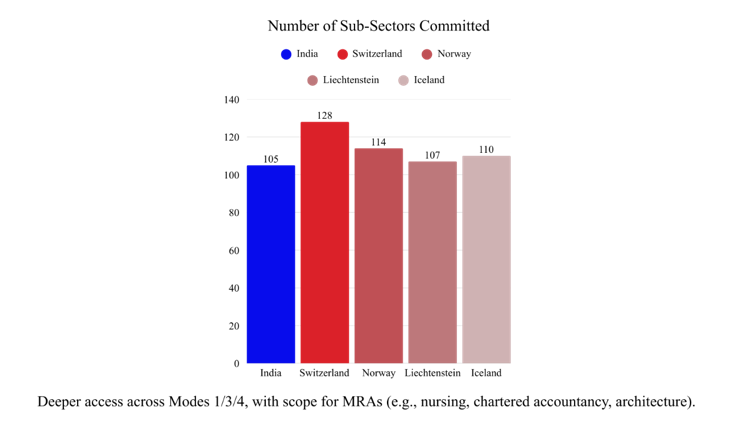
- The services sector, contributing nearly 55% of India’s Gross Value Added (GVA), stands to gain significantly from TEPA. India has offered commitments in 105 sub-sectors to the EFTA while securing enhanced access in 128 sub-sectors from Switzerland, 114 from Norway, 107 from Liechtenstein, and 110 from Iceland.
- TEPA is expected to boost India’s services exports in areas of core strength such as IT and business services, cultural and recreational services, education, and audio-visual services.
- EFTA’s Services offers better access through digital delivery of Services (Mode 1), commercial presence (Mode 3) and improved commitments and certainty for entry and temporary stay of key personnel (Mode 4).
- Additionally, TEPA includes provisions for Mutual Recognition Agreements (MRAs) in professional services such as nursing, chartered accountancy, and architecture, creating new avenues for Indian professionals in EFTA markets.
INVESTMENT PROMOTION
- EFTA has committed to promote investments with the aim to increase the foreign direct investments by USD 100 billion ((equivalent to Rs 8 Lakh crore as per present exchange rate) in India in the next 15 years -a major boost to “Make in India”.
- Dedicated EFTA Desk has been operational since Feb 2025, as a single-window mechanism for investment facilitation to support EFTA businesses in investing, expanding, and establishing operations in India.
- The India-EFTA Desk to drive investment in renewable energy, life sciences, engineering, and digital transformation, while streamlining regulatory processes for EFTA businesses.
- TEPA will facilitate joint ventures, SME collaborations, and technology partnerships, with the Desk streamlining regulatory navigation for EFTA businesses.
- The Desk will also act as the primary channel for fostering continuous business-government dialogue, ensuring continuous engagement between India and EFTA partners.
India Protects what Matters
- India has safeguarded its sensitive sectors such as dairy, soya, coal and sensitive agricultural products.
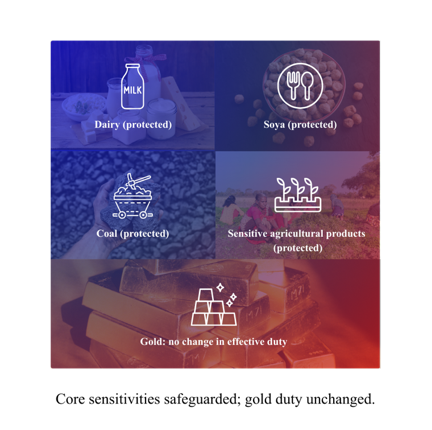
- India has opened 82.7% tariff 82.7% of its tariff lines which covers 95.3% of EFTA exports of which more than 80% import is Gold.
- Strategically important products- particularly that where domestic capacity is being built under flagship initiatives like Make in India and PLI – Concessions provided over period of 5,7 or even 10 years with gradual tariff reduction.
Conclusion
The India–EFTA Trade and Economic Partnership Agreement (TEPA) marks a historic milestone, establishing India’s first FTA with four developed European nations and committing USD 100 billion in investments and 1 million direct jobs over 15 years. TEPA enhances market access for goods and services, strengthens intellectual property rights, and fosters sustainable, inclusive development, while supporting Make in India and Atmanirbhar Bharat initiatives.
Complementing this, the India–EFTA Desk has been inaugurated as a single-window platform to facilitate EFTA investments in renewable energy, life sciences, engineering, and digital transformation, while fostering joint ventures, SME collaborations, and technology partnerships.
TEPA is a “model agreement” and reaffirms India’s readiness to build a robust future with EFTA.
References:
Ministry of Commerce and Industry
 TaxTMI
  TaxTMI


 Join Channel


