Loading...

Top
Help
×

By creating an account you can:

Logo TaxTMI
Call Us / Help / Feedback

Contact Us At :

E-mail: [email protected]

Call / WhatsApp at: +91 99117 96707

For more information, Check Contact Us

FAQs :

To know Frequently Asked Questions, Check FAQs

Most Asked Video Tutorials :

For more tutorials, Check Video Tutorials

Submit Feedback/Suggestion :

Email :
Please provide your email address so we can follow up on your feedback.
Category :
Description :
Min 15 characters 0/2000
Make Most of Text Search
  1. Checkout this video tutorial: How to search effectively on TaxTMI.
  2. Put words in double quotes for exact word search, eg: "income tax"
  3. Avoid noise words such as : 'and, of, the, a'
  4. Sort by Relevance to get the most relevant document.
  5. Press Enter to add multiple terms/multiple phrases, and then click on Search to Search.
  6. Text Search
  7. The system will try to fetch results that contains ALL your words.
  8. Once you add keywords, you'll see a new 'Search In' filter that makes your results even more precise.
  9. Text Search
Add to...
You have not created any category. Kindly create one to bookmark this item!
Create New Category
Hide
Title :
Description :
❮❮ Hide
Default View
Expand ❯❯
Close ✕
🔎 News - Adv. Search
TEXT SEARCH:

Press 'Enter' to add multiple search terms. Rules for Better Search

Search In:
Main Text + AI Text
  • Main Text
  • Main Text + AI Text
  • AI Text
Category: ?
Categorized by AI
---- All Categories ----
  • ---- All Categories ----
  • Income Tax
  • GST
  • Customs, DGFT & SEZ
  • FEMA & RBI
  • Corp. Laws, SEBI & IBC
  • PMLA, Black Money & ED
  • Budget
  • News and Press Release
  • PTI News
Month:
---- All Months ----
  • ---- All Months ----
  • January
  • February
  • March
  • April
  • May
  • June
  • July
  • August
  • September
  • October
  • November
  • December
Year:
---- All Years ----
  • ---- All Years ----
  • 2026
  • 2025
  • 2024
  • 2023
  • 2022
  • 2021
  • 2020
  • 2019
  • 2018
  • 2017
  • 2016
  • 2015
  • 2014
  • 2013
  • 2012
  • 2011
Sort By: ?
In Sort By 'Default', exact matches for text search are shown at the top, followed by the remaining results in their regular order.
Relevance Default Date
    Delhi tightens rules for ration shops, makes big stock discrepancies an FIR offence
    Regional Rural Banks (RRBs) Record Strong Growth in Credit Delivery during FY 2025–26
    METSTO Delivers Adjustable Pallet Racking System Solutions for Warehouses
    China rolls out new measures to boost consumption in counties, smaller cities
    Strengthening Collaboration to Preserve Sovereignty: Collaborative Cash Ecosystems - Global Strategies to Preserve Trust and Sovereignty - Keynote Add...
    SC asks CBI to examine all six allegations of dubious transactions involving Indiabulls
    Cyber fraudsters invent 'boss' scam to target companies; Ahmedabad cops bust international network
    Personal Loan Prepayment Charges: What RBI Rules Say in 2026
    Zeeba Revamps Packaging and Announces Chef Vikas Khanna as Its Global Brand Ambassador
    Paul Merchants Finance Launches Loan Against Silver, Becomes India’s First NBFC to Set Up Exclusive Silver Loan Branches
    CarePass Launches This Independence Day, Bringing Healthcare Savings Across India's Top and Premium Hospitals
    Keralam CM flags off containers from Vizhinjam, marking start of EXIM operations
    Kerala: Fresh ED raids in CMRL-Exalogic Solutions case
    ED raids KPSC office, ex-chairman in veterinary officers hiring 'scam' case
    Keralam CM reviews operational preparedness at Vizhinjam port
    Union Minister for Finance and Corporate Affairs Smt. Nirmala Sitharaman chairs 3rd Meeting of Apex Monitoring Authority of NICDIT and reviews the pro...
    NBCC moves SC for RERA exemptions to complete 16 stalled Supertech projects
    DFS Hosts PSB Confluence 2026: Day 1 Deliberations focus on Four themes- Deposit Mobilisation, Banking for Youth, Supporting the Investment Cycle and ...
    Govt to soon announce high-level panel on 'Banking for Viksit Bharat': FM
    Rupee falls 19 paise to close at 95.61 against US dollar
❯❯
Maximize Maximize Maximize
0 / 200
Expand Note
Add to Folder

No Folders have been created

+

Are you sure you want to delete "My most important" ?

NOTE:

News
Showing Results for :
Reset Filters
Results Found:
Show All Summaries Hide All Summaries
August 18, 2026
Show AI Summary
Fair Price Shop regulation introduces graded stock-shortage penalties, mandatory FIRs for major discrepancies, and restructured licensing requirements.
Fair Price Shop regulation introduces quantity-based penalties for stock discrepancies, ranging from performance-guarantee forfeiture and replenishment obligations to interim suspension, cancellation-related action and mandatory FIR registration for major shortages. Repeated or deliberate diversion or manipulation of public distribution supplies may lead to cancellation, blacklisting and FIR registration. Licensing now includes continuing regular licences and short-term temporary licences, with wider eligibility, points-based selection, card-linked performance guarantees and compulsory approved e-PoS, weighing-scale and iris-scanner use.
August 18, 2026
Show AI Summary
Priority sector lending strengthened rural credit access through agricultural, micro-enterprise and weaker-section finance, reinforcing financial inclusion and sustainable development.
Regional Rural Banks expanded rural credit delivery while maintaining strong Priority Sector Lending performance during FY 2025-26. Almost all Regional Rural Banks met the prescribed overall priority-sector target. Agriculture and allied activities remained the largest priority-sector component, with farm credit accounting for nearly all agricultural lending. MSME finance predominantly supported micro enterprises, rural entrepreneurs, artisans and small businesses. Lending to weaker sections and finance for housing, education, renewable energy and social infrastructure promoted inclusive access to institutional credit and sustainable rural development.
August 18, 2026
Show AI Summary
Adjustable pallet racking systems support customised, scalable warehouse storage through configurable layouts, safety assessment, installation and lifecycle support.
Adjustable pallet racking systems are configurable warehouse-storage solutions for varied inventory dimensions, weights and product types. They support bulk pallet storage, multi-level picking and high-density configurations through adjustable beams and shelves, load-bearing capacity, structural durability and space-efficient layouts. Storage configurations are customised after assessing inventory dimensions, payload requirements, available space and material-movement frequency, with support for design, installation, inspections and after-sales service.
August 18, 2026
Show AI Summary
Domestic consumption expansion targets lower-tier markets through improved retail channels, distribution networks, employment support and household income opportunities.
China has introduced measures to strengthen domestic consumption in counties, smaller cities, townships and rural areas. The measures include upgrading township commercial centres, rural markets and local fairs; encouraging domestic and international brands to establish regional debut stores; and reusing existing land resources to improve services. They also seek better services for elderly persons and children, stronger urban-rural distribution networks, county-level employment and resident income channels. The strategy supports a shift towards household consumption amid weak domestic demand, property-sector pressures and subdued consumer sentiment.
August 18, 2026
Show AI Summary
Currency management preserves monetary sovereignty through clean notes, secure logistics, decentralised distribution, durable banknotes, and sustainable cash-cycle operations.
Currency management supports trust in cash and monetary sovereignty through demand planning, secure production, distribution, replacement, and disposal. The Clean Note Policy requires good-quality banknotes to be available in required denominations and locations, with unfit notes continuously withdrawn and replaced. A decentralised Currency Chest network distributes fresh currency, processes returned notes, supports linked bank branches, and operates under licensing, real-time reporting, inspection, and audit requirements. Current priorities include managing uncertain cash demand, improving note durability, and reducing the carbon footprint of the cash cycle.
August 18, 2026
Show AI Summary
Independent investigation of alleged dubious transactions requires examination of all six allegations despite prior police conclusions.
Investigation into alleged dubious transactions involving Indiabulls Housing Finance Limited and related entities must cover all six allegations identified by the Enforcement Directorate. The CBI must independently examine five allegations previously reviewed by the Delhi Police Economic Offence Wing, irrespective of its conclusion, and submit a comprehensive report. Further investigation into the sixth allegation depends on the special PMLA court deciding the CBI's pending application, after which the CBI must provide a progress or status report.
August 18, 2026
Show AI Summary
Boss scam prevention requires independent verification of payment requests and avoidance of malicious WhatsApp attachments that enable executive impersonation.
Boss scam, or CEO impersonation fraud, uses malicious WhatsApp attachments and impersonation of regulatory officials or company executives to obtain control of WhatsApp sessions and issue fraudulent payment instructions. The alleged network supplied SIM cards, dummy SIMs, WhatsApp accounts and one-time passwords to cyber-fraud operators, illustrating a Cybercrime as a Service model. Preventive measures include avoiding suspicious ZIP, executable, library and APK files and independently verifying all financial-transfer requests.
August 18, 2026
Show AI Summary
Floating-rate personal loan prepayment protections prohibit charges and compulsory lock-ins for qualifying individual non-business borrowers from 2026.
Prepayment charges are prohibited for part or full repayment of qualifying floating-rate loans availed by individual borrowers for non-business purposes and sanctioned or renewed on or after 1 January 2026. Compulsory lock-in periods cannot restrict prepayment of such loans. Fixed-rate personal loans may still attract prepayment or foreclosure charges under lender policy and contractual terms. Borrowers should check the loan's rate type, sanction letter, loan agreement and key fact statement, where applicable, and compare applicable charges with potential interest savings before early repayment.
August 18, 2026
Show AI Summary
Premium Basmati rice positioning drives Zeeba's packaging refresh and ambassador-led campaign focused on quality, authenticity and domestic expansion.
Zeeba has refreshed its packaging and appointed Chef Vikas Khanna as global brand ambassador to support expansion in India. Its "Aisa Basmati Nahi Dekha" campaign positions the brand around export-quality Basmati rice, consistency, authenticity and a superior culinary experience. Promotional activity will extend across digital, retail and consumer touchpoints. The premium Basmati range is described as carefully sourced, naturally aged and processed according to global quality standards, with emphasis on grain quality, authentic taste, purity and consistency.
August 18, 2026
Show AI Summary
Silver-collateral lending creates a formal secured-credit channel for eligible borrowers, subject to regulatory requirements and lender policies.
Loans against silver collateral have been introduced following the Reserve Bank of India's Lending Against Gold and Silver Collateral Directions, 2025, enabling eligible regulated lenders to accept silver as security. The offering provides a formal and transparent credit channel against eligible silver jewellery, ornaments and approved silver coins. It is intended for individuals, proprietors and MSMEs requiring liquidity for personal, business and other legitimate financial needs, subject to lending policies and applicable regulatory requirements.
August 18, 2026
Show AI Summary
Healthcare discount membership provides instant savings on out-of-pocket care at participating premium providers without insurance claims or paperwork.
CarePass is a healthcare savings membership card providing instant point-of-billing discounts at participating premium healthcare providers across India. It covers out-of-pocket spending on hospital treatment, diagnostics, dental, vision, dermatology, hair and skin care, and IVF and maternity services, without claim processing, waiting periods or paperwork. Members present a digital CarePass at a participating provider to receive the applicable discount. Four membership tiers offer differing benefits, with higher tiers including tele-consultations and annual health checks. CarePass is a discount membership and not an insurance product.
August 18, 2026
Show AI Summary
EXIM operations at Vizhinjam commence with container movement, supported by investor facilitation, infrastructure backing and port-led logistics development.
EXIM operations at Vizhinjam international seaport commenced with the flagging off of two containers after a successful trial export shipment. The state government proposes investor engagement, regulatory facilitation and infrastructure support to expand global export activities through the port. Mission Samudra is to operate as a port-led industrial and logistics development scheme. The deep-water port was developed under a public-private partnership model and had received commercial commissioning certification.
August 18, 2026
Show AI Summary
Money-laundering investigation under PMLA expands through searches into alleged consultancy payments linked to CMRL and Exalogic Solutions.
Money-laundering investigation under the Prevention of Money Laundering Act involves fresh searches connected with Cochin Minerals and Rutile Ltd and Exalogic Solutions. The inquiry concerns alleged fraudulent payments made under the guise of IT consultancy services and a purported money trail involving persons allegedly connected with those transactions. The action follows earlier searches and questioning in relation to the same matter.
August 18, 2026
Show AI Summary
Recruitment examination irregularities trigger money-laundering investigation into alleged bribery, paper leaks, answer-sheet tampering, and preferential veterinary officer selections.
Money-laundering investigation under the Prevention of Money Laundering Act concerns alleged irregularities in veterinary officers' final selection through a public recruitment examination. Searches covered premises linked to commission officials, alleged intermediaries, the digital evaluation entity, and selected candidates. Allegations include bribery demands, examination-paper leakage, OMR answer-sheet tampering, and facilitation of selection for relatives of commission officials.
August 18, 2026
Show AI Summary
Export-import operations advance through operational preparedness review and planned port-led industrial and logistics development initiatives.
Operational preparedness for full land-based export-import operations at Vizhinjam Seaport was reviewed, including the Vehicle Traffic Management System. EXIM cargo operations follow a trial shipment of the port's first export container to Valencia. Mission Samudra is proposed to support port-led industrial and logistics development alongside these operations. The deep-water port was developed through a public-private partnership model and had obtained commercial commissioning certification before its dedication to the nation.
August 18, 2026
Show AI Summary
Industrial corridor development prioritises empowered SPVs, integrated infrastructure and investor-ready parks to accelerate manufacturing investment and operations.
National Industrial Corridor Development Programme implementation prioritises timely infrastructure completion, land allotment, investment mobilisation and commencement of manufacturing. PM GatiShakti-aligned planning requires integrated connectivity, utilities and social infrastructure, while States should resolve land, clearance and SPV-power bottlenecks. BHAVYA proposes investment-ready, plug-and-play industrial parks appraised for ready land, credible demand, connectivity, utilities, realistic phasing and early investor attraction. NICDIT routes Government participation and equity support for BHAVYA project SPVs, and NICDC coordinates implementation and monitoring.
August 17, 2026
Show AI Summary
RERA compliance exemption for stalled housing projects raises whether statutory obligations may be waived to enable phased project completion.
RERA compliance exemption is sought for completion of 16 stalled residential projects by a public sector construction entity appointed under a project-completion arrangement. The appellate insolvency tribunal declined to direct a waiver, considering itself incompetent to exempt compliance with statutory provisions. The arrangement requires phased completion, award and commencement of construction work, and oversight through an apex committee and project-wise committees. The projects remain incomplete owing to the developer's financial crisis.
August 17, 2026
Show AI Summary
Deposit mobilisation and youth banking guide strategies for stronger public financial institutions, investment financing and Global Capability Centre opportunities.
PSB Confluence 2026 considers strategic priorities for Public Sector Banks and Public Financial Institutions across deposit mobilisation, banking for youth, investment-cycle financing and Global Capability Centres. Discussions seek practical, scalable strategies to strengthen customer engagement, youth-responsive banking propositions, institutional financing capabilities and participation in the expanding Global Capability Centre ecosystem. Youth engagement may use the MY Bharat platform to strengthen links with the formal financial system and awareness of education finance, entrepreneurship, internships and financial-sector careers. Further themes include value-chain infrastructure, priority sector lending and credit card business reform.
August 17, 2026
Show AI Summary
Banking-sector reform will guide lender capacity, financial stability, inclusion, consumer protection, deposit growth and responsible credit-card expansion.
Banking-sector reform is proposed through a high-level committee on Banking for Viksit Bharat to review the sector and align it with growth needs while safeguarding financial stability, financial inclusion and consumer protection. Key themes include deposit mobilisation, youth banking, investment support, global capability centres, value-chain infrastructure, credit cards and priority-sector lending. Public-sector banks are expected to improve competitiveness through technology, sectoral expertise, product adaptation and customer-focused deposit growth. Credit-card development must maintain responsible underwriting, customer protection and appropriate risk controls.
August 17, 2026
Show AI Summary
FCNR(B) concessional swap facility availability narrows to timely mobilised deposits amid rupee depreciation and foreign currency inflow concerns.
Foreign-exchange conditions reflected rupee depreciation amid weak domestic equity markets and higher crude oil prices. FCNR(B) concessional swap facility availability is confined to foreign currency deposits mobilised by banks within the revised cut-off period, replacing the previously longer mobilisation window. The facility is intended to encourage foreign currency inflows, while banks use the FCNR(B) scheme to mobilise foreign currency deposits through attractive interest rates.

News

Back

All News

Showing Results for :
Reset Filters
No Records Found

News

Back

All News

Showing Results for : Reset Filters

India-European Free Trade Association Trade and Economic Partnership Agreement (TEPA) to come into effect on 01 October 2025

September 30, 2025

Contents
Summary
Note

Note

-

Bookmark

Print

Print

TEPA offers binding commitment of $100 bn investment and 1 million direct jobs in the next 15 years

TEPA to stimulate services exports in sectors such as IT, business services, education, audio-visual etc

TEPA provides Mutual Recognition Agreements in Professional Services like nursing, chartered accountants, architects etc

India-European Free Trade Association(EFTA) Trade and Economic Partnership Agreement (TEPA) will come into effect on 01 October 2025. The agreement was signed on 10th March 2024 at New Delhi.TEPA is a modern and ambitious agreement that incorporates, for the first time in any Free Trade Agreement (FTA) signed by India, a commitment linked to investment and job creation. 

The agreement comprises of 14 chapters with main focus on market access related to goods, rules of origin, trade facilitation, trade remedies, sanitary and phytosanitary measures, technical barriers to trade, investment promotion, market access on services, intellectual property rights, trade and sustainable development and other legal and horizontal provisions.

The EFTA’s market access offer under TEPA covers 100% of non-agri products and tariff concession on Processed Agricultural Products (PAP)Sensitivity related to PLI in sectors such as pharma, medical devices & processed food etc. have been taken while extending offers.

The agreement goes beyond goods and services and committed to promote investments with the aim to increase the stock of foreign direct investments by USD 100 billion in India in the next 15 years, and to facilitate the generation of 1 million direct employment in India, through such investments.

Key features of the agreement

EFTA is an important regional group, with several growing opportunities for enhancing international trade in goods and services. EFTA is one important economic block out of the three (other two - EU &UK) in Europe. Among EFTA countries, Switzerland is the largest trading partner of India followed by Norway.

The TEPA will empower India’s exporters by providing access to specialized inputs and create conducive trade and investment environment. This would boost exports of Indian made goods as well as provide opportunities for services sector to access more markets.

Investment and Employment Commitments

As per Article 7.1 of TEPA, the EFTA States shall aim to increase foreign direct investment (FDI) from their investors into India by USD 50 billion within 10 years from the entry into force of the Agreement, and an additional USD 50 billion in the succeeding 5 years, amounting to a total of USD 100 billion over 15 years. Concurrently, the EFTA States shall aim to facilitate the generation of 1 million direct jobs in India resulting from these investment inflows.

This investment commitment explicitly excludes foreign portfolio investment (FPI), focusing on long-term capital for productive capacity building. 

Market Access for Goods

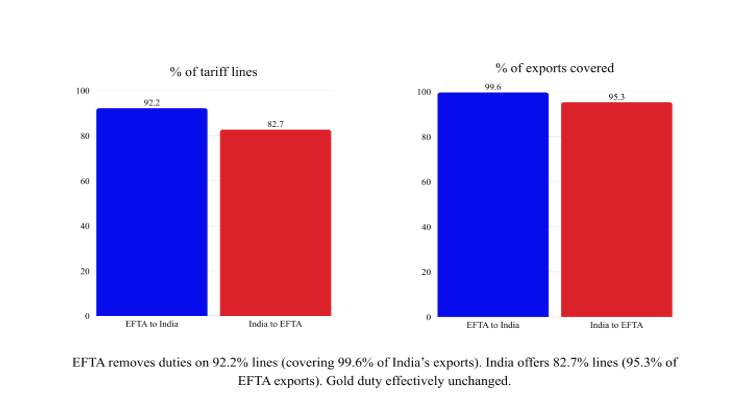
Under TEPA, EFTA has offered 92.2% of tariff lines encompassing 99.6% of India’s exports. Includes 100% of non-agricultural products and tariff concessions on Processed Agricultural Products (PAP).

India’s offer to EFTA covers 82.7% of tariff lines, accounting for 95.3% of EFTA exports. Over 80% of these imports are Gold, with no change in effective duty on Gold. Sensitive sectors protected, including pharma, medical devices, processed food, dairy, soya, coal, and sensitive agricultural products.
Boost for Services and Mobility

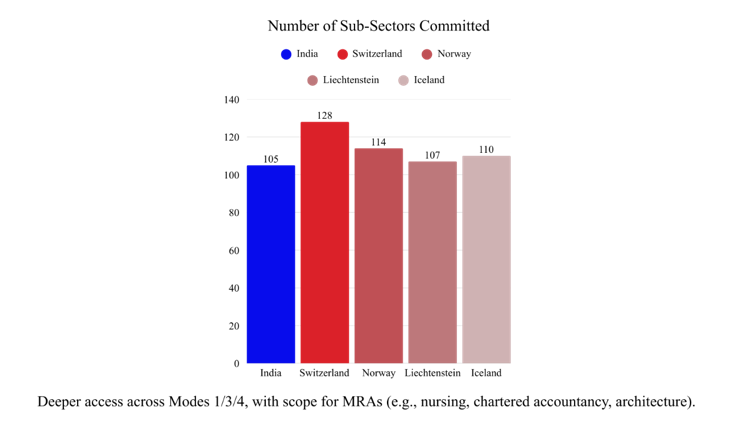
India has offered commitments in 105 sub-sectors. EFTA commitments: 128 (Switzerland), 114 (Norway), 107 (Liechtenstein), 110 (Iceland). TEPA enables Mutual Recognition Agreements (MRAs) in professional services such as nursing, chartered accountancy, and architecture

TEPA presents stronger opportunities in IT, business services, cultural and recreational services, education, and audio-visual services.

Improved access via: Mode 1: Digital delivery of services, Mode 3: Commercial presence and Mode 4: Greater certainty for entry and temporary stay of key personnel.

Intellectual Property Rights
TEPA ensures IPR commitments at TRIPS level. The IPR chapter with Switzerland has high standard for IPR, shows the robust IPR regime. India’s interests in generic medicines and concerns related to evergreening of patents have been fully addressed.

Sustainable and Inclusive Development
TEPA emphasizes sustainable development, inclusive growth, social progress, and environmental protection. It will foster transparency, efficiency, simplification, harmonization, and consistency in trade procedures.

Employment, Skills and Technology Collaboration
TEPA would accelerate creation of large number of direct jobs for India’s young aspirational workforce in next 15 years in India, including better facilities for vocational and technical training. TEPA also facilitates technology collaboration and access to world leading technologies in precision engineering, health sciences, renewable energy, Innovation and Research & Development.

Sector wise gains under TEPA
The India-EFTA Trade and economic Partnership Agreement unlock opportunities across wide range of industries. With EFTA’s offer covering 92% of tariff lines, Indian exporters in sectors like machinery, organic chemicals, textiles, and processed foods will enjoy significantly improved access to EFTA markets though TEPA. This will enhance competitiveness, reduce compliance costs and accelerate access to EFTA market.

Agriculture and Allied Goods

  • India’s exports to EFTA are concentrated, with Guar Gum accounting for over 70% of the export basket in 2024-25. Other exports include processed vegetables, basmati rice, pulses, fresh fruits, cereal preparations, and grapes.
  • Norway and Switzerland together account for over 99% of India’s agri-exports to EFTA.
  • India’s exports to EFTA stood at USD 72.37 million in 2024, contributing 0.41% of EFTA’s total imports. This agreement is expected to reduce tariff barriers and expand India’s share in key commodities.
  • Expected Gains: Based on trade patterns and FTA tariff concessions, the following categories are high-opportunity sectors for India:
  • Processed Food Products – biscuits, confectionery, chocolate, malt extracts, sauces, and miscellaneous food preparations.
  •  Rice (Basmati & Non-Basmati) – tariff elimination enhances competitiveness against Italy, Thailand, and Pakistan.
  • Guar Gum & Pulses – where India already has strong presence, FTA will secure larger market share.
  • Fresh Grapes, Mangoes, Vegetables, and Millets – tariff concessions improve market entry and positioning.
  • Cashew Kernels and Other Nuts – demand in EFTA is large, and India can scale exports.
  • Country Specific Gains: -

EFTA Nations

Products / HS Codes

Tariff Concessions / Opportunities

Switzerland

Food Preparations

Tariffs up to 127.5 CHF/100 kg eliminated; scope for Indian exports

Confectionery, Biscuits

Duty cuts create opportunities in processed foods

Fresh Grapes

Tariffs up to 272 CHF/100 kg eliminated

Nuts & Seeds, Fresh Vegetables

Zero tariffs post FTA, boosting competitiveness

Norway

Food Preparations, Condiments

Duty-free access on several tariff lines

Rice

Tariff reductions (non-feed purposes) open new markets

Processed Vegetables & Fruits

Duty-free access on selected lines

Biscuits, Malt Extracts, Beverages

Tariff relief improves access for Indian brands

Iceland

Processed Foods

High MFN tariffs (up to 97 ISK/kg) cut to zero

Chocolate & Confectionery

Duties eliminated; strong potential for processed food exports

Fresh/Chilled Vegetables

Tariff elimination

Coffee

  • EFTA member countries viz., Switzerland (USD 145 million), Norway (USD 27 million) and Iceland (USD 3 million) together import coffee valued at USD 175 million, which is about 3% of the global coffee imports.
  • EFTA has offered Import Duty of 0% on all the HS lines pertaining to Coffee.
  • Switzerland and Norway are high-value markets with strong demand for high quality coffee.
  • TEPA provide most favorable market access to Indian Coffees in EFTA market.
  • TEPA may help the coffee exporters to access the premium markets in Switzerland, Norway and Iceland with the opportunity for positioning India’s high-quality shade grown, handpicked and sun-dried coffees in EFTA market.

Tea

  • EFTA has a combined tea market size of around 3.0 million kg.
  • In the post-TEPA period, the average unit export price realization has risen appreciably ($6.77/kg in 2024-25 vis-à-vis $5.93/kg in 2023-24).

Marine Products

  • Norway: Exemption of duty of upto 13.16% from fish/shrimp feed. This will make Indian products competitive and enhance the export of fish feed and raw materials for fish/shrimp feed from India to Norway
  • Iceland: Tariff Elimination of upto 10% on Frozen, Prepared and preserved shrimps and prawns, squid and Cuttlefish and upto 55% on fish feed.
  • Switzerland: Zero Duty on Fats and oils of fish (other than liver oil)
  • TEPA will provide an opportunity to increase the export of the Marine products in addition to frozen shrimps from India to EFTA countries.
  • This is expected to increase the exports to USD 3.50 million in coming years.

Textiles and Clothing

  • India’s textiles and apparel exports to the EFTA stood at USD 0.13 billion in 2024.
  • Given India’s total global textiles exports were USD 36.71 billion in 2024, TEPA offers opportunity to capture the untapped market by leveraging tariff concessions.

Leather and Footwear

  • The MFN is 0% in EFTA countries for leathers and footwear, an advantage to continue Post TEPA implementation.
  • TEPA consolidates and guarantees this preferential treatment, providing long-term certainty and stability for exporters.

Sports Goods and Toys

  • TEPA would bring zero-duty access for a large share of tariff lines, enhancing competitiveness for Indian exporters.
  • Streamlined conformity assessment, mutual recognition of standards (MRAs), and simplified CE marking compliance under TEPA to lower compliance costs for exporters.

Engineering Goods

  • India’s engineering exports to the EFTA reached US$ 315.2 million in FY 2024–25, marking an 18% growth over the previous fiscal year.
  • Norway and Switzerland remain the largest destinations, accounting for almost 99% of total exports.
  • TEPA will provide enhanced market access and tariff concessions to boost competitiveness and open new opportunities for Indian engineering exporters across high-value sectors.
  • Significant Market Potential exists in electric machinery, aluminum products, AC/refrigeration machinery, bicycle and copper products highlighting diversification and potential for growth in sustainable, precision engineering, energy-efficient and infrastructure-related goods.

Gems and Jewellery

  • Gems & Jewellery exports enjoy duty-free access in EFTA markets- a preferential treatment that will continue under TEPA.
  • Country wise Market potential for Gems & Jewellery Sector include:
  • Iceland: Gold jewellery, silver jewellery, and imitation jewellery.
  • Norway: Cut and polished natural diamonds, gold jewellery, silver jewellery, and imitation jewellery.
  • Switzerland: Cut and polished natural diamonds, gold jewellery, and polished rubies, sapphires, and emeralds.

Electronics and Software

  • With a $100 billion investment commitment and preferential access to high-income European markets, TEPA offers a strategic springboard for India’s electronics sector—especially MSMEs and OEMs seeking global scale.
  • Country-wise Electronics Export Potential
  • Switzerland: Medical electronics (diagnostic devices, wearables), Smart sensors and embedded systems, Secure communication modules (for fintech and banking)

Strategic Edge: Leverage TEPA’s IPR chapter to protect proprietary tech

  • Norway: EV components and battery management systems, Marine electronics (navigation, sonar, IoT buoys), Smart grid and energy monitoring devices

        Strategic Edge: Align with Norway’s climate tech goals and public procurement Channels

  • Iceland: Compact medical devices and diagnostics, Smart home and energy-efficient electronics, educational tech hardware (tablets, sensors)

        Strategic Edge: Target niche distributors and public health initiatives

  • Liechtenstein: Industrial control systems, Secure embedded electronics for banking, High-precision components for OEMs

       Strategic Edge: Position India as a reliable EMS partner for European OEMs.

Chemicals and Allied Products

  • On the market access front, EFTA has offered zero or reduced tariffs on more than 95% of India’s exports, including a wide range of chemical products. India, in turn, has granted market access to nearly 80% of its tariff lines covering 95% of EFTA’s exports.
  • TEPA also incorporates product-specific rules of origin, certificates of origin, and movement certificates (EUR.1), ensuring greater transparency and simplifying compliance for exporters, especially in the chemical and pharmaceutical sectors.
  • Pre-FTA, certain chemical sector products faced tariffs of up to 54% (Source: Trademap), but post-FTA, these tariffs will be eliminated, increasing the reach of Indian chemical products in the EFTA bloc.
  • Exports of CAPEXIL products to EFTA are expected to expand gradually from USD 49.41 million to around USD 65–70 million in the post-FTA period, with notable gains anticipated in pet food, rubber products, paper, stone/ceramic items, and glassware.

Plastics and Shellac based products

  • TEPA offers Indian plastic exporters significant opportunities to diversify away from high-tariff markets such as the USA and strengthen their presence in high-value EFTA markets. With zero tariffs and improved trade facilitation, India’s exports across diverse panels are expected to achieve steady growth, supported by vast untapped potential in Switzerland and Norway.
  • TEPA can significantly strengthen India’s position in high-value botanical and forest product markets, while also attracting investments and supporting small exporters.

    Gains in the Services sector
  • The services sector, contributing nearly 55% of India’s Gross Value Added (GVA), stands to gain significantly from TEPA. India has offered commitments in 105 sub-sectors to the EFTA while securing enhanced access in 128 sub-sectors from Switzerland, 114 from Norway, 107 from Liechtenstein, and 110 from Iceland.  
  • TEPA is expected to boost India’s services exports in areas of core strength such as IT and business services, cultural and recreational services, education, and audio-visual services.
  •  EFTA’s Services offers better access through digital delivery of Services (Mode 1), commercial presence (Mode 3) and improved commitments and certainty for entry and temporary stay of key personnel (Mode 4).
  •  Additionally, TEPA includes provisions for Mutual Recognition Agreements (MRAs) in professional services such as nursing, chartered accountancy, and architecture, creating new avenues for Indian professionals in EFTA markets.

INVESTMENT PROMOTION

  • EFTA has committed to promote investments with the aim to increase the foreign direct investments by USD 100 billion ((equivalent to Rs 8 Lakh crore as per present exchange rate) in India in the next 15 years -a major boost to “Make in India”.
  • Dedicated EFTA Desk has been operational since Feb 2025, as a single-window mechanism for investment facilitation to support EFTA businesses in investing, expanding, and establishing operations in India.
  • The India-EFTA Desk to drive investment in renewable energy, life sciences, engineering, and digital transformation, while streamlining regulatory processes for EFTA businesses.
  • TEPA will facilitate joint ventures, SME collaborations, and technology partnerships, with the Desk streamlining regulatory navigation for EFTA businesses.
  • The Desk will also act as the primary channel for fostering continuous business-government dialogue, ensuring continuous engagement between India and EFTA partners.

    India Protects what Matters
  • India has safeguarded its sensitive sectors such as dairy, soya, coal and sensitive agricultural products.
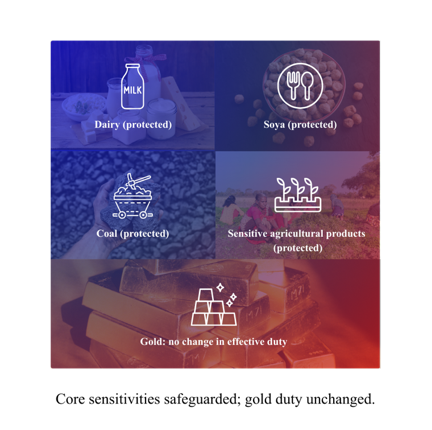
  • India has opened 82.7% tariff 82.7% of its tariff lines which covers 95.3% of EFTA exports of which more than 80% import is Gold.
  • Strategically important products- particularly that where domestic capacity is being built under flagship initiatives like Make in India and PLI – Concessions provided over period of 5,7 or even 10 years with gradual tariff reduction.

Conclusion

The India–EFTA Trade and Economic Partnership Agreement (TEPA) marks a historic milestone, establishing India’s first FTA with four developed European nations and committing USD 100 billion in investments and 1 million direct jobs over 15 years. TEPA enhances market access for goods and services, strengthens intellectual property rights, and fosters sustainable, inclusive development, while supporting Make in India and Atmanirbhar Bharat initiatives.

Complementing this, the India–EFTA Desk has been inaugurated as a single-window platform to facilitate EFTA investments in renewable energy, life sciences, engineering, and digital transformation, while fostering joint ventures, SME collaborations, and technology partnerships.

TEPA is a “model agreement” and reaffirms India’s readiness to build a robust future with EFTA.

References:

Ministry of Commerce and Industry

Topics

Acts Income Tax
