

Loading...

Top
Help
×

By creating an account you can:

Logo TaxTMI
Call Us / Help / Feedback

Contact Us At :

E-mail: [email protected]

Call / WhatsApp at: +91 99117 96707

For more information, Check Contact Us

FAQs :

To know Frequently Asked Questions, Check FAQs

Most Asked Video Tutorials :

For more tutorials, Check Video Tutorials

Submit Feedback/Suggestion :

Email :
Please provide your email address so we can follow up on your feedback.
Category :
Description :
Min 15 characters 0/2000
Make Most of Text Search
  1. Checkout this video tutorial: How to search effectively on TaxTMI.
  2. Put words in double quotes for exact word search, eg: "income tax"
  3. Avoid noise words such as : 'and, of, the, a'
  4. Sort by Relevance to get the most relevant document.
  5. Press Enter to add multiple terms/multiple phrases, and then click on Search to Search.
  6. Text Search
  7. The system will try to fetch results that contains ALL your words.
  8. Once you add keywords, you'll see a new 'Search In' filter that makes your results even more precise.
  9. Text Search
Add to...
You have not created any category. Kindly create one to bookmark this item!
Create New Category
Hide
Title :
Description :
❮❮ Hide
Default View
Expand ❯❯
Close ✕
🔎 News - Adv. Search
TEXT SEARCH:

Press 'Enter' to add multiple search terms. Rules for Better Search

Search In:
Main Text + AI Text
  • Main Text
  • Main Text + AI Text
  • AI Text
Category: ?
Categorized by AI
---- All Categories ----
  • ---- All Categories ----
  • Income Tax
  • GST
  • Customs, DGFT & SEZ
  • FEMA & RBI
  • Corp. Laws, SEBI & IBC
  • PMLA, Black Money & ED
  • Budget
  • News and Press Release
  • PTI News
Month:
---- All Months ----
  • ---- All Months ----
  • January
  • February
  • March
  • April
  • May
  • June
  • July
  • August
  • September
  • October
  • November
  • December
Year:
---- All Years ----
  • ---- All Years ----
  • 2026
  • 2025
  • 2024
  • 2023
  • 2022
  • 2021
  • 2020
  • 2019
  • 2018
  • 2017
  • 2016
  • 2015
  • 2014
  • 2013
  • 2012
  • 2011
Sort By: ?
In Sort By 'Default', exact matches for text search are shown at the top, followed by the remaining results in their regular order.
Relevance Default Date
    Office of the Controller General of Patents, Designs and Trade Marks Announces Tentative Schedule for Patent and Trade Marks Agent Examinations 2027 a...
    RBI invites comments on the draft “Reserve Bank of India (Non-Banking Financial Companies – Credit Facilities) Amendment Directions, 2026”
    West Bengal seeks 100pc foodgrain, 40pc sugar jute packaging quota at SAC meeting
    RBI clasifies Tata Sons, 16 others as large NBFCs
    Sensex climbs 374 points on buying in Reliance, ICICI Bank; Nifty ends flat
    Insurance Division, DFS Secures 3rd Rank in Group A Category of Grievance Redressal Assessment & Index (GRAI) for June 2026
    VKDL Group’s NPA Bazaar Strengthens India’s Distressed Asset Resolution Ecosystem Under the Leadership of V K Dubey
    Lok Sabha passes bill to authorise govt to permit banks to levy charges on UPI transactions
    Monetary Policy Statement, 2026-27 Resolution of the Monetary Policy Committee August 3 to 5, 2026
    Stock markets edged higher in early trade amid lower crude oil prices, buying in Reliance Industries
    Monthly review of accounts of Government of India upto June 2026 (FY 2026-27)
    DRI busts illegal drug manufacturing unit in Satara district in Maharashtra; two arrested
    CCI approves proposed combination inter alia involving share acquisition(s) and merger of certain entities e.g. AAPC India, Triguna, Caddie, SMPL, Tec...
    Rupee gains 20 paise to close at 95.08 against US dollar post-RBI policy decision
    TN Budget: Revenue deficit at Rs 55,775 crore, fiscal deficit estimated at Rs 1,21,819 crore
    Tatkare slams ‘gungi gudiya’ jibe against Sunetra; Cong says row being exploited for political gains
    RBI invites public comments on Draft Guidelines for ‘on tap’ Licensing of Urban Co-operative Banks
    Pakistan-origin dry dates, routed through UAE, seized at Kandla port
    RBI keeps rates unchanged, retains neutral stance; outlook uncertain on El Nino, geopolitical risks
    Government Notifies Inventory-based Cross-border E-Commerce Export Framework under Foreign Trade Policy 2023
❯❯
Maximize Maximize Maximize
0 / 200
Expand Note
Add to Folder

No Folders have been created

+

Are you sure you want to delete "My most important" ?

NOTE:

News
Showing Results for :
Reset Filters
Results Found:
Show All Summaries Hide All Summaries
August 6, 2026
Show AI Summary
Patent and trade marks agent qualification examinations require written-paper minimums, aggregate passing scores, and viva voce assessment for registration.
Patent and trade marks agent examinations comprise an objective Paper I, a descriptive Paper II and a viva voce assessing suitability to practise before the Intellectual Property Office. Candidates must secure the stipulated minimum marks in each written paper and the required aggregate score to pass. Registration in the relevant Register of Patent Agents or Register of Trade Marks Agents is available only to candidates who satisfy all prescribed eligibility conditions and qualify the examination.
August 6, 2026
Show AI Summary
Draft NBFC credit-facilities amendments open for stakeholder consultation through designated online and email feedback channels.
Draft amendments to the Non-Banking Financial Companies credit-facilities framework have been released for public consultation. Regulated entities and other interested stakeholders may submit comments or feedback through the 'Connect 2 Regulate' platform or by email using the specified subject line.
August 6, 2026
Show AI Summary
Mandatory jute packaging reservations were urged to protect cultivators, mill workers, crop absorption, and environmentally sustainable packaging.
Mandatory jute packaging reservations were sought to be retained at full coverage for foodgrains and increased for sugar packaging for the forthcoming Jute Year. The submission before the Standing Advisory Committee emphasised absorption of bumper jute output, remunerative prices for cultivators, uninterrupted mill operations, and protection of farm and worker livelihoods. It also stressed that biodegradable jute bags offer an environmentally friendly alternative to HDPE and polypropylene woven sacks, and that dilution of compulsory packaging could undermine plastic-pollution reduction efforts.
August 6, 2026
Show AI Summary
NBFC Upper Layer classification imposes enhanced regulation and listing obligations, while de-registration applications remain under examination.
NBFC Upper Layer classification subjects identified large non-banking financial companies to enhanced regulatory requirements for at least five years and requires stock-exchange listing within three years of identification. The framework divides NBFCs into Base, Middle, Upper and Top Layers. Seventeen large NBFCs were included in the Upper Layer list, while Tata Sons' classification remains subject to the pending examination of its de-registration application.
August 6, 2026
Show AI Summary
Closing auction price discovery may affect benchmark levels differently based on constituent liquidity and concentrated institutional order flow.
The Closing Auction Session in the equity cash segment uses an auction-based method to determine closing prices of eligible shares with futures and options contracts, aiming to strengthen transparent and robust price discovery. Its effect on benchmark closing levels may differ according to constituent liquidity and institutional order flow. The Reserve Bank of India retained the policy repo rate and neutral stance, indicating that future policy decisions will be data-dependent and influenced by assessment of energy-cost effects on inflation.
August 6, 2026
Show AI Summary
Public grievance redressal strengthens through monitoring, senior review, workshops, stakeholder coordination, and customer-centric service delivery improvements.
Public grievance redressal is assessed through the Grievance Redressal Assessment and Index, which analyses grievance categories and disposal. The Department of Financial Services' Insurance and Banking Divisions received third and sixth ranks respectively in the June 2026 assessment. Its framework includes disposal of grievances, random reviews by senior officials, and workshops on effective grievance redressal, supporting best practices, stakeholder coordination, technology use, customer-centric service, and accountable public service delivery.
August 6, 2026
Show AI Summary
Distressed asset resolution integrates restructuring, insolvency advisory, funding facilitation and digital marketplaces for transparent financial recovery transactions.
The platform provides integrated advisory, management and transaction-facilitation services for Non-Performing Assets, stressed assets and distressed assets. Its services include NPA resolution, debt restructuring, One-Time Settlements, funding assistance, insolvency and bankruptcy advisory, asset reconstruction, financial restructuring and capital raising. Digital and offline marketplaces facilitate transactions involving distressed assets, receivables and related movable or immovable properties, supported by collaborations with banks, Non-Banking Financial Companies, Asset Reconstruction Companies, corporates and investors.
August 6, 2026
Show AI Summary
Merchant discount rate framework may permit charges on notified UPI and digital payments through a government notification mechanism.
The proposed amendment to Section 10A of the Payment and Settlement Systems Act, 2007 replaces the existing income-tax-linked reference with a Central Government notification-based mechanism for electronic payment modes. It removes the current statutory restriction preventing banks and payment service providers from charging Merchant Discount Rate on notified modes, enabling the Government to permit charges for UPI and other digital payments. The policy rationale is to support funding for payment infrastructure and a sustainable revenue model for service providers.
August 6, 2026
Show AI Summary
Neutral monetary policy stance continues as resilient growth and food-fuel inflation risks require close macroeconomic monitoring.
The Monetary Policy Committee retained the policy repo rate and continued the neutral monetary policy stance, citing the need to assess evolving growth-inflation conditions. Domestic activity was assessed as resilient, supported by consumption, investment, credit, manufacturing, services and exports, although global uncertainty, energy prices, supply-chain pressures, geopolitical developments and monsoon conditions remain risks. CPI inflation increased mainly because of food and fuel pressures, while underlying inflation remained moderate. The Committee considered that price pressures were not yet generalised and reaffirmed its commitment to align inflation with the target.
August 6, 2026
Show AI Summary
Closing auction price discovery and a neutral monetary policy stance shaped equity market conditions amid lower crude prices.
The Closing Auction Session in the equity cash segment introduced an auction-based mechanism for determining closing prices of eligible shares with futures and options contracts, intended to make price discovery more transparent and robust. The Reserve Bank of India retained its neutral stance and left the benchmark policy rate unchanged, pending greater clarity on the inflationary effects of higher energy costs. Future policy decisions were stated to be data dependent.
August 6, 2026
Show AI Summary
Monthly public accounts review records receipts, expenditure, tax devolution, interest payments, subsidies, and capital spending through June.
Consolidated monthly accounts up to June 2026 report total receipts of Rs.10,49,243 crore, comprising net tax revenue, non-tax revenue and non-debt capital receipts. Tax devolution transfers to State Governments total Rs.2,63,336 crore. Total expenditure is Rs.13,57,076 crore, including revenue expenditure of Rs.10,16,818 crore and capital expenditure of Rs.3,40,258 crore. Revenue expenditure includes interest payments and major subsidies.
August 6, 2026
Show AI Summary
Illicit psychotropic drug manufacture triggered seizure, apprehensions, and investigation into planned trafficking under narcotics control law.
Illicit manufacture and trafficking of Alprazolam and Diazepam, psychotropic substances regulated under the Narcotic Drugs and Psychotropic Substances Act, 1985, were detected at a clandestine facility. Searches recovered finished and intermediary substances, together with raw materials and reaction mixtures used in manufacture, and the goods were seized under the Act. The manufacturer and an intended buyer were apprehended, with material indicating a proposed transaction for further illicit trafficking. Preliminary investigation indicated prior involvement in illegal drug production and trafficking.
August 6, 2026
Show AI Summary
Competition approval for hotel-sector consolidation covers share acquisitions and merger of Accor-branded hotel entities into InterGlobe Hotels.
Competition approval was granted for related share acquisitions and the merger of AAPC India, Caddie, Triguna, Srilanand Mansions, Techpark and Accent into InterGlobe Hotels. The combination involves entities jointly controlled by the Bhatia Family Group and the Accor Group, including hotel-owning and developing entities, hotel management and franchising operations, leasing activities, and captive consultancy and support services relating to Accor-branded hotels in India.
August 5, 2026
Show AI Summary
Rupee appreciation followed unchanged monetary policy, lower crude prices, weaker dollar and expectations of orderly exchange-rate management.
The rupee strengthened after the central bank maintained its policy rate and neutral monetary-policy stance. Lower crude oil prices, a weaker US dollar and declining US Treasury yields supported investor sentiment. Earlier measures to attract capital inflows remained part of the framework supporting the rupee, while the central bank stressed its endeavour to preserve an orderly currency trajectory. Future movement was linked to geopolitical de-escalation, global risk sentiment and US economic data.
August 5, 2026
Show AI Summary
Fiscal consolidation through revenue mobilisation and leakage control aims to reduce deficits while expanding capital expenditure capacity.
Tamil Nadu's Revised Budget Estimates for 2026-27 project a revenue deficit and fiscal deficit, with outstanding liabilities comprising public debt and public-account liabilities. Revenue mobilisation is proposed through improved tax administration, collection efficiency, closure of leakages, liquor-manufacturer privilege fees, and eligible Union grants. The strategy projects gradual deficit reduction to create room for capital expenditure, supported by expenditure reforms aimed at eliminating leakages, optimising expenditure, and improving service delivery.
August 5, 2026
Show AI Summary
Political criticism of public office-holders raises debate over media accountability, personal remarks, and acceptable public discourse.
Political criticism followed a social-media post describing Maharashtra Deputy Chief Minister Sunetra Pawar as "gungi gudiya" in connection with a press interaction on law-and-order issues in Beed district. Congress representatives stated that the post was not a personal insult, had been deleted after adverse reactions, and was followed by an expression of regret. NCP representatives termed the expression inappropriate and stressed that the principal dignitary should conduct media interactions. Shiv Sena (UBT) representatives described the phrase as not unparliamentary and linked it to criticism of a guardian minister's public responsibilities.
August 5, 2026
Show AI Summary
On-tap licensing for Urban Co-operative Banks enters public consultation through draft guidelines inviting stakeholder feedback.
Draft guidelines for 'on tap' licensing of Urban Co-operative Banks have been issued for public and stakeholder consultation. Comments and feedback may be submitted until September 05, 2026, through the designated online consultation facility or by written or email submission to the specified regulatory department.
August 5, 2026
Show AI Summary
Prohibition on indirect Pakistan-origin imports targets alleged origin misdeclaration and UAE routing used to circumvent trade restrictions.
Import prohibition on goods originating in Pakistan applies to direct and indirect imports under the Foreign Trade Policy, 2023. Pakistan-origin dry dates routed through the UAE were allegedly declared as UAE-origin goods for import, and were intercepted under the Customs Act, 1962. Investigation indicated that the goods were first sent from Pakistan to Dubai, re-containerised, and then exported to India. A separate interception involved Pakistan-origin guggul resin allegedly declared as Somali natural resin and routed through Dubai.
August 5, 2026
Show AI Summary
Neutral monetary policy stance keeps benchmark rates unchanged while inflation risks, liquidity management and consumer-protection reforms remain under review.
Monetary policy maintains the benchmark policy rate unchanged and retains a neutral stance, with future decisions guided by incoming data. The central bank remains committed to aligning headline inflation with its medium-term target while monitoring food, fuel and other input-cost risks. Surplus liquidity will be managed through two-way operations, and the regulatory framework for interest rates on advances is proposed to be harmonised and standardised across regulated entities to improve transparency and consumer protection.
August 5, 2026
Show AI Summary
Export-only e-commerce inventory framework enables seller exports through registered exporters while requiring traceability, timely payments and domestic-diversion controls.
The export-only inventory framework permits eligible e-commerce entities to export through a registered Exporter-on-Record, which procures goods from Indian Sellers-on-Record against confirmed overseas orders and assumes export and destination-country compliance responsibilities. Inventory must be segregated, digitally traceable and cannot be diverted to domestic sale. The framework requires timely seller payments, visibility of overseas sales and shipment information, proportional pass-through of export rebates and refunds, annual compliance certification and digital records.

News

Back

All News

Showing Results for :
Reset Filters
No Records Found

News

Back

All News

Showing Results for : Reset Filters
Corp. Laws, SEBI & IBC

Minister of State for Corporate Affairs Shri Harsh Malhotra Inaugurates third edition of the National Conference on Responsible Business Conduct (NCRBC) 2025

July 4, 2025

Contents
Summary
Note

Note

-

Bookmark

Print

Print

“India Embracing Trust-Based corporate Governance Rooted in Vasudhaiva Kutumbakam”: Shri Harsh Malhotra

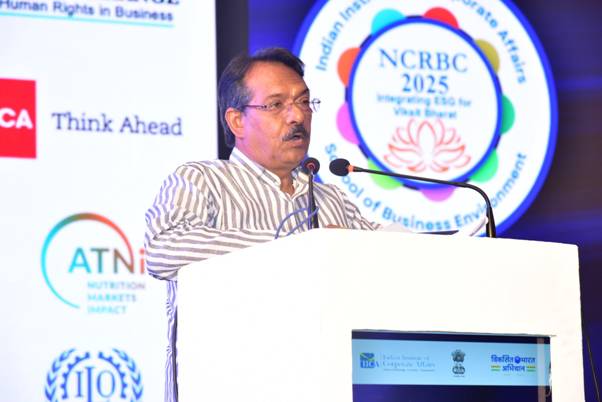
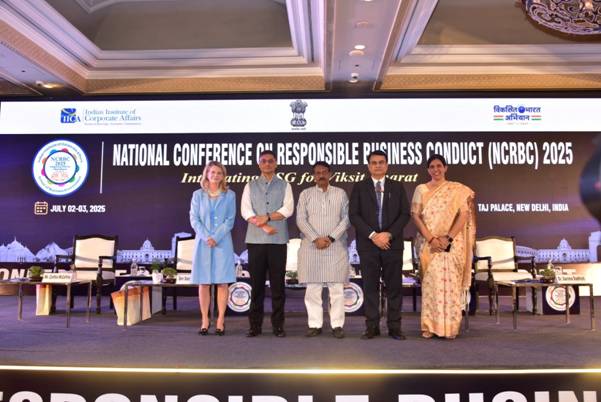
The third edition of the National Conference on Responsible Business Conduct (NCRBC) 2025 was inaugurated by Shri Harsh Malhotra, Minister of State for Corporate Affairs and Road Transport & Highways, Government of India, on 2nd July at the Taj Palace, New Delhi. Organised by the Indian Institute of Corporate Affairs (IICA), an autonomous institution under the Ministry of Corporate Affairs, the two-day flagship national conference is being held under the theme “Integrating ESG for Viksit Bharat.”
WhatsApp Image 2025-07-03 at 11.14.50 AM.jpeg

Addressing a distinguished audience comprising 300 plus senior corporate leaders, ESG (Environmental, Social, and Governance) professionals, policymakers, and international delegates, th Minister emphasised that India is transitioning from a regime of regulatory prosecution to one of trust-based corporate governance. He observed that responsible business conduct is no longer peripheral to business strategy, but foundational. He also asserted that “India is no longer catching up, India is ready to lead”. Reflecting on the spirit of ‘Vasudhaiva Kutumbakam,’ he noted that the Indian approach to ESG is not merely ‘climate-first’ but ‘climate-plus,’ integrating environmental stewardship with social inclusion, ethical governance, and intergenerational equity.

He highlighted several reform milestones of the Ministry, including the introduction of the National Guidelines on Responsible Business Conduct (NGRBC), Business Responsibility and Sustainability Reporting (BRSR), MCA21 Version 3.0 for digital governance, and the decriminalisation of over 180 statutory provisions through the Jan Vishwas Act. Applauding IICA’s contributions in strengthening board ethics and capacity-building, he remarked that the transition from compliance to conscience must be institutionalised across all business forms, including startups, MSMEs, and listed entities alike.

Delivering a special address, Shri Sanjeev Sanyal, Member of the Economic Advisory Council to the Prime Minister of India, brought a historical and analytical lens with his remarks, cautioning against the indiscriminate import and application of subjective ESG metrics, motivated and influenced by the developed world without reference to India’s priorities. He stressed the need for robust, context-specific and just indicators that reflect India’s developmental priorities and aspirations while cautioning against global indices that often undervalue grounded and situational responsible business conduct. Revering to India’s rich Indian history, he observed that Kautilya’s Arthashastra already embedded principles similar to modern ESG ethos, affirming that India possesses a civilisational heritage of ethical governance and responsible conduct. He urged stakeholders to pursue ESG pathways that are not only compliant but economically and socially coherent within India’s unique institutional context.

Thereafter, in her special address, Ms. Cynthia McCaffrey, UNICEF Representative to India, emphasised that ESG frameworks must reflect the lived realities of families and children. She asserted, “ESG is incomplete without healthy children and families,” and called for businesses to align their governance and social strategies with the rights of the youngest and most vulnerable stakeholders. Noting that inclusive development cannot ignore the social foundations of sustainability, she urged corporate actors to integrate child rights, access to nutrition, education, and community resilience deeper into the broader responsible business conduct architecture.

Shri Gyaneshwar Kumar Singh, Director General and CEO of IICA,  delivered a visionary Welcome address, reiterating India’s imperative to develop indigenous ESG frameworks rooted in national development goals. While charting the decade long history of initiating timely actions by Ministry of Corporate Affairs and IICA to strengthen the ESG framework in India, Shri Singh stated that imported templates would prove to be inadequate to address India’s diverse business ecosystem, while suggesting robust, evidence-based strategic models must lead to future ecosystem of both voluntary ESG compliance and transformation. Underscoring IICA’s central role in ESG evidence-based research, policy advocacy, and targeted capacity-building, he affirmed that the Institute is committed to fostering a regulatory culture where trust, accountability, and innovation are mutually reinforcing.
WhatsApp Image 2025-07-03 at 11.14.49 AM.jpeg

Welcoming dignitaries and delegates, Prof. Garima Dadhich, Head of the School of Business Environment at IICA, highlighted the evolution of NCRBC from its first edition on “Embracing ESG in India” to this year’s focus on integration. She noted that “this year marks a shift from awareness to action, from commitment to convergence,” as ESG becomes embedded within India’s broader developmental discourse. She reaffirmed that IICA, through its School of Business Environment, resolves to serve as a national knowledge and action hub for mainstreaming responsible business conduct, developing sector-specific frameworks, and fostering ecosystem-wide collaboration.

Following the inaugural session, Day 1 of the conference featured four high-level thematic panels that explored key dimensions of ESG transformation. The first panel, “The Rise of ESG in the Boardroom,” initiating with a Key note Address from Smt. Ravneet Kaur, Chairperson, Competition Commission of India and National Financial Regulatory Authority (NFRA), brought together eminent representatives from the Mahindra Group, Engineers India Ltd, ICAI, NSE, and ONGC. The discussion focused on embedding ESG into corporate governance structures and strategic oversight, with emphasis on the fiduciary duties of boards in advancing sustainability objectives. The second panel, “Sustainable Finance: Transforming Capital for a Green Future,” examined how financial instruments such as green bonds, sustainability-linked loans, and impact investing are enabling the transition to a low-carbon economy. Participants from SEBI, NABARD, India INX, the Indian Banks’ Association, and CEEW highlighted that capital must now flow toward long-term societal impact, not just quarterly returns. The third session focused on the “Relevance of the EU Corporate Social Due Diligence Directive (CSDDD) for India,” where experts discussed the need for Indian exporters and value chain actors to proactively align with international due diligence standards in order to retain global market access. The final panel of the day, “Envisioning the Workforce of the Future in the Age of Disruptive Trends,” convened leaders from the skill development ecosystem, academia, and industry to explore strategies for integrating ESG into workforce planning, upskilling for green jobs, and designing inclusive employment models for a dynamic economic future.

With substantive participation of over 300 plus senior corporate leaders, ESG professionals, policymakers, and international delegates, and thought-provoking deliberations led by eminent experts, Day 1 of NCRBC 2025 laid a strong foundation for the sessions to follow. The second day will witness further discussions on decarbonising India’s industrial base, advancing sector-specific ESG adoption, aligning BRSR disclosures with global reporting frameworks, and building resilient and sustainable supply chains. A high-level diplomatic panel will engage with ambassadors from key partner countries to deliberate on multilateral cooperation for responsible and equitable economic systems. Therefore, with an elaborate two-day agenda, the IICA’s NCRBC 2025, with support from Ministry of Corporate Affairs and partner organisations such as UNICEF India, Partners-in-Change, ICAI, ACCA, Global Alliance for Improved Nutrition (GAIN), Access to Nutrition Initiative (ATNi), International Labour Organisation (ILO) and Responsible Business Alliance (RBA), aims to position responsible business conduct as integral to India’s journey toward becoming a developed, inclusive, and ethically grounded nation by 2047.

Topics

Acts Income Tax