 TaxTMI
 Login
 TaxTMI
Login
Loading...
Press 'Enter' to add multiple search terms. Rules for Better Search

Press 'Enter' after typing page number.
Press 'Enter' after typing page number.


No Folders have been created
Are you sure you want to delete "My most important" ?
NOTE:
Press 'Enter' after typing page number.
Press 'Enter' after typing page number.

All News
Press 'Enter' after typing page number.
All News

Note

Bookmark

Share


“India Embracing Trust-Based corporate Governance Rooted in Vasudhaiva Kutumbakam”: Shri Harsh Malhotra
The third edition of the National Conference on Responsible Business Conduct (NCRBC) 2025 was inaugurated by Shri Harsh Malhotra, Minister of State for Corporate Affairs and Road Transport & Highways, Government of India, on 2nd July at the Taj Palace, New Delhi. Organised by the Indian Institute of Corporate Affairs (IICA), an autonomous institution under the Ministry of Corporate Affairs, the two-day flagship national conference is being held under the theme “Integrating ESG for Viksit Bharat.”
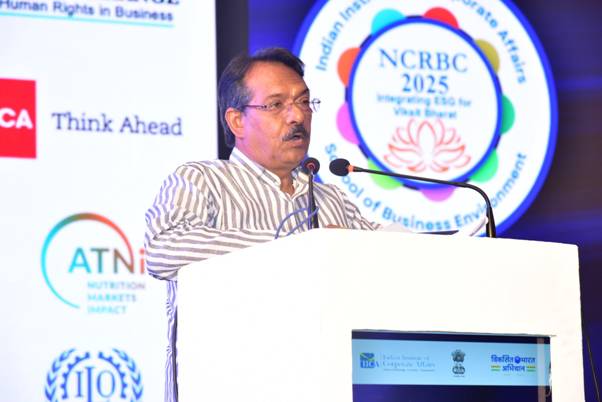
Addressing a distinguished audience comprising 300 plus senior corporate leaders, ESG (Environmental, Social, and Governance) professionals, policymakers, and international delegates, th Minister emphasised that India is transitioning from a regime of regulatory prosecution to one of trust-based corporate governance. He observed that responsible business conduct is no longer peripheral to business strategy, but foundational. He also asserted that “India is no longer catching up, India is ready to lead”. Reflecting on the spirit of ‘Vasudhaiva Kutumbakam,’ he noted that the Indian approach to ESG is not merely ‘climate-first’ but ‘climate-plus,’ integrating environmental stewardship with social inclusion, ethical governance, and intergenerational equity.
He highlighted several reform milestones of the Ministry, including the introduction of the National Guidelines on Responsible Business Conduct (NGRBC), Business Responsibility and Sustainability Reporting (BRSR), MCA21 Version 3.0 for digital governance, and the decriminalisation of over 180 statutory provisions through the Jan Vishwas Act. Applauding IICA’s contributions in strengthening board ethics and capacity-building, he remarked that the transition from compliance to conscience must be institutionalised across all business forms, including startups, MSMEs, and listed entities alike.
Delivering a special address, Shri Sanjeev Sanyal, Member of the Economic Advisory Council to the Prime Minister of India, brought a historical and analytical lens with his remarks, cautioning against the indiscriminate import and application of subjective ESG metrics, motivated and influenced by the developed world without reference to India’s priorities. He stressed the need for robust, context-specific and just indicators that reflect India’s developmental priorities and aspirations while cautioning against global indices that often undervalue grounded and situational responsible business conduct. Revering to India’s rich Indian history, he observed that Kautilya’s Arthashastra already embedded principles similar to modern ESG ethos, affirming that India possesses a civilisational heritage of ethical governance and responsible conduct. He urged stakeholders to pursue ESG pathways that are not only compliant but economically and socially coherent within India’s unique institutional context.
Thereafter, in her special address, Ms. Cynthia McCaffrey, UNICEF Representative to India, emphasised that ESG frameworks must reflect the lived realities of families and children. She asserted, “ESG is incomplete without healthy children and families,” and called for businesses to align their governance and social strategies with the rights of the youngest and most vulnerable stakeholders. Noting that inclusive development cannot ignore the social foundations of sustainability, she urged corporate actors to integrate child rights, access to nutrition, education, and community resilience deeper into the broader responsible business conduct architecture.
Shri Gyaneshwar Kumar Singh, Director General and CEO of IICA, delivered a visionary Welcome address, reiterating India’s imperative to develop indigenous ESG frameworks rooted in national development goals. While charting the decade long history of initiating timely actions by Ministry of Corporate Affairs and IICA to strengthen the ESG framework in India, Shri Singh stated that imported templates would prove to be inadequate to address India’s diverse business ecosystem, while suggesting robust, evidence-based strategic models must lead to future ecosystem of both voluntary ESG compliance and transformation. Underscoring IICA’s central role in ESG evidence-based research, policy advocacy, and targeted capacity-building, he affirmed that the Institute is committed to fostering a regulatory culture where trust, accountability, and innovation are mutually reinforcing.
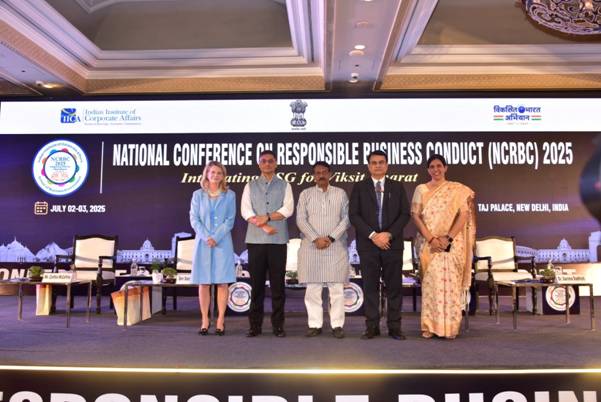
Welcoming dignitaries and delegates, Prof. Garima Dadhich, Head of the School of Business Environment at IICA, highlighted the evolution of NCRBC from its first edition on “Embracing ESG in India” to this year’s focus on integration. She noted that “this year marks a shift from awareness to action, from commitment to convergence,” as ESG becomes embedded within India’s broader developmental discourse. She reaffirmed that IICA, through its School of Business Environment, resolves to serve as a national knowledge and action hub for mainstreaming responsible business conduct, developing sector-specific frameworks, and fostering ecosystem-wide collaboration.
Following the inaugural session, Day 1 of the conference featured four high-level thematic panels that explored key dimensions of ESG transformation. The first panel, “The Rise of ESG in the Boardroom,” initiating with a Key note Address from Smt. Ravneet Kaur, Chairperson, Competition Commission of India and National Financial Regulatory Authority (NFRA), brought together eminent representatives from the Mahindra Group, Engineers India Ltd, ICAI, NSE, and ONGC. The discussion focused on embedding ESG into corporate governance structures and strategic oversight, with emphasis on the fiduciary duties of boards in advancing sustainability objectives. The second panel, “Sustainable Finance: Transforming Capital for a Green Future,” examined how financial instruments such as green bonds, sustainability-linked loans, and impact investing are enabling the transition to a low-carbon economy. Participants from SEBI, NABARD, India INX, the Indian Banks’ Association, and CEEW highlighted that capital must now flow toward long-term societal impact, not just quarterly returns. The third session focused on the “Relevance of the EU Corporate Social Due Diligence Directive (CSDDD) for India,” where experts discussed the need for Indian exporters and value chain actors to proactively align with international due diligence standards in order to retain global market access. The final panel of the day, “Envisioning the Workforce of the Future in the Age of Disruptive Trends,” convened leaders from the skill development ecosystem, academia, and industry to explore strategies for integrating ESG into workforce planning, upskilling for green jobs, and designing inclusive employment models for a dynamic economic future.
With substantive participation of over 300 plus senior corporate leaders, ESG professionals, policymakers, and international delegates, and thought-provoking deliberations led by eminent experts, Day 1 of NCRBC 2025 laid a strong foundation for the sessions to follow. The second day will witness further discussions on decarbonising India’s industrial base, advancing sector-specific ESG adoption, aligning BRSR disclosures with global reporting frameworks, and building resilient and sustainable supply chains. A high-level diplomatic panel will engage with ambassadors from key partner countries to deliberate on multilateral cooperation for responsible and equitable economic systems. Therefore, with an elaborate two-day agenda, the IICA’s NCRBC 2025, with support from Ministry of Corporate Affairs and partner organisations such as UNICEF India, Partners-in-Change, ICAI, ACCA, Global Alliance for Improved Nutrition (GAIN), Access to Nutrition Initiative (ATNi), International Labour Organisation (ILO) and Responsible Business Alliance (RBA), aims to position responsible business conduct as integral to India’s journey toward becoming a developed, inclusive, and ethically grounded nation by 2047.

