

Loading...

Top
Help
×

By creating an account you can:

Logo TaxTMI
Call Us / Help / Feedback

Contact Us At :

E-mail: [email protected]

Call / WhatsApp at: +91 99117 96707

For more information, Check Contact Us

FAQs :

To know Frequently Asked Questions, Check FAQs

Most Asked Video Tutorials :

For more tutorials, Check Video Tutorials

Submit Feedback/Suggestion :

Email :
Please provide your email address so we can follow up on your feedback.
Category :
Description :
Min 15 characters 0/2000
Make Most of Text Search
  1. Checkout this video tutorial: How to search effectively on TaxTMI.
  2. Put words in double quotes for exact word search, eg: "income tax"
  3. Avoid noise words such as : 'and, of, the, a'
  4. Sort by Relevance to get the most relevant document.
  5. Press Enter to add multiple terms/multiple phrases, and then click on Search to Search.
  6. Text Search
  7. The system will try to fetch results that contains ALL your words.
  8. Once you add keywords, you'll see a new 'Search In' filter that makes your results even more precise.
  9. Text Search
Add to...
You have not created any category. Kindly create one to bookmark this item!
Create New Category
Hide
Title :
Description :
❮❮ Hide
Default View
Expand ❯❯
Close ✕
🔎 News - Adv. Search
TEXT SEARCH:

Press 'Enter' to add multiple search terms. Rules for Better Search

Search In:
Main Text + AI Text
  • Main Text
  • Main Text + AI Text
  • AI Text
Category: ?
Categorized by AI
---- All Categories ----
  • ---- All Categories ----
  • Income Tax
  • GST
  • Customs, DGFT & SEZ
  • FEMA & RBI
  • Corp. Laws, SEBI & IBC
  • PMLA, Black Money & ED
  • Budget
  • News and Press Release
  • PTI News
Month:
---- All Months ----
  • ---- All Months ----
  • January
  • February
  • March
  • April
  • May
  • June
  • July
  • August
  • September
  • October
  • November
  • December
Year:
---- All Years ----
  • ---- All Years ----
  • 2026
  • 2025
  • 2024
  • 2023
  • 2022
  • 2021
  • 2020
  • 2019
  • 2018
  • 2017
  • 2016
  • 2015
  • 2014
  • 2013
  • 2012
  • 2011
Sort By: ?
In Sort By 'Default', exact matches for text search are shown at the top, followed by the remaining results in their regular order.
Relevance Default Date
    Compounded annual growth rate of Manufacturing GVA at constant prices (2022-23 base) as per revised series during 2022-23 to 2025-26 is 10.88%
    National Company Law Tribunal (NCLT) Launches e-Inspection and e-Certified Copy Services
    The Government of India to launch the Central Bank Digital Currency (CBDC)-based Direct Benefit Transfer (DBT) in the Union Territories of Chandigarh ...
    India and the Southern African Customs Union (SACU) sign Terms of Reference (ToR) for negotiations towards a Preferential Trade Agreement
    Airtel ends all prepaid mobile plans offering 1.5 GB data per day with unlimited calls
    ED arrests IBC resolution professional
    Mumbai cops bust fake documents racket; four arrested
    After nine years at helm, N Chandra to exit Tata Sons amid expansion, governance standoff
    RBI invites comments on the Draft “Reserve Bank of India (Interest Rates on Loans and Advances) Directions, 2026”
    Sensex falls 188 pts amid elevated crude oil prices; Tata Group stocks decline after N Chandra's exit
    SJM urges govt to stand firm against US tariff pressure, calls for boycott of American products
    Union Minister of Commerce and Industry Shri Piyush Goyal Calls for Fair Trading Practices and Taking ‘Make in India’ from Local to Global
    Union Minister for Finance & Corporate Affairs Smt. Nirmala Sitharaman delivers keynote address at Seminar on “Role of the New Development Bank in M...
    Delhi HC halts processing of IT-returns of Supreme Court, high court judges
    Over 36,000 firms shut operations in Maharashtra in 5 yrs; Oppn claims graft, govt interference
    Powering India's Energy Freedom
    Fourth Session of the India-Namibia Joint Trade Committee held in New Delhi
    Winning in the AI Era: The New Playbook for Indian Banks - Inaugural Address by Shri Sanjay Malhotra, Governor, Reserve Bank of India at the FIBAC 202...
    Assam Cabinet okays funds for land acquisition for Guwahati satellite city
    ED arrests Chhattisgarh Congress leader in liquor 'scam' case; sent to 7 days' custody
❯❯
Maximize Maximize Maximize
0 / 200
Expand Note
Add to Folder

No Folders have been created

+

Are you sure you want to delete "My most important" ?

NOTE:

News
Showing Results for :
Reset Filters
Results Found:
Show All Summaries Hide All Summaries
August 13, 2026
Show AI Summary
Manufacturing GVA growth under the revised national accounts series highlights stable sectoral contribution and resilience-focused industrial measures.
Manufacturing performance is assessed under the revised National Accounts Statistics series using 2022-23 as the base year. Manufacturing's share of total Gross Value Added at current prices remained broadly stable through 2025-26, and Manufacturing GVA at constant prices achieved a compounded annual growth rate of 10.88% from 2022-23 to 2025-26. Production Linked Incentive schemes, logistics and industrial-corridor measures, semiconductor initiatives, and MSME support seek to strengthen domestic manufacturing, diversify supply chains, reduce import dependence, and improve resilience.
August 13, 2026
Show AI Summary
Electronic inspection and certified copies expand digital access to judicial records while supporting efficient case management and reduced delays.
NCLT has launched e-Inspection and e-Certified Copy Services for faster and more convenient access to judicial records and certified copies by advocates, litigants and other stakeholders. The services support a technology-enabled Registry framework and transparent, efficient justice delivery. Pendency monitoring, workload redistribution, Special Benches, maximisation of court time, and registration and listing guidelines are intended to improve case management, optimise limited judicial resources and reduce avoidable delays.
August 13, 2026
Show AI Summary
CBDC-based food subsidy transfers enable eligible beneficiaries to use Digital Rupee wallet credits for traceable foodgrain purchases.
CBDC-based Direct Benefit Transfer under the Pradhan Mantri Garib Kalyan Anna Yojana will credit eligible beneficiaries' food subsidies as programmable Digital Rupee tokens directly into CBDC wallets. Beneficiaries may use these credits to purchase foodgrains from empanelled merchants through secure, real-time and traceable payments, replacing conventional bank-account transfers. The model is intended to improve traceability, reduce leakages and cash handling, enable real-time monitoring of subsidy use, and provide a scalable framework for CBDC integration with welfare schemes.
August 13, 2026
Show AI Summary
Preferential trade agreement negotiations begin under agreed terms covering market access, origin rules, trade remedies and dispute settlement.
India and the Southern African Customs Union have signed Terms of Reference to commence negotiations for a Preferential Trade Agreement. Negotiations are envisaged on trade in goods and market access, rules of origin, customs procedures and trade facilitation, trade remedies including bilateral safeguards, sanitary and phytosanitary measures, technical barriers to trade, dispute settlement, and legal and horizontal provisions. The Terms of Reference establish the negotiating framework only; preferential tariff treatment and other operative commitments depend on conclusion of a final agreement.
August 12, 2026
Show AI Summary
Prepaid plan restructuring eliminates mid-tier daily-data options and channels subscribers toward higher-priced plans with expanded data access.
Bharti Airtel has discontinued prepaid plans combining 1.5 GB daily data allowances with unlimited calling, directing subscribers towards higher-priced plans with expanded data access, including unlimited 5G data. The restructuring reduces low-priced unlimited-data offerings and changes the pricing architecture for customers using discontinued mid-tier plans. Management links tariff repair to differentiated mobile-plan categories and sustained average revenue per user growth.
August 12, 2026
Show AI Summary
Insolvency professional conduct faces money-laundering allegations over re-admitted claims, creditor committee changes, and a connected resolution applicant.
Enforcement action under the Prevention of Money Laundering Act concerns allegations that an insolvency professional re-admitted claims earlier rejected as spurious and fraudulent during the Corporate Insolvency Resolution Process. The alleged re-admission altered the Committee of Creditors' composition and facilitated consideration of a resolution plan allegedly submitted for, and funded through an entity controlled by, a company promoter under investigation for diversion of bank-loan funds. Adverse findings reportedly included acting beyond authority by relying on fabricated and improperly submitted material.
August 12, 2026
Show AI Summary
Identity document forgery allegations prompt investigation into fraudulent Aadhaar updates and falsified government and educational certificates.
Alleged forgery and misuse of identity-related records are under investigation following operations at Aadhaar centres. Seized materials reportedly include forged birth, educational, residence, caste and citizenship certificates, records bearing forged signatures and seals, and equipment used for Aadhaar updates. Four persons were arrested in two operations for allegedly preparing forged records and using them to update Aadhaar cards. Cases have been registered under relevant provisions of the Bharatiya Nyay Sanhita, with investigation continuing into the extent of the alleged network.
August 12, 2026
Show AI Summary
Holding-company governance succession follows leadership departure, requiring transition planning amid unresolved strategy, capital allocation, board representation and listing questions.
Tata Sons' leadership succession and governance framework have become central following the chairman's decision not to seek reappointment when his term ends in February 2027. The board has been asked to decide on a successor promptly. Unresolved matters include the strategic roadmap, losses and capital requirements in newer businesses, board representation, capital allocation, an exit route for the Shapoorji Pallonji Group, and the possible listing of Tata Sons. Future leadership must manage these issues while improving returns from investment-intensive businesses and maintaining established operations.
August 12, 2026
Show AI Summary
Interest-rate regulation for loans and advances proposes harmonised fixed and floating loan-pricing principles across regulated entities.
Interest-rate regulation for loans and advances is proposed to be harmonised across all regulated entities through a principles-based framework for fixed-rate and floating-rate loans. The framework would be calibrated to each entity's nature, complexity and scale, while supporting monetary policy transmission, credit-risk-based pricing, and fair, non-discriminatory borrower treatment. It addresses divergent commercial-bank practices in determining the marginal cost of funds-based lending rate and its components, alongside limited regulatory coverage of fixed-rate loans. Separate final directions are intended for each category of regulated entity after consideration of feedback.
August 12, 2026
Show AI Summary
Elevated crude oil prices and Tata leadership transition drove broad equity market selling amid inflation concerns.
Indian equity markets declined amid elevated crude oil prices, inflation concerns and broad risk-off selling. Tata Group shares, particularly TCS, came under pressure after N. Chandrasekaran announced that he would not seek reappointment as Tata Sons Chairman when his current term ends. Crude oil prices approaching the USD 90-per-barrel level affected investor confidence because of potential inflationary effects, while uncertainty over United States-Iran negotiations and Strait of Hormuz shipping disruptions added to global energy market concerns.
August 12, 2026
Show AI Summary
Trade sovereignty and energy security underpin calls to resist tariff pressure and protect sensitive sectors in bilateral negotiations.
Trade sovereignty and energy security are advanced as grounds for resisting tariff pressure linked to Indian purchases of Russian crude. Bilateral trade negotiations should proceed through equality, reciprocity and mutual respect without compromising agriculture, dairy, energy security or strategic autonomy. Concerns are also raised over removal of e-commerce inventory restrictions for foreign direct investment and over proposed Merchant Discount Rate charges on UPI transactions. Withdrawal of the inventory measure and opposition to payment-provider charges are urged, alongside possible restrictions on United States technology and social-media companies and consumer boycotts of American goods and services.
August 12, 2026
Show AI Summary
Fair trading practices and circular production are promoted to strengthen Make in India and expand global market participation.
Trade and industrial policy messaging encourages businesses to digitise operations, adopt good manufacturing practices, follow fair trading practices, and promote recycling, reuse and a circular economy. Nine free trade agreements are identified as creating preferential market-access opportunities for Indian industry and businesses. MSMEs, entrepreneurs, farmers, fishermen, workers and the services sector are encouraged to expand Indian products and services globally, improve competitiveness through scale, and strengthen the quality, design and brand value associated with Make in India.
August 12, 2026
Show AI Summary
Private capital mobilisation requires credible long-term frameworks, risk-sharing mechanisms, and multilateral partnerships to strengthen infrastructure investment.
Private capital mobilisation in infrastructure and development finance depends on credible long-term frameworks, investor confidence, project bankability, and balanced risk allocation. Public capital is intended to catalyse rather than replace private investment. Key financing mechanisms include Viability Gap Funding, the Hybrid Annuity Model, credit enhancement, and Infrastructure Investment Trusts. Long-term investment visibility and coordinated connectivity are supported through the National Infrastructure Pipeline and PM Gati Shakti framework, alongside investment measures for freight, rail, waterways, and coastal cargo.
August 12, 2026
Show AI Summary
Judicial allowance exemptions under the new tax regime remain disputed, with return processing and resulting demands kept in abeyance.
Tax treatment of specified judicial allowances under the new income-tax regime is disputed. Statutory service-condition provisions are asserted to exclude allowances, including official residence, conveyance, sumptuary allowance and leave travel concession, from income computation and to override the Income-tax Act. Pending consideration, affected judges may show these amounts as receipts not in the nature of income, and their returns are not to be processed further. Any resulting demand remains in abeyance, while refundable amounts are withheld subject to the pending proceedings.
August 12, 2026
Show AI Summary
Corporate closure data highlights worker-claim treatment through insolvency adjudication and liquidation priority, while affected-worker information remains unmaintained.
Corporate closure data recorded 36,211 private companies in Maharashtra as liquidated, dissolved or struck off during the preceding five financial years. Central information is not maintained on workers affected by closures or special rehabilitation packages. In corporate insolvency resolution, employee and worker claims are adjudicated under orders of the adjudicating authority. In winding-up or liquidation, the liquidator deals with pending wages and other admissible statutory dues, subject to available funds and the statutory order of priority.
August 12, 2026
Show AI Summary
Compressed biogas development converts organic waste into cleaner fuel, rural income and reduced dependence on imported fossil fuels.
CBG development is presented as a route for converting agricultural and organic waste into biomethane, bio-fertiliser and briquettes while reducing fossil-fuel imports, crop-residue burning and waste-management burdens. NexGen Energia's asset-light land-partner model uses landowner-provided sites while the company designs, installs and operates plants, including gas upgrading and offtake logistics. Anaerobic digestion and alternative gas-purification technologies support use of agricultural residue, food waste, manure and distillery effluent. Expansion is linked to the GOBARdhan National Circular Bioenergy Scheme, despite capital, feedstock-aggregation and commissioning constraints.
August 12, 2026
Show AI Summary
Bilateral trade cooperation advances through investment focal points, services and health working groups, and planned preferential trade agreement negotiations.
India-Namibia economic cooperation is being progressed through agreed follow-up mechanisms focused on value addition, investment facilitation and sectoral collaboration. Investment focal points have been designated, and a Services Working Group is to prepare a work plan for the Joint Trade Committee. Priority areas include health and pharmaceuticals, critical-mineral processing, gems and jewellery, digital payments, FinTech, railways, renewable energy and green hydrogen. Terms of Reference for the India-SACU preferential trade agreement were finalised, with negotiations to begin after signature and conclude within one year.
August 12, 2026
Show AI Summary
AI governance in banking requires explainability, board accountability, rigorous testing, vendor controls and meaningful human oversight for customer-facing decisions.
AI adoption in banking should be governed through a principles-based and proportionate framework that aligns innovation with financial stability, customer protection and accountability. Banks should maintain inventories of AI systems, adopt board-approved governance policies, ensure explainability for material lending and fraud decisions, conduct periodic red-teaming and stress testing, and preserve meaningful human oversight. Key risks include opacity, bias, vendor concentration, third-party dependence, data misuse, cyber vulnerability and loss of institutional accountability. Vendor arrangements require audit and explanation rights and credible exit plans.
August 11, 2026
Show AI Summary
Land acquisition funding and regulatory approvals advance satellite-city development, tax relief, identity enrolment, employment verification, and jail reform.
Assam Cabinet approvals include first-phase funding for land acquisition and development of the Aerotropolis Satellite City Project and a lease deed for a hotel supporting the Jagiroad semiconductor ecosystem. Measures also provide Aadhaar enrolment relaxation for Moran and Matak communities, zero agricultural tax up to the prescribed net-income threshold, OBC Non-Creamy Layer certificates, and trainee and graduate-assistance funding. Government jobs will be provisionally held pending police verification, with automatic confirmation where no report is submitted within six months. Jail rules will be amended to promote non-discrimination, sanitation, security and fair work allocation.
August 11, 2026
Show AI Summary
Money-laundering investigation into alleged liquor-sale proceeds led to arrest and custodial questioning amid contested political allegations.
Money-laundering investigation concerning an alleged liquor scam led to the Enforcement Directorate's arrest of Ramgopal Agrawal and seven days' custodial remand under the Prevention of Money Laundering Act. The agency alleged his connection with proceeds of crime, non-attendance despite multiple summonses, and evasiveness during questioning. Allegations concern purported control of the state excise department, illegal liquor sales, and sharing of commissions. The Congress has denied the allegations and described the investigation as politically motivated.

News

Back

All News

Showing Results for :
Reset Filters
No Records Found

News

Back

All News

Showing Results for : Reset Filters
Corp. Laws, SEBI & IBC

Minister of State for Corporate Affairs Shri Harsh Malhotra Inaugurates third edition of the National Conference on Responsible Business Conduct (NCRBC) 2025

July 4, 2025

Contents
Summary
Note

Note

-

Bookmark

Print

Print

“India Embracing Trust-Based corporate Governance Rooted in Vasudhaiva Kutumbakam”: Shri Harsh Malhotra

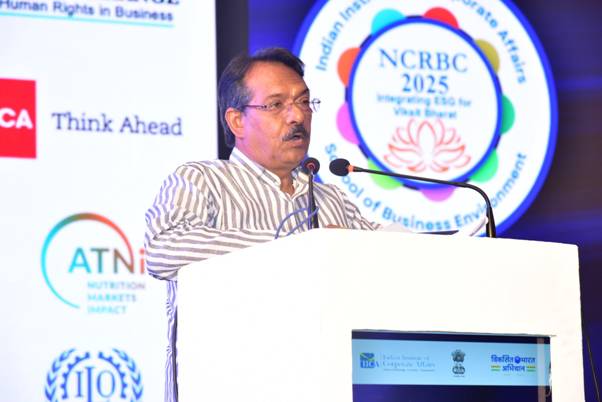
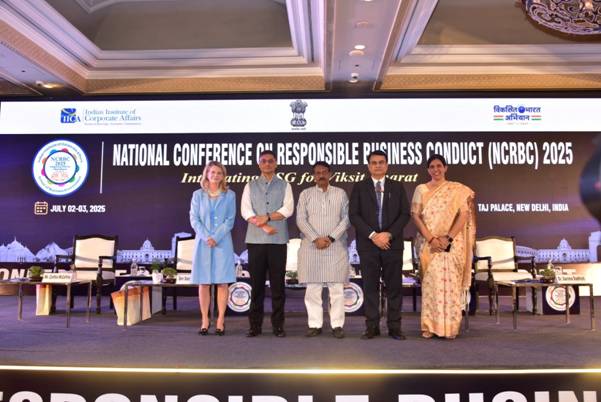
The third edition of the National Conference on Responsible Business Conduct (NCRBC) 2025 was inaugurated by Shri Harsh Malhotra, Minister of State for Corporate Affairs and Road Transport & Highways, Government of India, on 2nd July at the Taj Palace, New Delhi. Organised by the Indian Institute of Corporate Affairs (IICA), an autonomous institution under the Ministry of Corporate Affairs, the two-day flagship national conference is being held under the theme “Integrating ESG for Viksit Bharat.”
WhatsApp Image 2025-07-03 at 11.14.50 AM.jpeg

Addressing a distinguished audience comprising 300 plus senior corporate leaders, ESG (Environmental, Social, and Governance) professionals, policymakers, and international delegates, th Minister emphasised that India is transitioning from a regime of regulatory prosecution to one of trust-based corporate governance. He observed that responsible business conduct is no longer peripheral to business strategy, but foundational. He also asserted that “India is no longer catching up, India is ready to lead”. Reflecting on the spirit of ‘Vasudhaiva Kutumbakam,’ he noted that the Indian approach to ESG is not merely ‘climate-first’ but ‘climate-plus,’ integrating environmental stewardship with social inclusion, ethical governance, and intergenerational equity.

He highlighted several reform milestones of the Ministry, including the introduction of the National Guidelines on Responsible Business Conduct (NGRBC), Business Responsibility and Sustainability Reporting (BRSR), MCA21 Version 3.0 for digital governance, and the decriminalisation of over 180 statutory provisions through the Jan Vishwas Act. Applauding IICA’s contributions in strengthening board ethics and capacity-building, he remarked that the transition from compliance to conscience must be institutionalised across all business forms, including startups, MSMEs, and listed entities alike.

Delivering a special address, Shri Sanjeev Sanyal, Member of the Economic Advisory Council to the Prime Minister of India, brought a historical and analytical lens with his remarks, cautioning against the indiscriminate import and application of subjective ESG metrics, motivated and influenced by the developed world without reference to India’s priorities. He stressed the need for robust, context-specific and just indicators that reflect India’s developmental priorities and aspirations while cautioning against global indices that often undervalue grounded and situational responsible business conduct. Revering to India’s rich Indian history, he observed that Kautilya’s Arthashastra already embedded principles similar to modern ESG ethos, affirming that India possesses a civilisational heritage of ethical governance and responsible conduct. He urged stakeholders to pursue ESG pathways that are not only compliant but economically and socially coherent within India’s unique institutional context.

Thereafter, in her special address, Ms. Cynthia McCaffrey, UNICEF Representative to India, emphasised that ESG frameworks must reflect the lived realities of families and children. She asserted, “ESG is incomplete without healthy children and families,” and called for businesses to align their governance and social strategies with the rights of the youngest and most vulnerable stakeholders. Noting that inclusive development cannot ignore the social foundations of sustainability, she urged corporate actors to integrate child rights, access to nutrition, education, and community resilience deeper into the broader responsible business conduct architecture.

Shri Gyaneshwar Kumar Singh, Director General and CEO of IICA,  delivered a visionary Welcome address, reiterating India’s imperative to develop indigenous ESG frameworks rooted in national development goals. While charting the decade long history of initiating timely actions by Ministry of Corporate Affairs and IICA to strengthen the ESG framework in India, Shri Singh stated that imported templates would prove to be inadequate to address India’s diverse business ecosystem, while suggesting robust, evidence-based strategic models must lead to future ecosystem of both voluntary ESG compliance and transformation. Underscoring IICA’s central role in ESG evidence-based research, policy advocacy, and targeted capacity-building, he affirmed that the Institute is committed to fostering a regulatory culture where trust, accountability, and innovation are mutually reinforcing.
WhatsApp Image 2025-07-03 at 11.14.49 AM.jpeg

Welcoming dignitaries and delegates, Prof. Garima Dadhich, Head of the School of Business Environment at IICA, highlighted the evolution of NCRBC from its first edition on “Embracing ESG in India” to this year’s focus on integration. She noted that “this year marks a shift from awareness to action, from commitment to convergence,” as ESG becomes embedded within India’s broader developmental discourse. She reaffirmed that IICA, through its School of Business Environment, resolves to serve as a national knowledge and action hub for mainstreaming responsible business conduct, developing sector-specific frameworks, and fostering ecosystem-wide collaboration.

Following the inaugural session, Day 1 of the conference featured four high-level thematic panels that explored key dimensions of ESG transformation. The first panel, “The Rise of ESG in the Boardroom,” initiating with a Key note Address from Smt. Ravneet Kaur, Chairperson, Competition Commission of India and National Financial Regulatory Authority (NFRA), brought together eminent representatives from the Mahindra Group, Engineers India Ltd, ICAI, NSE, and ONGC. The discussion focused on embedding ESG into corporate governance structures and strategic oversight, with emphasis on the fiduciary duties of boards in advancing sustainability objectives. The second panel, “Sustainable Finance: Transforming Capital for a Green Future,” examined how financial instruments such as green bonds, sustainability-linked loans, and impact investing are enabling the transition to a low-carbon economy. Participants from SEBI, NABARD, India INX, the Indian Banks’ Association, and CEEW highlighted that capital must now flow toward long-term societal impact, not just quarterly returns. The third session focused on the “Relevance of the EU Corporate Social Due Diligence Directive (CSDDD) for India,” where experts discussed the need for Indian exporters and value chain actors to proactively align with international due diligence standards in order to retain global market access. The final panel of the day, “Envisioning the Workforce of the Future in the Age of Disruptive Trends,” convened leaders from the skill development ecosystem, academia, and industry to explore strategies for integrating ESG into workforce planning, upskilling for green jobs, and designing inclusive employment models for a dynamic economic future.

With substantive participation of over 300 plus senior corporate leaders, ESG professionals, policymakers, and international delegates, and thought-provoking deliberations led by eminent experts, Day 1 of NCRBC 2025 laid a strong foundation for the sessions to follow. The second day will witness further discussions on decarbonising India’s industrial base, advancing sector-specific ESG adoption, aligning BRSR disclosures with global reporting frameworks, and building resilient and sustainable supply chains. A high-level diplomatic panel will engage with ambassadors from key partner countries to deliberate on multilateral cooperation for responsible and equitable economic systems. Therefore, with an elaborate two-day agenda, the IICA’s NCRBC 2025, with support from Ministry of Corporate Affairs and partner organisations such as UNICEF India, Partners-in-Change, ICAI, ACCA, Global Alliance for Improved Nutrition (GAIN), Access to Nutrition Initiative (ATNi), International Labour Organisation (ILO) and Responsible Business Alliance (RBA), aims to position responsible business conduct as integral to India’s journey toward becoming a developed, inclusive, and ethically grounded nation by 2047.

Topics

Acts Income Tax