

Loading...

Top
Help
×

By creating an account you can:

Logo TaxTMI
Call Us / Help / Feedback

Contact Us At :

E-mail: [email protected]

Call / WhatsApp at: +91 99117 96707

For more information, Check Contact Us

FAQs :

To know Frequently Asked Questions, Check FAQs

Most Asked Video Tutorials :

For more tutorials, Check Video Tutorials

Submit Feedback/Suggestion :

Email :
Please provide your email address so we can follow up on your feedback.
Category :
Description :
Min 15 characters 0/2000
Make Most of Text Search
  1. Checkout this video tutorial: How to search effectively on TaxTMI.
  2. Put words in double quotes for exact word search, eg: "income tax"
  3. Avoid noise words such as : 'and, of, the, a'
  4. Sort by Relevance to get the most relevant document.
  5. Press Enter to add multiple terms/multiple phrases, and then click on Search to Search.
  6. Text Search
  7. The system will try to fetch results that contains ALL your words.
  8. Once you add keywords, you'll see a new 'Search In' filter that makes your results even more precise.
  9. Text Search
Add to...
You have not created any category. Kindly create one to bookmark this item!
Create New Category
Hide
Title :
Description :
❮❮ Hide
Default View
Expand ❯❯
Close ✕
🔎 News - Adv. Search
TEXT SEARCH:

Press 'Enter' to add multiple search terms. Rules for Better Search

Search In:
Main Text + AI Text
  • Main Text
  • Main Text + AI Text
  • AI Text
Category: ?
Categorized by AI
---- All Categories ----
  • ---- All Categories ----
  • Income Tax
  • GST
  • Customs, DGFT & SEZ
  • FEMA & RBI
  • Corp. Laws, SEBI & IBC
  • PMLA, Black Money & ED
  • Budget
  • News and Press Release
  • PTI News
Month:
---- All Months ----
  • ---- All Months ----
  • January
  • February
  • March
  • April
  • May
  • June
  • July
  • August
  • September
  • October
  • November
  • December
Year:
---- All Years ----
  • ---- All Years ----
  • 2026
  • 2025
  • 2024
  • 2023
  • 2022
  • 2021
  • 2020
  • 2019
  • 2018
  • 2017
  • 2016
  • 2015
  • 2014
  • 2013
  • 2012
  • 2011
Sort By: ?
In Sort By 'Default', exact matches for text search are shown at the top, followed by the remaining results in their regular order.
Relevance Default Date
    Goyal says India negotiating FTAs with 8-9 more blocs, aims to cover 75 pc of global trade
    Rupee rises 7 paise to 95.64 against US dollar in early trade
    Woman passenger from Sharjah held with undeclared gold chain at Ahmedabad airport
    Delhi: Retired railway employee put under 'digital arrest', duped of Rs 30 lakh; one held
    CPI(M) accuses ED of ‘politically targeting’ Pinarayi Vijayan in CMRL case
    ED arrests ex-Andhra minister K Nageswara Rao in liquor transport 'scam'
    Orris Infrastructure MD Amit Gupta arrested in cheating case
    In a knot: Surat weaving units take voluntary two-day holiday as yarn prices shoot up
    Canada will impose retaliatory tariffs on US goods beginning Sept 8 as trade negotiations collapse
    Trade war between Canada, US deepens rupture in what had been close and durable alliance
    Canada will impose retaliatory tariffs on US good beginning Sept 8
    J-K parties oppose hike in power tarrif
    IAS officer Gangwar not ‘missing’, away in UP over father’s health: Karnataka minister
    J-K Dy CM terms ED case against his brother 'selective targeting'
    T'gana HC CJ calls for timely, expert dispute resolution in telecom, broadcasting, airport sectors
    Latur CA booked for issuing certificates to facilitate remittance of hundreds of crores abroad
    Stock Market for Beginners: How to Start Investing Without Feeling Overwhelmed
    CGST Zone detects clandestine pan masala, tobacco unit, detects tax evasion of Rs 160 cr
    Korea Industry Expo (KoINDEX) 2026 Opens at Yashobhoomi on 27 August
    Protection in predicate offence doesn't automatically extend to PMLA case: Delhi HC
❯❯
Maximize Maximize Maximize
0 / 200
Expand Note
Add to Folder

No Folders have been created

+

Are you sure you want to delete "My most important" ?

NOTE:

News
Showing Results for :
Reset Filters
Results Found:
Show All Summaries Hide All Summaries
August 24, 2026
Show AI Summary
Free trade agreement strategy expands preferential market access and supports India's integration into global value chains and investment partnerships.
India's free trade agreement strategy seeks to expand preferential market access and integrate the country into global value chains as a trusted trading partner. Negotiations with additional country groups and individual nations are intended to extend agreement coverage to a substantial share of global trade. Investment opportunities are identified in data centres, manufacturing and artificial intelligence, alongside an objective of developing more balanced trade relations between India and Japan.
August 24, 2026
Show AI Summary
Foreign exchange market conditions supported rupee appreciation, but crude prices, importer demand and geopolitical sanctions concerns limited gains.
Foreign exchange market conditions supported a modest early appreciation of the rupee against the US dollar due to relative dollar softness. The gain was limited by elevated crude oil prices, importer demand for dollars, and caution over anticipated sanctions affecting Iranian oil trade, banking networks and shipping routes. Currency markets remained sensitive to geopolitical uncertainty and possible wider trade effects.
August 23, 2026
Show AI Summary
Undeclared gold importation led to customs interception, seizure, arrest and continuing investigation after concealment inside passenger clothing.
Customs enforcement against undeclared gold importation involved interception of a passenger arriving from Sharjah at Ahmedabad airport following passenger profiling. A gold chain concealed inside clothing was recovered after it was not declared for customs purposes. The chain was seized and the passenger was arrested under the Customs Act, 1962, before being released on bail, with further investigation continuing.
August 23, 2026
Show AI Summary
Digital arrest cyber fraud used impersonation, forged notices and coercive video calls to obtain transfers through mule accounts.
Digital arrest cyber fraud allegedly used impersonation of law-enforcement and central banking officials, fabricated notices, threats of arrest and continuous video communications to coerce a retired railway employee into disclosing financial details and transferring funds for purported verification. The alleged proceeds were routed through mule and shell accounts. Banking records, KYC details, digital evidence and transaction trails allegedly connected a recipient account with suspicious transactions and multiple cyber-fraud cases; part of the cheated amount was recovered or refunded.
August 23, 2026
Show AI Summary
Political targeting allegations challenge money-laundering enforcement actions, searches, questioning, and public disclosures in the CMRL investigation.
CPI(M) alleges that enforcement action under the Prevention of Money Laundering Act in the CMRL matter is politically motivated targeting of Pinarayi Vijayan, family members and party associates. It contends that searches, questioning and public communications during the investigation were used to create suspicion without incriminating evidence, and characterises references to hawala as a new investigative narrative. The party also alleges selective anti-money-laundering enforcement against opposition leaders and states that the company will address the CMRL-related matter.
August 23, 2026
Show AI Summary
Money-laundering investigation into alleged liquor transport irregularities results in arrests connected with claimed loss to the government exchequer.
Money-laundering proceedings concerning alleged financial irregularities in liquor transport led to the arrest of former Andhra Pradesh minister Karumuri Nageswara Rao under the Prevention of Money Laundering Act. The inquiry concerns alleged wrongful loss to the government exchequer arising from liquor-transport operations. Investigative measures included raids and the arrest of Rao's son, along with arrests of a former state beverages corporation managing director and the person described as the principal accused.
August 23, 2026
Show AI Summary
Alleged LLP record forgery raises cheating, breach of trust and conspiracy concerns over unauthorised partnership interest changes.
Alleged forgery, cheating, criminal breach of trust and conspiracy concern purported unauthorised changes to LLP statutory records filed with the Registrar of Companies. The allegations include use of false documents to remove a nominated partner, substitute another person as partner and transfer a partner's interest in the LLP. The matter also draws attention to separate land-collaboration allegations and delayed possession claims by homebuyers in a halted housing project.
August 23, 2026
Show AI Summary
Voluntary production curtailment addresses polyester yarn cost volatility as weaving units seek customs-duty relief on inputs.
Voluntary production curtailment by weaving units is being adopted in response to increased polyester yarn and related input costs. Units may reduce shifts or observe periodic holidays according to individual commercial feasibility to limit yarn consumption until prices and fabric-market conditions stabilise. Industry representatives allege that yarn-price increases exceed corresponding input-cost movements and seek examination of possible artificial pricing, along with customs-duty relief on yarn and relevant inputs.
August 22, 2026
Show AI Summary
Retaliatory tariffs escalate trade restrictions as historic tariff authority enables duties without prior investigation or a prescribed duration.
Retaliatory tariffs are set to escalate bilateral trade restrictions after the United States imposed tariffs of up to 50 per cent on specified Canadian imports. Canada proposes dollar-for-dollar countermeasures covering sectors including steel, dairy, appliances, agricultural equipment, pulp and paper and electronics. Section 338 of the Tariff Act of 1930 is invoked as the legal basis for the United States measures, permitting presidential import duties up to 50 per cent without a prior investigation or prescribed maximum duration. Escalation creates uncertainty for supply chains and renewal of the United States-Mexico-Canada Agreement.
August 22, 2026
Show AI Summary
Reciprocal tariffs reshape Canada-United States trade relations, increasing supply-chain risks and accelerating Canadian trade diversification beyond its primary export market.
Canada-United States trade relations are described as entering a confrontational phase after tariff negotiations collapsed. The United States imposed tariffs on specified Canadian goods, while Canada committed to reciprocal import taxes and suspended negotiations. The dispute marks a retreat from preferential market access and continental integration. Canada's export dependence on the United States may limit retaliation and increase risks to output, employment, investment and integrated supply chains. Trade diversification, non-United States investment and expanded Pacific export infrastructure are identified as responses to a potentially enduring protectionist bilateral relationship.
August 22, 2026
Show AI Summary
Retaliatory tariffs on United States goods will target key sectors after trade negotiations failed and reciprocal tariff relief was unavailable.
Retaliatory tariffs on United States goods will take effect from 8 September in response to United States tariffs on Canadian products and unsuccessful negotiations. The dollar-for-dollar measures will cover steel, dairy, appliances, agricultural equipment, pulp and paper, and electronics, with product-specific details to follow. Canada had been willing to remove certain retaliatory tariffs if corresponding United States tariffs were substantially reduced, but considered the final demands unacceptable.
August 22, 2026
Show AI Summary
Power tariff revision faces political opposition over increased consumer electricity costs and conflict with prior free-electricity commitments.
Power tariff regulation in Jammu and Kashmir and Ladakh has been revised through approval of an average tariff increase, effective from 1 September 2026. Political representatives have opposed the increase on the ground that it adds to consumer hardship amid unemployment, inflation, and sectoral difficulties. The criticism also contrasts the revised tariff with prior commitments concerning free domestic electricity and gas.
August 22, 2026
Show AI Summary
Recruitment examination integrity prompted enforcement scrutiny and proposed disciplinary inquiry, while an officer's absence was attributed to family emergency.
Reported absence of an IAS officer was attributed to a family medical emergency and a pending leave request, rather than enforcement searches concerning an alleged recruitment-examination scam. The officer denied any connection with those searches and expressed willingness to face an inquiry. Enforcement searches at the Karnataka Public Service Commission concerned a money-laundering investigation into alleged recruitment irregularities. The State Cabinet decided to advise suspension of the commission chairperson and initiation of an inquiry after an earlier suspension was set aside for lacking the Cabinet's aid and advice.
August 22, 2026
Show AI Summary
Money-laundering and benami asset allegations prompt enforcement proceedings, while the accused officer's brother calls the action selective targeting.
Enforcement proceedings under the Prevention of Money Laundering Act concern allegations that suspended police officer Vijay Choudhary managed numerous assets through benami transactions and engaged in money laundering. An Anti-Corruption Bureau FIR had already been registered in relation to the allegations. Surinder Choudhary characterised the action as selective targeting but maintained that investigating agencies and the judiciary should address and decide matters concerning his family.
August 22, 2026
Show AI Summary
Specialised dispute resolution requires technical expertise, timely proceedings, mediation support, and human oversight to safeguard natural justice.
Specialised, timely and effective dispute-resolution mechanisms are necessary for technically complex disputes in telecom, broadcasting, airport tariffs and cyber sectors. Technology may assist legal reasoning but cannot replace judicial reasoning, requiring verification, professional responsibility and meaningful human oversight. Effective specialised adjudication should combine domain expertise with judicial discipline, respond to technical complexity, and protect natural justice, transparency and reasoned decision-making. Mediation and other consensual mechanisms can support dispute resolution.
August 22, 2026
Show AI Summary
Form 15CB certification faces scrutiny where inadequate verification allegedly enables foreign remittances through shell companies and false certificates.
Alleged misuse of Form 15CB certification has resulted in criminal proceedings concerning certificates issued for foreign remittances without verification of underlying documents. Form 15CB requires certification of applicable taxability and tax-deduction particulars for specified remittances to non-residents before processing by an authorised dealer. The allegations concern certificates that potentially enabled cross-border transfers through shell or non-existent companies, involving cheating, false certification, false evidence and common intention.
August 22, 2026
Show AI Summary
Beginner stock market investing requires regulated accounts, risk-aware financial planning, diversification and informed company assessment before purchasing securities.
Beginner stock market investing requires a bank account, a trading or broking account with a SEBI-registered broker, and a Demat account for electronic holding of securities. Investments involve risk of loss and should align with financial goals, time horizon and loss-bearing capacity. Investors should understand primary and secondary markets, distinguish long-term investing from short-term trading, assess companies before purchase, diversify holdings, consider charges, maintain records and avoid borrowed-money investing, rumours and momentum-driven decisions.
August 22, 2026
Show AI Summary
Capacity-based tobacco taxation targets undeclared packing machinery used for clandestine production and clearance without indirect tax payment.
Clandestine manufacture and clearance of pan masala, scented jarda and tobacco products without registration or payment of GST, HSNS Cess and central excise duty was detected through an intelligence-led search. Undeclared Form-Fill-Seal packing machines, workers, finished goods, raw materials, transport vehicles, packing materials and records indicated unaccounted production and clearance. Capacity-based monthly HSNS Cess for pan masala is computed according to the number, type and capacity of installed packing machines, while a corresponding capacity-based central excise levy applies to chewing tobacco, jarda and gutkha.
August 22, 2026
Show AI Summary
Trade exhibition connects Korean exporters with Indian buyers through sector-specific consultations and certification guidance for market entry.
KoINDEX 2026 is a business-to-business trade exhibition bringing Korean manufacturers and exporters together with buyers in India and South Asia. It focuses on beauty and personal-care products, processed and functional foods, and construction, building and safety products. Commercial engagement includes pre-matched export consultations with project owners, contractors, distributors, wholesalers, e-commerce platforms and food distribution businesses. A seminar addresses Bureau of Indian Standards certification and market-entry requirements for Korean products entering the Indian market.
August 22, 2026
Show AI Summary
Independent PMLA proceedings require separate anticipatory bail assessment; predicate-offence protection alone cannot establish pre-arrest protection.
Protection in a predicate-offence FIR does not automatically extend to independent PMLA proceedings. Anticipatory bail in a money-laundering investigation must be assessed under the applicable PMLA condition and on the material connecting the applicant to alleged proceeds of crime. Relevant considerations include the financial trail, recorded statements, bank-account analysis, compliance with summonses, cooperation with inquiry, and the need for personal participation in evidence collection and confrontation with documentary and digital material.

News

Back

All News

Showing Results for :
Reset Filters
No Records Found

News

Back

All News

Showing Results for : Reset Filters
Customs, DGFT & SEZ

India's Retail Inflation Hits Six-Year Low

April 16, 2025

Contents
Summary
Note

Note

-

Bookmark

Print

Print

2024-25 Retail Inflation Drops to 4.6%, March Sees YoY Dip to 3.34%

Introduction

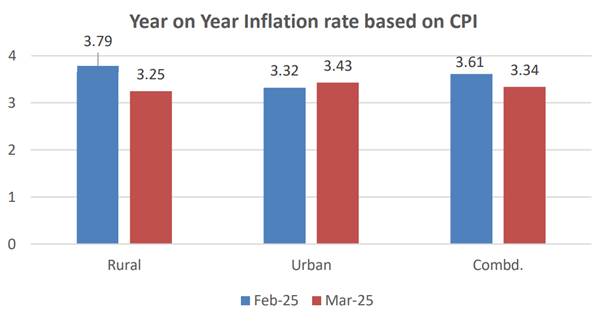
Retail inflation in India, as measured by the Consumer Price Index (CPI), which reflects the cost of everyday goods and services, fell to a remarkable 4.6% in the fiscal year 2024-25, the lowest since 2018-19. This milestone highlights the effectiveness of the Reserve Bank of India’s pro-growth monetary policy, which has successfully balanced economic expansion with price stability. Notably, the year-on-year inflation rate for March 2025 dropped to 3.34%, a decline of 27 basis points from February 2025, marking the lowest monthly inflation rate since August 2019. These figures demonstrate a sustained effort to curb price rises while fostering economic growth.
The government’s strategic interventions have been pivotal in achieving this outcome. Key measures include bolstering buffer stocks of essential food items and releasing them periodically in open markets, alongside subsidised retail sales of staples like rice, wheat flour, pulses, and onions. Simplified import duties on critical food items, stricter stock limits to prevent hoarding, and reduced GST rates on essentials have further eased price pressures. Targeted subsidies, such as LPG support under the Pradhan Mantri Ujjwala Yojana and the Pradhan Mantri Garib Kalyan Anna Yojana, have protected vulnerable households from rising food grain costs, ensuring that the benefits of lower inflation reach those who need it most.

What is Consumer Price Index?

The Consumer Price Index (CPI) is one of the most important economic indicators used to measure changes in the general level of retail prices over time. It reflects how much households need to spend on a fixed basket of goods and services they typically consume, such as food, clothing, housing, and fuel. In India, the CPI is compiled by the National Statistical Office (NSO) under the Ministry of Statistics and Programme Implementation (MoSPI) and is currently calculated using the base year 2012. By tracking the cost of this basket over time, the CPI shows how prices rise or fall, affecting the purchasing power of consumers and their overall welfare.

The CPI measures price changes by comparing the current cost of this fixed basket of goods and services to what it cost in a previous period. Since the contents of the basket are kept constant in terms of quantity and quality, any change in the index reflects only the change in prices. When prices increase, the CPI goes up, signalling inflation; when they fall, the CPI declines, indicating lower inflation or deflation.

Originally, CPI figures were developed to track changes in the cost of living for workers so that their wages could be adjusted in line with price movements. Over time, however, the CPI has evolved into a widely used macroeconomic tool. It is now a key benchmark for targeting inflation, monitoring price stability, and guiding monetary policy decisions by the Reserve Bank of India (RBI). It also serves as a deflator in the National Accounts to measure real economic growth.

In India, along with the general CPI (CPI–Combined), segment-specific indices are also published to cater to different population groups:

  • CPI (IW) – Consumer Price Index for Industrial Workers
  • CPI (AL) – Consumer Price Index for Agricultural Labourers
  • CPI (RL) – Consumer Price Index for Rural Labourers

These indices help in wage revisions, rural planning, and understanding inflation trends in specific segments of the population.

Key Highlights for March 2025

  • Food Inflation: The year-on-year food inflation based on the Consumer Food Price Index (CFPI) stood at 2.69% in March 2025, the lowest since November 2021. This marks a sharp decline of 106 basis points from the previous month.
  • Rural food inflation: 2.82%
  • Urban food inflation: 2.48%
  • Drivers of Decline: The overall moderation in food prices was led by a drop in inflation across key categories such as vegetables, eggs, pulses and products, meat and fish, cereals and products, and milk and products.
  • Rural Inflation: A notable fall was recorded in both headline and food inflation in rural areas.
  • Headline inflation fell from 3.79% in February to 3.25% in March
  • Food inflation dropped from 4.06% to 2.82%
  • Urban Inflation: Headline inflation in urban areas saw a marginal rise to 3.43% in March, up from 3.32% in February. However, food inflation declined significantly from 3.15% to 2.48%.
  • Housing Inflation: For the urban sector, housing inflation rose slightly to 3.03% in March 2025 from 2.91% in February.
  • Fuel & Light: Inflation in this category rebounded to 1.48% in March from -1.33% in February, covering both rural and urban areas.
  • Education Inflation: A moderate increase was noted in education-related inflation, rising to 3.98% from 3.83% the previous month.
  • Health Inflation: Prices in the health segment saw a mild rise, with inflation at 4.26% in March, up from 4.12% in February.
  • Transport & Communication: Inflation in this category increased to 3.30% in March 2025 compared to 2.93% in February.
  • Items with Highest Inflation: In March 2025, the top five items with the highest year-on-year inflation were coconut oil (56.81%), coconut (42.05%), gold (34.09%), silver (31.57%), and grapes (25.55%).
  • Items with Lowest Inflation: The items witnessing the steepest decline in prices were ginger (-38.11%), tomato (-34.96%), cauliflower (-25.99%), jeera (-25.86%), and garlic (-25.22%).

Retail Inflation Eases for Third Year in a Row

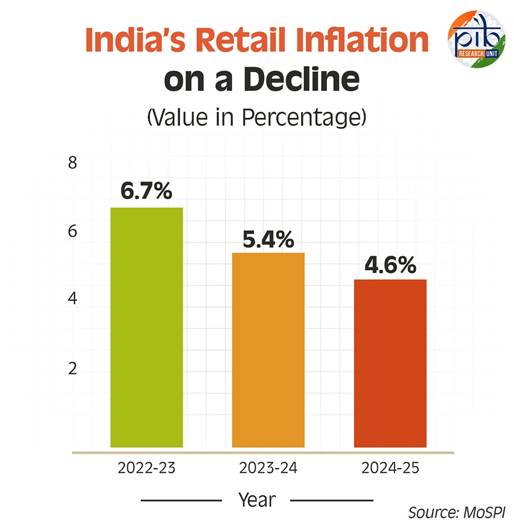
Retail inflation in India has followed a steady downward path over the past three financial years, falling from 6.7 percent in 2022–23 to 5.4 percent in 2023–24, and further to 4.6 percent in 2024–25. This consistent moderation highlights the combined impact of the Reserve Bank of India’s calibrated monetary policy and the Government of India’s focused interventions to ease supply-side constraints and stabilise prices of essential commodities. The declining trend has helped ease cost-of-living pressures and fostered a more stable environment for economic growth.
From High Prices to Stability: A Decade of Inflation Control

Between 2009–10 and 2013–14, India faced a prolonged period of high inflation, with the average annual rate remaining in double digits. Households across the country bore the brunt of steep increases in food and fuel prices, which eroded purchasing power and created a challenging environment for both consumers and businesses. Looking at a broader timeframe, the average annual inflation between 2004–05 and 2013–14 stood at 8.2 percent, reflecting a decade marked by considerable volatility in retail prices.
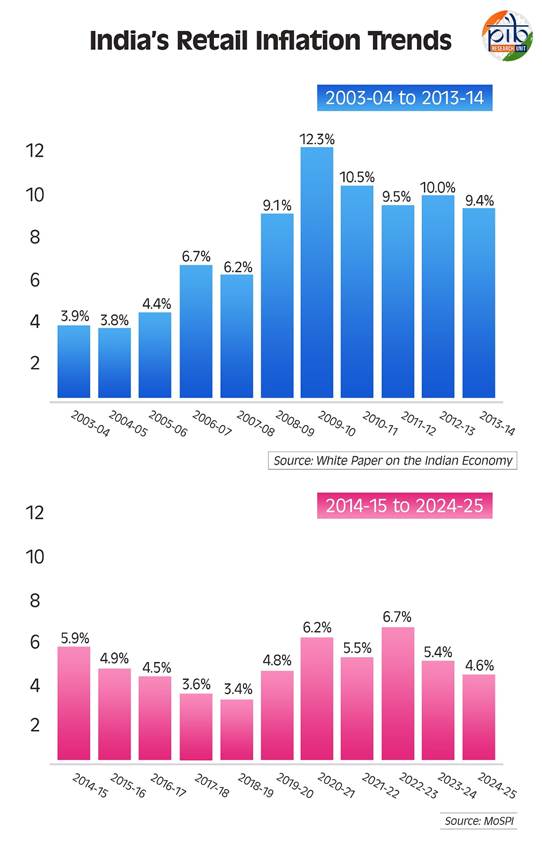
In sharp contrast, the ten-year period from 2015–16 to 2024–25 witnessed a marked decline in inflationary pressures, with the average rate coming down to 5 percent. This significant moderation reflects the sustained efforts of both the Government and the Reserve Bank of India to improve price stability through better supply-side management, fiscal prudence, and inflation-targeting monetary policy. The shift from a high-inflation era to a more stable pricing environment has provided greater certainty for consumers and strengthened the foundation for long-term economic growth.

Conclusion

In conclusion, the steady decline in retail inflation over recent years marks a crucial milestone in India’s economic journey, reflecting the success of coordinated efforts by the Government of India. From proactive monetary policies to targeted fiscal measures that safeguard consumers, especially the vulnerable, from volatile price swings, the approach has been both inclusive and effective. With inflation now at its lowest since 2018–19, India has not only reinforced macroeconomic stability but also created an enabling environment for sustainable growth. This trajectory underscores the country’s resilience and commitment to ensuring price stability without compromising on development goals.

References:

Topics

Acts Income Tax