

Just a moment...

Top
Help
Upgrade to AI Search

We've upgraded AI Search on TaxTMI with two powerful modes:

1. Basic
Quick overview summary answering your query with referencesCategory-wise results to explore all relevant documents on TaxTMI

2. Advanced
• Includes everything in Basic
Detailed report covering:
     -   Overview Summary
     -   Governing Provisions [Acts, Notifications, Circulars]
     -   Relevant Case Laws
     -   Tariff / Classification / HSN
     -   Expert views from TaxTMI
     -   Practical Guidance with immediate steps and dispute strategy

• Also highlights how each document is relevant to your query, helping you quickly understand key insights without reading the full text.Help Us Improve - by giving the rating with each AI Result:

Explore AI Search

Powered by Weblekha - Building Scalable Websites

×

By creating an account you can:

Logo TaxTMI
>
Call Us / Help / Feedback

Contact Us At :

E-mail: [email protected]

Call / WhatsApp at: +91 99117 96707

For more information, Check Contact Us

FAQs :

To know Frequently Asked Questions, Check FAQs

Most Asked Video Tutorials :

For more tutorials, Check Video Tutorials

Submit Feedback/Suggestion :

Email :
Please provide your email address so we can follow up on your feedback.
Category :
Description :
Min 15 characters0/2000
Make Most of Text Search
  1. Checkout this video tutorial: How to search effectively on TaxTMI.
  2. Put words in double quotes for exact word search, eg: "income tax"
  3. Avoid noise words such as : 'and, of, the, a'
  4. Sort by Relevance to get the most relevant document.
  5. Press Enter to add multiple terms/multiple phrases, and then click on Search to Search.
  6. Text Search
  7. The system will try to fetch results that contains ALL your words.
  8. Once you add keywords, you'll see a new 'Search In' filter that makes your results even more precise.
  9. Text Search
Add to...
You have not created any category. Kindly create one to bookmark this item!
Create New Category
Hide
Title :
Description :
❮❮ Hide
Default View
Expand ❯❯
Close ✕
🔎 News - Adv. Search
TEXT SEARCH:

Press 'Enter' to add multiple search terms. Rules for Better Search

Search In:
Main Text + AI Text
  • Main Text
  • Main Text + AI Text
  • AI Text
Category: ?
Categorized by AI
---- All Categories ----
  • ---- All Categories ----
  • Income Tax
  • GST
  • Customs, DGFT & SEZ
  • FEMA & RBI
  • Corp. Laws, SEBI & IBC
  • PMLA, Black Money & ED
  • Budget
  • News and Press Release
  • PTI News
Month:
---- All Months ----
  • ---- All Months ----
  • January
  • February
  • March
  • April
  • May
  • June
  • July
  • August
  • September
  • October
  • November
  • December
Year:
---- All Years ----
  • ---- All Years ----
  • 2026
  • 2025
  • 2024
  • 2023
  • 2022
  • 2021
  • 2020
  • 2019
  • 2018
  • 2017
  • 2016
  • 2015
  • 2014
  • 2013
  • 2012
  • 2011
Sort By: ?
In Sort By 'Default', exact matches for text search are shown at the top, followed by the remaining results in their regular order.
RelevanceDefaultDate
    No Records Found
    ❯❯
    MaximizeMaximizeMaximize
    0 / 200
    Expand Note
    Add to Folder

    No Folders have been created

      +

      Are you sure you want to delete "My most important" ?

      NOTE:

      News
      Showing Results for :
      Reset Filters
      Results Found:
      AI TextQuick Glance by AIHeadnote
      Show All SummariesHide All Summaries
      No Records Found

      News

      Back

      All News

      Showing Results for :
      Reset Filters
      Showing
      Records
      ExpandCollapse
        No Records Found

        News

        Back

        All News

        Showing Results for : Reset Filters
        Case ID :
        Customs, DGFT & SEZ

        India's Retail Inflation Hits Six-Year Low

        April 16, 2025

        📋
        Contents
        Note

        Note

        -

        Bookmark

        print

        Print

        Login to TaxTMI
        Verification Pending

        The Email Id has not been verified. Click on the link we have sent on

        Didn't receive the mail? Resend Mail

        Don't have an account? Register Here

        2024-25 Retail Inflation Drops to 4.6%, March Sees YoY Dip to 3.34%

        Introduction

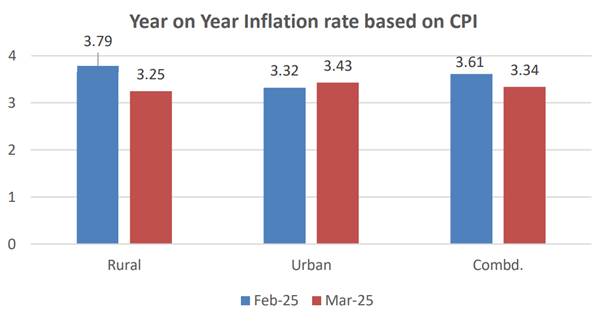
        Retail inflation in India, as measured by the Consumer Price Index (CPI), which reflects the cost of everyday goods and services, fell to a remarkable 4.6% in the fiscal year 2024-25, the lowest since 2018-19. This milestone highlights the effectiveness of the Reserve Bank of India’s pro-growth monetary policy, which has successfully balanced economic expansion with price stability. Notably, the year-on-year inflation rate for March 2025 dropped to 3.34%, a decline of 27 basis points from February 2025, marking the lowest monthly inflation rate since August 2019. These figures demonstrate a sustained effort to curb price rises while fostering economic growth.
        The government’s strategic interventions have been pivotal in achieving this outcome. Key measures include bolstering buffer stocks of essential food items and releasing them periodically in open markets, alongside subsidised retail sales of staples like rice, wheat flour, pulses, and onions. Simplified import duties on critical food items, stricter stock limits to prevent hoarding, and reduced GST rates on essentials have further eased price pressures. Targeted subsidies, such as LPG support under the Pradhan Mantri Ujjwala Yojana and the Pradhan Mantri Garib Kalyan Anna Yojana, have protected vulnerable households from rising food grain costs, ensuring that the benefits of lower inflation reach those who need it most.

        What is Consumer Price Index?

        The Consumer Price Index (CPI) is one of the most important economic indicators used to measure changes in the general level of retail prices over time. It reflects how much households need to spend on a fixed basket of goods and services they typically consume, such as food, clothing, housing, and fuel. In India, the CPI is compiled by the National Statistical Office (NSO) under the Ministry of Statistics and Programme Implementation (MoSPI) and is currently calculated using the base year 2012. By tracking the cost of this basket over time, the CPI shows how prices rise or fall, affecting the purchasing power of consumers and their overall welfare.

        The CPI measures price changes by comparing the current cost of this fixed basket of goods and services to what it cost in a previous period. Since the contents of the basket are kept constant in terms of quantity and quality, any change in the index reflects only the change in prices. When prices increase, the CPI goes up, signalling inflation; when they fall, the CPI declines, indicating lower inflation or deflation.

        Originally, CPI figures were developed to track changes in the cost of living for workers so that their wages could be adjusted in line with price movements. Over time, however, the CPI has evolved into a widely used macroeconomic tool. It is now a key benchmark for targeting inflation, monitoring price stability, and guiding monetary policy decisions by the Reserve Bank of India (RBI). It also serves as a deflator in the National Accounts to measure real economic growth.

        In India, along with the general CPI (CPI–Combined), segment-specific indices are also published to cater to different population groups:

        • CPI (IW) – Consumer Price Index for Industrial Workers
        • CPI (AL) – Consumer Price Index for Agricultural Labourers
        • CPI (RL) – Consumer Price Index for Rural Labourers

        These indices help in wage revisions, rural planning, and understanding inflation trends in specific segments of the population.

        Key Highlights for March 2025

        • Food Inflation: The year-on-year food inflation based on the Consumer Food Price Index (CFPI) stood at 2.69% in March 2025, the lowest since November 2021. This marks a sharp decline of 106 basis points from the previous month.
        • Rural food inflation: 2.82%
        • Urban food inflation: 2.48%
        • Drivers of Decline: The overall moderation in food prices was led by a drop in inflation across key categories such as vegetables, eggs, pulses and products, meat and fish, cereals and products, and milk and products.
        • Rural Inflation: A notable fall was recorded in both headline and food inflation in rural areas.
        • Headline inflation fell from 3.79% in February to 3.25% in March
        • Food inflation dropped from 4.06% to 2.82%
        • Urban Inflation: Headline inflation in urban areas saw a marginal rise to 3.43% in March, up from 3.32% in February. However, food inflation declined significantly from 3.15% to 2.48%.
        • Housing Inflation: For the urban sector, housing inflation rose slightly to 3.03% in March 2025 from 2.91% in February.
        • Fuel & Light: Inflation in this category rebounded to 1.48% in March from -1.33% in February, covering both rural and urban areas.
        • Education Inflation: A moderate increase was noted in education-related inflation, rising to 3.98% from 3.83% the previous month.
        • Health Inflation: Prices in the health segment saw a mild rise, with inflation at 4.26% in March, up from 4.12% in February.
        • Transport & Communication: Inflation in this category increased to 3.30% in March 2025 compared to 2.93% in February.
        • Items with Highest Inflation: In March 2025, the top five items with the highest year-on-year inflation were coconut oil (56.81%), coconut (42.05%), gold (34.09%), silver (31.57%), and grapes (25.55%).
        • Items with Lowest Inflation: The items witnessing the steepest decline in prices were ginger (-38.11%), tomato (-34.96%), cauliflower (-25.99%), jeera (-25.86%), and garlic (-25.22%).

        Retail Inflation Eases for Third Year in a Row

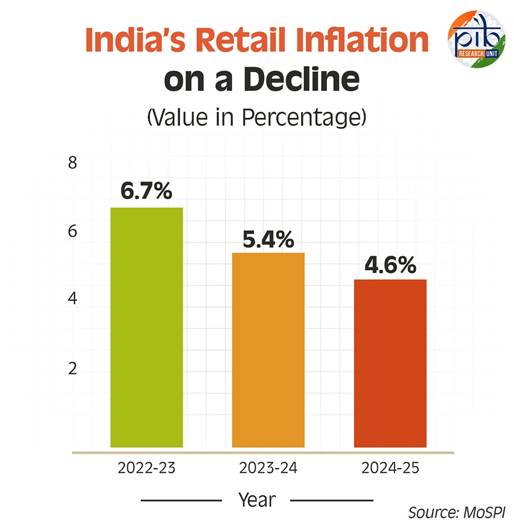
        Retail inflation in India has followed a steady downward path over the past three financial years, falling from 6.7 percent in 2022–23 to 5.4 percent in 2023–24, and further to 4.6 percent in 2024–25. This consistent moderation highlights the combined impact of the Reserve Bank of India’s calibrated monetary policy and the Government of India’s focused interventions to ease supply-side constraints and stabilise prices of essential commodities. The declining trend has helped ease cost-of-living pressures and fostered a more stable environment for economic growth.
        From High Prices to Stability: A Decade of Inflation Control

        Between 2009–10 and 2013–14, India faced a prolonged period of high inflation, with the average annual rate remaining in double digits. Households across the country bore the brunt of steep increases in food and fuel prices, which eroded purchasing power and created a challenging environment for both consumers and businesses. Looking at a broader timeframe, the average annual inflation between 2004–05 and 2013–14 stood at 8.2 percent, reflecting a decade marked by considerable volatility in retail prices.
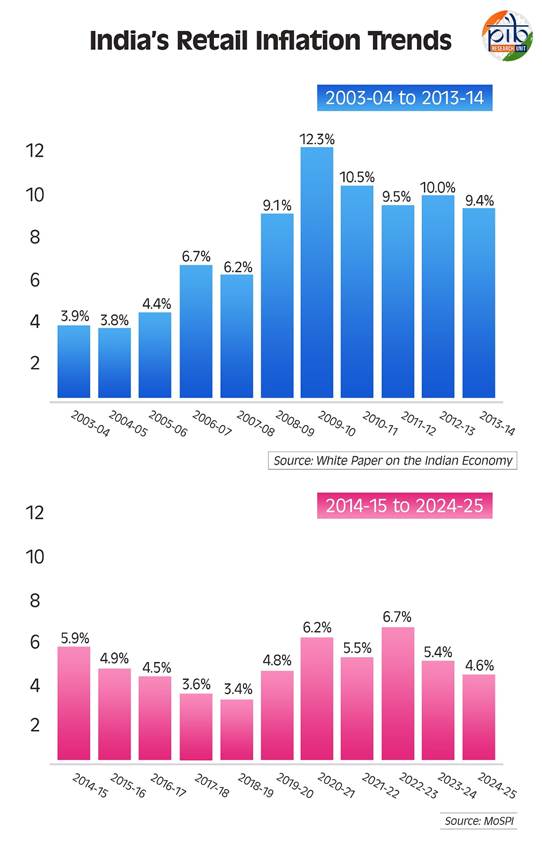
        In sharp contrast, the ten-year period from 2015–16 to 2024–25 witnessed a marked decline in inflationary pressures, with the average rate coming down to 5 percent. This significant moderation reflects the sustained efforts of both the Government and the Reserve Bank of India to improve price stability through better supply-side management, fiscal prudence, and inflation-targeting monetary policy. The shift from a high-inflation era to a more stable pricing environment has provided greater certainty for consumers and strengthened the foundation for long-term economic growth.

        Conclusion

        In conclusion, the steady decline in retail inflation over recent years marks a crucial milestone in India’s economic journey, reflecting the success of coordinated efforts by the Government of India. From proactive monetary policies to targeted fiscal measures that safeguard consumers, especially the vulnerable, from volatile price swings, the approach has been both inclusive and effective. With inflation now at its lowest since 2018–19, India has not only reinforced macroeconomic stability but also created an enabling environment for sustainable growth. This trajectory underscores the country’s resilience and commitment to ensuring price stability without compromising on development goals.

        References:

        Retail inflation eases, reflecting sustained price stability from coordinated monetary policy and supply side interventions. Retail inflation moderated to a multi year low in fiscal 2024 25, driven by coordinated monetary policy and government supply side measures. Key interventions included buffer stock management and periodic releases, subsidised retail sales of staples, simplified import duties, stock limits to prevent hoarding, reduced indirect taxes on essentials, and targeted subsidies protecting vulnerable households. March data showed marked easing in food inflation across rural and urban segments, while sectoral categories exhibited mixed movements; the trend reflects a multi year decline in inflationary pressures supported by demand and supply management.
                          Cases where this provision is explicitly mentioned in the judgment/order text; may not be exhaustive. To view the complete list of cases mentioning this section, Click here.
                            Provisions expressly mentioned in the judgment/order text.

                                Retail inflation eases, reflecting sustained price stability from coordinated monetary policy and supply side interventions.

                                Retail inflation moderated to a multi year low in fiscal 2024 25, driven by coordinated monetary policy and government supply side measures. Key interventions included buffer stock management and periodic releases, subsidised retail sales of staples, simplified import duties, stock limits to prevent hoarding, reduced indirect taxes on essentials, and targeted subsidies protecting vulnerable households. March data showed marked easing in food inflation across rural and urban segments, while sectoral categories exhibited mixed movements; the trend reflects a multi year decline in inflationary pressures supported by demand and supply management.


                                Note: It is a system-generated summary and is for quick reference only.

                                Topics

                                ActsIncome Tax
                                No Records Found