TaxTMI
 Login
 TaxTMI
Login
Loading...
Press 'Enter' to add multiple search terms. Rules for Better Search

Press 'Enter' after typing page number.
Press 'Enter' after typing page number.


No Folders have been created
Are you sure you want to delete "My most important" ?
NOTE:
Press 'Enter' after typing page number.
Press 'Enter' after typing page number.

All News
Press 'Enter' after typing page number.
All News

Note

Bookmark

Share


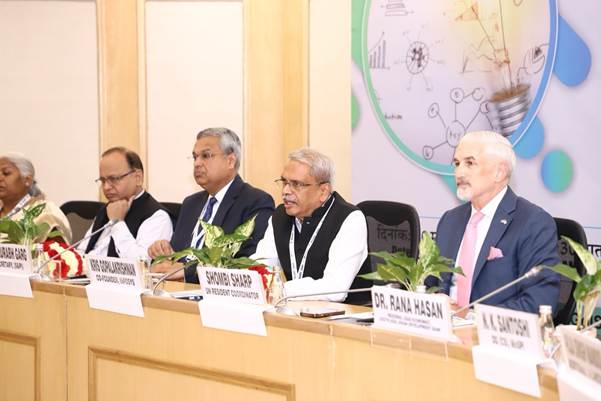
The brainstorming session on Leveraging Non-Conventional Data Sources for Official Statistics, of Ministry of Statistics and Programme Implementation (MoSPI), was concluded on 20th March, 2025 at Vigyan Bhawan, New Delhi.
The inaugural session of the event was addressed by Sri Kris Gopalakrishnan, Chairman Axilor Ventures and Co-founder of Infosys, Sri Rana Hasan, Regional Lead Economist, South Asia, Asian Development Bank (ADB), Sri Shombi Sharp, UN Resident Coordinator (UNRC), and Dr. Saurabh Garg, Secretary, Ministry of Statistics and Programme Implementation.
Sri Kris Gopalakrishnan, one of the co-founders of Infosys, Chairman, The Council, IISc Bangalore, and the Chairman, Board of Governors of IIIT, Bangalore, in his keynote address, underpinned the importance of the non-conventional data by citing success of Aadhar, primarily developed as a tool of citizen services, however, now used for developing various applications. He said that in view of India’s tremendous potential in technology, it can lead from front in respect of using non-conventional datasets for decision making.
He impressed upon the need of standardization of various datasets, strengthening data processing capabilities, and developing data governance framework. He emphasized further that there is a need for evolving a framework enabling access to private data, legally backed and for rightful usages. In addition, he underlined that there is a need of fostering data literacy amongst all stakeholders so that the non-conventional sources are effectively used. Further, he opined that a single source of data would empower not only to the data producers but also to the entrepreneurs. He concluded by stating that the deliberations like this would strengthen formalizing the non-conventional data sources.
Dr. Saurabh Garg, Secretary, MoSPI, impressed upon the importance of such sessions for encouraging a concerted effort of all stakeholders for the optimal usages of available in the ecosystem. He urged upon the representatives of the Central Ministries/Departments, including the Statistical Advisors to explore the possibility of reusing datasets generated by the other agencies. Further, he also mentioned that the culture of data sharing, however, maintaining the sanctity of Personally Identifiable Information (PII) must be fostered in the working of all the stakeholders.
Sri Shombi Sharp, UNRC in his address shared some best practices regarding the citizen generated data and their usages in the official statistics especially in achieving the SDGs. Besides, he also emphasized upon a greater collaboration amongst the stakeholders to capitalize the full potentials of all possible alternate datasets.
Sri Rana Hasan in his presentation demonstrated the power of combining various datasets for an improved decision making. He noted that the cities are hubs of growth and innovation, and thus India’s ongoing urbanization should be appropriately leveraged. He observed further that since the industrial parks are affecting neighboring settlements, they should be catalysed for structural transformation.
The first technical session invited presentations from Shri. M. C. Gaur, Addl. Surveyor General (NZ), Survey of India; Shri. Ayago Wambile, Senior Economist, World Bank; Prof. Bappaditya Mukhopadhyay, Expert in Analytics, Great Lakes Institute of Management, New Delhi; and Shri. Ankur Bansal, Founder, GDi Partners. This session was moderated by Sh. P. R. Meshram, Director General (Data Governance), MoSPI.
Sh. Gaur from Survey of India, in his presentation, highlighted the relevance of linking statistical data to geospatial locations and making the same easily accessible to various data users. While Shri. Wambile from World Bank, spoke about different non-traditional data sources such as, scanner data, mobile phone data, etc that can be leveraged to supplement the official statistical data in the country. Prof Mukhopadhyay from Great Lakes Institute of Management, presented a specific use case of using satellite data to assess SDG at district and sub-district levels over time. Shri Bansal from GDi Partners thereafter, brought attention to objectives, challenges, and potential way forward of using non-traditional data sources along with illustrations of use of such data sets by NSOs across the world.
The second technical session invited presentations from Ms. Tanusree Deb Barma, Deputy Director General, UIDAI, M/o Electronics and Technology; Prof. Shalabh, Professor of Statistics & Data Science, IIT Kanpur; Shri Srinivasa Rao Sitiraju, DD, BGWSA, NRSC, Department of Space, ISRO; and Dr. Karan Nagpal, India Regional Director, IDinsight, New Delhi, India. The session was moderated by Ms. Geeta Singh Rathore, Director General (NSS), MoSPI.
Ms. Tansuree from M/o Electronics and Technology, provided an overview of the Aadhar Ecosystem and presented areas where non-traditional data is being used for authentication of data, identification of bugs, etc. Further, Shri Sitiraju from ISRO, presented various types and aspects of Geospatial data being collected by ISRO and products built using them within the official data ecosystem. Dr. Shalabh from IIT Kanpur, thereafter, presented a specific use case of grievance redressal mechanism leveraging emerging technologies for deriving insights from grievance data collected by Government of India, while Dr. Nagpal from IDinsight presented various use cases of alternative datasets and their usages in generating macro indicators. He, specifically, discussed various usages in price data in official statistics.
The event has been attended by around 150 delegates, ranging representations from the central Ministries/Departments, UN agencies, Think Tanks, Independent organisations, and Universities and research institutions.
The deliberations of the brainstorming session would be a sine qua non for the data innovation involving tapping into alternative data gathered from new or non-conventional data sources and combining and enhancing existing data sources with that new data to gain additional insights.
One of the significant takeaways of the brainstorming session is that the digital revolution provides abundant opportunities to improve the way services are delivered, including harnessing valuable data and insights into products, services, and customer behaviors. Such data innovations are rapidly changing institutions and the data sources available to them. A well-designed intertwining of various data sources may provide better comprehension resulting into improved health care system, Strong supply chains and logistics, Convenient travel, Smart farming, and a transparent FinTech ecosystem.
Further, it was discussed that the Ministries/Departments may use the alternative datasets for the real time monitoring and tracking the decision variables. In addition, it also emerged that the Ministries/Departments may make available Alternative/Administrative datasets to various stakeholders so that their integration with Census/Survey data may become possible. Besides, it emerged that there should be concerted efforts of all the stakeholders for creation of enabling environment so that all possible data sources, Conventional and Non-Conventional are used for decision making.