 TaxTMI
 Login
 TaxTMI
Login
Loading...
Press 'Enter' to add multiple search terms. Rules for Better Search

Press 'Enter' after typing page number.
Press 'Enter' after typing page number.


No Folders have been created
Are you sure you want to delete "My most important" ?
NOTE:
Press 'Enter' after typing page number.
Press 'Enter' after typing page number.

All News
Press 'Enter' after typing page number.
All News

Note

Bookmark

Share


Transforming India into a Global Manufacturing PowerhouseIntroduction
Launched on September 25, 2014, by Prime Minister Narendra Modi, the "Make in India" initiative is completing 10 years as a pivotal step in India's nation-building efforts. On the occasion, Prime Minister Shri Narendra Modi expressed in his blog that “Today is an occasion to salute each and every one of you who has made this initiative a roaring success. Each of you is a pioneer, visionary and innovator, whose tireless efforts have fuelled the success of ‘Make in India’ and thereby made our nation the focus of global attention as well as curiosity. It is the collective drive, relentless in nature, which has transformed a dream into a powerful movement. The impact of ‘Make in India’ shows that Bharat is unstoppable.”
Union Minister of Commerce and Industry, Shri Piyush Goyal, celebrated the 10th anniversary of the "Make in India" initiative, noting significant progress in manufacturing, increased investments, and job creation. He pointed to improvements in ease of doing business, driven by digitization and procedural simplifications, and emphasized India's rise as the world's second-largest mobile phone manufacturer. The minister credited zero tolerance for corruption and targeted sectoral efforts for attracting both domestic and international investments. Looking ahead, he expressed confidence in further growth in the manufacturing sector and its contribution to the economy. He said "We are seeing very big investment plans on the anvil which will create millions of jobs and expand our manufacturing contribution to the economy."
The initiative was conceived during a period when India's economic growth had sharply declined, and the country faced critical challenges in sustaining its development trajectory. Against this backdrop, "Make in India" was designed to transform India into a global hub for design and manufacturing. Its core objectives were to facilitate investment, encourage innovation, and develop world-class infrastructure. As one of the pioneering 'Vocal for Local' initiatives, it sought not only to boost India's manufacturing capabilities but also to showcase its industrial potential on a global stage.
The initiative’s focus on developing a robust manufacturing sector promises to elevate India's economic trajectory and generate employment opportunities for its vast young workforce. Now, with the "Make in India 2.0" phase encompassing 27 sectors, the program continues to drive forward with significant achievements and renewed vigour, reinforcing India's position as a major player in the global manufacturing landscape.
Sectors Under ‘Make in India’ Initiative
| Manufacturing Sectors | Service Sectors |
| Aerospace and Defence | Information Technology & Information Technology enabled Services (IT &ITeS) |
| Automotive and Auto Components | Tourism and Hospitality Services |
| Pharmaceuticals and Medical Devices | Medical Value Travel |
| Bio-Technology | Transport and Logistics Services |
| Capital Goods | Accounting and Finance Services |
| Textile and Apparels | Audio Visual Services |
| Chemicals and Petro chemicals | Legal Services |
| Electronics System Design and Manufacturing (ESDM) | Communication Services |
| Leather & Footwear | Construction and Related Engineering Services |
| Food Processing | Environmental Services |
| Gems and Jewellery | Financial Services |
| Shipping | Education Services |
| Railways |
|
| Construction |
|
| New and Renewable Energy |
|
Pillars of ‘Make in India’
Major Initiatives Taken to Enable Make in India
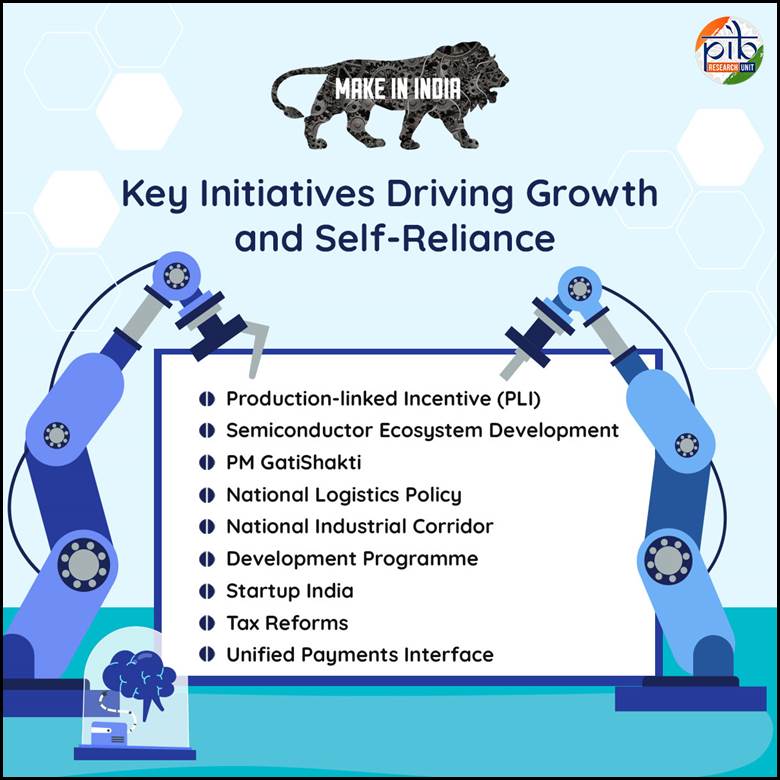
"Make in India" initiative has been a cornerstone in transforming India into a global manufacturing hub. With a strong focus on enhancing industrial capabilities, fostering innovation, and creating world-class infrastructure, the initiative aims to position India as a key player in the global economy. Supported by major programs like Production Linked Incentive (PLI) Schemes, PM GatiShakti, the National Logistics Policy, and comprehensive tax reforms like the Goods and Services Tax (GST), "Make in India" continues to drive economic growth, job creation, and global competitiveness.
Production linked Incentive (PLI) Schemes
Aligned with India’s vision of becoming 'Atmanirbhar' (self-reliant), the Production Linked Incentive (PLI) Schemes were introduced to enhance the country’s manufacturing capabilities and boost exports. With an impressive outlay of ₹1.97 lakh crore (over US$26 billion), these schemes cover 14 key sectors aimed at fostering investment in cutting-edge technology and promoting global competitiveness.
The 14 sectors covered under the PLI Scheme include:
The primary goals of the PLI Schemes are to attract substantial investments, incorporate advanced technology, and ensure operational efficiency. By fostering economies of scale and enhancing global competitiveness, these schemes are expected to significantly boost production, stimulate manufacturing activities, and contribute to economic growth over the coming years.
As of July 30, 2024, 755 applications have been approved across these sectors, leading to an investment realization of ₹1.23 lakh crore by March 2024. This investment has generated employment for approximately 8 lakh individuals, marking a significant stride towards achieving the objectives of the PLI Scheme.
PM GatiShakti
Launched on October 13, 2021, PM GatiShakti is a strategic initiative aimed at achieving Aatmanirbhar Bharat and a US $5 trillion economy by 2025 through the creation of multimodal and last-mile connectivity infrastructure. The program addresses the need for efficient transportation by promoting holistic planning and coordination among 36 Ministries/Departments, integrating progress, and synchronizing project implementation. By enhancing logistics efficiency and bridging critical infrastructure gaps, PM GatiShakti fosters a ‘whole of the government’ approach to transform India’s infrastructure landscape.
PM GatiShakti is a transformative approach for economic growth and sustainable development. The approach is driven by 7 engines, namely:
All 7 engines will pull forward the economy in unison. These engines are supported by the complementary roles of Energy Transmission, IT Communication, Bulk Water & Sewerage, and Social Infrastructure. The approach is powered by Clean Energy and Sabka Prayas – the efforts of the Central Government, the state governments, and the private sector together – leading to huge job and entrepreneurial opportunities for all, especially the youth.
Semiconductor Ecosystem Development
Recognizing the urgent need for a robust and comprehensive policy framework, the Union Cabinet approved the Semicon India programme in 2021, with a substantial financial outlay of INR 76,000 crore. This initiative is designed to foster the development of a sustainable semiconductor and display ecosystem in the country. The Semicon India Programme aims to provide a significant impetus to semiconductor and display manufacturing by facilitating capital support and promoting technological collaborations. Notably, India has crafted policies that support every segment of the semiconductor ecosystem, extending beyond just fabrication plants (fabs) to include packaging, display technologies, outsourced semiconductor assembly and testing (OSAT), sensors, and more.
The Semicon India Programme encompasses four key schemes:
India's semiconductor ecosystem has gained significant momentum, with several landmark projects receiving approval. Notably, the first major project with Micron was sanctioned for nearly Rs 22,000 crores. Additionally, Tata's joint venture with Taiwan’s Powerchip in Dholera stands out as a promising development. Currently, there are five such proposals, with a total combined investment nearing Rs 1.52 lakh crores, signalling a strong commitment to advancing India's position in the global semiconductor landscape.
National Logistics Policy
Launched on September 17, 2022, the National Logistics Policy (NLP) was introduced to complement the PM GatiShakti National Master Plan by focusing on enhancing the soft infrastructure of India’s logistics sector. The NLP aims to drive economic growth and competitiveness through an integrated, efficient, and sustainable logistics network by leveraging advanced technology, improved processes, and skilled manpower. Its targets include reducing logistics costs, improving India's Logistics Performance Index ranking to among the top 25 countries by 2030, and developing a data-driven decision support system. To meet these objectives, the Comprehensive Logistics Action Plan (CLAP) was rolled out, addressing key areas such as digital logistics systems, standardization, human resource development, state engagement, and logistics parks.
Industrialization and Urbanization
The National Industrial Corridor Development Programme is India's most ambitious infrastructure initiative, aiming to create "Smart Cities" and advanced industrial hubs. This program focuses on developing integrated industrial corridors with robust multi-modal connectivity, promoting growth in manufacturing and systematic urbanization. Recent cabinet approval of 12 new project proposals, involving an estimated ₹28,602 crore investment, marks a significant step in this transformative effort, positioning India as a leading global destination for manufacturing and investment.
Startup India
Launched on January 16, 2016, the Startup India Initiative has rolled out several programs aimed at supporting entrepreneurs, building a robust startup ecosystem, and transforming India into a country of job creators instead of job seekers. As of September 25, 2024, India boasts the third-largest startup ecosystem in the world, with 148,931 DPIIT Recognized Startups, which have created over 15.5 lakh direct jobs. This remarkable growth underscores the initiative's success in fostering innovation, enhancing employment opportunities, and driving economic development across the nation.
Tax Reforms
The implementation of the Goods and Services Tax (GST) on July 1, 2017, marked a significant step in India's tax reforms, especially in the context of the Make in India initiative. GST unified the country’s 36 states and union territories into a single common market, simplifying the tax structure and reducing the cascading effect of multiple taxes. This has lowered production costs, making local manufacturing more competitive. The GST rate on over 200 products was reduced from 28% to 18%, enhancing overall efficiency and productivity. The formation of the Goods & Services Tax Council has further ensured the smooth implementation of GST, boosting foreign direct investment by fostering a stable and business-friendly tax environment.
Unified Payments Interface
India's Unified Payments Interface (UPI) has emerged as a frontrunner in the global digital payments landscape, showcasing its remarkable capability to surpass the world's leading digital payments platforms. With an impressive 46% of the global real-time payment transactions occurring in India, UPI has firmly established itself as a significant player in this sector.
In a striking demonstration of its growth, UPI processed nearly ₹81 lakh crore in transactions between April and July 2024 alone. This achievement not only highlights the robustness of UPI but also reflects the increasing trust and reliance on digital payment solutions among Indian consumers. The platform's user-friendly interface, combined with widespread acceptance across various sectors, has made it a cornerstone of India's digital economy, setting a benchmark for other countries to follow.
Record FDI to Boost ‘Make in India’
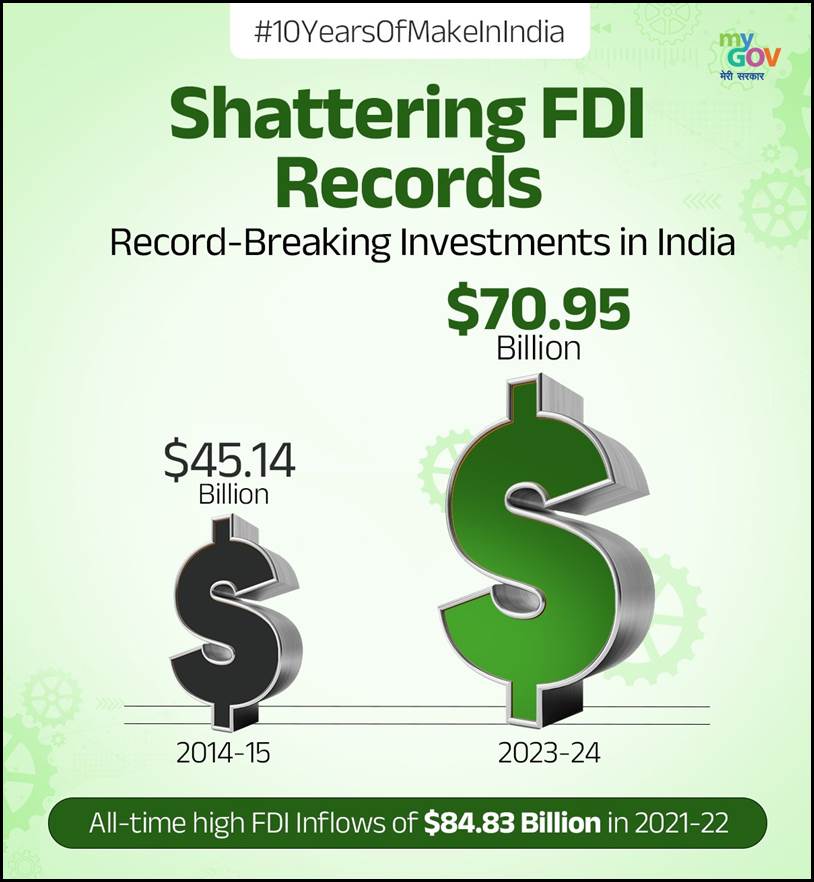
The success of the Make in India initiative has been significantly bolstered by record-breaking Foreign Direct Investment (FDI) inflows, driven by the simplification of FDI rules and improvements in ease of doing business. India now ranks among the top 100 nations in the Ease of Doing Business (EoDB) index. FDI inflows have steadily risen, starting from $45.14 billion in 2014-15 to a record $84.83 billion in 2021-22. Between April 2014 and March 2024, India attracted $667.41 billion in FDI, representing nearly 67% of the total FDI received over the last 24 years. In FY 2023-24, total FDI inflows amounted to $70.95 billion, with equity inflows reaching $44.42 billion, underscoring India's growing appeal as a global investment destination.
Ease of Doing Business
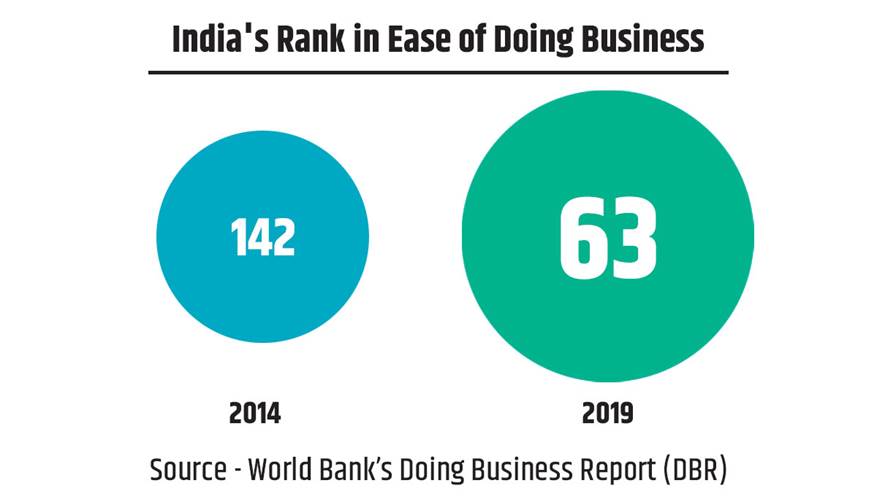
India made remarkable progress in improving its business environment, climbing from 142nd in 2014 to 63rd in the World Bank’s Doing Business Report (DBR) 2020, published in October 2019 before its discontinuation. This 79-rank jump over five years reflects the government’s sustained efforts to simplify regulations, reduce bureaucratic hurdles, and create a more business-friendly environment, significantly boosting investor confidence and supporting the objectives of the Make in India initiative.
Major Achievements under Make in India
Conclusion
In conclusion, as the "Make in India" initiative celebrates its 10th anniversary, it stands as a testament to India’s determination to reshape its manufacturing landscape and enhance its global standing. With strategic reforms, investment-friendly policies, and a strong focus on infrastructure development, the initiative has significantly enhanced India's industrial capabilities. The success of indigenous projects like the Vande Bharat trains and INS Vikrant, alongside record-breaking FDI inflows, reflects India's growing self-reliance and global competitiveness.
The launch of the Semiconductor Ecosystem Development program and the remarkable growth of the Unified Payments Interface (UPI) further underscore India's commitment to innovation and technological advancement. As India moves forward with initiatives like the Production Linked Incentive (PLI) Scheme and PM GatiShakti, it is well on its way to achieving sustained economic growth, creating employment opportunities, and strengthening its position on the global stage. The future of India's manufacturing and industrial sectors looks promising, driven by innovation, infrastructure, and a renewed commitment to economic excellence.
References:

