

Loading...

Top
Help
×

By creating an account you can:

Logo TaxTMI
Call Us / Help / Feedback

Contact Us At :

E-mail: [email protected]

Call / WhatsApp at: +91 99117 96707

For more information, Check Contact Us

FAQs :

To know Frequently Asked Questions, Check FAQs

Most Asked Video Tutorials :

For more tutorials, Check Video Tutorials

Submit Feedback/Suggestion :

Email :
Please provide your email address so we can follow up on your feedback.
Category :
Description :
Min 15 characters 0/2000
Make Most of Text Search
  1. Checkout this video tutorial: How to search effectively on TaxTMI.
  2. Put words in double quotes for exact word search, eg: "income tax"
  3. Avoid noise words such as : 'and, of, the, a'
  4. Sort by Relevance to get the most relevant document.
  5. Press Enter to add multiple terms/multiple phrases, and then click on Search to Search.
  6. Text Search
  7. The system will try to fetch results that contains ALL your words.
  8. Once you add keywords, you'll see a new 'Search In' filter that makes your results even more precise.
  9. Text Search
Add to...
You have not created any category. Kindly create one to bookmark this item!
Create New Category
Hide
Title :
Description :
❮❮ Hide
Default View
Expand ❯❯
Close ✕
🔎 News - Adv. Search
TEXT SEARCH:

Press 'Enter' to add multiple search terms. Rules for Better Search

Search In:
Main Text + AI Text
  • Main Text
  • Main Text + AI Text
  • AI Text
Category: ?
Categorized by AI
---- All Categories ----
  • ---- All Categories ----
  • Income Tax
  • GST
  • Customs, DGFT & SEZ
  • FEMA & RBI
  • Corp. Laws, SEBI & IBC
  • PMLA, Black Money & ED
  • Budget
  • News and Press Release
  • PTI News
Month:
---- All Months ----
  • ---- All Months ----
  • January
  • February
  • March
  • April
  • May
  • June
  • July
  • August
  • September
  • October
  • November
  • December
Year:
---- All Years ----
  • ---- All Years ----
  • 2026
  • 2025
  • 2024
  • 2023
  • 2022
  • 2021
  • 2020
  • 2019
  • 2018
  • 2017
  • 2016
  • 2015
  • 2014
  • 2013
  • 2012
  • 2011
Sort By: ?
In Sort By 'Default', exact matches for text search are shown at the top, followed by the remaining results in their regular order.
Relevance Default Date
    Union Minister for Finance and Corporate Affairs Smt. Nirmala Sitharaman chairs 3rd Meeting of Apex Monitoring Authority of NICDIT and reviews the pro...
    NBCC moves SC for RERA exemptions to complete 16 stalled Supertech projects
    DFS Hosts PSB Confluence 2026: Day 1 Deliberations focus on Four themes- Deposit Mobilisation, Banking for Youth, Supporting the Investment Cycle and ...
    Govt to soon announce high-level panel on 'Banking for Viksit Bharat': FM
    Rupee falls 19 paise to close at 95.61 against US dollar
    Govt to soon announce high-level panel on 'Banking for Viksit Bharat'
    Union Minister of Finance and Corporate Affairs interacts with interns from PM Internship Scheme in New Delhi
    DRI uncovers large-scale illegal use of SAFTA agreement in areca imports
    Rupee falls 17 paise to 95.59 against US dollar in early trade
    Colombian president asks Trump to suspend tariffs to help earthquake recovery
    Mission Samudra to be launched alongside Vizhinjam’s EXIM operations
    Europe emerges top destination for India's electric car shipments in Q1
    Govt sets LPG production targets for refiners; Reliance gets largest quota
    PM urges MSMEs to tap opportunities from FTAs
    PM urges farmers to adopt 'chemical-free farming' to tap rising global demand for such food items
    Govt rolls out foreign asset disclosure scheme for small taxpayers
    Need one or two Indian pharma firms to be among global top 5: PM Modi
    Small taxpayers with€™ foreign assets to face 30 pc tax plus penalty; disclosure scheme opens till Dec 31
    PM urges MSMEs to tap opportunities from FTAs
    Govt cuts windfall gains tax on petrol, diesel, ATF exports
❯❯
Maximize Maximize Maximize
0 / 200
Expand Note
Add to Folder

No Folders have been created

+

Are you sure you want to delete "My most important" ?

NOTE:

News
Showing Results for :
Reset Filters
Results Found:
Show All Summaries Hide All Summaries
August 18, 2026
Show AI Summary
Industrial corridor development prioritises empowered SPVs, integrated infrastructure and investor-ready parks to accelerate manufacturing investment and operations.
National Industrial Corridor Development Programme implementation prioritises timely infrastructure completion, land allotment, investment mobilisation and commencement of manufacturing. PM GatiShakti-aligned planning requires integrated connectivity, utilities and social infrastructure, while States should resolve land, clearance and SPV-power bottlenecks. BHAVYA proposes investment-ready, plug-and-play industrial parks appraised for ready land, credible demand, connectivity, utilities, realistic phasing and early investor attraction. NICDIT routes Government participation and equity support for BHAVYA project SPVs, and NICDC coordinates implementation and monitoring.
August 17, 2026
Show AI Summary
RERA compliance exemption for stalled housing projects raises whether statutory obligations may be waived to enable phased project completion.
RERA compliance exemption is sought for completion of 16 stalled residential projects by a public sector construction entity appointed under a project-completion arrangement. The appellate insolvency tribunal declined to direct a waiver, considering itself incompetent to exempt compliance with statutory provisions. The arrangement requires phased completion, award and commencement of construction work, and oversight through an apex committee and project-wise committees. The projects remain incomplete owing to the developer's financial crisis.
August 17, 2026
Show AI Summary
Deposit mobilisation and youth banking guide strategies for stronger public financial institutions, investment financing and Global Capability Centre opportunities.
PSB Confluence 2026 considers strategic priorities for Public Sector Banks and Public Financial Institutions across deposit mobilisation, banking for youth, investment-cycle financing and Global Capability Centres. Discussions seek practical, scalable strategies to strengthen customer engagement, youth-responsive banking propositions, institutional financing capabilities and participation in the expanding Global Capability Centre ecosystem. Youth engagement may use the MY Bharat platform to strengthen links with the formal financial system and awareness of education finance, entrepreneurship, internships and financial-sector careers. Further themes include value-chain infrastructure, priority sector lending and credit card business reform.
August 17, 2026
Show AI Summary
Banking-sector reform will guide lender capacity, financial stability, inclusion, consumer protection, deposit growth and responsible credit-card expansion.
Banking-sector reform is proposed through a high-level committee on Banking for Viksit Bharat to review the sector and align it with growth needs while safeguarding financial stability, financial inclusion and consumer protection. Key themes include deposit mobilisation, youth banking, investment support, global capability centres, value-chain infrastructure, credit cards and priority-sector lending. Public-sector banks are expected to improve competitiveness through technology, sectoral expertise, product adaptation and customer-focused deposit growth. Credit-card development must maintain responsible underwriting, customer protection and appropriate risk controls.
August 17, 2026
Show AI Summary
FCNR(B) concessional swap facility availability narrows to timely mobilised deposits amid rupee depreciation and foreign currency inflow concerns.
Foreign-exchange conditions reflected rupee depreciation amid weak domestic equity markets and higher crude oil prices. FCNR(B) concessional swap facility availability is confined to foreign currency deposits mobilised by banks within the revised cut-off period, replacing the previously longer mobilisation window. The facility is intended to encourage foreign currency inflows, while banks use the FCNR(B) scheme to mobilise foreign currency deposits through attractive interest rates.
August 17, 2026
Show AI Summary
Banking sector review panel will align future growth with financial stability, inclusion and consumer protection through government recommendations.
High Level Committee on Banking for Viksit Bharat is proposed to comprehensively review the banking sector and align it with India's next phase of growth. It is intended to safeguard financial stability, financial inclusion and consumer protection, while providing views and recommendations to the Government on banking-sector development and reform.
August 17, 2026
Show AI Summary
Prime Minister Internship Scheme enhances youth employability through paid industry exposure, cross-field learning, workplace readiness and potential full-time employment.
The Prime Minister Internship Scheme provides paid internships with leading companies across India to improve youth employability through practical workplace exposure, industry experience and skills development. It addresses the gap between classroom learning and employers' expectations of workplace readiness. Participation is not confined to academic qualifications, allowing youth to pursue fields of interest and gain hands-on professional learning. Strong internship performance may lead to full-time roles, while the scheme stresses responsible work where errors may affect quality, consumer safety and organisational reputation.
August 17, 2026
Show AI Summary
SAFTA origin fraud in areca imports allegedly enabled improper duty exemption through false Bangladeshi-origin declarations.
SAFTA preferential duty treatment for areca-nut imports was allegedly misused by falsely declaring goods originating in South-East Asian countries as Bangladeshi origin. Since areca nuts normally attract 100% basic customs duty, the scheme sought to obtain the full SAFTA exemption reserved for qualifying Bangladeshi goods meeting Rules of Origin requirements. The alleged mechanism included routing goods through Bangladesh, changing containers and bags, using improperly obtained Certificates of Origin, and facilitating clearance through importers, Customs Brokers and IEC holders. Investigative findings also indicated cash proceeds, hawala channels and dummy entities.
August 17, 2026
Show AI Summary
FCNR(B) concessional swap facility closure may reduce temporary foreign-currency inflow support and heighten rupee weakness concerns.
The Reserve Bank of India restricted its concessional swap facility for FCNR(B) deposits to deposits mobilised by August 31, advancing the earlier cut-off date. The facility was intended to encourage foreign-currency inflows, while banks mobilise such deposits through attractive interest rates. Market commentary indicated that existing inflows may support the rupee in the near term, but the curtailed availability of the facility could reduce this temporary cushion and increase depreciation risk.
August 16, 2026
Show AI Summary
Temporary tariff suspension for earthquake recovery is sought to ease pressure on affected Colombian businesses.
Temporary suspension of high tariffs on Colombian products has been sought to support business recovery following a severe earthquake declared a natural disaster. The request links tariff relief to economic disruption affecting businesses amid extensive destruction, injuries and missing persons. United States emergency assistance has been provided through food, shelter and health supplies, while no response to the tariff-suspension request had been reported.
August 16, 2026
Show AI Summary
Port-led industrial development and direct export operations aim to expand logistics infrastructure, market access and trade connectivity.
Mission Samudra is proposed as a port-led industrial and logistics development programme linked to the commencement of export-import operations at Vizhinjam seaport. It covers industrial clusters, new cities, port connectivity, logistics, development initiatives, programme management and capacity building. Direct export shipments are intended to improve overseas-market access and reduce transit time and logistics costs, particularly for small and medium enterprises. The framework also anticipates growth in warehousing, cold storage, container freight stations and logistics parks, supported by private participation and road and rail connectivity.
August 16, 2026
Show AI Summary
Electric vehicle export diversification strengthens India's presence across European, Asia-Pacific and Latin American markets through expanding overseas demand.
India's electric motor car exports expanded sharply in the first quarter of 2026-27, reflecting increased international acceptance and competitiveness of India-manufactured electric vehicles. Europe became the principal export destination, led by Spain and the United Kingdom, with further demand across several European markets. Exports also reached Asia-Pacific markets, Nepal and emerging Latin American destinations. This wider market presence reflects improving quality and safety standards, stronger integration into global electric-vehicle supply chains, and diversification of India's electric-vehicle export profile.
August 16, 2026
Show AI Summary
LPG production preparedness requires refiners and upstream producers to maintain capacity and increase output during supply constraints.
Government has established a standing LPG production preparedness framework under which refining companies, oil marketing companies and upstream producers may be directed to increase production during supply constraints. Companies must maintain adequate LPG storage, evacuation and transportation infrastructure and pursue technically and economically feasible production-enhancing measures. Written directions may prescribe production quantities and periods, including restrictions on alternative uses of input streams required for LPG. The production schedule is updated twice yearly to reflect new facilities and added capacity from infrastructure, technology and distribution improvements.
August 16, 2026
Show AI Summary
Free trade agreement market access requires MSMEs, farmers and exporters to meet global quality standards.
Free trade agreements expand market-access opportunities for Indian MSMEs, exporters and producers through reduced or eliminated import duties on traded goods. Textiles, machinery, medicines, seafood and agricultural products can access international markets where they meet global standards and remain competitively priced. Farmers and producers are encouraged to develop export-oriented products, including chemical-free agricultural produce, while MSMEs may use preferential trade access to support manufacturing, exports, employment and growth.
August 15, 2026
Show AI Summary
Chemical-free farming can strengthen agricultural exports by meeting global standards and responding to rising international demand.
Chemical-free farming is urged to meet growing global demand and expand agricultural exports. Agricultural products must meet global parameters to facilitate access to international markets, including markets opened through free trade agreements. Food processing, export-oriented farm production, and global branding of traditional cuisine, millets, spices, fruits and flowers are identified as important elements of agriculture and food production policy.
August 15, 2026
Show AI Summary
Voluntary foreign asset disclosure allows eligible taxpayers to regularise overseas holdings with immunity from further tax, penalties and prosecution.
FAST-DS permits eligible taxpayers to disclose specified undisclosed foreign assets, foreign income, and foreign assets omitted from return schedules. Undisclosed assets or income not previously offered to tax may be declared up to Rs 1 crore on payment of an effective 60 per cent levy, based on fair market value as of 31 March 2026. Assets already offered to tax, or acquired during non-resident status but omitted from the return schedule, may be declared up to Rs 5 crore on payment of a fee. Valid declarations provide immunity from further tax, penalty and prosecution, while declared amounts are excluded from total income.
August 15, 2026
Show AI Summary
Global pharmaceutical leadership is urged through Indian firms achieving top-five status, supported by generic manufacturing and export capacity.
Indian pharmaceutical companies are urged to attain representation among the world's five leading pharmaceutical firms, despite India's established position as a major producer of generic medicines. India has a broad manufacturing base, supplies generic medicines across numerous therapeutic categories, and exports to worldwide markets including highly regulated jurisdictions. Although pharmaceutical exports and the domestic market have expanded, Indian firms have not yet secured positions among the largest global companies. Greater international scale may be supported through acquisitions and expanded established-brand and branded-generic operations.
August 15, 2026
Show AI Summary
Foreign asset voluntary disclosure permits eligible small taxpayers to regularise qualifying assets through tax, additional levy, and statutory immunity.
FAST-DS permits eligible small taxpayers to voluntarily disclose specified foreign assets or foreign income. It covers undisclosed foreign assets or income not offered to tax, subject to an aggregate value threshold of Rs 1 crore, and certain foreign assets omitted from the relevant return schedule, subject to a Rs 5 crore threshold and prescribed fee. Payment comprises 30 per cent tax and an additional equal amount. Disclosed income or investment is excluded from total income, with immunity from further tax, penalty and prosecution under the Black Money Act for the disclosed asset or income.
August 15, 2026
Show AI Summary
Free trade agreement opportunities require MSMEs to meet global standards and expand exports across textiles, machinery, medicines and seafood.
Free trade agreements are presented as export-market opportunities for Indian MSMEs because they reduce or eliminate import duties on a substantial range of traded goods. MSMEs are urged to expand exports of textiles, machinery, medicines and seafood, including shrimp, by meeting global quality standards and offering products competitively. Their export role is linked to self-reliance and their significant contribution to manufacturing, exports, GDP and employment.
August 15, 2026
Show AI Summary
Windfall gains tax on petroleum exports was reduced to support domestic fuel availability and limit export price advantages.
Special additional excise duty (windfall gains tax) on exports of petrol, diesel and aviation turbine fuel was reduced from 15 August 2026. Petrol export duty was reduced to nil, and export-duty rates on diesel and ATF were lowered. Duty rates for petrol and diesel cleared for domestic consumption remained unchanged. The export-duty framework seeks to maintain domestic petroleum-product availability and limit export advantages arising from higher global crude oil prices amid West Asia tensions.

News

Back

All News

Showing Results for :
Reset Filters
No Records Found

News

Back

All News

Showing Results for : Reset Filters
News and Press Release

India attends Ministerial Meeting of Indo-Pacific Economic Framework for Prosperity

September 24, 2024

Contents
Summary
Note

Note

-

Bookmark

Print

Print

IPEF partners welcome upcoming entry into force of the Clean Economy Agreement, Fair Economy Agreement, and IPEF Overarching Agreement under Indo-Pacific Economic Framework for Prosperity

IPEF partners commit to continued progress at virtual Ministerial Meeting


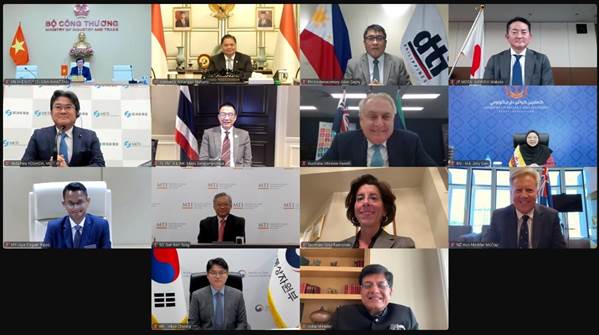
Union Commerce and Industry Minister Shri Piyush Goyal along with 13 other IPEF Ministers virtually attended the third Ministerial meeting focused on IPEF Pillar II, III, and IV.                

In particular, Minister Goyal along with other IPEF Ministers welcomed the upcoming entry into force of the Clean Economy Agreement, Fair Economy Agreement, and the Overarching Agreement on IPEF on October 11, 2024, October 12, 2024, and October 11, 2024, respectively, and emphasized the significant opportunities to further deepen economic cooperation and deliver concrete benefits under the IPEF agreements through ongoing collaboration.
Supply Chain Resilience

In the virtual meeting, IPEF Ministers reviewed and appreciated the substantive progress made to operationalize the Supply Chain Agreement, deepening cooperation to build more competitive and resilient supply chains, better prepare for, prevent, and respond to supply chain disruptions when they happen, and ensure that regional supply chains raise up workers and respect labor rights.  They outlined concrete next steps for the upcoming months, building on the progress made by the Supply Chain Agreement's three bodies: the Supply Chain Council, Crisis Response Network, and Labor Rights Advisory Board.  IPEF partners also highlighted the meaningful collaboration taking place under the Supply Chain Agreement which includes:

The IPEF Ministers noted that the three supply chain bodies – the Supply Chain Council (Council), the Crisis Response Network (Network), and the Labor Rights Advisory Board (LRAB) – met virtually in July to elect leadership in which India was elected as Vice Chair of the Council with US as Chair; Korea as Chair and Japan as Vice Chair of the Network; and the United States as Chair and Fiji as Vice Chair of the LRAB.

Minister Goyal noted that the formation of Action Plan teams in the first in person meeting of supply chain council held in Washington last week, for three critical sectors - semiconductors, critical minerals with a focus on batteries, and chemicals which are highly relevant today given their supply/production concentration and the experience learned from disruptions faced during the COVID-19 pandemic.

The world has witnessed exponential growth in demand for clean energy solutions to meet respective climate goals. The paradigm shift towards a sustainable and low-carbon future has brought to the forefront of the critical importance in securing a reliable supply of minerals which are critical for green transition.

The use of specific minerals is indispensable for the sectors including clean energy, electronics, defence, transportation, telecommunications, fertilisers, and pharmaceuticals. One of the key challenges in supply chains is risk on account of concentration of global capacities or resources, which can add to price volatility and supply uncertainty. The work under the Action Plan team needs to address this global concentration of supply chains in any form.

The growing population puts immense pressure on limited agricultural land for higher yields and in this context, the importance of resilient supply chains for Agro-chemicals has become extremely important. According to an estimate, the Global Agrochemicals Market (fertilizers, pesticides, adjuvants, and plant regulators) is projected to reach USD 282.2 billion by 2028 from USD 235.2 billion by 2023, at a CAGR of 3.7%.

Minister Goyal emphasized that healthcare including pharmaceuticals and medical devices is an extremely relevant area due to over concentration of global production of APIs and Key Starting Materials (KSMs) which can severely impair supply chain resilience and impact our capacity to address the healthcare needs of our economies. Besides, the multimodal transport systems including multimodal transport corridors, upgrades of logistics infrastructure, enhanced technological interoperability and data flows among freight and logistics enterprises, are some of the key areas which need to be focused upon.  

Minister Goyal noted that IPEF’s focus on Logistics and Movement of Good aligns perfectly with Prime Minister Shri Narendra Modi’s vision of Gati Shakti initiative, which aims to improve logistics and transportation infrastructure across India through evidence based integrated planning. Further, data and analytics on one hand will help identify new opportunities for collaboration for better resilience amongst IPEF supply chains and on other will help identify structural and systemic risks, enhancing the Council’s ability to address current challenges. He emphasized the workforce development which is a key cross cutting component of building resilient supply chains across the IPEF region should include efforts to identify skill gaps, support reskilling and upskilling, and ensure skill qualification comparability across the region to facilitate workforce mobility.

Crisis Response Network

IPEF Ministers emphasized the importance of collaboration under the Crisis Response Network to help partners timely understand risks in their supply chains. They also reflected on the emergency simulation exercise conducted during the Crisis Response Network (CRN) in person meeting to assist partners in creating tailored systems for real-time monitoring and crisis preparedness.

Clean Economy

Agreement on Clean Economy intends to accelerate efforts of IPEF partners towards energy security and transition, climate resilience and adaptation, GHG emissions mitigation; find/develop innovative ways of reducing dependence on fossil fuel energy; promote technical cooperation, workforce development, capacity building, and research collaborations; and collaborate to facilitate development, access, and deployment of clean energy and climate-friendly technologies.  The IPEF partners welcomed the progress made on the eight Cooperative Work Programs (CWPs), which serve as one of the primary mechanisms under the Clean Economy Agreement for facilitating cooperation among participating IPEF partners on priority topics. Each CWP, as developed by the proposing IPEF partner or partners, in consultation with the other IPEF partners, has different objectives and workstreams to carry forward the collaborative work.  During the virtual Ministerial, the IPEF partners commended the progress made on the Clean Economy Agreement since the successful Ministerial and inaugural Clean Economy Investor Forum in June.

The IPEF partners welcomed the continued efforts to build and sustain longer-term cooperation among various groupings of interested partners on a range of climate solutions through the CWP mechanism, in furtherance of the overarching goals of the IPEF Clean Economy Agreement, especially w.r.t hydrogen, carbon markets, and small modular reactors (SMRs) and e-waste urban mining proposed by India.

IPEF Ministers expressed great satisfaction over the very successful first IPEF investor Forum held in Singapore which provided a common platform to the investors and the project proponents together and facilitated them to gainfully engage on a wide array of investment opportunities including innovative ideas in the space of climate friendly technologies.

Fair Economy

By strengthening anti-corruption efforts and enhancing the efficiency of tax administration, the IPEF partners are demonstrating their commitment to increased transparency and predictability, and thereby will be better positioned to expand their trade, investment ties and ensure the benefits of trade are broadly shared throughout their economies.

The IPEF partners welcomed the next steps to implement the Agreement, including operationalizing the Technical Assistance and Capacity Building Coordination Group that will coordinate technical assistance and capacity building (TACB) under the Agreement’s Capacity Building Framework. Some of the TACB initiatives highlighted include:-

  • The US Department of Commerce’s Commercial Law Development Program (CLDP)’s  two-year program will offer IPEF partners TACB to help with implementation of the anti-corruption provisions of the Agreement, primarily focused on enforcement training centered on foreign bribery, corporate liability, and compliance.
  • In August 2024, the US Treasury Department’s Office of Technical Assistance (OTA)’s virtual workshop served as a forum for the IPEF partners to discuss the importance of effective tax administration to support economic and development objectives.
  • In October 2024, the US State Department, with the Malaysia Anti-Corruption Commission and the United Nations Office on Drugs and Crime, will hold an IPEF workshop focused on the implementation and enforcement of foreign bribery laws and another IPEF workshop on preventing corruption in public procurement, including tools to improve the effectiveness of oversight mechanisms, appeal systems, and potential remedies and legal options.

Minister Goyal underscored that peer learning, knowledge sharing and capacity building initiatives under the Fair Economy agreement will remain key to achieving its objectives. India, under the dynamic leadership of Prime Minister Narendra Modi, has established a robust anti-corruption regime and has already implemented several legislative, administrative, and regulatory measures to address both corruption and promote tax transparency. 

Minister Goyal emphasized that the full potential of IPEF can only be realised if each partner country brings their respective strengths to the table whether it is technological advancements or investment capacity or market potential or requisite resources including skilled workforce, to address various challenges of supply chain resilience or green transition.

The IPEF partners agreed that the Ministers will continue to monitor the progress made to further operationalize the Supply Chain Agreement, the Clean Economy Agreement, the Fair Economy Agreement, and the IPEF Overarching arrangement, and look forward to the first meetings of the ministerial-level IPEF Council and IPEF Joint Commission established under the IPEF Overarching  Agreement .

About IPEF

IPEF was launched on 23 May 2022 at Tokyo, Japan, comprising 14 countries – Australia, Brunei, Fiji, India, Indonesia, Japan, Republic of Korea, Malaysia, New Zealand, Philippines, Singapore, Thailand, Vietnam and USA. The IPEF seeks to strengthen economic engagement and cooperation among partner countries with the goal of advancing growth, economic stability and prosperity in the region.

The framework is structured around four pillars relating to Trade (Pillar I); Supply Chain Resilience (Pillar II); Clean Economy (Pillar III); and Fair Economy (Pillar IV). Agreement on Supply Chain Resilience (Pillars II) was signed in November 2023 and is in force since February 2024. Agreement on Clean Economy (Pillar-III), Agreement on Fair Economy (Pillar- IV) and the IPEF Overarching Agreement were signed by India early this week in Delaware, USA in the presence of the Prime Minister during his 3-day visit to the US.  India has maintained an observer status in Pillar-I.

These agreements were negotiated in consultation with line Ministries/Departments including the Ministry of External Affairs and other relevant stakeholders.

Topics

Acts Income Tax