 TaxTMI
 Login
 TaxTMI
Login
Loading...
Press 'Enter' to add multiple search terms. Rules for Better Search

Press 'Enter' after typing page number.
Press 'Enter' after typing page number.


No Folders have been created
Are you sure you want to delete "My most important" ?
NOTE:
Press 'Enter' after typing page number.
Press 'Enter' after typing page number.

All News
Press 'Enter' after typing page number.
All News

Note

Bookmark

Share


IPEF partners welcome upcoming entry into force of the Clean Economy Agreement, Fair Economy Agreement, and IPEF Overarching Agreement under Indo-Pacific Economic Framework for Prosperity
IPEF partners commit to continued progress at virtual Ministerial Meeting
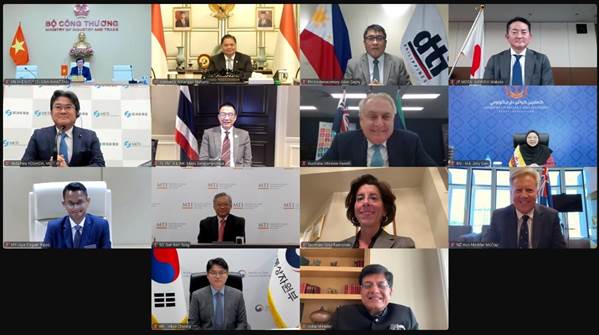
Union Commerce and Industry Minister Shri Piyush Goyal along with 13 other IPEF Ministers virtually attended the third Ministerial meeting focused on IPEF Pillar II, III, and IV.
In particular, Minister Goyal along with other IPEF Ministers welcomed the upcoming entry into force of the Clean Economy Agreement, Fair Economy Agreement, and the Overarching Agreement on IPEF on October 11, 2024, October 12, 2024, and October 11, 2024, respectively, and emphasized the significant opportunities to further deepen economic cooperation and deliver concrete benefits under the IPEF agreements through ongoing collaboration.
Supply Chain Resilience
In the virtual meeting, IPEF Ministers reviewed and appreciated the substantive progress made to operationalize the Supply Chain Agreement, deepening cooperation to build more competitive and resilient supply chains, better prepare for, prevent, and respond to supply chain disruptions when they happen, and ensure that regional supply chains raise up workers and respect labor rights. They outlined concrete next steps for the upcoming months, building on the progress made by the Supply Chain Agreement's three bodies: the Supply Chain Council, Crisis Response Network, and Labor Rights Advisory Board. IPEF partners also highlighted the meaningful collaboration taking place under the Supply Chain Agreement which includes:
The IPEF Ministers noted that the three supply chain bodies – the Supply Chain Council (Council), the Crisis Response Network (Network), and the Labor Rights Advisory Board (LRAB) – met virtually in July to elect leadership in which India was elected as Vice Chair of the Council with US as Chair; Korea as Chair and Japan as Vice Chair of the Network; and the United States as Chair and Fiji as Vice Chair of the LRAB.
Minister Goyal noted that the formation of Action Plan teams in the first in person meeting of supply chain council held in Washington last week, for three critical sectors - semiconductors, critical minerals with a focus on batteries, and chemicals which are highly relevant today given their supply/production concentration and the experience learned from disruptions faced during the COVID-19 pandemic.
The world has witnessed exponential growth in demand for clean energy solutions to meet respective climate goals. The paradigm shift towards a sustainable and low-carbon future has brought to the forefront of the critical importance in securing a reliable supply of minerals which are critical for green transition.
The use of specific minerals is indispensable for the sectors including clean energy, electronics, defence, transportation, telecommunications, fertilisers, and pharmaceuticals. One of the key challenges in supply chains is risk on account of concentration of global capacities or resources, which can add to price volatility and supply uncertainty. The work under the Action Plan team needs to address this global concentration of supply chains in any form.
The growing population puts immense pressure on limited agricultural land for higher yields and in this context, the importance of resilient supply chains for Agro-chemicals has become extremely important. According to an estimate, the Global Agrochemicals Market (fertilizers, pesticides, adjuvants, and plant regulators) is projected to reach USD 282.2 billion by 2028 from USD 235.2 billion by 2023, at a CAGR of 3.7%.
Minister Goyal emphasized that healthcare including pharmaceuticals and medical devices is an extremely relevant area due to over concentration of global production of APIs and Key Starting Materials (KSMs) which can severely impair supply chain resilience and impact our capacity to address the healthcare needs of our economies. Besides, the multimodal transport systems including multimodal transport corridors, upgrades of logistics infrastructure, enhanced technological interoperability and data flows among freight and logistics enterprises, are some of the key areas which need to be focused upon.
Minister Goyal noted that IPEF’s focus on Logistics and Movement of Good aligns perfectly with Prime Minister Shri Narendra Modi’s vision of Gati Shakti initiative, which aims to improve logistics and transportation infrastructure across India through evidence based integrated planning. Further, data and analytics on one hand will help identify new opportunities for collaboration for better resilience amongst IPEF supply chains and on other will help identify structural and systemic risks, enhancing the Council’s ability to address current challenges. He emphasized the workforce development which is a key cross cutting component of building resilient supply chains across the IPEF region should include efforts to identify skill gaps, support reskilling and upskilling, and ensure skill qualification comparability across the region to facilitate workforce mobility.
Crisis Response Network
IPEF Ministers emphasized the importance of collaboration under the Crisis Response Network to help partners timely understand risks in their supply chains. They also reflected on the emergency simulation exercise conducted during the Crisis Response Network (CRN) in person meeting to assist partners in creating tailored systems for real-time monitoring and crisis preparedness.
Clean Economy
Agreement on Clean Economy intends to accelerate efforts of IPEF partners towards energy security and transition, climate resilience and adaptation, GHG emissions mitigation; find/develop innovative ways of reducing dependence on fossil fuel energy; promote technical cooperation, workforce development, capacity building, and research collaborations; and collaborate to facilitate development, access, and deployment of clean energy and climate-friendly technologies. The IPEF partners welcomed the progress made on the eight Cooperative Work Programs (CWPs), which serve as one of the primary mechanisms under the Clean Economy Agreement for facilitating cooperation among participating IPEF partners on priority topics. Each CWP, as developed by the proposing IPEF partner or partners, in consultation with the other IPEF partners, has different objectives and workstreams to carry forward the collaborative work. During the virtual Ministerial, the IPEF partners commended the progress made on the Clean Economy Agreement since the successful Ministerial and inaugural Clean Economy Investor Forum in June.
The IPEF partners welcomed the continued efforts to build and sustain longer-term cooperation among various groupings of interested partners on a range of climate solutions through the CWP mechanism, in furtherance of the overarching goals of the IPEF Clean Economy Agreement, especially w.r.t hydrogen, carbon markets, and small modular reactors (SMRs) and e-waste urban mining proposed by India.
IPEF Ministers expressed great satisfaction over the very successful first IPEF investor Forum held in Singapore which provided a common platform to the investors and the project proponents together and facilitated them to gainfully engage on a wide array of investment opportunities including innovative ideas in the space of climate friendly technologies.
Fair Economy
By strengthening anti-corruption efforts and enhancing the efficiency of tax administration, the IPEF partners are demonstrating their commitment to increased transparency and predictability, and thereby will be better positioned to expand their trade, investment ties and ensure the benefits of trade are broadly shared throughout their economies.
The IPEF partners welcomed the next steps to implement the Agreement, including operationalizing the Technical Assistance and Capacity Building Coordination Group that will coordinate technical assistance and capacity building (TACB) under the Agreement’s Capacity Building Framework. Some of the TACB initiatives highlighted include:-
Minister Goyal underscored that peer learning, knowledge sharing and capacity building initiatives under the Fair Economy agreement will remain key to achieving its objectives. India, under the dynamic leadership of Prime Minister Narendra Modi, has established a robust anti-corruption regime and has already implemented several legislative, administrative, and regulatory measures to address both corruption and promote tax transparency.
Minister Goyal emphasized that the full potential of IPEF can only be realised if each partner country brings their respective strengths to the table whether it is technological advancements or investment capacity or market potential or requisite resources including skilled workforce, to address various challenges of supply chain resilience or green transition.
The IPEF partners agreed that the Ministers will continue to monitor the progress made to further operationalize the Supply Chain Agreement, the Clean Economy Agreement, the Fair Economy Agreement, and the IPEF Overarching arrangement, and look forward to the first meetings of the ministerial-level IPEF Council and IPEF Joint Commission established under the IPEF Overarching Agreement .
About IPEF
IPEF was launched on 23 May 2022 at Tokyo, Japan, comprising 14 countries – Australia, Brunei, Fiji, India, Indonesia, Japan, Republic of Korea, Malaysia, New Zealand, Philippines, Singapore, Thailand, Vietnam and USA. The IPEF seeks to strengthen economic engagement and cooperation among partner countries with the goal of advancing growth, economic stability and prosperity in the region.
The framework is structured around four pillars relating to Trade (Pillar I); Supply Chain Resilience (Pillar II); Clean Economy (Pillar III); and Fair Economy (Pillar IV). Agreement on Supply Chain Resilience (Pillars II) was signed in November 2023 and is in force since February 2024. Agreement on Clean Economy (Pillar-III), Agreement on Fair Economy (Pillar- IV) and the IPEF Overarching Agreement were signed by India early this week in Delaware, USA in the presence of the Prime Minister during his 3-day visit to the US. India has maintained an observer status in Pillar-I.
These agreements were negotiated in consultation with line Ministries/Departments including the Ministry of External Affairs and other relevant stakeholders.

