 TaxTMI
 Login
 TaxTMI
Login
Loading...
Press 'Enter' to add multiple search terms. Rules for Better Search

Press 'Enter' after typing page number.
Press 'Enter' after typing page number.


No Folders have been created
Are you sure you want to delete "My most important" ?
NOTE:
Press 'Enter' after typing page number.
Press 'Enter' after typing page number.

All News
Press 'Enter' after typing page number.
All News

Note

Bookmark

Share


Prioritizing Skill Development for Employment Growth
The Union Budget 2024-25 outlines a comprehensive strategy to achieve 'Viksit Bharat' by focusing on nine key priorities that aim to create abundant opportunities for all citizens. Together, these initiatives are designed to propel India towards a developed nation status.
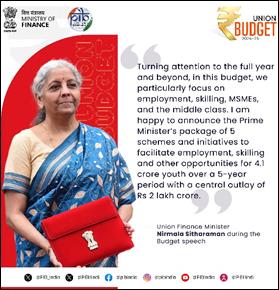
The Union Budget 2024-25 prioritizing skilling and employment highlights the crucial role these aspects play in nation-building. Skilling equips the workforce with the necessary competencies to meet industry demands, fostering innovation and productivity. Employment not only ensures economic stability but also empowers individuals, enhancing their quality of life and contributing to overall societal progress.
With one of the youngest populations, a median age of 28, India can harness its demographic dividend by nurturing a workforce that is equipped with employable skills and prepared for the needs of the industry. Sixty-five per cent of India’s fast-growing population is under 35, and many lack the skills needed by a modern economy. Estimates show that about 51.25 per cent of the youth is deemed employable. However, it must be noted that the percentage has improved from around 34 per cent to 51.3 per cent in the last decade.
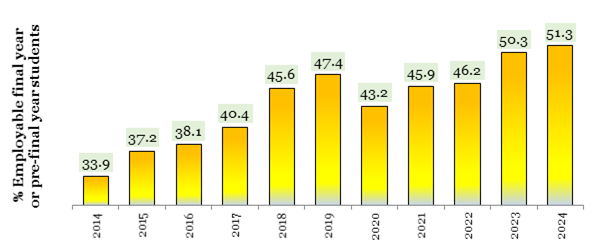
Source: India Skills Report, Wheebox
This sets the stage to discuss various government schemes and initiatives aimed at bolstering skill development and bridging the employability gap among India's burgeoning young population.
Government's Focus and Commitment Towards Skill Development
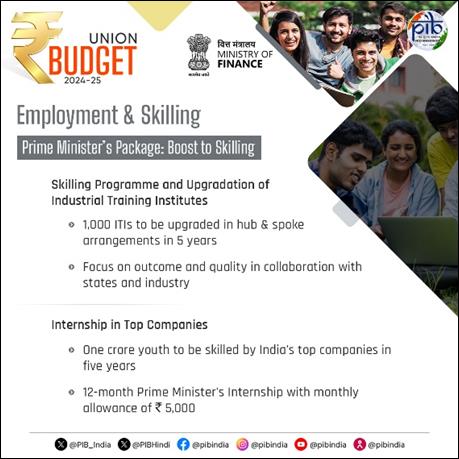
The Government of India has demonstrated a strong commitment to skill development through various comprehensive initiatives aimed at enhancing employability and fostering entrepreneurship. Under the Union Budget 2024-25, a notable highlight is the announcement of a new centrally sponsored scheme under the Prime Minister’s package, in collaboration with state governments and industry. This scheme aims to skill 20 lakh youth over five years and upgrade 1,000 Industrial Training Institutes (ITIs).
Additionally, the Model Skill Loan Scheme will be revised to facilitate loans up to ₹7.5 lakh with government-backed guarantees, benefiting 25,000 students annually. For those ineligible for existing schemes, financial support for loans up to ₹10 lakh for higher education in domestic institutions will be provided, with e-vouchers offering annual interest subvention of 3% for 1 lakh students each year.
In alignment with these new measures, the government continues to support established programs. The National Policy on Skill Development & Entrepreneurship (NPSDE) continues to bridge gaps, improve industry engagement, and expand apprenticeship opportunities. Pradhan Mantri Kaushal Vikas Yojana (PMKVY) has successfully trained over 1.42 crore individuals since 2015, integrating over 1,000 educational institutions as Skill India Centres. The Craftsmen Training Scheme (CTS), with 14,955 ITIs, focuses on long-term vocational training, showing significant female participation growth. Jan Shikshan Sansthan (JSS) targets non/neo-literates, having trained 26.36 lakh individuals from FY19 to FY24, with women constituting 82% of beneficiaries.
The National Apprenticeship Promotion Scheme (NAPS) has engaged 32.38 lakh apprentices and increased industry participation, highlighting substantial growth in female apprentices. Entrepreneurship training is bolstered by institutions like the National Institute for Entrepreneurship and Small Business Development (NIESBUD) and the Indian Institute of Entrepreneurship (IIE), which have collectively trained 4.64 lakh individuals from FY19 to FY24. The Skill India Digital Hub launched in August 2023, enhances access to skilled resources and integrates multiple government initiatives, engaging over 60 lakh learners.
Targeted skilling efforts extend to emerging sectors such as Green Hydrogen and the PM Vishwakarma initiative, which upskill diverse populations. Skilling India at global standards is advanced through Skill India International Centers and international partnerships with countries like Australia, Germany, etc., promoting mutual recognition of qualifications and international mobility. The National Skill Development Corporation (NSDC) drives industry collaboration through innovative finance mechanisms like the Skill Impact Bond, which has trained and placed thousands of youths, including a significant proportion of women. The Directorate General of Training (DGT) partners with major corporations to provide industry-relevant skills training, preparing trainees for Industry 4.0 and beyond.
In conclusion, while India faces significant challenges with its skill gap, the government's proactive initiatives have shown progress in bridging this divide These efforts address talent shortages and prepare India's youth for a global economy, emphasizing the need for sustained investment and collaboration.
Efforts to Boost Employment
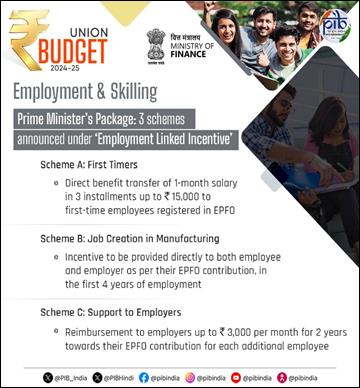
The government has unveiled a robust package to bolster employment and skill development, targeting 4.1 crore youth over five years. This includes three Employment-Linked Incentive Schemes to enhance job creation and support employees and employers. Scheme A - First Timers offers up to ₹15,000 in three installments for first-time employees registered with EPFO, encouraging new workforce entrants. Scheme B - Job Creation in Manufacturing provides incentives for EPFO contributions for both employees and employers in the first four years of employment, fostering job creation in the manufacturing sector. Scheme C - Support to Employers reimburses up to ₹3,000 per month for two years towards EPFO contributions for each additional employee, easing the financial burden on employers and promoting workforce expansion. Further, a new scheme for internships will provide opportunities for 1 crore youth in 500 top companies, offering valuable industry exposure and experience.
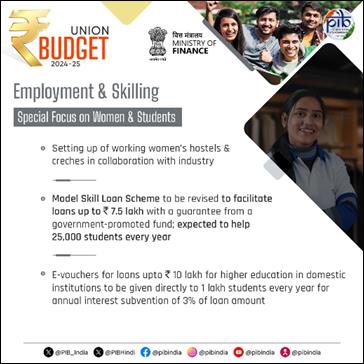
The government is also taking significant steps to facilitate higher participation of women in the workforce. This includes establishing working women hostels and crèches in collaboration with industry partners, organizing women-specific skilling programs to enhance their employability, and promoting market access for women-led Self-Help Group (SHG) enterprises, empowering women economically and socially.
Through these initiatives, the government is not only addressing immediate employment needs but also building a sustainable framework for long-term skill development and job creation. This comprehensive approach aims to equip India's youth with the necessary skills and opportunities to thrive in a rapidly evolving global economy, thereby maximizing the nation's demographic dividend.

