 TaxTMI
 Login
 TaxTMI
Login
Loading...
Press 'Enter' to add multiple search terms. Rules for Better Search

Press 'Enter' after typing page number.
Press 'Enter' after typing page number.


No Folders have been created
Are you sure you want to delete "My most important" ?
NOTE:
Press 'Enter' after typing page number.
Press 'Enter' after typing page number.

All News
Press 'Enter' after typing page number.
All News

Note

Bookmark

Share


Work of the Task Force led to acceptance of definition and framework of the Digital Public Infrastructure (DPI) during India’s G20 Presidency, expected to be taken forward during the Brazilian and South African G20 Presidencies
India achieved in 9 years what would have taken 50 years without DPI: G20 India Sherpa Shri Amitabh Kant
Report will play a key role in defining the future course of DPI approach and actions around the globe: Co-Chair of Task Force Shri Nandan Nilekani
The final ‘Report of India’s G20 Task Force on Digital Public Infrastructure’ by ‘India’s G20 Task Force on Digital Public Infrastructure for Economic Transformation, Financial Inclusion and Development’ was released in New Delhi. The Task Force was led by the Co-Chairs — Shri Amitabh Kant, G20 Sherpa of India and Shri Nandan Nilekani, Co-founder and Chairman of Infosys and the Founding Chairman of UIDAI (Aadhaar).
The work of this Task Force had led to the acceptance of the definition and framework of the Digital Public Infrastructure (DPI) during India’s G20 Presidency and will be taken forward for implementation during the Brazilian and South African Presidencies.
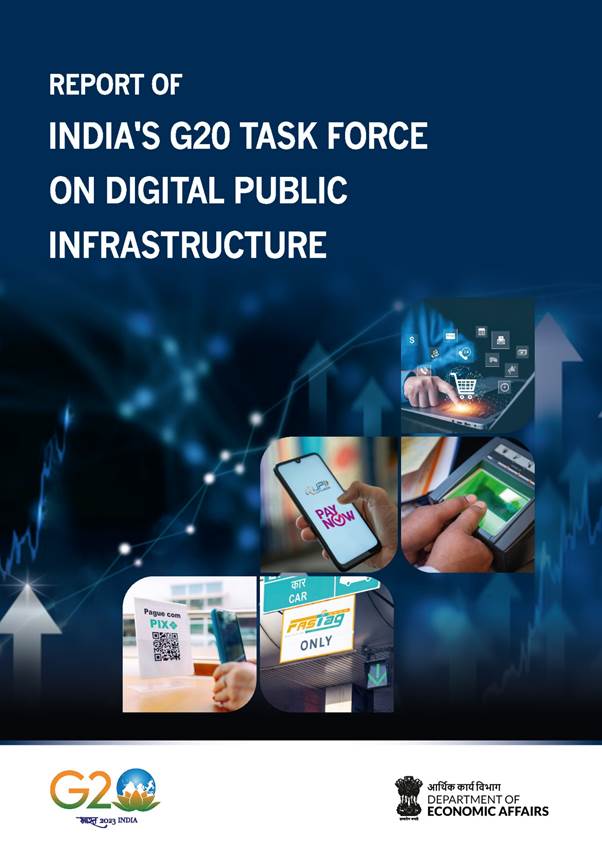
After a very successful G20 Presidency and upon the culmination of its tenure, the Report of the Task Force is aimed at strengthening the foundations of DPI worldwide. The complete report is available on the website of Department of Economic Affairs, Ministry of Finance at:
On the occasion of releasing the report, Shri Amitabh Kant, G20 Sherpa of India, said, “India did an incredible pole vault in Digital Public Infrastructure. We achieved in 9 years what would have taken 50 years without DPI. Today in India, UPI is used at all levels from street vendors to large shopping malls, with the highest percentage of digital transactions globally, accounting for nearly 46% share. All these proved to be building blocks for India to steer through the COVID-19 pandemic, be it transfer $4.5 billion into the bank accounts of 160 million beneficiaries or facilitate distribution of 2.5 million vaccinations in two years with digital vaccine certificates on mobiles. We are far advanced in terms of digitisation and I am confident, this report will be the guiding North Star for the world to follow.”
On the occasion, Co-Chair of Task Force, Shri Nandan Nilekani, said, “Governments and businesses around the world are increasingly realising that if they really want to achieve SDGs and social goals like inclusive growth, it has to have underlying DPI to make that happen. DPI has the power to dramatically improve the lives of citizens and transform governance. It has happened here in India and it started with the Aadhaar ID system, aimed at providing a digital identity to every Indian. Now, around 1.3 billion Indians possess this digital ID and on average 10 million eKYC per day is being facilitated through Aadhar. Meanwhile in payment, UPI facilitates 13 billion transactions monthly, serving about 350 million individuals and 50 million merchants and DPI enabled direct transfer has saved Government $41 billion across Central Government Schemes. Therefore, it’s no longer a choice or a luxury, DPI is essential to get to where we want. This Report will play a key role in defining the future course of DPI approach and actions around the globe.”
India's G20 Presidency provided a significant opportunity to set and drive the global policy discourse on key economic and developmental agenda. One of the critical enablers for the development and empowerment of people is technological innovations and technology-led economic transformation. India's digital public infrastructure (DPI) – digital identity, fast payment system along with consent-based data sharing - has demonstrated how 1.4 billion individuals can access socio-economically important services in the field of finance, health, education, e-Governance, taxation, skills etc. This infrastructure is a result of strong partnership between the public & private sectors, unlocking innovations to address the size and diversity of the Indian population. Such digital highways can significantly improve productivity of private and public sectors alike in both advanced as well as emerging economies and benefit citizens across the world to achieve higher and sustainable growth. India during its G20 Presidency could steer a strong digital agenda by showcasing India’s achievements in the field of DPI and also could gather unanimous support from all G20 members on DPI related reports and deliverables under both Finance Track and Sherpa Tracks.
ABOUT THE REPORT OF INDIA’S G20 TASK FORCE ON DPI
The Report encompasses three essential parts that collectively unravel the approach for global DPI advancement and adoption. In Part 1, the DPI Approach emerges as a transformative paradigm that effectively addresses global challenges through innovative technological solutions. Part 2 of the Report delves into how India has steered its DPI agenda, especially during its G20 Presidency in 2023 under its various working groups including the Global Partnership for Financial Inclusion (GPFI) of Finance Track and Digital Economy Working Group (DEWG) of Sherpa Track. In Part 3 of the Report, a forward-looking perspective is presented, outlining a strategic blueprint for elevating DPI across various sectors, as well as on a global scale through a range of its policy recommendations.
The Report also highlights the need to identify an existing body of global standard with the scope of multinational presence, to foster and harness DPI ecosystem across various regions and countries especially Global South countries. Many countries across the world are considering how to develop their national digital infrastructure to accelerate economic progress through drastic improvement in provisioning public services, and foster trust between people and the institutions by improving transparency and reducing distance. The report will play a key role in defining the future course of DPI approach and actions for implementation around the globe, particularly in the Global South.
ABOUT THE TASK FORCE
The Task force was established in January 2023 to oversee and facilitate achieving India's G20 Presidency agenda and priorities on Digital Public Infrastructure (DPI) and Financial Inclusion. The Task Force looked at ways G20 member countries can boost productivity by adopting digital technology and DPI across sectors as well as help the government's digital economy policies and regulations. The composition of the Task Force is given below.
Following is the composition of ‘India's G20 Task Force on Digital Public Infrastructure for Economic Transformation, Financial Inclusion and Development’:
Co-Chairs
1. Shri Amitabh Kant (G20 Sherpa of India)
2. Shri Nandan Nilekani
Members
3. Secretary, D/o Economic Affairs (DEA), Member Coordinator
4. Secretary, D/o Financial Services (DEA)
5. Secretary, M/o Electronic and Information Technology (MeitY)
6. Secretary, M/o External Affairs (MEA)
7. Deputy Governor, Reserve Bank of India (RBI)
8. CEO, National Institution for Transforming India (NITI Aayog)
9. Chief Economic Adviser, D/o Economic Affairs (DEA)
10. CEO, Unique Identification Authority of India (UIDAI)
11. MD, National Payments Corporation of India (NPCI)

