

Just a moment...

Top
Help
×

By creating an account you can:

Logo TaxTMI
>
Call Us / Help / Feedback

Contact Us At :

E-mail: [email protected]

Call / WhatsApp at: +91 99117 96707

For more information, Check Contact Us

FAQs :

To know Frequently Asked Questions, Check FAQs

Most Asked Video Tutorials :

For more tutorials, Check Video Tutorials

Submit Feedback/Suggestion :

Email :
Please provide your email address so we can follow up on your feedback.
Category :
Description :
Min 15 characters0/2000
Add to...
You have not created any category. Kindly create one to bookmark this item!
Create New Category
Hide
Title :
Description :
❮❮ Hide
Default View
Expand ❯❯
Close ✕
🔎 News - Adv. Search
TEXT SEARCH:

Press 'Enter' to add multiple search terms. Rules for Better Search

Search In:
Main Text + AI Text
  • Main Text
  • Main Text + AI Text
  • AI Text
Category: ?
Categorized by AI
---- All Categories ----
  • ---- All Categories ----
  • Income Tax
  • GST
  • Customs, DGFT & SEZ
  • FEMA & RBI
  • Corp. Laws, SEBI & IBC
  • PMLA, Black Money & ED
  • Budget
  • News and Press Release
  • PTI News
Month:
---- All Months ----
  • ---- All Months ----
  • January
  • February
  • March
  • April
  • May
  • June
  • July
  • August
  • September
  • October
  • November
  • December
Year:
---- All Years ----
  • ---- All Years ----
  • 2026
  • 2025
  • 2024
  • 2023
  • 2022
  • 2021
  • 2020
  • 2019
  • 2018
  • 2017
  • 2016
  • 2015
  • 2014
  • 2013
  • 2012
  • 2011
Sort By: ?
In Sort By 'Default', exact matches for text search are shown at the top, followed by the remaining results in their regular order.
RelevanceDefaultDate
    India's forex kitty swells by USD 10.5 bn to USD 692.87 bn
    Rs 5,000 cr credited to 6.22 lakh Maharashtra farmers so far under loan waiver scheme: Fadnavis
    SBI Life and J&K Bank partner to bring comprehensive life insurance solutions closer to families across India
    DRI intensifies vigil along India's North-Eastern Frontier
    Vijayan slams Kerala govt's move to end doorstep pension delivery through cooperative banks
    Kerala to stop welfare pension delivery through cooperative banks, shifts to DBT
    China's exports slow slightly in July despite robust demand for high-tech products
    India successfully concludes the Tenth BRICS Industry Ministers' Meeting in Jaipur under its BRICS Chairship 2026
    APEDA Organises BIOFACH INDIA 2026 to Promote India's Certified Organic Products and Expand Global Market Access
    RBI bars banks from disabling mobile devices of defaulting borrowers
    Par panel for early conclusion of India-US trade pact, tariff exemptions on key goods
    No commitments relating to ethanol import from US for fuel blending under FTA talks: Govt
    No concession or commitment on import of Ethanol for fuel blending from the United States
    Office of the Controller General of Patents, Designs and Trade Marks Announces Tentative Schedule for Patent and Trade Marks Agent Examinations 2027 a...
    RBI invites comments on the draft “Reserve Bank of India (Non-Banking Financial Companies – Credit Facilities) Amendment Directions, 2026”
    West Bengal seeks 100pc foodgrain, 40pc sugar jute packaging quota at SAC meeting
    RBI clasifies Tata Sons, 16 others as large NBFCs
    Sensex climbs 374 points on buying in Reliance, ICICI Bank; Nifty ends flat
    Insurance Division, DFS Secures 3rd Rank in Group A Category of Grievance Redressal Assessment & Index (GRAI) for June 2026
    VKDL Group’s NPA Bazaar Strengthens India’s Distressed Asset Resolution Ecosystem Under the Leadership of V K Dubey
❯❯
MaximizeMaximizeMaximize
0 / 200
Expand Note
Add to Folder

No Folders have been created

    +

    Are you sure you want to delete "My most important" ?

    NOTE:

    News
    Showing Results for :
    Reset Filters
    Results Found:
    Show All SummariesHide All Summaries
    August 7, 2026
    Show AI Summary
    Foreign exchange reserves rose as foreign currency assets, gold holdings, Special Drawing Rights and IMF reserve position increased.
    India's foreign exchange reserves increased during the week ended July 31, principally because of higher foreign currency assets and gold reserves. Foreign currency assets include US dollar valuation effects arising from movements in currencies such as the euro, pound and yen. Special Drawing Rights and India's reserve position with the International Monetary Fund also increased. The movement followed measures to attract foreign exchange inflows, including an FCNR(B) measure, after earlier reserve declines associated with rupee pressure and dollar sales for foreign exchange market intervention.
    August 7, 2026
    Show AI Summary
    Farm loan waiver eligibility depends on verified beneficiary status and Aadhaar authentication for direct credit of eligible crop-loan relief.
    The farm loan waiver scheme covers eligible short-term crop loans within the prescribed ceiling and eligibility period. Waiver amounts are credited to verified bank accounts after field verification and completion of Aadhaar authentication. Aadhaar authentication is the operative condition for automatic processing of benefits, while eligibility rules and technical conditions have raised concerns about exclusion of distressed farmers.
    August 7, 2026
    Show AI Summary
    Corporate agency distribution expands access to life insurance products, supporting insurance awareness, financial inclusion and long-term household financial protection.
    A corporate agency arrangement enables J&K Bank to distribute SBI Life Insurance protection, savings, retirement and child-oriented life insurance plans through its branch network. The partnership aims to improve insurance access, awareness, financial literacy and long-term financial planning for households, particularly in Jammu & Kashmir and Ladakh. It is intended to expand insurance penetration, strengthen household financial protection and support financial inclusion in line with the IRDAI vision of "Insurance for All by 2047".
    August 7, 2026
    Show AI Summary
    Cross-border smuggling controls target narcotics, poppy seeds and areca nuts entering through the Indo-Myanmar border region.
    Cross-border smuggling enforcement targeted methamphetamine, foreign-origin poppy seeds and areca nuts allegedly brought from Myanmar. Methamphetamine concealed in an ambulance was seized under the NDPS Act, 1985. Poppy seeds and areca nuts recovered in separate operations were seized under the Customs Act, 1962. Poppy-seed imports are restricted to designated countries and require registration to ensure traceability and prevent illicit produce entering legitimate supply chains. The enforcement action addresses circumvention of customs controls and regulated import requirements.
    August 7, 2026
    Show AI Summary
    Direct benefit transfer for welfare pensions replaces cooperative-bank doorstep delivery, while retaining limited home service for excluded beneficiaries.
    Direct Benefit Transfer for social security and welfare pensions is to be made through Aadhaar-linked bank accounts, replacing cooperative-bank doorstep delivery. Home delivery remains available for bedridden persons and others who cannot be excluded. The change is associated with delays in remitting undistributed amounts, record-update failures, reconciliation issues, duplicate payments, and incomplete Aadhaar-based payment implementation. Concerns have been raised that mandatory bank-account credit may disadvantage beneficiaries dependent on doorstep delivery.
    August 7, 2026
    Show AI Summary
    Direct Benefit Transfer for welfare pensions replaces doorstep cooperative-bank delivery, while home delivery remains for bedridden beneficiaries.
    Direct Benefit Transfer of social security and welfare pensions is to be made mandatory through Aadhaar-linked bank accounts, replacing cooperative-bank doorstep distribution. Home delivery continues for completely bedridden beneficiaries and others who cannot be excluded. The change addresses delays in remitting undistributed amounts, record-update and reconciliation deficiencies, duplicate payments linked to incomplete Aadhaar-based payments, delivery incentive costs, and the need to comply with Direct Benefit Transfer norms to avoid loss of central financial assistance.
    August 7, 2026
    Show AI Summary
    Customs trade data show moderating July growth while high-technology exports, vehicles and advanced manufacturing supplies remain strongly supported.
    Customs and trade data showed that China's July export and import growth moderated and its trade surplus narrowed from the preceding month. Typhoon-related port disruptions affected trade flows, but demand for electronics and green technology products supported elevated values. High-technology items, vehicles, electronics and machinery recorded strong January-July export growth, while trade performance varied among the United States, the European Union and Southeast Asia.
    August 7, 2026
    Show AI Summary
    BRICS industrial cooperation advances MSME, photovoltaic, startup and logistics frameworks alongside resilient trade and digital services collaboration.
    BRICS industrial cooperation under PartNIR was strengthened through a Joint Declaration and institutional measures addressing MSMEs, photovoltaics, startup-led innovation, and resilient transport and logistics. The measures include an SME cooperation framework, Terms of Reference and an Action Plan for photovoltaic industry cooperation, and a startup innovation action plan. Trade discussions focused on the multilateral trading system, MSME participation in international trade, resilient global value chains, and cross-border digitally delivered services within a rules-based trading framework.
    August 7, 2026
    Show AI Summary
    Certified organic export promotion: BIOFACH INDIA facilitates buyer-seller engagement, certification awareness, traceability discussions and international market access.
    BIOFACH INDIA 2026 promotes certified organic exports by providing a platform for Indian organic enterprises to showcase diverse certified products and engage with overseas buyers through structured Buyer-Seller Meets. Technical sessions address organic certification, traceability, sustainability, quality standards, international regulatory requirements and export-market expectations. The initiative supports quality assurance, international market access, export linkages and sustainable agricultural practices across the organic value chain.
    August 6, 2026
    Show AI Summary
    Device-based loan recovery restrictions protect essential mobile functions while permitting gradual locking only for lender-financed devices.
    Technology-based recovery mechanisms cannot restrict or disable a borrower's mobile device unless the bank financed acquisition of that device. Where permitted, banks must adopt a gradual approach and preserve essential functions, including incoming calls, SMS access, and emergency SOS features. Regulated entities and service providers must obtain manufacturer or operating-system certification for device-locking technology. Disclosure of borrower or guarantor information to recovery personnel must be limited to what is necessary for loan-recovery duties.
    August 6, 2026
    Show AI Summary
    Bilateral trade agreement negotiations should secure tariff certainty, protect key exports, strengthen supply chains, and support vulnerable small industries.
    An early Bilateral Trade Agreement is proposed to protect Indian interests, secure tariff exemptions for key exports, reduce barriers affecting industrial products, and create predictable trade conditions. Recommended measures include financial and export-credit support for small industries, real-time monitoring of customs requirements, documentation assistance, and timely policy support against tariff and non-tariff barriers. Export strategy should develop knowledge services and critical supply-chain integration, while a National Fund should assist suppliers with redesign, tooling, certification and entry into new global supply chains.
    August 6, 2026
    Show AI Summary
    Ethanol imports for fuel blending remain excluded from trade commitments, with domestic producers continuing to supply the blending programme.
    Ethanol imports for fuel blending remain outside concessions or commitments in India-US trade discussions. Under the Ethanol Blended with Petrol Programme, ethanol procurement is governed solely by domestic policy requirements and is sourced entirely from domestic producers. Claims of existing or intended large-scale ethanol imports from the United States for fuel blending, or of a policy change permitting them, are stated to be baseless.
    August 6, 2026
    Show AI Summary
    Domestic ethanol sourcing for fuel blending continues unchanged, with no import commitments or concessions involving United States ethanol.
    Ethanol used for fuel blending under the Ethanol Blended with Petrol Programme is sourced entirely from domestic producers, with no imports from the United States for that purpose. No concessions or commitments on importing United States ethanol for fuel blending have been made in trade discussions. Fuel blending and ethanol procurement continue to be governed solely by domestic policy requirements, and claims of a policy change allowing large-scale imports are incorrect.
    August 6, 2026
    Show AI Summary
    Patent and trade marks agent qualification examinations require written-paper minimums, aggregate passing scores, and viva voce assessment for registration.
    Patent and trade marks agent examinations comprise an objective Paper I, a descriptive Paper II and a viva voce assessing suitability to practise before the Intellectual Property Office. Candidates must secure the stipulated minimum marks in each written paper and the required aggregate score to pass. Registration in the relevant Register of Patent Agents or Register of Trade Marks Agents is available only to candidates who satisfy all prescribed eligibility conditions and qualify the examination.
    August 6, 2026
    Show AI Summary
    Draft NBFC credit-facilities amendments open for stakeholder consultation through designated online and email feedback channels.
    Draft amendments to the Non-Banking Financial Companies credit-facilities framework have been released for public consultation. Regulated entities and other interested stakeholders may submit comments or feedback through the 'Connect 2 Regulate' platform or by email using the specified subject line.
    August 6, 2026
    Show AI Summary
    Mandatory jute packaging reservations were urged to protect cultivators, mill workers, crop absorption, and environmentally sustainable packaging.
    Mandatory jute packaging reservations were sought to be retained at full coverage for foodgrains and increased for sugar packaging for the forthcoming Jute Year. The submission before the Standing Advisory Committee emphasised absorption of bumper jute output, remunerative prices for cultivators, uninterrupted mill operations, and protection of farm and worker livelihoods. It also stressed that biodegradable jute bags offer an environmentally friendly alternative to HDPE and polypropylene woven sacks, and that dilution of compulsory packaging could undermine plastic-pollution reduction efforts.
    August 6, 2026
    Show AI Summary
    NBFC Upper Layer classification imposes enhanced regulation and listing obligations, while de-registration applications remain under examination.
    NBFC Upper Layer classification subjects identified large non-banking financial companies to enhanced regulatory requirements for at least five years and requires stock-exchange listing within three years of identification. The framework divides NBFCs into Base, Middle, Upper and Top Layers. Seventeen large NBFCs were included in the Upper Layer list, while Tata Sons' classification remains subject to the pending examination of its de-registration application.
    August 6, 2026
    Show AI Summary
    Closing auction price discovery may affect benchmark levels differently based on constituent liquidity and concentrated institutional order flow.
    The Closing Auction Session in the equity cash segment uses an auction-based method to determine closing prices of eligible shares with futures and options contracts, aiming to strengthen transparent and robust price discovery. Its effect on benchmark closing levels may differ according to constituent liquidity and institutional order flow. The Reserve Bank of India retained the policy repo rate and neutral stance, indicating that future policy decisions will be data-dependent and influenced by assessment of energy-cost effects on inflation.
    August 6, 2026
    Show AI Summary
    Public grievance redressal strengthens through monitoring, senior review, workshops, stakeholder coordination, and customer-centric service delivery improvements.
    Public grievance redressal is assessed through the Grievance Redressal Assessment and Index, which analyses grievance categories and disposal. The Department of Financial Services' Insurance and Banking Divisions received third and sixth ranks respectively in the June 2026 assessment. Its framework includes disposal of grievances, random reviews by senior officials, and workshops on effective grievance redressal, supporting best practices, stakeholder coordination, technology use, customer-centric service, and accountable public service delivery.
    August 6, 2026
    Show AI Summary
    Distressed asset resolution integrates restructuring, insolvency advisory, funding facilitation and digital marketplaces for transparent financial recovery transactions.
    The platform provides integrated advisory, management and transaction-facilitation services for Non-Performing Assets, stressed assets and distressed assets. Its services include NPA resolution, debt restructuring, One-Time Settlements, funding assistance, insolvency and bankruptcy advisory, asset reconstruction, financial restructuring and capital raising. Digital and offline marketplaces facilitate transactions involving distressed assets, receivables and related movable or immovable properties, supported by collaborations with banks, Non-Banking Financial Companies, Asset Reconstruction Companies, corporates and investors.

    News

    Back

    All News

    Showing Results for :
    Reset Filters
      No Records Found

      News

      Back

      All News

      whatsappJoin Channel
      Showing Results for : Reset Filters

      Union Finance Minister Smt. Nirmala Sitharaman inaugurates first-ever National Conference of Enforcement Chiefs of the State and the Central GST Formations in New Delhi

      March 5, 2024

      Contents
      Summary
      Note

      Note

      -

      Bookmark

      Print

      Print

      FM exhorts GST officials to engage with stakeholders to understand their concerns, enhance compliance, streamline processes, and work collaboratively towards making the tax system more transparent and efficient

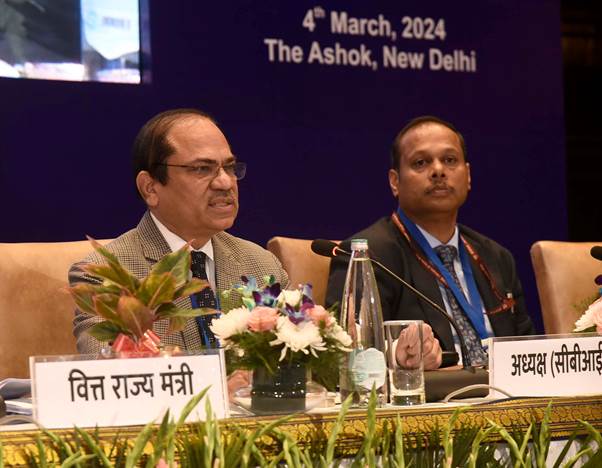
      GST has simplified indirect taxation and made lives of people easier: MoS Finance

      Revenue Secretary outlines key priorities for an effective and efficient GST enforcement and emphasises the need for feedback to further improve policy and technology interventions

      CBIC Chairman highlights importance of maintaining balance between enforcement and fairness in sync with instructions of CBIC

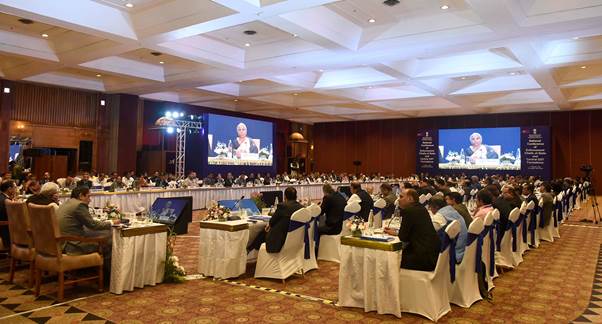
      The one-day inaugural conference saw in-depth discussions on GST evasion typologies, preferred methods, and prevalent sectors, importance of collaborative efforts, need to utilise technology effectively, and proactively preventing fraudulent behaviour by identifying high-risk taxpayers

      Union Minister for Finance and Corporate Affairs Smt. Nirmala Sitharaman inaugurated the first-ever National Conference of Enforcement Chiefs of the State and the Central GST Formations, in New Delhi, today. The conference provided one more step towards facilitating understanding and streamlining operations of the tax authorities in enforcement actions undertaken by different indirect tax authorities.
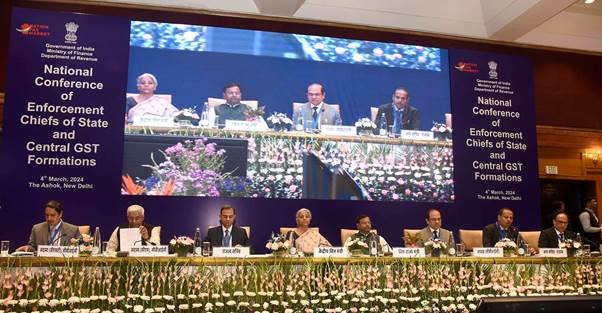
       

      Union Minister of State for Finance Shri Pankaj Chaudhary; Shri Sanjay Malhotra, Secretary, Department of Revenue, Ministry of Finance; Shri Sanjay Kumar Agarwal, Chairman, Central Board of Indirect Taxes and Customs (CBIC); other senior officers of the Department of Revenue, GST Enforcement Chiefs of the States and Central GST authorities, CEO and representative of GSTN, other heads of enforcement like the Chairman Central Board of Direct Taxes (CBDT), Director, Directorate of Enforcement (ED), Director Central Narcotics Bureau (NCB); and DG, Central Economic Intelligence Bureau (CEIB) were also present at the occasion.

      In her address on the occasion, the Union Finance Minister commended the untiring efforts of both the Centre and States GST formations since 2017 in making the GST a reliable, goal-oriented and capable system by leveraging technology.
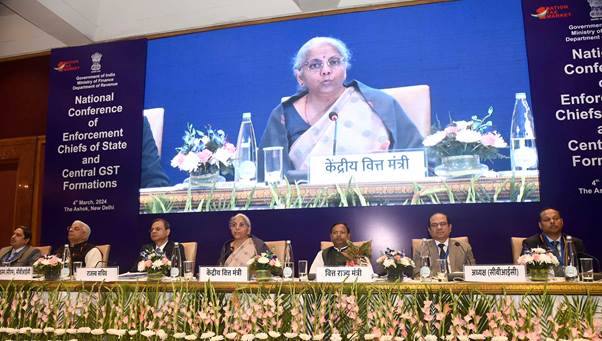
      The Union Finance Minister urged all the GST formations to leverage technology to plug the loopholes as well provide better taxpayer services. Highlighting the importance of innovation, the Union Finance Minister advocated for sharing of emerging best practices, emphasising the need for seamless coordination across States in the larger national interest.

      Further, Smt. Sitharaman stressed on the significance of holding such meetings regularly among enforcement chiefs of Centre and States, and to leverage this platform for discussing obstacles, exchanging successful strategies, and collectively advance towards a more robust and harmonious tax infrastructure.

      The Union Finance Minister also stressed that clarity on classification related issues should be looked into at the earliest through appropriate channels.

      The Union Finance Minister said that the past 10 years under the leadership of Prime Minister Shri Narendra Modi have shown that systems can be cleansed and made more effective through persistent efforts.

      Smt. Sitharaman exhorted the GST officials to engage with stakeholders to understand their concerns, enhance compliance, streamline processes, and work collaboratively towards making the tax system more transparent and efficient.

      Appreciating the initiative of organising this conference, Shri Chaudhary said that it will help to streamline the various issues related to indirect tax enforcement and also help in developing strategies for oncoming challenges through brainstorming during the conference.
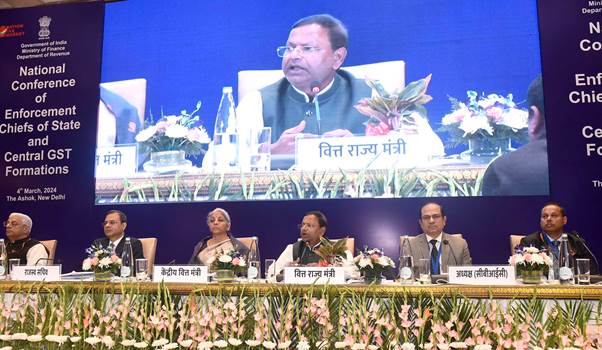
      Hailing GST as a big reform in India, Shri Chaudhary said that GST has simplified indirect taxation and brought down the effective tax rate, thereby made lives of people easier. Shri Chaudhary exhorted the GST formations to work towards facilitating more and more taxpayers.

      Citing the multi-fold increase in GST collections, Shri Chaudhary appreciated the contribution of the GST authorities in achieving the vision of Prime Minister towards achieving ‘Sabka Saath, Sabka Vikas’. He credited the leadership of Prime Minister and Finance Minister in propelling India's economic journey from fragile five in 2014 to top five now. Shri Chaudhary expressed optimism about achieving a monthly target of Rs. 2 lakh crore in GST revenue soon.

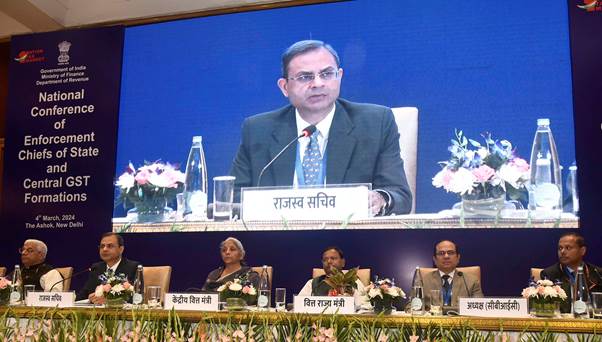
      In his address on the occasion, Shri Sanjay Malhotra, Revenue Secretary emphasised the crucial role of enforcement in ensuring the success of the GST system. Shri Malhotra outlined key priorities - targeting high-risk areas, combating tax evaders, balancing enforcement with taxpayer rights, strengthening collaboration between central and state authorities, and gathering feedback for improvement in policy and technological interventions.
      Setting the context of the one-day conference, Shri Sanjay Kumar Agarwal, CBIC Chairman said that fake entities and GST evasion not only erode our national revenue but also distort fair competition and fuel an underground economy. He highlighted the importance of strong data analytics and use of technology and the need to stay ahead of the perpetrators of GST evasion. He reminded the officers to follow the instructions issued by CBIC in respect of procedure to be followed during enforcement action.
      In his welcome address, Additional Secretary, Revenue, highlighted this platform's unique potential for fostering collaboration and sharing best practices in GST enforcement, bringing together Central and State GST authorities.

      During the one-day conference, various presentations were also made by the GST formations. As per data presented by GST Council Secretariat, the nationwide crackdown on fake registrations and bogus billing from May 2023 alone has resulted in detection of ITC tax evasion of Rs. 49,623 crore involving 31,512 bogus firms. CBIC presented that it has detected fake ITC evasion of Rs.1,14,755 crore from the year 2020 till date.

      Maharashtra State GST showcased the real time monitoring dashboard of suspected non-genuine tax payers (NGTPs). As on 29th February 2024, State has identified 41,601 suspected NGTPs out of which 6,034 NGTPs were detected. It was further highlighted that detection was based on various intelligence gathered during registration, e-way bills and inputs from CBIC/other states and outlined the steps taken to improve detection rate at an early stage.

      During the focussed thematic sessions, the delegates from Central and State GST formations discussed various issues through in-depth discussions such as GST evasion typologies, preferred methods, and prevalent sectors, importance of collaborative efforts, need to utilize technology effectively, not only to detect existing fraudulent behavior but also to proactively prevent it by identifying high-risk taxpayers.

      Participants deliberated on addressing the menace of fake invoicing and its associated issues like money laundering, identity theft, and circular trading. Best practices and deterrent actions implemented by Directorate General of GST Intelligence were also shared.
      The conference discussed navigating legal and operational challenges faced by enforcement authorities while ensuring minimal disruption for businesses. It was highlighted that CBIC and DGGI have issued instructions emphasising the need to have more taxpayer-friendly approach to GST enforcement, focusing on avoiding unnecessary audits on issues involving prevalent trade practices and prioritising evidence-based inquiries. It also advocates for considering location convenience and requesting information formally through letters instead of using summons.

      GSTN and DG Systems, CBIC outlined the various analytical tools available to the tax officers to detect risky taxpayers and combat GST evasion. Discussion was also centred around ways of streamlining the tools and to make them available to all GST enforcement formations. DG Analytics and Risk Management showcased risk analytical tool to detect potential GST evaders early in the cycle even before filing of first return.

      Gujarat highlighted the recent success of GST Seva Kendras in reducing the number of fake registrations. The recent case involving fake registration wherein 20 people have been arrested under Gujarat Control of Terrorism and Organised Crime Act, 2015 was also highlighted as a case study of best practice.

      Karnataka highlighted unique case typologies such as bill trading in services sector and mild steel scrap, misclassification etc. West Bengal highlighted the benefits of establishing a cyber forensic lab aiding investigation of GST frauds. Uttarakhand, Sikkim and Andhra Pradesh also presented their best practices in GST enforcement.

      The conference facilitated experience sharing and knowledge transfer between various states and the central government. Participants reviewed past enforcement actions, extracted valuable learnings, and explored future work areas for tax enforcement officers.

      Based on the positive feedback, the conference established the need for regular experience sharing. It was decided to conduct the National Conference of Enforcement Chiefs of State and Central GST Formations bi-annually moving forward.

      Topics

      ActsIncome Tax