 TaxTMI
 Login
 TaxTMI
Login
Loading...
150 credits · 30 days
Already used our earlier 20-Credit Demo?
You are still eligible for this new 150-Credit Demo.
Press 'Enter' to add multiple search terms. Rules for Better Search

Press 'Enter' after typing page number.
Press 'Enter' after typing page number.


No Folders have been created
Are you sure you want to delete "My most important" ?
NOTE:
Press 'Enter' after typing page number.
Press 'Enter' after typing page number.

All News
Press 'Enter' after typing page number.
All News

Note

Bookmark

Share


FM exhorts GST officials to engage with stakeholders to understand their concerns, enhance compliance, streamline processes, and work collaboratively towards making the tax system more transparent and efficient
GST has simplified indirect taxation and made lives of people easier: MoS Finance
Revenue Secretary outlines key priorities for an effective and efficient GST enforcement and emphasises the need for feedback to further improve policy and technology interventions
CBIC Chairman highlights importance of maintaining balance between enforcement and fairness in sync with instructions of CBIC
The one-day inaugural conference saw in-depth discussions on GST evasion typologies, preferred methods, and prevalent sectors, importance of collaborative efforts, need to utilise technology effectively, and proactively preventing fraudulent behaviour by identifying high-risk taxpayers
Union Minister for Finance and Corporate Affairs Smt. Nirmala Sitharaman inaugurated the first-ever National Conference of Enforcement Chiefs of the State and the Central GST Formations, in New Delhi, today. The conference provided one more step towards facilitating understanding and streamlining operations of the tax authorities in enforcement actions undertaken by different indirect tax authorities.
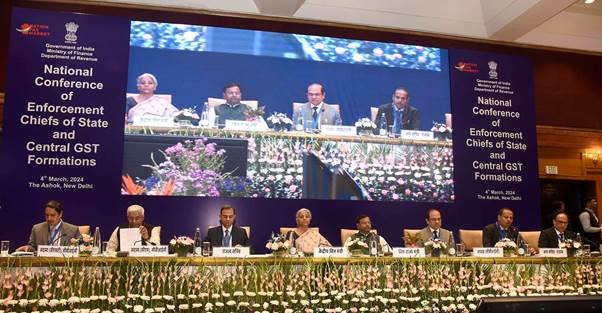
Union Minister of State for Finance Shri Pankaj Chaudhary; Shri Sanjay Malhotra, Secretary, Department of Revenue, Ministry of Finance; Shri Sanjay Kumar Agarwal, Chairman, Central Board of Indirect Taxes and Customs (CBIC); other senior officers of the Department of Revenue, GST Enforcement Chiefs of the States and Central GST authorities, CEO and representative of GSTN, other heads of enforcement like the Chairman Central Board of Direct Taxes (CBDT), Director, Directorate of Enforcement (ED), Director Central Narcotics Bureau (NCB); and DG, Central Economic Intelligence Bureau (CEIB) were also present at the occasion.
In her address on the occasion, the Union Finance Minister commended the untiring efforts of both the Centre and States GST formations since 2017 in making the GST a reliable, goal-oriented and capable system by leveraging technology.
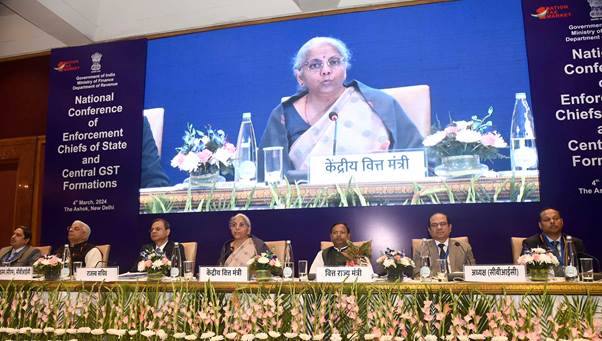
The Union Finance Minister urged all the GST formations to leverage technology to plug the loopholes as well provide better taxpayer services. Highlighting the importance of innovation, the Union Finance Minister advocated for sharing of emerging best practices, emphasising the need for seamless coordination across States in the larger national interest.
Further, Smt. Sitharaman stressed on the significance of holding such meetings regularly among enforcement chiefs of Centre and States, and to leverage this platform for discussing obstacles, exchanging successful strategies, and collectively advance towards a more robust and harmonious tax infrastructure.
The Union Finance Minister also stressed that clarity on classification related issues should be looked into at the earliest through appropriate channels.
The Union Finance Minister said that the past 10 years under the leadership of Prime Minister Shri Narendra Modi have shown that systems can be cleansed and made more effective through persistent efforts.
Smt. Sitharaman exhorted the GST officials to engage with stakeholders to understand their concerns, enhance compliance, streamline processes, and work collaboratively towards making the tax system more transparent and efficient.
Appreciating the initiative of organising this conference, Shri Chaudhary said that it will help to streamline the various issues related to indirect tax enforcement and also help in developing strategies for oncoming challenges through brainstorming during the conference.
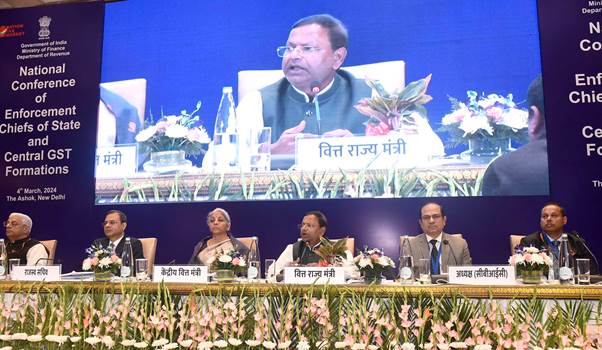
Hailing GST as a big reform in India, Shri Chaudhary said that GST has simplified indirect taxation and brought down the effective tax rate, thereby made lives of people easier. Shri Chaudhary exhorted the GST formations to work towards facilitating more and more taxpayers.
Citing the multi-fold increase in GST collections, Shri Chaudhary appreciated the contribution of the GST authorities in achieving the vision of Prime Minister towards achieving ‘Sabka Saath, Sabka Vikas’. He credited the leadership of Prime Minister and Finance Minister in propelling India's economic journey from fragile five in 2014 to top five now. Shri Chaudhary expressed optimism about achieving a monthly target of Rs. 2 lakh crore in GST revenue soon.
In his address on the occasion, Shri Sanjay Malhotra, Revenue Secretary emphasised the crucial role of enforcement in ensuring the success of the GST system. Shri Malhotra outlined key priorities - targeting high-risk areas, combating tax evaders, balancing enforcement with taxpayer rights, strengthening collaboration between central and state authorities, and gathering feedback for improvement in policy and technological interventions.
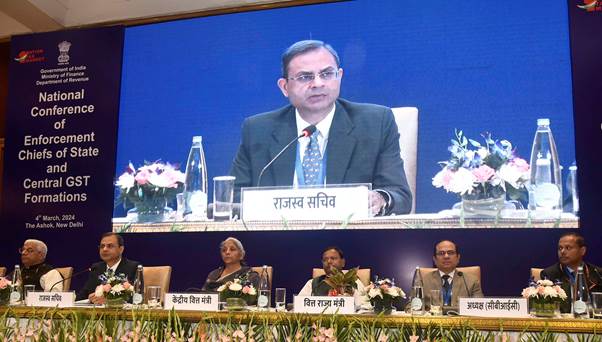
Setting the context of the one-day conference, Shri Sanjay Kumar Agarwal, CBIC Chairman said that fake entities and GST evasion not only erode our national revenue but also distort fair competition and fuel an underground economy. He highlighted the importance of strong data analytics and use of technology and the need to stay ahead of the perpetrators of GST evasion. He reminded the officers to follow the instructions issued by CBIC in respect of procedure to be followed during enforcement action.
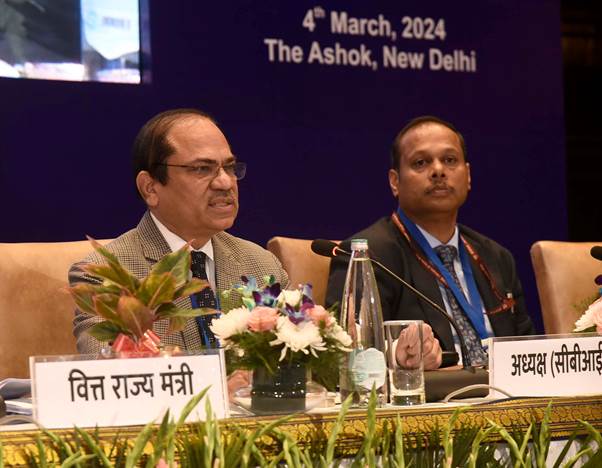
In his welcome address, Additional Secretary, Revenue, highlighted this platform's unique potential for fostering collaboration and sharing best practices in GST enforcement, bringing together Central and State GST authorities.
During the one-day conference, various presentations were also made by the GST formations. As per data presented by GST Council Secretariat, the nationwide crackdown on fake registrations and bogus billing from May 2023 alone has resulted in detection of ITC tax evasion of Rs. 49,623 crore involving 31,512 bogus firms. CBIC presented that it has detected fake ITC evasion of Rs.1,14,755 crore from the year 2020 till date.
Maharashtra State GST showcased the real time monitoring dashboard of suspected non-genuine tax payers (NGTPs). As on 29th February 2024, State has identified 41,601 suspected NGTPs out of which 6,034 NGTPs were detected. It was further highlighted that detection was based on various intelligence gathered during registration, e-way bills and inputs from CBIC/other states and outlined the steps taken to improve detection rate at an early stage.
During the focussed thematic sessions, the delegates from Central and State GST formations discussed various issues through in-depth discussions such as GST evasion typologies, preferred methods, and prevalent sectors, importance of collaborative efforts, need to utilize technology effectively, not only to detect existing fraudulent behavior but also to proactively prevent it by identifying high-risk taxpayers.
Participants deliberated on addressing the menace of fake invoicing and its associated issues like money laundering, identity theft, and circular trading. Best practices and deterrent actions implemented by Directorate General of GST Intelligence were also shared.
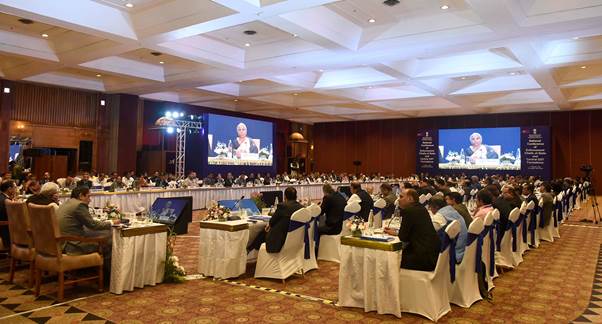
The conference discussed navigating legal and operational challenges faced by enforcement authorities while ensuring minimal disruption for businesses. It was highlighted that CBIC and DGGI have issued instructions emphasising the need to have more taxpayer-friendly approach to GST enforcement, focusing on avoiding unnecessary audits on issues involving prevalent trade practices and prioritising evidence-based inquiries. It also advocates for considering location convenience and requesting information formally through letters instead of using summons.
GSTN and DG Systems, CBIC outlined the various analytical tools available to the tax officers to detect risky taxpayers and combat GST evasion. Discussion was also centred around ways of streamlining the tools and to make them available to all GST enforcement formations. DG Analytics and Risk Management showcased risk analytical tool to detect potential GST evaders early in the cycle even before filing of first return.
Gujarat highlighted the recent success of GST Seva Kendras in reducing the number of fake registrations. The recent case involving fake registration wherein 20 people have been arrested under Gujarat Control of Terrorism and Organised Crime Act, 2015 was also highlighted as a case study of best practice.
Karnataka highlighted unique case typologies such as bill trading in services sector and mild steel scrap, misclassification etc. West Bengal highlighted the benefits of establishing a cyber forensic lab aiding investigation of GST frauds. Uttarakhand, Sikkim and Andhra Pradesh also presented their best practices in GST enforcement.
The conference facilitated experience sharing and knowledge transfer between various states and the central government. Participants reviewed past enforcement actions, extracted valuable learnings, and explored future work areas for tax enforcement officers.
Based on the positive feedback, the conference established the need for regular experience sharing. It was decided to conduct the National Conference of Enforcement Chiefs of State and Central GST Formations bi-annually moving forward.

