 TaxTMI
 Login
 TaxTMI
Login
Loading...
Press 'Enter' to add multiple search terms. Rules for Better Search

Press 'Enter' after typing page number.
Press 'Enter' after typing page number.


No Folders have been created
Are you sure you want to delete "My most important" ?
NOTE:
Press 'Enter' after typing page number.
Press 'Enter' after typing page number.

All News
Press 'Enter' after typing page number.
All News

Note

Bookmark

Share


“SOCIAL JUSTICE IS AN EFFECTIVE AND NECESSARY GOVERNANCE MODEL”
‘VIKSIT BHARAT’ IS ABOUT IMPROVING PEOPLE’S CAPABILITY AND EMPOWERMENT ; UNION FINANCE MINISTER
The government under the leadership of Hon’ble Prime Minister firmly believes to focus on four major castes i.e. ‘Garib’ (poor), ‘Mahilayen’ (women), ‘Yuva’ (youth) and ‘Annadata’ (farmer). This was stated by Smt. Nirmala Sitharaman while presenting the Interim Budget 2024-25 in Parliament today. “Their needs, their aspirations, and their welfare are our highest priority. The country progresses, when they progress. All four require and receive government support in their quest to better their lives. Their empowerment and well-being will drive the country forward”, she added.
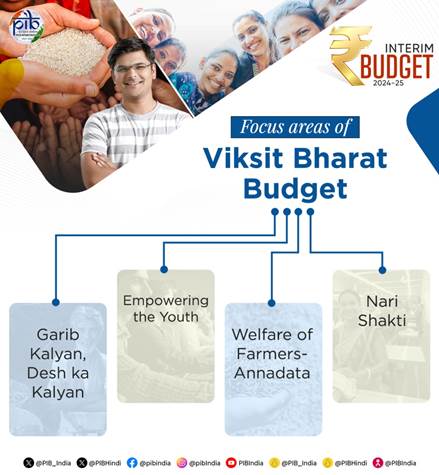
Smt. Nirmala Sitharaman expressed that social justice is an effective and necessary governance model. She further added that emphasis on reducing corruption has brought in transparency and benefits of delivered to all the eligible people. She stressed how ‘Direct Benefit Transfer’ achieved the above. The focus of the government is on outcomes and not on outlays, she added.
Smt. Nirmala Sitharaman stated that all-round, all-pervasive and all-inclusive approach of government towards development is in line with making India a ‘Viksit Bharat’ by 2047. For achieving this goal, we need to improve people’s capability and empower them, she added.

