 TaxTMI
 Login
 TaxTMI
Login
Loading...
Press 'Enter' to add multiple search terms. Rules for Better Search

Press 'Enter' after typing page number.
Press 'Enter' after typing page number.


No Folders have been created
Are you sure you want to delete "My most important" ?
NOTE:
Press 'Enter' after typing page number.
Press 'Enter' after typing page number.

All News
Press 'Enter' after typing page number.
All News

Note

Bookmark

Share


In the run up to Harit Mahotsav, officers & staff from Directorate General of Goods and Services Tax Intelligence (DGGI) New Delhi, planted native and endemic plants, in an effort to supplement conservation of the Aravalli ecosystem at Aravalli Biodiversity Park, Vasant Kunj, New Delhi, in association with Department of Environment Studies, Delhi University, and Delhi Development Authority.
The plantation drive saw active participation by Shri Surjit Bhujabal, Pr.DG, GSTI, Shri Samanjas Das, DG, Shri Rajesh Jindal, Pr. ADG, Shri B.B Gupta, Pr. ADG and other officers & staff of DGGSTI, Hqrs. and Delhi Zonal Unit offices. Dr. M. Shah Hussain, Ecologist and Scientist in charge, Aravalli Biodiversity Park, Dr. Aisha Sultana, Ecologist, Dr. Dinesh Albertson W, Field Biologist, Dr. Rizwan Khan, Field Biologist, Dr. Dushyant Rathore, Field Biologist, Mr. Pradeep Pal Poonia and Mr. Purushottam Pathak, Supervisory staff explained the goals and objectives of this ecological park and guided the team DGGI in plantation drive.
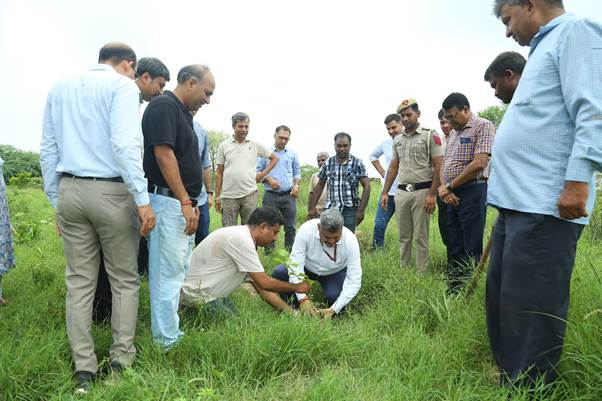
Around 200 plants of local, endemic varieties/natural strains that are native to Aravalli ecosystem were planted to enrich the local flora which will not only prevent the degradation of ecosystem but will enrich the fauna and help in conservation efforts of DDA. The endemic local species of Albizia lebbeck (siris), Bauhinia acuminata (Kachnar), Diospyros mlntana (tendu), Kydia calycina (bharanga), Murraya paniculata (kadipatha), Nyctanthes arbor-tristis (harsingar) , Sapindus trifoliatua(rita), Sapandus emarginata(another type of rita), Senegalia modesta (phulai), Senegalia catechu (khayar), Senegalia senegal (kumttha), Stereospermum chelonoides (patlaa), Terminalia bellirica (Baheda), Terminalia elliptica (aasan), Wrightia arborea (duthi), Wrightia tinctorea (also anotger duthi) were planted to enrich local ecosystem.

This Plantation Drive seeks to create awareness to preserve the biodiversity of habitat and to conserve keystone species and other threatened plant and animal species, establish field gene banks for threatened land races and wild genetic resources, promote education on environmental awareness and nature conservation, establish native communities of the Aravalli hills and the River Yamuna basin particularly of the Delhi region, develop mosaic of treatment and catchment wetlands that not only improve the water quality of untreated sewage but also sustain the rich aquatic flora and fauna of the Yamuna and monitor short term and long term changes in the ecology of the Delhi region.
****
PPG/KMN

