 TaxTMI
 Login
 TaxTMI
Login
Loading...
Press 'Enter' to add multiple search terms. Rules for Better Search

Press 'Enter' after typing page number.
Press 'Enter' after typing page number.


No Folders have been created
Are you sure you want to delete "My most important" ?
NOTE:
Press 'Enter' after typing page number.
Press 'Enter' after typing page number.

All News
Press 'Enter' after typing page number.
All News

Note

Bookmark

Share


GOVERNMENT COMMITTED TO ENSURE QUALITY EDUCATION FOR ALL
SCHOOL ENROLLMENT STANDS AT 26.5 CRORE CHILDREN IN FY22
19.4 LAKH ADDITIONAL SCHOOL CHILDREN ENROLLED IN PRIMARY TO HIGHER SECONDARY LEVEL IN FY 22
SCHOOL DROPOUT RATES WITNESS A STEADY DECLINE IN RECENT YEARS FOR BOTH GIRLS AND BOYS AT ALL LEVELS
A 3.3 % INCREASE IN THE ENROLMENT OF CHILDREN WITH SPECIAL NEEDS (CWSN) IN FY22 i.e 22.7 LAKH AS COMPARED TO 21.9 LAKH IN FY21
PUPIL-TEACHER RATIO IMPROVES AT ALL LEVELS CONTINUOUSLY FROM FY13 TO FY22
OVER 14,500 SCHOOLS TO BE DEVELOPED AS EXEMPLARY SCHOOLS UNDER PM SHRI, MORE THAN 20 LAKH STUDENTS TO BENEFIT
NUMBER OF INDIAN INSTITUTES OF INFORMATION TECHNOLOGY (IIITS) RISES TO 25 IN 2022 AGAINST 9 IN 2014
TOTAL ENROLMENT IN HIGHER EDUCATION INCREASES TO NEARLY 4.1 CRORE IN FY21 FROM 3.9 CRORE IN FY20.
HIGHER EDUCATION SEEES AN INCREASE OF 21 PERCENT IN ENROLMENT SINCE FY15
FEMALE ENROLMENT IN HIGHER EDUCATION INCREASES TO 2 CRORE IN FY21 FROM 1.9 CRORE IN FY20
ENROLMENT IN DISTANCE EDUCATION INCREASES BY AROUND 7 PER CENT OVER FY20 AND BY 20 PER CENT SINCE FY15
GER IN HIGHER EDUCATION RECORDED AT 27.3 PER CENT IN FY21, STOOD AT 25.6 IN FY20
GER FOR MALES INCREASES FROM 24.8 IN FY20 TO 26.7 IN FY21, GER FOR FEMALES IMPROVES FROM 26.4 TO 27.9 DURING SAME PERIOD
The Survey states that the Quality Education which is enlisted as Goal 4 under UN SDGs (SDG4) aims to “Ensure inclusive and equitable quality education and promote lifelong learning opportunities for all” by 2030. It is in this context that the National Education Policy 2020 was laid down as the 1st Education Policy of the 21st century, aiming to address the many growing developmental imperatives of the country. The policy provided for the revision and revamping of all aspects of the education structure. The Union Minister for Finance and Corporate Affairs, Smt Nirmala Sitharaman tabled Economic Survey 2022-23 in Parliament today.
School Enrolment:
The year FY22 saw improvement in Gross Enrolment Ratios (GER) in schools and improvement in gender parity. GER in the primary-enrolment in class I to V as a percentage of the population in age 6 to 10 years – for girls as well as boys have improved in FY 22. This improvement has reversed the declining trends between FY17 and FY19. GER in Upper Primary (enrolment in class VI to VIII as a per cent of the population in age 11-13 years), which was stagnant between FY17 and FY19, improved in FY22. In corresponding age groups in Primary and Upper-Primary levels, girls’ GER is better than boys.
School Gross Enrolment Ratios
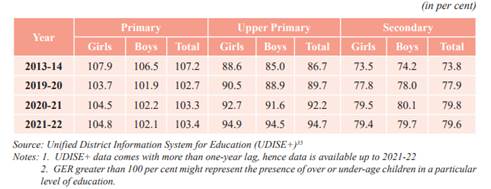
In FY22, school enrolment stood at 26.5 crore children with 19.4 lakh additional children enrolled in Primary to Higher Secondary levels. Total enrolment of Children with Special Needs (CWSN) in FY22 stands at 22.7 lakh as compared to 21.9 lakh in FY21, which is an increase of 3.3 per cent. The enrolments increased across all levels viz., Primary, Upper-Primary, Secondary, and Higher Secondary except for the Pre-Primary level. At the Pre-primary level, enrolment reduced from 1.1 crore in FY21 to 1.0 crore in FY22. During the year, about 1.0 crore children were enrolled in pre-primary, 12.2 crore in Primary, 6.7 crore in Upper Primary, 3.9 crore in Secondary and 2.9 crore in Higher Secondary.
School Drop-out
School dropout rates at all levels have witnessed a steady decline in recent years. The decline is for both girls and boys. The schemes such as Samagra Shiksha, RTE Act, improvement in school infrastructure and facilities, residential hostel buildings, availability of teachers, regular training of teachers, free textbooks, uniforms for children, Kasturba Gandhi Balika Vidyalaya and the PM POSHAN Scheme play an important role in enhancing enrolment and retention of children in schools.
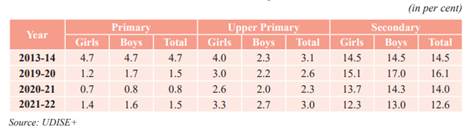
School dropout rates
School Infrastructure
The education infrastructure in the form of schools, amenities, and digitalisation has been steadily promoted along with a focus on pedagogy. The basic infrastructure facilities in schools – both in terms of the number of recognised schools and teachers’ availability reflected in the Pupil-Teacher Ratio, showed an improvement in FY22.
Basic facilities in schools continued to improve in FY22 over earlier years. Toilets (girls or boys), drinking water, and hand-washing facilities are now available in most Government schools. Priority to drinking water and sanitation in schools under Samagra Shiksha Scheme as well as Swachh Bharat Mission have been instrumental in providing required resources and creating these assets in schools. Under the Information & Communication Technology (ICT) component of the Samagra Shiksha Scheme, Government supports the establishment of smart classrooms, and ICT labs in schools, including support for hardware, educational software, and e-content for teaching.
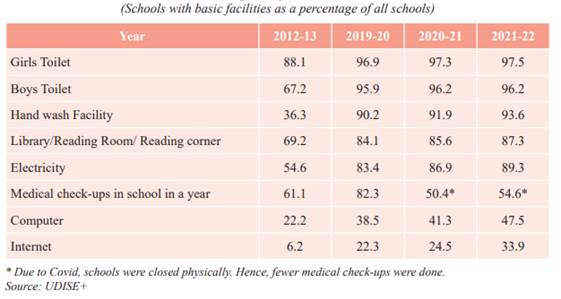
Improving School Infrastructure
The availability of teachers, measured by pupil-teacher ratio, an indicator which is inversely related to improvement in quality of education, has improved at all levels continuously from FY13 to FY22: from 34.0 to 26.2 at Primary, 23.0 to 19.6 at Upper Primary, 30.0 to 17.6 at Secondary, and 39.0 to 27.1 at the Higher Secondary level. The improvement in the number of schools, teachers’ availability, and facilities in schools is expected to help improve enrolment and reduce dropout rates.
Various programmes and schemes for school education launched during FY23 are presented in the following paras.
Higher Education
Number of Indian Institutes of Technology (IITs) and Indian Institute of Management (IIMs), respectively stand at 23 and 20 in 2022 against 16 and 13 in 2014. The strength of Indian Institutes of Information Technology (IIITs) is 25 in 2022 against 9 in 2014.
The total enrolment in higher education has increased to nearly 4.1 crore in FY21 from 3.9 crore in FY20. Since FY15, there has been an increase of around 72 lakh in enrolment (21 per cent). The female enrolment has increased to 2.0 crore in FY21 from 1.9 crore in FY20.
Total Students’ Enrolments in Higher Education
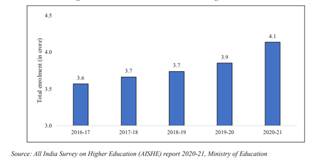
Students’ Enrolment in Higher Education
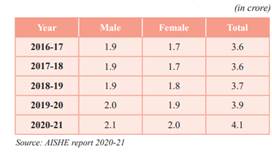
The enrolment in Distance Education is 45.7 lakh (with 20.9 lakh females), an increase of around 7 per cent since FY20 and 20 per cent since FY15. The GER in higher education, based on 2011 population projections (revised), was recorded at 27.3 per cent in FY21, which is an improvement from 25.6 in FY20. GER for males increased from 24.8 in FY20 to 26.7 in FY21 while GER for females has also shown improvement from 26.4 to 27.9 during the same period.
The total number of faculty/teachers in Higher Education is 15,51,070 of which about 57.1 per cent are male and 42.9 per cent are female.
The survey appreciated the various initiatives for Higher education including Research & Development Cell (RDC) in Higher Education Institutions, Guidelines for pursuing two academic programmes simultaneously, Interest subsidy on education loan.
The Survey also mentions about a three-day Akhil Bharatiya Shiksha Samagam organised at Varanasi on 7-9 July 2022 by the Ministry of Education in association with the UGC and Banaras Hindu University. The event brought together over 300 Vice Chancellors and Directors from public and private universities, educationists, policymakers, as also industry representatives to deliberate on how the implementation of NEP 2020 can be taken further across the country after successful implementation of several initiatives in the last two years. The Summit provided a platform for thought-provoking discussions that helped articulate the roadmap and implementation strategies, foster knowledge exchange, build networks through interdisciplinary deliberations, and discuss challenges being faced by educational institutions and articulate solutions.

