

Just a moment...

Top
Help
×

By creating an account you can:

Logo TaxTMI
Call Us / Help / Feedback

Contact Us At :

E-mail: [email protected]

Call / WhatsApp at: +91 99117 96707

For more information, Check Contact Us

FAQs :

To know Frequently Asked Questions, Check FAQs

Most Asked Video Tutorials :

For more tutorials, Check Video Tutorials

Submit Feedback/Suggestion :

Email :
Please provide your email address so we can follow up on your feedback.
Category :
Description :
Min 15 characters0/2000
Make Most of Text Search
  1. Checkout this video tutorial: How to search effectively on TaxTMI.
  2. Put words in double quotes for exact word search, eg: "income tax"
  3. Avoid noise words such as : 'and, of, the, a'
  4. Sort by Relevance to get the most relevant document.
  5. Press Enter to add multiple terms/multiple phrases, and then click on Search to Search.
  6. Text Search
  7. The system will try to fetch results that contains ALL your words.
  8. Once you add keywords, you'll see a new 'Search In' filter that makes your results even more precise.
  9. Text Search
Add to...
You have not created any category. Kindly create one to bookmark this item!
Create New Category
Hide
Title :
Description :
❮❮ Hide
Default View
Expand ❯❯
Close ✕
🔎 News - Adv. Search
TEXT SEARCH:

Press 'Enter' to add multiple search terms. Rules for Better Search

Search In:
Main Text + AI Text
  • Main Text
  • Main Text + AI Text
  • AI Text
Category: ?
Categorized by AI
---- All Categories ----
  • ---- All Categories ----
  • Income Tax
  • GST
  • Customs, DGFT & SEZ
  • FEMA & RBI
  • Corp. Laws, SEBI & IBC
  • PMLA, Black Money & ED
  • Budget
  • News and Press Release
  • PTI News
Month:
---- All Months ----
  • ---- All Months ----
  • January
  • February
  • March
  • April
  • May
  • June
  • July
  • August
  • September
  • October
  • November
  • December
Year:
---- All Years ----
  • ---- All Years ----
  • 2026
  • 2025
  • 2024
  • 2023
  • 2022
  • 2021
  • 2020
  • 2019
  • 2018
  • 2017
  • 2016
  • 2015
  • 2014
  • 2013
  • 2012
  • 2011
Sort By: ?
In Sort By 'Default', exact matches for text search are shown at the top, followed by the remaining results in their regular order.
RelevanceDefaultDate
    Colombian president asks Trump to suspend tariffs to help earthquake recovery
    Mission Samudra to be launched alongside Vizhinjam’s EXIM operations
    Europe emerges top destination for India's electric car shipments in Q1
    Govt sets LPG production targets for refiners; Reliance gets largest quota
    PM urges MSMEs to tap opportunities from FTAs
    PM urges farmers to adopt 'chemical-free farming' to tap rising global demand for such food items
    Govt rolls out foreign asset disclosure scheme for small taxpayers
    Need one or two Indian pharma firms to be among global top 5: PM Modi
    Small taxpayers with€™ foreign assets to face 30 pc tax plus penalty; disclosure scheme opens till Dec 31
    PM urges MSMEs to tap opportunities from FTAs
    Govt cuts windfall gains tax on petrol, diesel, ATF exports
    Modi warns of weaponisation of resources, sea routes; urges energy self-reliance
    Current account deficit widens to USD 6.2 bn in Jun: RBI data
    Concessional swap facility attracts USD 56.85 bn forex inflows: RBI
    DFS Highlights Mechanism for Timely Redressal of Insurance Policyholders’ Grievances
    Forex kitty jumps USD 14.14 bn to USD 707 bn in one of the biggest weekly expansions
    PROVISIONAL ESTIMATES OF WHOLESALE PRICE INDEX, OUTPUT PRODUCER PRICE INDEX, AND TRIAL INPUT PRODUCER PRICE INDEX FOR THE MONTH OF JULY 2026, AND FINA...
    Logistics Data Bank Tracks 10 Crore EXIM Containers, Provides Visibility across Logistics Chain
    APEDA and Government of Tripura Organise International Organic Buyer-Seller Meet to Expand Global Market Linkages
    WPI inflation eases to 9.78 pc in July on softening in fuel prices
❯❯
MaximizeMaximizeMaximize
0 / 200
Expand Note
Add to Folder

No Folders have been created

    +

    Are you sure you want to delete "My most important" ?

    NOTE:

    News
    Showing Results for :
    Reset Filters
    Results Found:
    Show All SummariesHide All Summaries
    August 16, 2026
    Show AI Summary
    Temporary tariff suspension for earthquake recovery is sought to ease pressure on affected Colombian businesses.
    Temporary suspension of high tariffs on Colombian products has been sought to support business recovery following a severe earthquake declared a natural disaster. The request links tariff relief to economic disruption affecting businesses amid extensive destruction, injuries and missing persons. United States emergency assistance has been provided through food, shelter and health supplies, while no response to the tariff-suspension request had been reported.
    August 16, 2026
    Show AI Summary
    Port-led industrial development and direct export operations aim to expand logistics infrastructure, market access and trade connectivity.
    Mission Samudra is proposed as a port-led industrial and logistics development programme linked to the commencement of export-import operations at Vizhinjam seaport. It covers industrial clusters, new cities, port connectivity, logistics, development initiatives, programme management and capacity building. Direct export shipments are intended to improve overseas-market access and reduce transit time and logistics costs, particularly for small and medium enterprises. The framework also anticipates growth in warehousing, cold storage, container freight stations and logistics parks, supported by private participation and road and rail connectivity.
    August 16, 2026
    Show AI Summary
    Electric vehicle export diversification strengthens India's presence across European, Asia-Pacific and Latin American markets through expanding overseas demand.
    India's electric motor car exports expanded sharply in the first quarter of 2026-27, reflecting increased international acceptance and competitiveness of India-manufactured electric vehicles. Europe became the principal export destination, led by Spain and the United Kingdom, with further demand across several European markets. Exports also reached Asia-Pacific markets, Nepal and emerging Latin American destinations. This wider market presence reflects improving quality and safety standards, stronger integration into global electric-vehicle supply chains, and diversification of India's electric-vehicle export profile.
    August 16, 2026
    Show AI Summary
    LPG production preparedness requires refiners and upstream producers to maintain capacity and increase output during supply constraints.
    Government has established a standing LPG production preparedness framework under which refining companies, oil marketing companies and upstream producers may be directed to increase production during supply constraints. Companies must maintain adequate LPG storage, evacuation and transportation infrastructure and pursue technically and economically feasible production-enhancing measures. Written directions may prescribe production quantities and periods, including restrictions on alternative uses of input streams required for LPG. The production schedule is updated twice yearly to reflect new facilities and added capacity from infrastructure, technology and distribution improvements.
    August 16, 2026
    Show AI Summary
    Free trade agreement market access requires MSMEs, farmers and exporters to meet global quality standards.
    Free trade agreements expand market-access opportunities for Indian MSMEs, exporters and producers through reduced or eliminated import duties on traded goods. Textiles, machinery, medicines, seafood and agricultural products can access international markets where they meet global standards and remain competitively priced. Farmers and producers are encouraged to develop export-oriented products, including chemical-free agricultural produce, while MSMEs may use preferential trade access to support manufacturing, exports, employment and growth.
    August 15, 2026
    Show AI Summary
    Chemical-free farming can strengthen agricultural exports by meeting global standards and responding to rising international demand.
    Chemical-free farming is urged to meet growing global demand and expand agricultural exports. Agricultural products must meet global parameters to facilitate access to international markets, including markets opened through free trade agreements. Food processing, export-oriented farm production, and global branding of traditional cuisine, millets, spices, fruits and flowers are identified as important elements of agriculture and food production policy.
    August 15, 2026
    Show AI Summary
    Voluntary foreign asset disclosure allows eligible taxpayers to regularise overseas holdings with immunity from further tax, penalties and prosecution.
    FAST-DS permits eligible taxpayers to disclose specified undisclosed foreign assets, foreign income, and foreign assets omitted from return schedules. Undisclosed assets or income not previously offered to tax may be declared up to Rs 1 crore on payment of an effective 60 per cent levy, based on fair market value as of 31 March 2026. Assets already offered to tax, or acquired during non-resident status but omitted from the return schedule, may be declared up to Rs 5 crore on payment of a fee. Valid declarations provide immunity from further tax, penalty and prosecution, while declared amounts are excluded from total income.
    August 15, 2026
    Show AI Summary
    Global pharmaceutical leadership is urged through Indian firms achieving top-five status, supported by generic manufacturing and export capacity.
    Indian pharmaceutical companies are urged to attain representation among the world's five leading pharmaceutical firms, despite India's established position as a major producer of generic medicines. India has a broad manufacturing base, supplies generic medicines across numerous therapeutic categories, and exports to worldwide markets including highly regulated jurisdictions. Although pharmaceutical exports and the domestic market have expanded, Indian firms have not yet secured positions among the largest global companies. Greater international scale may be supported through acquisitions and expanded established-brand and branded-generic operations.
    August 15, 2026
    Show AI Summary
    Foreign asset voluntary disclosure permits eligible small taxpayers to regularise qualifying assets through tax, additional levy, and statutory immunity.
    FAST-DS permits eligible small taxpayers to voluntarily disclose specified foreign assets or foreign income. It covers undisclosed foreign assets or income not offered to tax, subject to an aggregate value threshold of Rs 1 crore, and certain foreign assets omitted from the relevant return schedule, subject to a Rs 5 crore threshold and prescribed fee. Payment comprises 30 per cent tax and an additional equal amount. Disclosed income or investment is excluded from total income, with immunity from further tax, penalty and prosecution under the Black Money Act for the disclosed asset or income.
    August 15, 2026
    Show AI Summary
    Free trade agreement opportunities require MSMEs to meet global standards and expand exports across textiles, machinery, medicines and seafood.
    Free trade agreements are presented as export-market opportunities for Indian MSMEs because they reduce or eliminate import duties on a substantial range of traded goods. MSMEs are urged to expand exports of textiles, machinery, medicines and seafood, including shrimp, by meeting global quality standards and offering products competitively. Their export role is linked to self-reliance and their significant contribution to manufacturing, exports, GDP and employment.
    August 15, 2026
    Show AI Summary
    Windfall gains tax on petroleum exports was reduced to support domestic fuel availability and limit export price advantages.
    Special additional excise duty (windfall gains tax) on exports of petrol, diesel and aviation turbine fuel was reduced from 15 August 2026. Petrol export duty was reduced to nil, and export-duty rates on diesel and ATF were lowered. Duty rates for petrol and diesel cleared for domestic consumption remained unchanged. The export-duty framework seeks to maintain domestic petroleum-product availability and limit export advantages arising from higher global crude oil prices amid West Asia tensions.
    August 15, 2026
    Show AI Summary
    Energy self-reliance drives diversified fuel sourcing, expanded offshore exploration, and domestic capacity to reduce geopolitical supply vulnerability.
    Energy security policy seeks to reduce exposure to geopolitical pressure and supply disruption caused by dependence on overseas fuel and strategic maritime routes. India is diversifying crude oil and LNG sourcing while strengthening domestic hydrocarbon production through offshore exploration, seismic surveys, exploratory drilling and shared infrastructure. Expanded access to sedimentary basins is intended to unlock domestic oil and gas resources. Wider piped natural gas coverage, solar generation, critical-mineral exploration, and nuclear and other non-fossil energy sources support the broader objective of energy self-reliance.
    August 14, 2026
    Show AI Summary
    Current account deficit widened as merchandise trade imbalance expanded, despite stronger services surplus, transfers, and positive capital inflows.
    India's current account deficit widened in June 2026, principally because merchandise imports increased faster than exports and expanded the merchandise trade deficit. A higher services surplus, increased net transfers and a narrower net income deficit provided partial offsets. Net capital inflows, including foreign direct investment and foreign portfolio investment, supported a positive overall monthly balance. During the April-June quarter, despite increased services surplus and net transfers, the overall balance shifted to a deficit as the merchandise trade deficit widened.
    August 14, 2026
    Show AI Summary
    Concessional foreign-currency swap facility closes early for new FCNR(B) deposits while ECB and OFCB access remains available.
    The concessional swap facility for FCNR(B) deposits encourages foreign-currency inflows and supports foreign-exchange liquidity. New FCNR(B) deposits eligible for the facility must be mobilised by 31 August 2026, while swaps for eligible deposits may be availed until 11 September 2026. The swap arrangement for External Commercial Borrowings and Overseas Foreign Currency Borrowings remains available until 31 December 2026.
    August 14, 2026
    Show AI Summary
    Insurance grievance redressal requires initial insurer complaint, prompt acknowledgement, and escalation through integrated monitoring channels when resolution remains unsatisfactory.
    Insurance policyholder grievances must first be raised with the concerned insurer, whose Grievance Redressal Officer and Board-level monitoring committee oversee redressal. Complaints received through digital channels, correspondence or call centres are recorded in the insurer's Complaints Management System, integrated with Bima Bharosa. Insurers must acknowledge complaints immediately and resolve them within 14 days. Where no response is received within a reasonable period or the response is unsatisfactory, policyholders may escalate through Bima Bharosa or designated helplines, email or physical correspondence.
    August 14, 2026
    Show AI Summary
    Foreign exchange reserve growth reflects increases in foreign currency assets, gold holdings, special drawing rights, and IMF reserve position.
    India's foreign exchange reserves rose to USD 707.002 billion for the week ended 7 August 2026. The increase comprised higher foreign currency assets, gold reserves, special drawing rights and the reserve position with the IMF. Foreign currency asset valuation incorporates appreciation or depreciation of non-US currencies held in reserve assets. Measures including the FCNR(B) scheme were introduced to attract additional foreign exchange inflows.
    August 14, 2026
    Show AI Summary
    Wholesale and producer price indices show July inflation movements, provisional estimates, final revisions, and manufacturing input-price trends.
    Wholesale Price Index, Output Producer Price Index, and trial Input Producer Price Index estimates under the 2022-23 base-year series set out provisional July 2026 measures and final May 2026 revisions. All-commodities WPI stood at 110.0 in July 2026, with year-on-year inflation of 9.78 per cent. The all-commodities Output PPI was unchanged at 109.9, while the trial Input PPI for manufacturing was provisionally estimated at 105.9. Final May WPI, Output PPI and trial Input PPI measures were revised from their respective provisional estimates.
    August 14, 2026
    Show AI Summary
    Logistics data visibility enables EXIM container tracking, operational analytics and multimodal shipment monitoring across India's logistics chain.
    Logistics Data Bank provides near real-time visibility of India's EXIM container movement through technology-based tracking and stakeholder monitoring tools. RFID-based coverage extends across ports, terminals, inland logistics facilities, rail networks, industrial zones, borders and highways. The platform uses RFID, Internet of Things, Big Data and Cloud technologies, with analytics on dwell time, transit time, and port and terminal performance to identify logistics bottlenecks. LDB 2.0 adds high-seas tracking of export containers and multimodal shipment visibility.
    August 14, 2026
    Show AI Summary
    International organic buyer-seller linkages support Tripura producers through direct sourcing engagement, market access and sustainable export opportunities.
    International Organic Buyer-Seller Meet in Tripura created a direct platform for organic producers, Farmer Producer Organisations, exporters and international buyers to explore sourcing opportunities, market requirements and long-term commercial linkages. Organic and naturally produced goods, including Queen Pineapple, GI-tagged Kalikhasa Rice, organic ginger and turmeric, black sesame, jackfruit and scented lemon, were showcased through product displays and producer interactions. The initiative seeks to strengthen global market access, sourcing partnerships and income opportunities for organic farmers.
    August 14, 2026
    Show AI Summary
    Wholesale price inflation moderation was driven by softer fuel prices, while manufactured goods and primary articles recorded higher inflation.
    Wholesale price inflation moderated in July, led by a decline in fuel and power inflation and a marginal easing in food-article inflation. Inflation in manufactured products and primary articles increased, making the moderation uneven across groups. Mineral oils, food articles, basic metals, non-food articles, food products, and chemical products remained significant inflation drivers. The output Producer Price Index remained unchanged year-on-year, with lower manufacturing and mining inflation offset by higher agriculture and electricity producer-price inflation.

    News

    Back

    All News

    Showing Results for :
    Reset Filters
      No Records Found

      News

      Back

      All News

      whatsappJoin Channel
      Showing Results for : Reset Filters
      PMLA, Black Money & ED

      PM dedicates 75 Digital Banking Units across 75 districts to the nation

      October 17, 2022

      Contents
      Summary
      Note

      Note

      -

      Bookmark

      Print

      Print

      PM dedicates 75 Digital Banking Units across 75 districts to the nation

      “We have given top priority to ensure that banking services reach the last mile”

      “A whole new world of possibilities opens up when financial partnerships are combined with digital partnerships”

      “Today the number of branches per one lakh adult citizens in India is more than countries like Germany, China and South Africa”

       “The IMF has praised India's digital banking infrastructure”

      “The World Bank has even gone so far as to say that India has become a leader in ensuring social security through digitization”

      “Banking today has gone beyond financial transactions and has also become a medium of ‘Good Governance’ and ‘Better Service Delivery’”

      “If Jan Dhan accounts had laid the foundation of financial inclusion in the country, then Fintech would form the basis of financial revolution”

       “Today the entire country is experiencing the power of Jan Dhan Bank accounts”

      “The economy of any country is as progressive as its banking system is strong”

      Deploying technology to achieve development goals is a hallmark of our Government, says Smt. Sitharaman

      DBUs an enabler in digital ecosystem, to improve customer experience by facilitating seamless banking transactions: RBI Governor

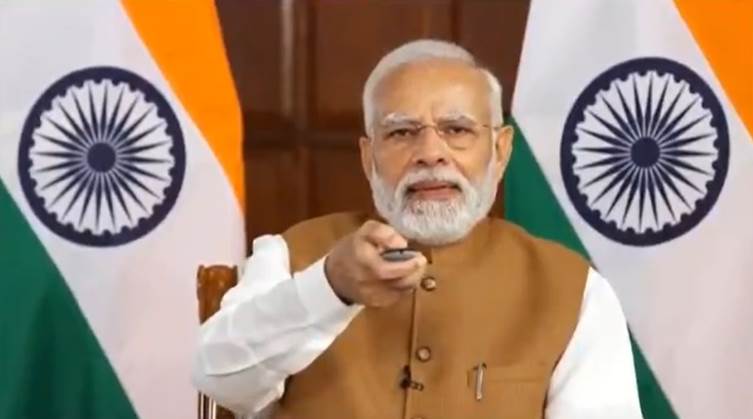
      The Prime Minister, Shri Narendra Modi dedicated 75 Digital Banking Units (DBU) across 75 districts to the nation via video conferencing.
      https://static.pib.gov.in/WriteReadData/userfiles/image/image001OT9Q.jpg

      Addressing the gathering, the Prime Minister started by stressing that the 75 Digital Banking Units (DBU) will further financial inclusion and enhance banking experience for citizens. “DBU is a big step in the direction of Ease of Living for the common citizens”, he said. The Prime Minister informed that in such a banking setup, the government aims to provide maximum services with minimum infrastructure, and all of this will happen digitally without involving any paperwork. It will also simplify the banking procedure while also providing a robust and secure banking system. “People living in small towns and villages will find benefits like transferring money to availing loans. Digital Banking Units are another big step in that direction which is going on in the country to make the life of common man of India easier”, he added.

      The Prime Minister said that the aim of the government is to empower the common citizen and make them powerful, and as a result, policies were made keeping in mind the last person and the entire government moving in the direction of their welfare. He pointed out the two areas on which the government worked simultaneously. First, reforming, strengthening, and making the banking system transparent, and secondly financial inclusion.

      Recalling the traditional ways of the past where people had to go to the bank, the Prime Minister said that this government transformed the approach by bringing the bank to the people. “We have given top priority to ensure that banking services reach the last mile”, he said.  A huge change from the days when it was expected that poor will go to the bank to a scenario when the banks were going on the doorstep of the poor. This involved reduction of distance between the poor and the banks. “We not only removed the physical distance but, most importantly, we removed the psychological distance.” Highest priority was given to cover far flung areas with banking. The Prime Minister informed that today more than 99 percent of villages in India have a bank branch, banking outlet or a ‘banking mitra’ within 5 km radius. “Extensive Post Office network too was harnessed via India Post Banks for providing the banking needs to the common citizens”, he said. “Today the number of branches per one lakh adult citizens in India is more than countries like Germany, China and South Africa”, he added.

      Despite initial misgivings in certain sections, the Prime Minister said, “today the entire country is experiencing the power of Jan Dhan Bank accounts.” He informed that these accounts enabled the government to provide insurance to the vulnerable at a very low premium. “This opened the way for loans for the poor without collateral and provided Direct Benefit Transfer to the accounts of the target beneficiaries. These accounts were the key modality for providing homes, toilets, gas subsidy, and benefits of schemes for farmers could be ensured seamlessly”, he said. The Prime Minister acknowledged the global recognition for India’s digital banking infrastructure. “The IMF has praised India's digital banking infrastructure. The credit for this goes to the poor, farmers and labourers of India, who have adopted new technologies, made it a part of their lives”, he emphasised.

      “UPI has opened up new possibilities for India,” the Prime Minister continued, “When financial partnerships are combined with digital partnerships, a whole new world of possibilities opens up. A huge example like UPI is before us. India is proud of this as it is the first technology of its kind in the world.” He informed that today 70 crore indigenous Rupay cards are in operation, a vast change from the days of foreign players and the elite nature of such products. “This combination of technology and economy is enhancing the dignity and affordability for the poor and empowering the middle class, while at the same time it is also eliminating the digital divide of the country”, he said. He also praised the role of DBT in eliminating corruption and said that more than 25 lakh crore rupees have been transferred in various schemes via DBT. He informed that he will transfer the next instalment to the farmers tomorrow. “Today the whole world is appreciating this DBT and the digital power of India. Today it is being seen as a global model. The World Bank has even gone so far as to say that India has become a leader in ensuring social security through digitization”, said the Prime Minister.

      The Prime Minister informed that fintech is at the heart of India's policies and efforts, and it is playing a key role in shaping the future. Digital banking units will further expand this capability of fintech. “If Jan Dhan accounts had laid the foundation of financial inclusion in the country, then Fintech would form the basis of financial revolution”, he said.

      Referring to the government’s announcement of the launch of a digital currency based on blockchain technology, the Prime Minister pointed out that “Be it digital currency in the coming times, or digital transactions in today's time, apart from the economy, many important aspects are associated with them”. He listed the savings, elimination of the hassle of physical currency and environmental benefits as key advantages. The Prime Minister pointed out that paper and ink for currency printing are imported, and by adopting a digital economy we are contributing to a self-reliant India while also benefiting the environment by reducing the consumption of paper.

      The Prime Minister pointed out that banking today has gone beyond financial transactions and has also become a medium of ‘Good Governance’ and ‘Better Service Delivery’. Today, this system has given rise to immense possibilities for growth for the private sector and small-scale industries as well. He further added that there is hardly any area in India in which product and service delivery through technology is not creating a new startup ecosystem. “Digital economy today is a great strength of our economy, of our startup world, of Make in India and of self-reliant India”, he said. “Today our small industries, our MSMEs are also participating in government tenders through a system like GEM. They are getting new business opportunities. So far, orders worth Rs 2.5 lakh crore have been placed on GEM. Many more new opportunities will now arise in this direction through digital banking units”, he added.

      “The economy of any country is as progressive as its banking system is strong”, the Prime Minister remarked. He informed that the country has shifted from the pre-2014 ‘phone banking’ system to digital banking in the last 8 years, and as a result, India's economy is moving forward with a continuum. Recalling the old ways, the Prime Minister pointed out that before 2014, the banks used to get phone calls to decide their functioning. He further added that phone banking politics had made the banks unsafe and made the country's economy insecure by sowing the seeds of thousands of crores of scams.

      Throwing light on how the present government had transformed the system, the Prime Minister informed that transparency has been the main focus. He continued, “After bringing transparency in the identification of NPAs, lakhs of crores of rupees were brought back into the banking system. We recapitalized banks, took action against willful defaulters, and reformed the Prevention of Corruption Act.” He further noted that the resolution of NPA-related issues was expedited with the help of IBC while promoting the use of technology and analytics for loans, for the creation of a transparent and scientific system. “Decisions such as the merger of banks were victims of policy paralysis and the country took them boldly. The results of these decisions are before us today”, he added. He informed that a new self-driven mechanism is now being created for the banking system through new initiatives like digital banking units and innovative use of Fintech. There is as much autonomy for the consumers, there is also the same convenience and transparency for the banks, he said while asking the stakeholders to take the movement further.

      In concluding his address, the Prime Minister urged the small business owners from villages to completely move towards digital transactions. He also urged banks to connect 100 merchants with them for going totally digital for the benefit of the country. “I am sure, this initiative will take our banking system and economy to a stage which will be future-ready, and will have the capability to lead the global economy”, Shri Modi concluded.

      In her address on the occasion, Union Minister for Finance & Corporate Affairs Smt. Nirmala Sitharaman said that during Amrit Kaal, honourable Prime Minister, honouring your vision for greater use of technology and getting digital banking into India, the Scheduled Commercial Banks are establishing 75 Digital Banking units (DBUs) in 75 districts of our country.

      Smt. Sitharaman, while participating in the launch via video conference from Washington DC, said that DBUs will enable people who do not have a personal computer, who do not have a laptop, or do not have even a smartphone, to be able to access banking services. They can do it digitally in a paperless mode. For those who are not even tech savvy, there is a mode where they can be facilitated to avail of these paperless services.

      The Finance Minister said that deploying technology to achieve development goals is the hallmark of our Government.

      Smt. Sitharaman said, “As Reserve Bank Governor also explained, paperless operations will be available 24x7. Even cash deposit facilities or opening of a deposit of fixed deposit or recurring deposits, one can avail of all these services. Government's credit link schemes through the Jan Samarth portal will also be available for ordinary users, MSME and retail loan users can benefit out of it.”

      As was explained, the Union Finance Minister said, financial literacy can be promoted through these DBU units. Financial inclusion and digital banking go another mile in achieving greater digitising and formalising of Indian economy. “I urge all the representatives who are present here today to spend at least some time each day to promote literacy, financial literacy, digital education for the bank customers and for all those business units which are small in your neighbourhood, Smt. Sitharaman said.

      The Finance Minister said, “Popularising digital banking is important, so the most important aspect is that it is going to be cost effective for the consumer and it is going to be absolutely safe and secure for them to use it. These thoughts will have to be promoted by the bank agents, meaning banking agents, banking correspondent bank managers and all officials so that greater formalisation of the Indian economy can be achieved.”

      Congratulating the RBI and the Indian Bank Association for very speedy documenting this in a very efficient manner, Smt. Sitharaman said that the DBUs will go a long way in giving further and faster digital banking in India and help our economy to move towards a cashless and inclusive economy.

      On the ocassion, RBI Governor Shri Shaktikanta Das in his address said that this is indeed a historic occasion when 75 Digital Banking Units (DBUs) are being dedicated to the service of the nation by the Prime Minister at a time when we are celebrating ‘Azadi Ka Amrit Mahotsav’.  This is a joint initiative of the Government, the RBI, the Indian Banks Association and the participating banks.

      In recent years, the RBI Governor said, digital banking has emerged as a preferred channel for delivering banking services in the country. The Reserve Bank has been taking progressive measures to improve availability of digital infrastructure for banking services. Following the announcement made in the Union Budget 2022-23 for setting up of 75 DBUs, the RBI issued the required guidelines after consulting the Indian Banks Association and other experts in the field.

      Shri Das noted that the commercial banks – both in the public and private sectors – have responded very positively to this initiative. 75 DBUs have been set up in record six months’ time in 75 districts of the country to commemorate 75 years of our independence.

      Shri Das said that DBUs will act as an enabler in the digital ecosystem and will improve customer experience by facilitating seamless banking transactions as also augment our efforts to promote financial inclusion by providing banking services in a paperless, efficient, safe and secure environment.

      The RBI Governor further said, the specific financial services to be provided by the DBUs include, among other things, savings, credit, investment and insurance. On the credit delivery front, to start with, the DBUs will provide end-to-end digital processing of small ticket retail and MSME loans, starting from online applications to disbursals.

      Shri Das said, "The DBUs will also provide services related to certain identified government sponsored schemes. The products and services in these Units will be provided in two modes, namely, self-service and assisted modes, with self-service mode being available on 24*7*365 basis. The banks are also free to engage the services of digital business facilitators and business correspondents to expand the footprint of the DBUs."

      The function was attended by Union Finance Minister; Chief Ministers; Union and State Ministers; Governor, RBI; LGs; MPs and MLAs; Secretaries and other senior officials from Government of India. MD & CEOs, officials of Banks & other public representatives also attended the event from various DBUs across the country.  All the officials posted at the 75 DBUs were also connected during the event.

      ABOUT DIGITAL BANKING UNITS (DBUs)

      The DBUs will enable those who do not have ICT infrastructure to access banking services digitally. They will also assist those who are not tech savvy to adopt digital banking. In DBU, the products and services will be offered to customers in 2 modes:

      • Self Service Mode
      • Digital Assistance Mode

      DBUs will be different from traditional branch in following aspects:

      • They will provide banking services including cash deposit & withdrawal 24 x 7.
      • Services shall be provided digitally.
      • People not having connectivity or computing devices can do banking transactions from DBU in a paperless mode.
      • Bank staff will be available to help and guide users for banking transactions in assisted mode
      • Will help in providing digital financial literacy and create awareness for adopting digital banking.

      Services being offered through DBU include banking facilities like opening of savings account, balance-check, print passbook, transfer of funds, investment in fixed deposits, loan applications, stop-payment instructions for cheques issued, application for credit / debit cards, view statement of account, pay taxes, pay bills, make nominations, etc. The DBUs will also facilitate onboarding to Government credit link schemes through the Jan Samarth portal and end-to-end digital processing of a small ticket MSME/retail loans. 

      BACKGROUND

      In yet another measure to deepen financial inclusion, the Prime Minister, Shri Narendra Modi dedicated 75 Digital Banking Units (DBUs) to the nation via video conferencing.

      As part of the Union budget speech for 2022-23, the Finance Minister announced setting up the 75 DBUs in 75 districts to commemorate our country's 75 years of independence. The DBUs are being set up with the objective to ensure the benefits of digital banking reach every nook and corner of the country and will cover all the States and Union territories. 11 Public Sector Banks, 12 Private Sector Banks and one Small Finance Bank are participating in the endeavour.

      DBUs will be brick-and-mortar outlets which will provide a variety of digital banking facilities to people such as opening savings accounts, balance-check, print passbooks, transfer of funds, investment in fixed deposits, loan applications, stop-payment instructions for cheques issued, applying for credit/debit cards, view statement of account, pay taxes, pay bills, make nominations, etc.

      DBUs will enable customers to have cost-effective, convenient access and enhanced digital experience of banking products and services throughout the year. They will spread Digital Financial Literacy and special emphasis will be given to customer education on cyber security awareness and safeguards. Also, there shall be adequate digital mechanisms to offer real-time assistance and redress customer grievances arising from business and services provided by the DBUs directly or through Business Facilitators/ Correspondents.

      CLICK HERE to access the list of Digital Banking Units (DBUs).

      Topics

      ActsIncome Tax