

Loading...

⚠ ✕
❮ Top
☎ Help
☰
×

By creating an account you can:

Logo TaxTMI
Call Us / Help / Feedback✕

Contact Us At :

✉ E-mail: [email protected]

✆ Call / WhatsApp at: +91 99117 96707

For more information, Check Contact Us

FAQs :

To know Frequently Asked Questions, Check FAQs

Most Asked Video Tutorials :

For more tutorials, Check Video Tutorials

Submit Feedback/Suggestion :

Email :
Please provide your email address so we can follow up on your feedback.
Category :
Description :
Min 15 characters 0/2000
Make Most of Text Search ✕
  1. Checkout this video tutorial: How to search effectively on TaxTMI.
  2. Put words in double quotes for exact word search, eg: "income tax"
  3. Avoid noise words such as : 'and, of, the, a'
  4. Sort by Relevance to get the most relevant document.
  5. Press Enter to add multiple terms/multiple phrases, and then click on Search to Search.
  6. Text Search
  7. The system will try to fetch results that contains ALL your words.
  8. Once you add keywords, you'll see a new 'Search In' filter that makes your results even more precise.
  9. Text Search
╳
Add to...
You have not created any category. Kindly create one to bookmark this item!
✕
Create New Category
Hide
Title :
Description :
❮❮ Hide
❮ Default View
Expand ❯❯
Close ✕
🔎 Filters / Advanced Search ❯
TEXT

Press 'Enter' to add multiple search terms. Rules for Better Search

Search In
Main Text + AI Text ❯
  • Main Text
  • Main Text + AI Text
  • AI Text
Category: ?
Categorized by AI
---- All Categories ---- ❯
  • ---- All Categories ----
  • Income Tax
  • GST
  • Customs, DGFT & SEZ
  • FEMA & RBI
  • Corp. Laws, SEBI & IBC
  • PMLA, Black Money & ED
  • Budget
  • News and Press Release
  • PTI News
Month:
---- All Months ---- ❯
  • ---- All Months ----
  • January
  • February
  • March
  • April
  • May
  • June
  • July
  • August
  • September
  • October
  • November
  • December
Year:
---- All Years ---- ❯
  • ---- All Years ----
  • 2026
  • 2025
  • 2024
  • 2023
  • 2022
  • 2021
  • 2020
  • 2019
  • 2018
  • 2017
  • 2016
  • 2015
  • 2014
  • 2013
  • 2012
  • 2011
Sort By: ?
In Sort By 'Default', exact matches for text search are shown at the top, followed by the remaining results in their regular order.
Relevance Default Date
    India–Nepal Inter-Governmental Sub-Committee on Trade, Transit and Cooperation to Control Unauthorised Trade Meets in New Delhi
    OnEMI Technology Solutions Limited’s Board Approves Fundraise of approximately ₹832 Crore through a Preferential Issue of Securities
    CGST Delhi South officers bust firm in fraudulent availment of ITC involving over Rs. 25.22 crore; proprietor arrested
    Net direct tax collection rises 13 pc to Rs 12.12 lakh cr till Sep 17 on higher advance tax mop-up
    Protean launches next-generation KYC Onboarding & Reporting Solution at Global Fintech Fest 2026
    Japan's central bank raises benchmark interest rate to 1.25 pc, highest in 31 years
    Net direct tax collection rises 13 pc to Rs 12.12 lakh cr till Sept 17 on higher advance tax mop-up
    SP Group backs Tata Sons listing, bolstering board's push despite Trusts' opposition
    Shapoor Mistry backs Tata Sons listing, calls it opportunity for greater accountability
    India Welcomes Passage of New Zealand Legislation to Give Effect to India-New Zealand FTA
    CCI approves acquisition of certain additional shareholding in Azure Power Global Limited by OMERS Infrastructure Asia Holdings Pte. Ltd.
    CCI approves acquisition of certain equity share capital of Great White Global Pvt Ltd by ISAF III Onshore Fund, India Special Assets Fund III, Specia...
    CCI approves acquisition of three professional cricket franchises: Rajasthan Royals (India), Paarl Royals (South Africa) and Barbados Royals (Barbados...
    India warns that Washington's Russia sanctions bill holds implications for bilateral ties, energy market
    Tata Sons in open revolt: Board reappoints Chandrasekaran, Trusts call it illegal
    Tata Trusts puts Rs 25,000 cr SP Group liquidity plan before Tata Sons board
    Tata turf war spills over: Board reappoints Chandrasekaran, Trusts call it illegal
    Scale up fishing capacity in EEZ, target high-value species for export: Minister to fishermen
    FinMin allays fears of increase in cash transactions post UPI MDR levy: Sources
❮
❯
❯❯
Maximize Maximize Maximize
0 / 200
Expand Note
Add to Folder

No Folders have been created

+

Are you sure you want to delete "My most important" ?

NOTE:

News
Showing Results for :
Reset Filters
Results Found:
Show All Summaries Hide All Summaries
September 18, 2026
Show AI Summary
Customs cooperation and trade facilitation advance electronic origin verification, pre-arrival information exchange, and safeguards against preferential trade misuse.
Customs cooperation and trade facilitation measures included pre-arrival information exchange, electronic verification of Certificates of Origin, and Customs automation and digitalisation. These measures are directed at facilitating legitimate trade while ensuring compliance with applicable rules and preventing misuse of preferential trade arrangements. Rail and road connectivity, freight movement, Integrated Check Posts and land-port infrastructure were reviewed to improve infrastructure utilisation and address operational bottlenecks affecting bilateral and transit trade.
September 18, 2026
Show AI Summary
Preferential equity issuance approved to strengthen capital, support digital lending expansion, and fund subsidiary operations subject to required approvals.
OnEMI Technology Solutions Limited has approved a preferential issue of equity shares to identified investors, subject to shareholder and requisite regulatory and statutory approvals. The issuance is proposed under the Companies Act, 2013, the SEBI capital-issue and disclosure framework, other applicable SEBI regulations, and applicable law. Seventy-five per cent of the additional capital raised is proposed for infusion into its wholly owned subsidiary to support lending, technology, digital capabilities and product expansion, while the remaining twenty-five per cent is proposed for general corporate purposes.
September 18, 2026
Show AI Summary
Fraudulent input tax credit claims through bogus invoices prompted arrest over alleged invoicing without actual supply of goods.
Alleged fraudulent availment, utilisation and passing on of inadmissible input tax credit involved invoices from purported suppliers found to be non-existent, non-functional, suspended or cancelled. Input tax credit was allegedly claimed without actual receipt of goods and passed on through invoices unsupported by corresponding supplies. Following investigation and recorded statements, the proprietor of an iron and steel trading firm was arrested under statutory arrest powers, while further investigation remains in progress.
September 18, 2026
Show AI Summary
Direct tax collections: stronger advance tax payments support growth in corporate, non-corporate, and securities transaction tax receipts.
Direct tax collections grew through September 17, supported principally by increased advance tax payments from corporate and non-corporate taxpayers. Gross collections exceeded Rs 14.32 lakh crore, while net collections, after refunds, exceeded Rs 12.12 lakh crore. Corporate tax collections grew more strongly than non-corporate tax collections, and Securities Transactions Tax receipts recorded significant growth. The trend indicated broad-based tax buoyancy, supported by underlying economic activity, taxpayer confidence and business performance.
September 18, 2026
Show AI Summary
Reusable consent-based KYC enables integrated onboarding, reporting, record updates and periodic re-verification for regulated financial institutions.
Central KYC-based onboarding enables regulated financial institutions to reuse a customer's existing verified identity record through the Central KYC Registry with customer consent. The integrated solution supports onboarding, KYC reporting, unsolicited notifications and re-KYC. It retrieves consented KYC records through CKYC APIs, uses facial matching or video-based customer identification for authentication, and applies AI-based duplicate detection. Reporting automates validation, image correction and real-time registry submission, while record updates and simplified periodic re-verification support the currency of institutional KYC information.
September 18, 2026
Show AI Summary
Benchmark interest rate normalisation raises borrowing costs while monetary policy monitors inflation, wage growth, currency risks, and economic recovery.
The Bank of Japan increased the uncollateralised overnight call rate from 1.0 per cent to 1.25 per cent, advancing monetary-policy normalisation after a prolonged period of near-zero or negative rates. The increase was assessed against gradual economic recovery, inflation near its target, wage growth, currency fluctuations, elevated crude oil prices, and external risks. Further tightening remains contingent on stable price increases, wage developments, and monitoring of other risks.
September 18, 2026
Show AI Summary
Direct tax collections reflect stronger advance tax payments, alongside increased corporate tax, securities transaction tax, and refund issuance.
Net direct-tax collections exceeded Rs 12.12 lakh crore through 17 September, reflecting 13 per cent growth following increased advance-tax receipts. Gross direct-tax collections exceeded Rs 14.32 lakh crore, while refunds exceeded Rs 2.20 lakh crore. Corporate-tax and non-corporate tax collections increased, as did Securities Transaction Tax collections. Advance-tax receipts exceeded Rs 5.22 lakh crore, comprising increased corporate advance tax and non-corporate advance tax payments.
September 18, 2026
Show AI Summary
Upper-layer NBFC listing compliance sharpens corporate governance conflict over public accountability, shareholder liquidity, and preservation of private ownership.
Tata Sons' status as an upper-layer non-banking financial company has brought its proposed public listing into focus after the Reserve Bank of India rejected its application to voluntarily surrender core investment company registration. Tata Sons is required to take steps to comply with the enhanced regulatory framework applicable to upper-layer NBFCs, which includes stock-market listing. Classified in 2022, Tata Sons did not meet the original listing deadline and had pursued deregistration after repaying debt.
September 18, 2026
Show AI Summary
Upper-layer NBFC compliance places Tata Sons on a listing-oriented path emphasising transparency, governance, shareholder visibility, and philanthropic continuity.
Reserve Bank of India rejection of Tata Sons' application to surrender its core investment company registration requires compliance with the upper-layer non-banking financial company regulatory framework. The resulting regulatory path is associated with public listing. Shapoor Mistry supports listing as a means to enhance transparency, shareholder visibility, and corporate governance accountability, while potentially clarifying the holding company's value and supporting a durable flow of value towards charitable activities without compromising Tata's philanthropic mission.
September 18, 2026
Show AI Summary
Duty-free market access will cover all covered exports upon entry into force under the bilateral free trade agreement.
Upon entry into force, the India-New Zealand Free Trade Agreement grants duty-free access in New Zealand for 100 per cent of Indian exports, including textiles and apparel, leather and footwear, engineering goods, pharmaceuticals, agriculture, and processed food products. It also provides enhanced preferential access to the Indian market for specified New Zealand exports. The Agreement further covers services, investment, professional, student and youth mobility, and cooperation in agricultural productivity, pharmaceuticals and medical devices, traditional medicine and AYUSH, technology, and trade facilitation.
September 18, 2026
Show AI Summary
Competition clearance for additional shareholding acquisition facilitates increased investment in Azure Power's renewable energy business by OMERS Infrastructure.
Competition approval has been granted for a proposed combination involving OMERS Infrastructure Asia Holdings Pte. Ltd.'s acquisition of certain additional shareholding in Azure Power Global Limited from CDPQ Infrastructures Asia Pte. Ltd. Azure Power Global Limited is the parent entity of the Azure group, which establishes and operates renewable energy plants and sells solar power in India.
September 18, 2026
Show AI Summary
Competition approval for interconnected acquisitions enables shared equity acquisition in Great White and sole control acquisition in ITVIS.
Competition-law approval covers an interconnected combination involving acquisition of 50% of Great White Global Private Limited's issued and paid-up equity share capital by EAAA Acquiring Entities and the Continuing Promoter group, through inter-connected steps using an acquisition special purpose vehicle that will merge into Great White. The combination also includes Mr. Mehul Shah's acquisition of sole control over ITVIS Innovations Private Limited.
September 18, 2026
Show AI Summary
Competition approval for acquiring three Royals franchises covers cross-border professional cricket franchise ownership interests and related transaction arrangements.
Competition Commission of India granted competition approval for the proposed combination involving Westview Cricket Limited and Poonawalla Sports and Fitness Private Limited acquiring the Rajasthan Royals, Paarl Royals and Barbados Royals professional cricket franchises. The franchises operate respectively in India, South Africa and Barbados, with Rajasthan Royals participating in the Indian Premier League T20 cricket tournament organised by the Board of Control for Cricket in India.
September 17, 2026
Show AI Summary
Sanctions bill permits punitive tariffs on oil and gas trading partners, raising energy-market and bilateral relationship concerns.
United States sanctions bill concerning Russia would authorize the President to impose sanctions on Russia and punitive tariffs of up to 100 per cent on nations importing Russian crude oil. The tariff mechanism may affect oil and gas trading partners, bilateral relations and global energy markets, with concern expressed over its implications for energy trade.
September 17, 2026
Show AI Summary
Secondary sanctions on Russian energy trade could expose major crude importers to punitive tariffs and economic pressure.
Congressional legislation targeting Russia and Iran would authorise sanctions against Russia's leadership, energy sector, and vessels facilitating evasion of oil-delivery restrictions. It would also permit punitive tariffs of up to 100 per cent on leading trading partners continuing to import Russian oil and gas. India has identified possible effects on bilateral economic relations and the international energy market, while maintaining that diversified sourcing is necessary for energy security and that its trade and economic interests will be protected.
September 17, 2026
Show AI Summary
Trust-nominated director consent shapes the contested chairmanship reappointment as regulatory classification renews pressure to consider a stock-market listing.
Validity of the reappointment is therefore contested under the company's internal governance framework despite the majority board vote, and the appointment is expected to be considered for ratification at the annual general meeting. The dispute also concerns the distinction between shareholder influence and directors' decision-making duties. A Trust sought to direct its nominee director to oppose a listing, but the director declined on the basis of independent director duties.
September 17, 2026
Show AI Summary
Selective capital reduction offers a proposed shareholder-liquidity route while preserving private-company status, subject to valuation and approval scrutiny.
Tata Trusts has placed before the Tata Sons board a framework for the Shapoorji Pallonji Group to monetise part of its Tata Sons shareholding without requiring a public listing. The transaction would be valued under Rule 11UA principles, completed in two tranches over 18 months, and require Tata Sons to commence a selective capital reduction process before the National Company Law Tribunal. Completion remains contingent on financing capacity, regulatory and tribunal approvals, and scrutiny of valuation, shareholder treatment, and the legal validity of the capital-reduction structure.
September 17, 2026
Show AI Summary
Board chair reappointment validity turns on mandatory nominee-director approval, amid separate listing-compliance and succession disputes.
Tata Sons' board reappointed its executive chairman by majority vote, but Tata Trusts contend that the resolution is void under the Articles of Association because both Trust-nominated directors must approve a chairmanship resolution. The dispute also concerns the effect of the chairman's earlier decision to step aside, an ongoing successor-selection process, and uncertainty over a nominee director's status following a failed general meeting. Separately, the rejection of Tata Sons' deregistration request has revived questions over compliance with the listing requirement applicable to an upper-layer non-banking financial company.
September 17, 2026
Show AI Summary
Deep-sea fishing access supports export-oriented harvesting of high-value species, with foreign-port high-seas landings recognised as exports.
Deep-sea fishing policy promotes expansion of fishing operations within India's Exclusive Economic Zone (EEZ) and on the high seas to increase fisherfolk income through exports of high-value species. High-seas catch classification has been altered so that fish caught on the high seas and offloaded at a foreign port are treated as exports rather than imports.
September 17, 2026
Show AI Summary
Merchant discount rate on eligible UPI payments places charges on merchants while preserving consumer protections and small merchant exemptions.
Merchant Discount Rate at 0.4 per cent will apply from October 15 to person-to-merchant UPI payments above Rs 2,000, payable by merchants and subject to a cap for high-value transactions. Individual transfers and most everyday merchant payments remain free, while eligible small QR-code merchants are exempt. Essential-service payments and capital-market transactions receive separate fee treatment, and a portion of MDR collections will support small-merchant UPI adoption.

News

Back

All News

Showing Results for :
Reset Filters
No Records Found

News

Back

All News

Customs, DGFT & SEZ

SUMMARY OF THE ECONOMIC SURVEY 2021-22

January 31, 2022

Contents
Plus +
Summary
Note

Note

-

Bookmark

Print

Print

SUMMARY OF THE ECONOMIC SURVEY 2021-22

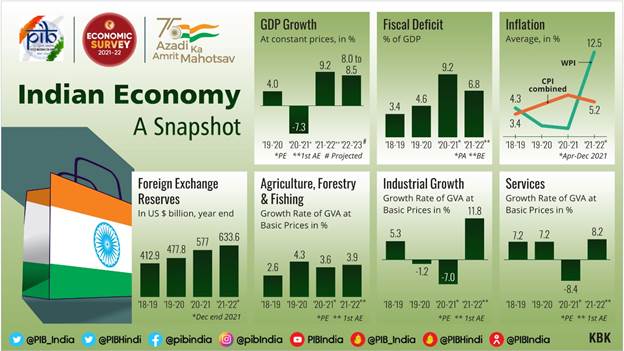
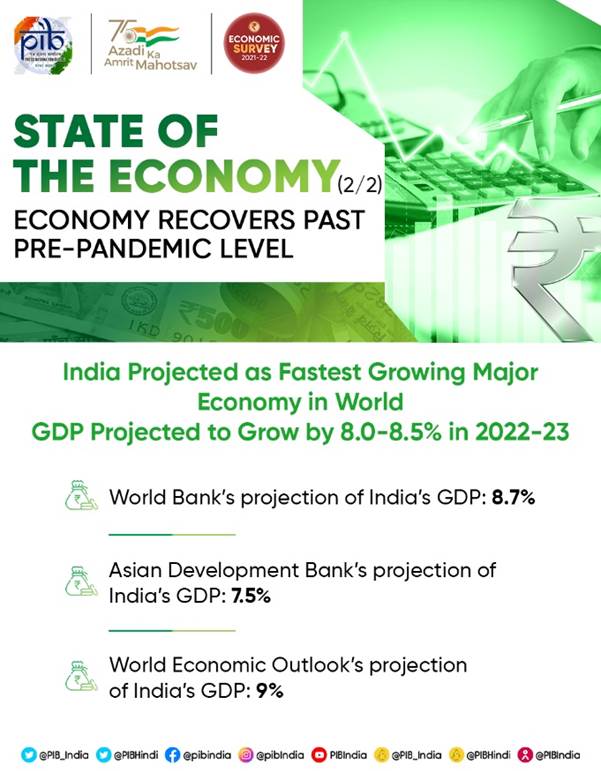
AS PER WORLD BANK, ADB AND IMF PROJECTIONS, INDIA TO REMAIN THE FASTEST GROWING MAJOR ECONOMY IN THE WORLD DURING 2021-24

INDIAN ECONOMY TO GROW BY 9.2% IN REAL TERMS IN 2021-22

AGRICULTURE TO GROW BY 3.9 % IN 2021-22 IN COMPARISON TO 3.6% IN THE PREVIOUS YEAR

INDUSTRIAL SECTOR TO WITNESS SHARP REBOUND FROM A CONTRACTION OF 7% IN 2020-21 TO EXPANSION OF 11.8% IN 2021-22

SERVICES TO CLOCK 8.2% GROWTH IN 2021-22 AFTER A CONTRACTION OF 8.4% LAST YEAR

FOREIGN EXCHANGE RESERVES STOOD AT US$ 634 BILLION AS ON 31ST DECEMBER 2021 EQUIVALENT TO OVER 13 MONTHS OF IMPORTS AND HIGHER THAN COUNTRY’S EXTERNAL DEBT

INVESTMENT IS EXPECTED TO SEE A STRONG GROWTH OF 15% IN 2021-22

CONSUMER PRICE INDEX (CPI) COMBINED INFLATION OF 5.6% IN DECEMBER 2021 IS WELL WITHIN TARGETED TOLERANCE BAND

FISCAL DEFICIT FOR APRIL-NOVEMBER 2021 CONTAINED AT 46.2% OF BUDGET ESTIMATES

CAPITAL MARKET BOOMS DESPITE PANDEMIC; OVER ₹ 89 THOUSAND CRORE RAISED VIA 75 IPO ISSUES IN APRIL-NOVEMBER 2021, MUCH HIGHER THAN IN ANY YEAR IN THE LAST DECADE

MACRO-ECONOMIC STABILITY INDICATORS SUGGEST INDIAN ECONOMY WELL PL


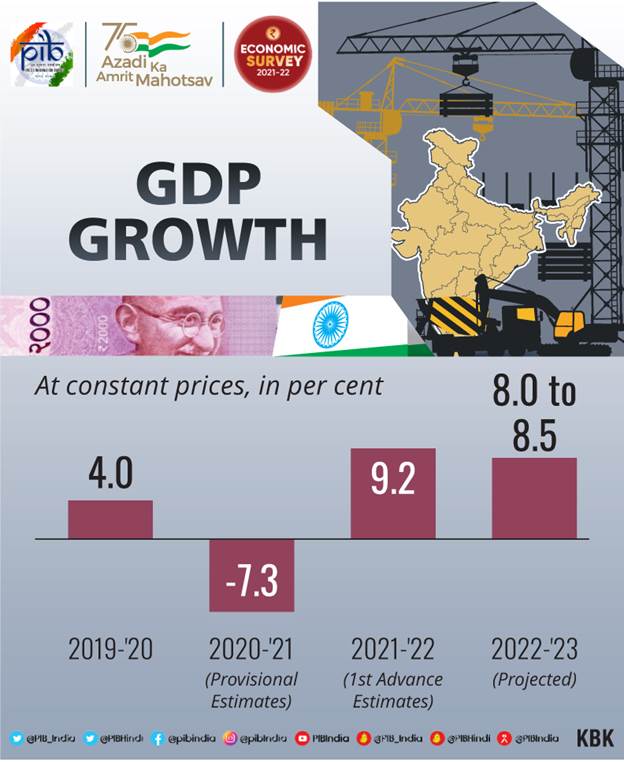
India to witness GDP growth of 8.0-8.5 per cent in 2022-23, supported by widespread vaccine coverage, gains from supply-side reforms and easing of regulations, robust export growth, and availability of fiscal space to ramp up capital spending.

The Union Minister for Finance & Corporate Affairs Smt Nirmala Sitharaman tabled the Economic Survey 2021-22 in Parliament today, which states that the year ahead is well poised for a pick-up in private sector investment with the financial system in a good position to provide support to the revival of economy. The growth projection for 2022-23 is based on the assumption that there will be no further debilitating pandemic related economic disruption, monsoon will be normal, withdrawal of global liquidity by major central banks will be broadly orderly, oil prices will be in the range of  US$70-$75/bbl, and global supply chain disruptions will steadily ease over the course of the year.
The Survey says, the above projection is comparable with the World Bank’s and Asian Development Bank’s latest forecasts of real GDP growth of 8.7 per cent and 7.5 per cent respectively for 2022-23. As per the IMF’s latest World Economic Outlook (WEO) growth projections released on 25th January, 2022, India’s real GDP is projected to grow at 9 per cent in both 2021-22 and 2022-23 and at 7.1 per cent in 2023-24. This projects India as the fastest growing major economy in the world in all these three years.
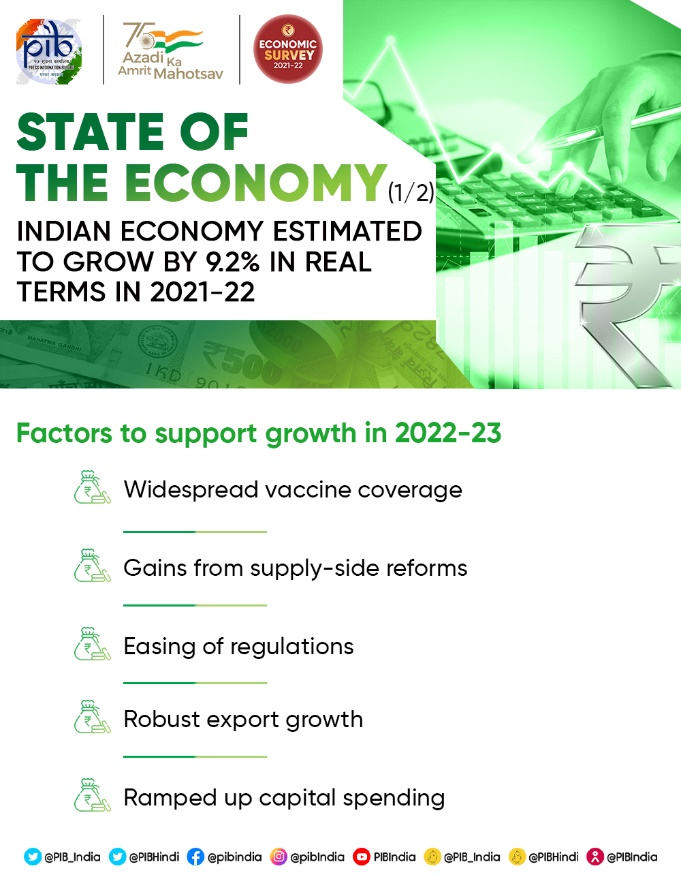
Referring to First Advance Estimates, the Survey states that the Indian economy is estimated to grow by 9.2 per cent in real terms in 2021-22, after a contraction of 7.3 per cent in 2020-21. This implies that overall economic activity has recovered past the pre-pandemic levels. Almost all indicators show that the economic impact of the “second wave” in Q1 was much smaller than that experienced during the full lockdown phase in 2020-21, even though the health impact was more severe.
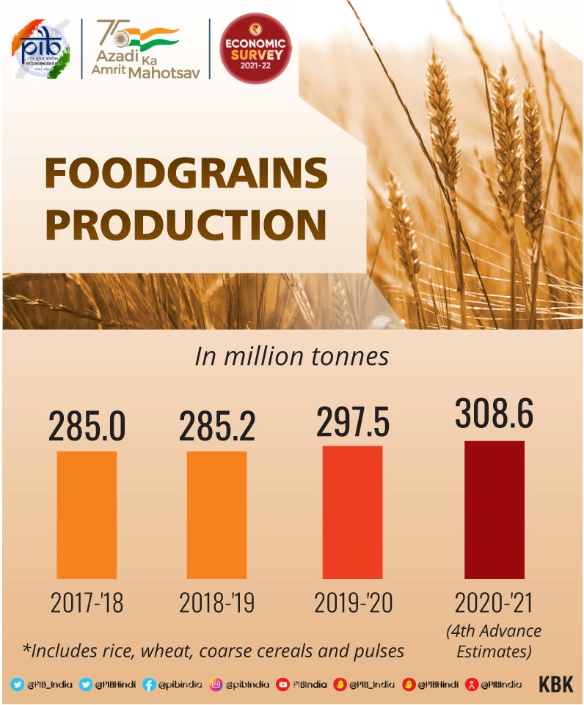
Dwelling on the sectoral aspects, the Survey states that Agriculture and allied sectors have been the least impacted by the pandemic and the sector is expected to grow by 3.9 per cent in 2021-22 after growing by 3.6 per cent in the previous year. The area sown under Kharif and Rabi crops, and the production of wheat and rice has been steadily increasing over the years. In the current year, food grains production for the Kharif season is estimated to post a record level of 150.5 million tonnes. Moreover, procurement of food grains under the central pool accordingly maintained its rising trend in 2021-22 along with minimum support prices, which augur well for national food security and farmers’ incomes. Importantly, the strong performance of the sector was supported by Government policies that ensured timely supplies of seed and fertilizers despite pandemic related disruptions. It was helped by good monsoon rains as reflected in reservoir levels being higher than the 10-year average.
According to Survey, the industrial sector went through a sharp rebound  from a contraction of 7 per cent in 2020-21 to an expansion of  11.8 per cent in this financial year. The manufacturing, construction and mining sub-sectors went through the same swing although the utilities segment experienced a more muted cycle as basic services such as electricity and water supply were maintained even at the height of the national lockdown. The share of industry in GVA is now estimated at 28.2 per cent.

The Survey states that the services sector has been the hardest hit by the pandemic, especially segments that involve human contact.  This sector is estimated to grow by 8.2 per cent this financial year following last year’s 8.4 per cent contraction. It should be noted that there is a wide dispersion of performance by different sub-sectors. Both the finance /Real Estate and the Public Administration segments are now well above pre-COVID levels. However, segments like Travel, Trade and hotels are yet to fully recover. There has been a boom in software and IT-enabled services exports even as earnings from tourism have declined sharply.

The Survey added that total consumption is estimated to have grown by 7.0 per cent in 2021-22 with government consumption remaining the biggest contributor as in the previous year. Government consumption is estimated to grow by a strong 7.6 per cent surpassing pre-pandemic levels. Private consumption is also estimated to have improved significantly to recover 97 per cent of corresponding pre-pandemic output level and it is poised to see stronger recovery with rapid coverage in vaccination and faster normalization of economic activity.

According to the Survey, Investment, as measured by Gross Fixed Capital Formation (GFCF) is expected to see strong growth of 15 per cent in 2021-22 and achieve full recovery of pre-pandemic level. Government’s policy thrust on quickening virtuous cycle of growth via capex and infrastructure spending has increased capital formation in the economy lifting the investment of GDP ratio to about 29.6 per cent in 2021-22, the highest in seven years. While private investment recovery is still at a nascent stage, there are many signals which indicate that India is poised for stronger investment. A sturdy and cleaned-up banking sector stands ready to support private investment adequately.

On the Exports and Imports front, the Survey states that India’s exports of both goods and services have been exceptionally strong so far in 2021-22. Merchandise exports have been above US$30 billion for eight consecutive months in 2021-22, despite many pandemic related global supply constraints. Net services exports have also risen sharply, driven by professional and management consulting services, audio visual and related services, freight transport services, telecommunications, computer and information services. From a demand perspective, India’s total exports are expected to grow by 16.5 per cent in 2021-22 surpassing pre-pandemic levels. Imports also recovered strongly with revival of domestic demand and continuous rise in price of imported crude and metals. Imports are expected to grow by 29.4 per cent in 2021-22 surpassing corresponding pre-pandemic levels. Resultantly, India’s net exports have turned negative in the first half of 2021-22, compared to a surplus in the corresponding period of 2020-21. But current account deficit is expected to remain within manageable limits.

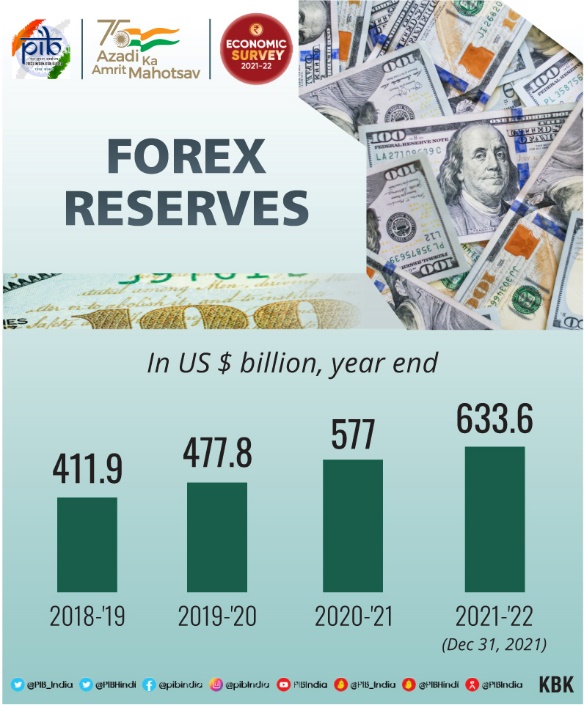
Further, the Survey points out that despite all the disruptions caused by the global pandemic, India’s balance of payments remained in surplus throughout the last two years. This allowed the Reserve Bank of India to keep accumulating foreign exchange reserves, which stand at US$634 billion on 31st December 2021. This is equivalent to 13.2 months of imports and higher than the country’s external debt.
The Survey notes that inflation has reappeared as a global issue in both advanced and emerging economies. The surge in energy prices, non-food commodities, input prices, disruption of global supply chains, and rising freight costs stoked global inflation during the year. In India, Consumer Price Index (CPI) inflation moderated to 5.2 per cent in 2021-22 (April-December) from 6.6 per cent in the corresponding period of 2020-21. It was 5.6 per cent (YoY) in December 2021, which is within the targeted tolerance band. The decline in retail inflation in 2021-22 was led by easing of food inflation. Wholesale Price Inflation (WPI), however, has been running in double-digits.

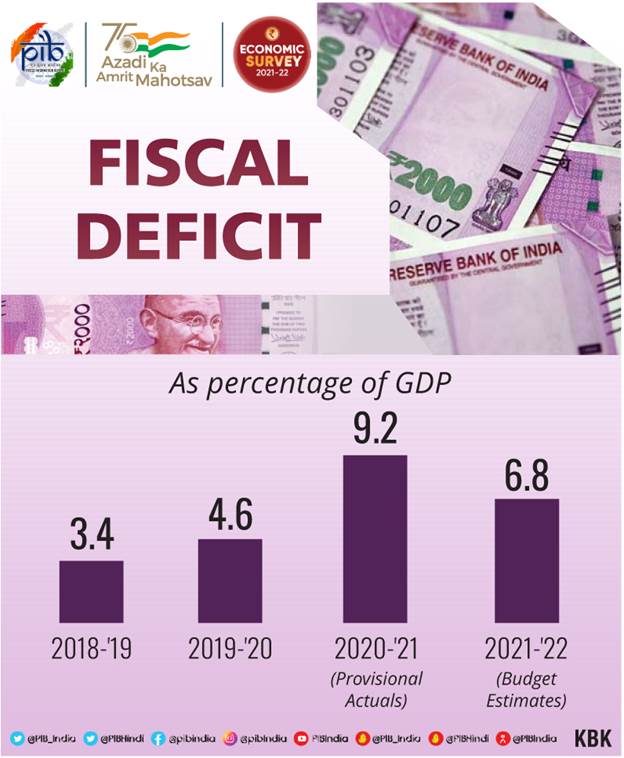
The Survey says that fiscal support given to the economy as well as the health response caused the fiscal deficit and government debt to rise in 2020-21. However, there has been a strong rebound in government revenues in 2021-22 so far. The revenue receipts of the central government during April-November 2021 have gone up by 67.2 per cent (YOY), as against an expected growth of 9.6 per cent in the 2021-22 Budget Estimates over provisional actuals. The tax collections have been buoyant for both direct and indirect taxes and the gross monthly GST collections have crossed ₹ 1 lakh crore consistently since July 2021.
 

It adds that on the account of a sustained revenue collection and a targeted expenditure policy by the Government of India, the fiscal deficit for April-November 2021 has been contained at 46.2 per cent of Budget Estimates (BE) which is nearly one third of the proportion reached during the same period of the previous two years (135.1% of BE in April-November 2020 and 114.8% of BE in April-November 2019).
 

The Survey points out that the financial sector is always a possible area of stress during turbulent times. However, India’s capital markets have done exceptionally well and have allowed record mobilization of risk capital of Indian companies. The Sensex and Nifty scaled up to touch its peak at 61,766 and 18,477 on October 18, 2021. ₹ 89,066 crore was raised via 75 IPO issues in April- November 2021, much higher than in any year in the last decade. Moreover, the banking system is well capitalized and NPAs seems to have structurally declined. The Gross Non-Performing Advances (GNPA) ratio (i.e. GNPAs as a percentage of Gross Advances) and Net Non-Performing Advances (NNPA) ratio of Scheduled Commercial banks (SCBs) continued to decline since 2018-19. GNPA ratio of SCBs decreased from 7.5 per cent at end-September 2020 to 6.9 per cent at end-September 2021.

The Survey expresses that another distinguishing feature of India’s economic response has been an emphasis on supply-side reforms rather than a total reliance on demand management. These supply-side reforms include deregulation of numerous sectors, simplification of processes, removal of legacy issues like ‘retrospective tax’, privatization, production-linked incentives and so on. Even the sharp increase in capital spending by the Government can be seen as both demand and supply response as it creates infrastructure capacity for future growth.

There are two common themes in India’s supply-side strategy: (i) Reforms that improve flexibility and innovation in order to deal with the long-term unpredictability of the post-Covid world. This includes factor market reforms; deregulation of sectors like space, drones, geospatial mapping, trade finance factoring; process reforms like those in government procurement and in telecommunications sector; removal of legacy issues like retrospective tax; privatization and monetization, creation of physical infrastructure, and so on. (ii) Reforms aimed at improving the resilience o the Indian economy. These range from climate/environment related policies; social infrastructure such as public provision of tap water, toilets, basic housing, insurance for the poor, and so on; support for key industries under Atmanirbhar Bharat; a strong emphasis on reciprocity in foreign trade agreements, and so on.

An important theme that has been discussed through the course of the Economic Survey is that of ‘process reforms’. It is important to distinguish between deregulation and process reforms. The former relates to reducing or removing the role of government from a particular activity. In contrast, the latter broadly relates to simplification and smoothening of the process for activities where the government’s presence as a facilitator or regulator is necessary.

The Survey points out that the last two years have been difficult for the world economy on account of the COVID-19 pandemic. Repeated waves of infection, supply-chain disruptions and more recently, global inflation have created particularly challenging times for policy-making. Faced with these challenges, the Government of India opted for a ‘ Barbell Strategy” that combined a bouquet of safety-nets to cushion the impact on vulnerable sections of society and the business sector. It next pushed through a significant increase in capital expenditure on infrastructure to build back medium-term demand as well as aggressively implemented supply-side measures to prepare the economy for the sustained long-term expansion. This flexible and multi-layered approach is partly based on an “Agile” framework that used feedback-loops, and the monitoring of real-time data.

The Survey underlines that Monetary policy since the outbreak of the pandemic was calibrated to provide a cushion and support growth, but carefully controlled in order to avoid the medium term dislocations of excess liquidity. An important aspect of the safety-net was the use of Government guarantees to provide access to financial support to the economy in general and MSMEs in particular. In the last two years, government leveraged an array of eighty High Frequency Indicators (HFIs) representing industry, services, global trends, macro-stability indicators and several other activities, from both public and private sources to gauge the underlying state of the economy on a real-time basis. These HFIs helped policy makers tailor their response to an evolving situation rather than rely on pre-defined responses of a Waterfall framework, which has been the conventional method for framing policy in India and most of the world.

In conclusion, the Survey is quite optimistic that overall macro-economic stability indicators suggest that the Indian Economy is well placed to take on the challenges of 2022-23 and one of the reasons that the Indian Economy is in good position is its unique response strategy.

Topics

Acts Income Tax