

Loading...

⚠ âś•
❮ Top
☎ Help
☰
×

By creating an account you can:

Logo TaxTMI
Call Us / Help / Feedbackâś•

Contact Us At :

✉ E-mail: [email protected]

✆ Call / WhatsApp at: +91 99117 96707

For more information, Check Contact Us

FAQs :

To know Frequently Asked Questions, Check FAQs

Most Asked Video Tutorials :

For more tutorials, Check Video Tutorials

Submit Feedback/Suggestion :

Email :
Please provide your email address so we can follow up on your feedback.
Category :
Description :
Min 15 characters 0/2000
Make Most of Text Search âś•
  1. Checkout this video tutorial: How to search effectively on TaxTMI.
  2. Put words in double quotes for exact word search, eg: "income tax"
  3. Avoid noise words such as : 'and, of, the, a'
  4. Sort by Relevance to get the most relevant document.
  5. Press Enter to add multiple terms/multiple phrases, and then click on Search to Search.
  6. Text Search
  7. The system will try to fetch results that contains ALL your words.
  8. Once you add keywords, you'll see a new 'Search In' filter that makes your results even more precise.
  9. Text Search
╳
Add to...
You have not created any category. Kindly create one to bookmark this item!
âś•
Create New Category
Hide
Title :
Description :
❮❮ Hide
❮ Default View
Expand ❯❯
Close âś•
🔎 Filters / Advanced Search ❯
TEXT

Press 'Enter' to add multiple search terms. Rules for Better Search

Search In
Main Text + AI Text ❯
  • Main Text
  • Main Text + AI Text
  • AI Text
Category: ?
Categorized by AI
---- All Categories ---- ❯
  • ---- All Categories ----
  • Income Tax
  • GST
  • Customs, DGFT & SEZ
  • FEMA & RBI
  • Corp. Laws, SEBI & IBC
  • PMLA, Black Money & ED
  • Budget
  • News and Press Release
  • PTI News
Month:
---- All Months ---- ❯
  • ---- All Months ----
  • January
  • February
  • March
  • April
  • May
  • June
  • July
  • August
  • September
  • October
  • November
  • December
Year:
---- All Years ---- ❯
  • ---- All Years ----
  • 2026
  • 2025
  • 2024
  • 2023
  • 2022
  • 2021
  • 2020
  • 2019
  • 2018
  • 2017
  • 2016
  • 2015
  • 2014
  • 2013
  • 2012
  • 2011
Sort By: ?
In Sort By 'Default', exact matches for text search are shown at the top, followed by the remaining results in their regular order.
Relevance Default Date
    Advisory on “Multistate Registration” Facility for GST Registration
    Forward-Looking Survey on Private Corporate Sector CAPEX Investment Intentions (Survey period: October–December 2026)
    CRIT and IIFT Organise Three-Day Orientation Course on Trade Negotiations
    Union Minister of Commerce and Industry Shri Piyush Goyal Participates in Opening Day of G20 Trade Ministers’ Meeting in Milwauke, U.S
    Insolvency and Bankruptcy Code has strengthened credit discipline, improved recovery climate and contributed to ease of doing business: Harsh Malhotra...
    Central Bureau of Narcotics, DNC office, conducts drug abuse and addiction awareness campaign under Operation Jagriti in Lucknow
    Commerce and Industry Minister Piyush Goyal Calls for WTO-Compliant Approach to Correcting Global Trade Distortions at the Concluding Day of G20 Trade...
    APEDA Facilitates Export of Bihar’s Makhana from Purnea to Greece
    APEDA Facilitates FPO-led Export of Frozen Food Products from Haryana to Canada
    Government Extends Operational Timelines of RELIEF (Resilience & Logistics Intervention for Export Facilitation) Intervention to Support Exporters Ami...
    Government Extends Remission of Duties and Taxes on Exported Products ( RoDTEP) Scheme upto 31st December 2026
    DRI cracks down on illegal wildlife trafficking; elephant ivory, leopard skin, live pangolins and tiger parts seized; 11 persons arrested
    DRI busts two-way gold-diamond smuggling syndicate at Mumbai airport
    CBN Madhya Pradesh Unit destroys over 10.84 tonnes of seized narcotic drugs and deposits 154.375 kg of seized opium at GOAW, Neemuch
    CBN Rajasthan Unit seizes 1.080 kg hydroponic weed (ganja) concealed in international parcel from Thailand
    CBN Madhya Pradesh Unit seizes 4.240 kg opium; one person arrested
    Gross and Net GST revenue collections for the month of September, 2026
    Release of the Annual Survey of Industries (2024-25) results
    5th Kautilya Economic Conclave to be held in New Delhi from 3 to 5 October 2026 under the theme “Resilience in an Age of Flux”
    CCI approves the acquisition of certain equity share capital in IndiaFirst Life Insurance Co. Ltd. by BNP Paribas Cardif
❮
❯
❯❯
Maximize Maximize Maximize
0 / 200
Expand Note
Add to Folder

No Folders have been created

+

Are you sure you want to delete "My most important" ?

NOTE:

News
Showing Results for :
Reset Filters
Results Found:
Show All Summaries Hide All Summaries
October 3, 2026
Show AI Summary
Multistate GST registration enables normal taxpayers to submit common information once for simultaneous State and UT applications.
Multistate Registration enables normal taxpayers seeking GST registration under the same PAN in more than one State or Union Territory to apply simultaneously. A Master TRN is generated after selection of the intended jurisdictions and must be submitted with Common Registration Information. Individual TRNs are then generated for each selected jurisdiction, with common information auto-populated and editable. Applicants must provide principal and additional places of business, State-specific information, and Aadhaar authentication.
October 3, 2026
Show AI Summary
Private corporate CAPEX survey collects forward investment data through secure self-reporting while protecting enterprise-level confidentiality.
CAPEX 2026 collects information from selected large private corporate enterprises on past, provisional and intended capital expenditure across asset groups and sectors, including investment strategies, financing, green energy and robotics. Responses are self-compiled through a secure portal with bilingual and digital assistance. Complete, accurate and timely reporting supports validation and aggregate investment indicators. Individual enterprise information is protected through confidentiality safeguards, and unit-level CAPEX data are not disseminated.
October 3, 2026
Show AI Summary
International trade negotiations training addressed WTO rules, dispute settlement, sustainability, trade remedies, digital trade, and services.
Trade-negotiation capacity-building introduced foundational trade theory and the WTO framework, followed by instruction on treaty interpretation, trade data and dispute settlement. Specialised sessions addressed trade remedies, rules of origin, non-tariff measures, intellectual property rights, digital trade and services. It also considered labour, environmental and sustainability issues, including carbon border adjustment and deforestation requirements, within an increasingly complex global trade environment.
October 3, 2026
Show AI Summary
Food security safeguards distinguish transparent public stockholding measures from coercive trade actions within multilateral trade cooperation.
India maintains public stockholding, procures food from small and marginal farmers, and may adopt temporary, transparent measures during harvest shortfalls to preserve food availability and affordability. These food-security measures are identified as recognised within the WTO framework. A distinction is advanced between legitimate food-security interventions and coercive trade actions used to exert pressure on other countries. G20 Trade Ministers reached consensus on a statement addressing the weaponization of food through coercive trade actions and committed to continued cooperation.
October 3, 2026
Show AI Summary
Insolvency resolution reform prioritises timely, value-maximising outcomes through technology adoption, mediation, and legislative responsiveness across the insolvency ecosystem.
The Insolvency and Bankruptcy Code seeks faster, value-maximising resolutions through legislative responsiveness, technology adoption and adherence to prescribed timelines. Reform priorities include reducing case-disposal delays, speeding consideration of resolution plans, revising admission thresholds, mediation and sector-specific carveouts. The framework is associated with creditor recoveries, rescue of viable businesses and changed debtor-creditor behaviour.
October 3, 2026
Show AI Summary
Drug abuse prevention awareness promotes student education, peer outreach, and youth responsibility for a drug-free society.
Operation Jagriti promotes drug abuse and addiction awareness among students by addressing the harmful effects of substance use and practical prevention measures. Students are encouraged to avoid drugs, spread prevention awareness among peers and communities, and contribute responsibly to the Nasha Mukt Bharat objective of a drug-free India.
October 3, 2026
Show AI Summary
Forced-labour border measures require verifiable evidence, due process and WTO consistency while preserving cooperation without unilateral trade action.
Global trade distortions should be addressed through WTO-consistent, evidence-based anti-dumping and countervailing measures, without restricting developing countries' policy space for industrialisation. Most-Favoured-Nation treatment, consensus decision-making, special and differential treatment, and a two-tier dispute-settlement system remain central to multilateral trade governance. Imports produced using forced labour are prohibited, while border measures must rely on specific, verifiable evidence, observe due process and WTO rules, and avoid presumptions concerning entire countries, regions or sectors.
October 3, 2026
Show AI Summary
Export-led market access for Makhana expands overseas buyer linkages, supports higher producer returns, and promotes European market diversification.
Export-oriented market access for Bihar's Makhana is being expanded through a facilitated shipment of popped Makhana from Purnea to Greece. APEDA's support connects producers and exporters with international buyers and strengthens the export value chain. Higher price realisation than domestic selling prices indicates scope for improved producer returns, wider farmer and producer-group participation, and diversification into European markets. Export promotion is linked to a proposed Agri Export Policy and packhouse development.
October 3, 2026
Show AI Summary
FPO-led export market access links processed food producers with global buyers and strengthens agricultural value-chain participation.
APEDA facilitated an FPO-led export of frozen food products to Canada by Aterna Foods Producer Company Limited, with support under its Financial Assistance Scheme. The export included frozen vegetables, sweet corn, samosa and other processed food products. Market-linkage initiatives connect Farmer Producer Organisations and Farmer Producer Companies with exporters and global buyers, promoting export-oriented value chains and integrating agricultural produce with processing and international markets.
October 3, 2026
Show AI Summary
RELIEF timeline extension preserves credit-insurance support and premium protection for exporters facing West Asia maritime disruptions.
Component II of the RELIEF intervention extends operational timelines for exporters affected by West Asia maritime-logistics disruptions. It encourages eligible exporters to obtain ECGC cover for upcoming shipments to specified regions with 95% risk coverage. Benefits apply to qualifying Stand Alone Policies and Whole Turnover Policies, covering full container load, less than container load, and reefer containers, but excluding energy shipments. Eligible exporters' insurance premium cannot increase beyond the pre-disruption level during the relevant period.
October 3, 2026
Show AI Summary
RoDTEP duty remission continues for eligible exporters, preserving existing rates and value caps through the extended period.
RoDTEP Scheme continuation is extended until 31 December 2026 for exports made by Domestic Tariff Area units, Advance Authorisation holders, Special Economic Zone units and Export Oriented Units. The scheme remits embedded, un-rebated Central, State and local duties, taxes and levies borne on exported products. Existing RoDTEP rates and value caps remain unchanged throughout the extension.
October 3, 2026
Show AI Summary
Wildlife trafficking enforcement targeted unlawful possession, transport and proposed sale of ivory, leopard skin, pangolins and tiger parts.
Illegal wildlife trafficking operations addressed alleged possession, transportation, and attempted sale of elephant ivory, leopard skin, live pangolins, and tiger parts. Possession without licence and trade in elephant ivory or ivory articles are prohibited under the Wild Life (Protection) Act, 1972. Leopards, pangolins, tigers, and their body parts receive Schedule I protection, while pangolins are also listed in CITES Appendix I, prohibiting international trade. Recovered wildlife articles, live animals, and vehicles were transferred or seized for action by forest and specialised wildlife enforcement agencies.
October 3, 2026
Show AI Summary
Two-way airport smuggling: airport staff allegedly facilitated clandestine gold entry and illicit diamond export through transit and outbound passengers.
An alleged two-way smuggling arrangement involved airport staff receiving foreign-origin gold dust in wax capsules from transit passengers for clandestine removal into India and transferring diamonds to an outbound passenger for illicit export to Dubai. Seizure included 23 capsules of 24-carat foreign-origin gold dust in wax form and natural and lab-grown diamonds. The modus operandi used the same airport employee to facilitate import-side gold smuggling and export-side diamond smuggling.
October 3, 2026
Show AI Summary
Seized narcotic-drug disposal prevents contraband re-entry through supervised destruction, lawful opium deposit, and environmentally safe incineration.
Authorised disposal of seized narcotic drugs under the Narcotic Drugs and Psychotropic Substances Act, 1985 involved destruction of 10,842.150 kg of contraband through an approved process supervised by the Drug Disposal Committee and attended by a pollution-control representative. Seized opium was separately deposited with the Government Opium and Alkaloid Works as part of the disposal process, aimed at preventing contraband from returning to illicit drug trafficking and ensuring environmentally safe incineration.
October 3, 2026
Show AI Summary
International postal narcotics trafficking: hydroponic ganja concealed in cake pouches was seized under NDPS procedures.
Seizure under the relevant provisions of the Narcotic Drugs and Psychotropic Substances Act, 1985, covered hydroponic weed (ganja) recovered from an international parcel received from Thailand. The contraband was concealed in cake pouches placed among other packets and articles to camouflage its presence. Specific intelligence prompted examination, recovery, weighing and seizure following due legal procedure, with further investigation in progress.
October 3, 2026
Show AI Summary
NDPS enforcement enabled opium and vehicle seizure, with arrest after an intelligence-led roadside interception operation.
Intelligence-based enforcement under the Narcotic Drugs and Psychotropic Substances Act, 1985, resulted in the interception of a motorcycle and recovery of 4.240 kg of opium. The opium and motorcycle used for transportation were seized after legal formalities, and one person was arrested. Investigation continues to trace the contraband's source and intended destination and identify other persons connected with the suspected trafficking network.
October 1, 2026
Show AI Summary
GST revenue accounting distinguishes gross collections, refunds, net domestic and customs revenue, and SGST-IGST settlement reporting.
Gross GST revenue for September 2026 distinguishes domestic collections and IGST on imports; after domestic and ICEGATE refund adjustments, net revenue is calculated separately for domestic and customs GST. Cumulative collections through September similarly distinguish gross receipts, refunds and net revenue. SGST reporting compares pre-settlement receipts with post-settlement amounts that include the SGST portion of IGST settled to States and Union Territories. State and Union Territory revenue comparisons exclude GST on imported goods, while April-September domestic collections are split between Central and State formations.
October 1, 2026
Show AI Summary
Annual Survey of Industries results record broad manufacturing growth and define survey coverage, enumeration, digital data collection, and reliability limits.
ASI 2024-25 records broad-based growth in registered manufacturing, including establishments, output, Gross Value Added, employment, emoluments, fixed capital, invested capital, net income and net profit. The survey covers specified registered factories, bidi and cigar establishments, certain electricity undertakings, and qualifying large units in State-maintained business registers. Data are collected electronically under the statutory framework for collection of statistics using an establishment-based approach, with quality checks and caution required because the estimates arise from a sample survey.
October 1, 2026
Show AI Summary
Economic resilience policy dialogue examines financial stability, digital governance, trade fragmentation, and investment priorities amid global uncertainty.
The fifth Kautilya Economic Conclave will examine economic resilience amid global shocks through discussions on macroeconomic stability, monetary policy, financial stability, investment, fiscal federalism and capital-market development. Its agenda also covers digital economy governance, artificial intelligence, trade fragmentation, strategic autonomy, climate resilience, food systems, demographic change and global health security. Plenaries, parallel sessions and closed-door roundtables will consider policy responses and mobilisation of domestic and foreign capital for long-term investment.
September 30, 2026
Show AI Summary
Equity acquisition in a life insurer receives competition clearance for BNP Paribas Cardif's proposed investment.
Competition Commission of India approval covers a proposed combination under which BNP Paribas Cardif will acquire certain equity share capital in IndiaFirst Life Insurance Company Limited. The transaction is an acquisition of an ownership interest in an Indian life insurer. IndiaFirst Life Insurance Company Limited is incorporated in India, is an IRDAI-licensed insurer, and provides life insurance in India.

News

Back

All News

Showing Results for :
Reset Filters
No Records Found

News

Back

All News

Customs, DGFT & SEZ

SUMMARY OF THE ECONOMIC SURVEY 2021-22

January 31, 2022

Contents
Plus +
Summary
Note

Note

-

Bookmark

Print

Print

SUMMARY OF THE ECONOMIC SURVEY 2021-22

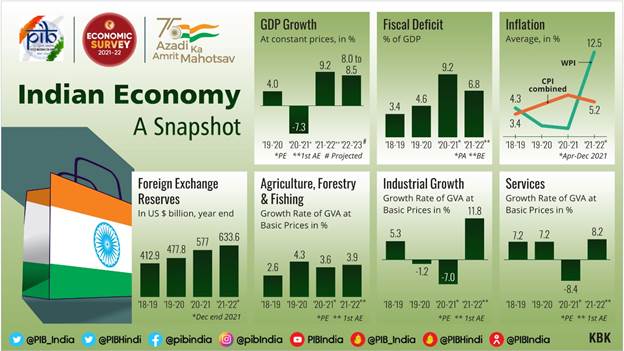
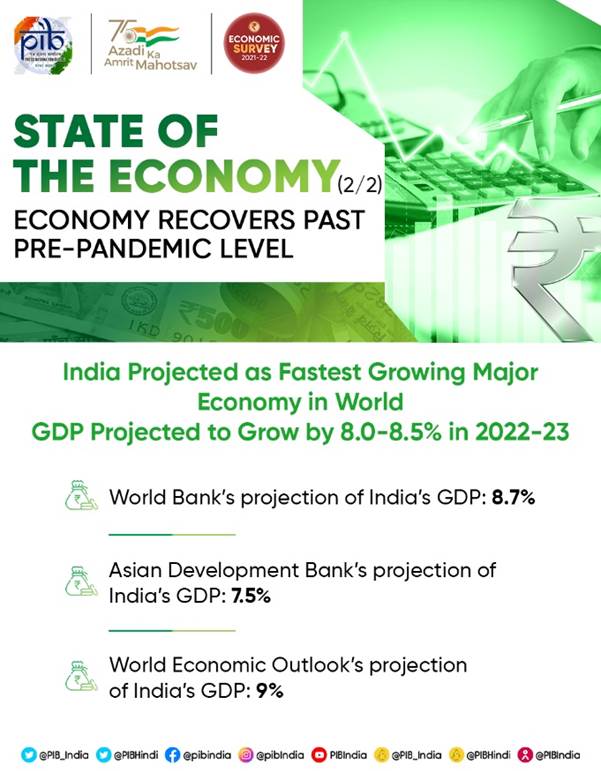
AS PER WORLD BANK, ADB AND IMF PROJECTIONS, INDIA TO REMAIN THE FASTEST GROWING MAJOR ECONOMY IN THE WORLD DURING 2021-24

INDIAN ECONOMY TO GROW BY 9.2% IN REAL TERMS IN 2021-22

AGRICULTURE TO GROW BY 3.9 % IN 2021-22 IN COMPARISON TO 3.6% IN THE PREVIOUS YEAR

INDUSTRIAL SECTOR TO WITNESS SHARP REBOUND FROM A CONTRACTION OF 7% IN 2020-21 TO EXPANSION OF 11.8% IN 2021-22

SERVICES TO CLOCK 8.2% GROWTH IN 2021-22 AFTER A CONTRACTION OF 8.4% LAST YEAR

FOREIGN EXCHANGE RESERVES STOOD AT US$ 634 BILLION AS ON 31ST DECEMBER 2021 EQUIVALENT TO OVER 13 MONTHS OF IMPORTS AND HIGHER THAN COUNTRY’S EXTERNAL DEBT

INVESTMENT IS EXPECTED TO SEE A STRONG GROWTH OF 15% IN 2021-22

CONSUMER PRICE INDEX (CPI) COMBINED INFLATION OF 5.6% IN DECEMBER 2021 IS WELL WITHIN TARGETED TOLERANCE BAND

FISCAL DEFICIT FOR APRIL-NOVEMBER 2021 CONTAINED AT 46.2% OF BUDGET ESTIMATES

CAPITAL MARKET BOOMS DESPITE PANDEMIC; OVER ₹ 89 THOUSAND CRORE RAISED VIA 75 IPO ISSUES IN APRIL-NOVEMBER 2021, MUCH HIGHER THAN IN ANY YEAR IN THE LAST DECADE

MACRO-ECONOMIC STABILITY INDICATORS SUGGEST INDIAN ECONOMY WELL PL


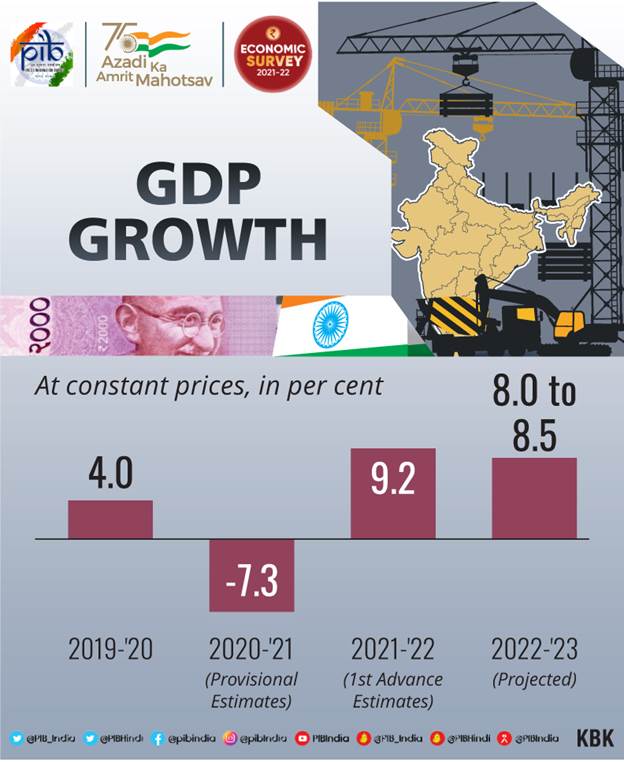
India to witness GDP growth of 8.0-8.5 per cent in 2022-23, supported by widespread vaccine coverage, gains from supply-side reforms and easing of regulations, robust export growth, and availability of fiscal space to ramp up capital spending.

The Union Minister for Finance & Corporate Affairs Smt Nirmala Sitharaman tabled the Economic Survey 2021-22 in Parliament today, which states that the year ahead is well poised for a pick-up in private sector investment with the financial system in a good position to provide support to the revival of economy. The growth projection for 2022-23 is based on the assumption that there will be no further debilitating pandemic related economic disruption, monsoon will be normal, withdrawal of global liquidity by major central banks will be broadly orderly, oil prices will be in the range of  US$70-$75/bbl, and global supply chain disruptions will steadily ease over the course of the year.
The Survey says, the above projection is comparable with the World Bank’s and Asian Development Bank’s latest forecasts of real GDP growth of 8.7 per cent and 7.5 per cent respectively for 2022-23. As per the IMF’s latest World Economic Outlook (WEO) growth projections released on 25th January, 2022, India’s real GDP is projected to grow at 9 per cent in both 2021-22 and 2022-23 and at 7.1 per cent in 2023-24. This projects India as the fastest growing major economy in the world in all these three years.
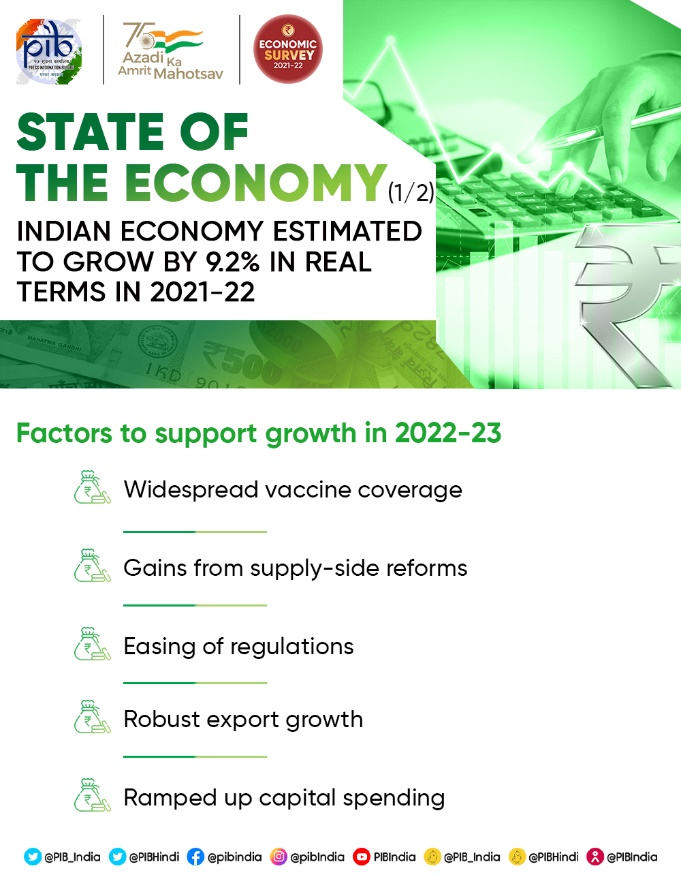
Referring to First Advance Estimates, the Survey states that the Indian economy is estimated to grow by 9.2 per cent in real terms in 2021-22, after a contraction of 7.3 per cent in 2020-21. This implies that overall economic activity has recovered past the pre-pandemic levels. Almost all indicators show that the economic impact of the “second wave” in Q1 was much smaller than that experienced during the full lockdown phase in 2020-21, even though the health impact was more severe.
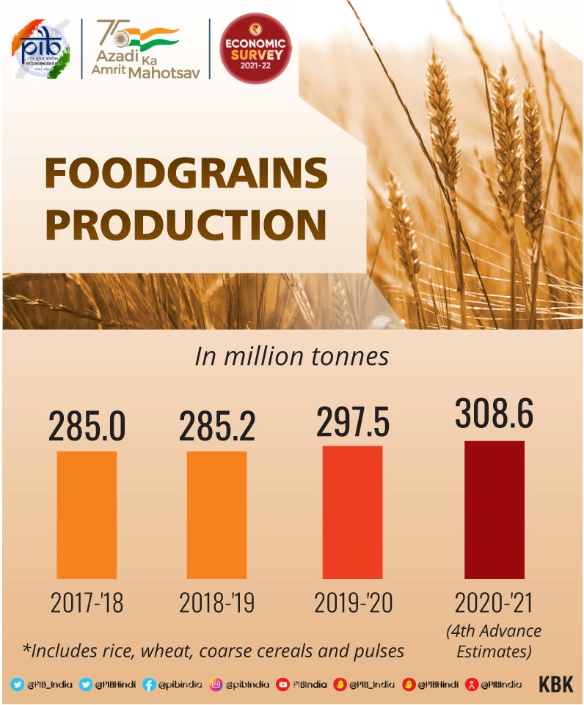
Dwelling on the sectoral aspects, the Survey states that Agriculture and allied sectors have been the least impacted by the pandemic and the sector is expected to grow by 3.9 per cent in 2021-22 after growing by 3.6 per cent in the previous year. The area sown under Kharif and Rabi crops, and the production of wheat and rice has been steadily increasing over the years. In the current year, food grains production for the Kharif season is estimated to post a record level of 150.5 million tonnes. Moreover, procurement of food grains under the central pool accordingly maintained its rising trend in 2021-22 along with minimum support prices, which augur well for national food security and farmers’ incomes. Importantly, the strong performance of the sector was supported by Government policies that ensured timely supplies of seed and fertilizers despite pandemic related disruptions. It was helped by good monsoon rains as reflected in reservoir levels being higher than the 10-year average.
According to Survey, the industrial sector went through a sharp rebound  from a contraction of 7 per cent in 2020-21 to an expansion of  11.8 per cent in this financial year. The manufacturing, construction and mining sub-sectors went through the same swing although the utilities segment experienced a more muted cycle as basic services such as electricity and water supply were maintained even at the height of the national lockdown. The share of industry in GVA is now estimated at 28.2 per cent.

The Survey states that the services sector has been the hardest hit by the pandemic, especially segments that involve human contact.  This sector is estimated to grow by 8.2 per cent this financial year following last year’s 8.4 per cent contraction. It should be noted that there is a wide dispersion of performance by different sub-sectors. Both the finance /Real Estate and the Public Administration segments are now well above pre-COVID levels. However, segments like Travel, Trade and hotels are yet to fully recover. There has been a boom in software and IT-enabled services exports even as earnings from tourism have declined sharply.

The Survey added that total consumption is estimated to have grown by 7.0 per cent in 2021-22 with government consumption remaining the biggest contributor as in the previous year. Government consumption is estimated to grow by a strong 7.6 per cent surpassing pre-pandemic levels. Private consumption is also estimated to have improved significantly to recover 97 per cent of corresponding pre-pandemic output level and it is poised to see stronger recovery with rapid coverage in vaccination and faster normalization of economic activity.

According to the Survey, Investment, as measured by Gross Fixed Capital Formation (GFCF) is expected to see strong growth of 15 per cent in 2021-22 and achieve full recovery of pre-pandemic level. Government’s policy thrust on quickening virtuous cycle of growth via capex and infrastructure spending has increased capital formation in the economy lifting the investment of GDP ratio to about 29.6 per cent in 2021-22, the highest in seven years. While private investment recovery is still at a nascent stage, there are many signals which indicate that India is poised for stronger investment. A sturdy and cleaned-up banking sector stands ready to support private investment adequately.

On the Exports and Imports front, the Survey states that India’s exports of both goods and services have been exceptionally strong so far in 2021-22. Merchandise exports have been above US$30 billion for eight consecutive months in 2021-22, despite many pandemic related global supply constraints. Net services exports have also risen sharply, driven by professional and management consulting services, audio visual and related services, freight transport services, telecommunications, computer and information services. From a demand perspective, India’s total exports are expected to grow by 16.5 per cent in 2021-22 surpassing pre-pandemic levels. Imports also recovered strongly with revival of domestic demand and continuous rise in price of imported crude and metals. Imports are expected to grow by 29.4 per cent in 2021-22 surpassing corresponding pre-pandemic levels. Resultantly, India’s net exports have turned negative in the first half of 2021-22, compared to a surplus in the corresponding period of 2020-21. But current account deficit is expected to remain within manageable limits.

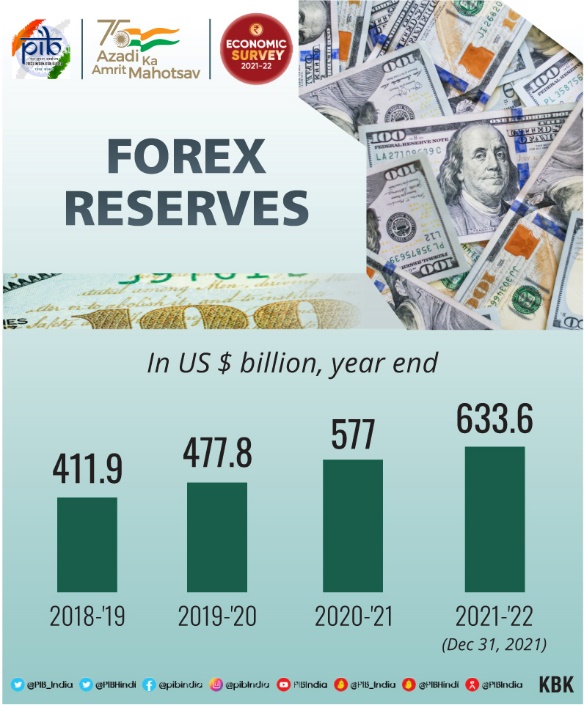
Further, the Survey points out that despite all the disruptions caused by the global pandemic, India’s balance of payments remained in surplus throughout the last two years. This allowed the Reserve Bank of India to keep accumulating foreign exchange reserves, which stand at US$634 billion on 31st December 2021. This is equivalent to 13.2 months of imports and higher than the country’s external debt.
The Survey notes that inflation has reappeared as a global issue in both advanced and emerging economies. The surge in energy prices, non-food commodities, input prices, disruption of global supply chains, and rising freight costs stoked global inflation during the year. In India, Consumer Price Index (CPI) inflation moderated to 5.2 per cent in 2021-22 (April-December) from 6.6 per cent in the corresponding period of 2020-21. It was 5.6 per cent (YoY) in December 2021, which is within the targeted tolerance band. The decline in retail inflation in 2021-22 was led by easing of food inflation. Wholesale Price Inflation (WPI), however, has been running in double-digits.

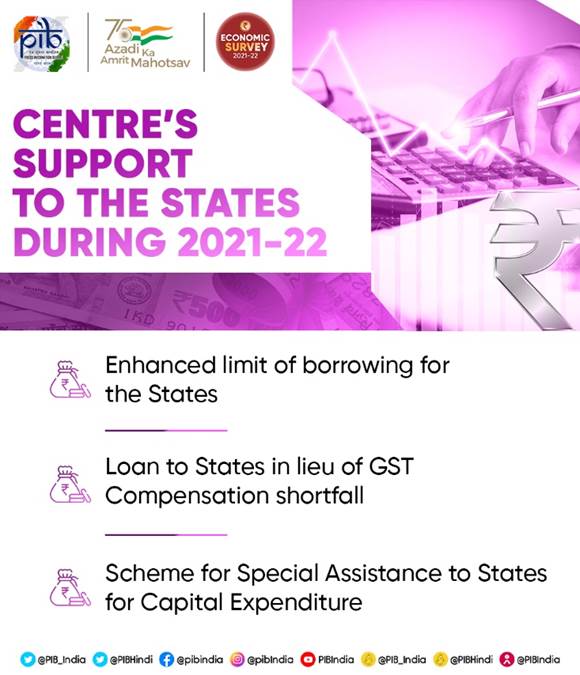
The Survey says that fiscal support given to the economy as well as the health response caused the fiscal deficit and government debt to rise in 2020-21. However, there has been a strong rebound in government revenues in 2021-22 so far. The revenue receipts of the central government during April-November 2021 have gone up by 67.2 per cent (YOY), as against an expected growth of 9.6 per cent in the 2021-22 Budget Estimates over provisional actuals. The tax collections have been buoyant for both direct and indirect taxes and the gross monthly GST collections have crossed ₹ 1 lakh crore consistently since July 2021.
 

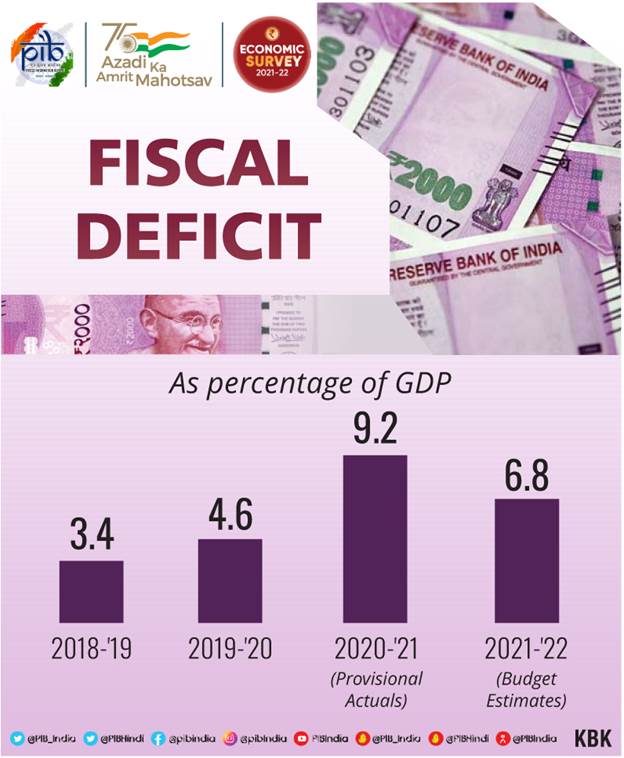
It adds that on the account of a sustained revenue collection and a targeted expenditure policy by the Government of India, the fiscal deficit for April-November 2021 has been contained at 46.2 per cent of Budget Estimates (BE) which is nearly one third of the proportion reached during the same period of the previous two years (135.1% of BE in April-November 2020 and 114.8% of BE in April-November 2019).
 

The Survey points out that the financial sector is always a possible area of stress during turbulent times. However, India’s capital markets have done exceptionally well and have allowed record mobilization of risk capital of Indian companies. The Sensex and Nifty scaled up to touch its peak at 61,766 and 18,477 on October 18, 2021. ₹ 89,066 crore was raised via 75 IPO issues in April- November 2021, much higher than in any year in the last decade. Moreover, the banking system is well capitalized and NPAs seems to have structurally declined. The Gross Non-Performing Advances (GNPA) ratio (i.e. GNPAs as a percentage of Gross Advances) and Net Non-Performing Advances (NNPA) ratio of Scheduled Commercial banks (SCBs) continued to decline since 2018-19. GNPA ratio of SCBs decreased from 7.5 per cent at end-September 2020 to 6.9 per cent at end-September 2021.

The Survey expresses that another distinguishing feature of India’s economic response has been an emphasis on supply-side reforms rather than a total reliance on demand management. These supply-side reforms include deregulation of numerous sectors, simplification of processes, removal of legacy issues like ‘retrospective tax’, privatization, production-linked incentives and so on. Even the sharp increase in capital spending by the Government can be seen as both demand and supply response as it creates infrastructure capacity for future growth.

There are two common themes in India’s supply-side strategy: (i) Reforms that improve flexibility and innovation in order to deal with the long-term unpredictability of the post-Covid world. This includes factor market reforms; deregulation of sectors like space, drones, geospatial mapping, trade finance factoring; process reforms like those in government procurement and in telecommunications sector; removal of legacy issues like retrospective tax; privatization and monetization, creation of physical infrastructure, and so on. (ii) Reforms aimed at improving the resilience o the Indian economy. These range from climate/environment related policies; social infrastructure such as public provision of tap water, toilets, basic housing, insurance for the poor, and so on; support for key industries under Atmanirbhar Bharat; a strong emphasis on reciprocity in foreign trade agreements, and so on.

An important theme that has been discussed through the course of the Economic Survey is that of ‘process reforms’. It is important to distinguish between deregulation and process reforms. The former relates to reducing or removing the role of government from a particular activity. In contrast, the latter broadly relates to simplification and smoothening of the process for activities where the government’s presence as a facilitator or regulator is necessary.

The Survey points out that the last two years have been difficult for the world economy on account of the COVID-19 pandemic. Repeated waves of infection, supply-chain disruptions and more recently, global inflation have created particularly challenging times for policy-making. Faced with these challenges, the Government of India opted for a ‘ Barbell Strategy” that combined a bouquet of safety-nets to cushion the impact on vulnerable sections of society and the business sector. It next pushed through a significant increase in capital expenditure on infrastructure to build back medium-term demand as well as aggressively implemented supply-side measures to prepare the economy for the sustained long-term expansion. This flexible and multi-layered approach is partly based on an “Agile” framework that used feedback-loops, and the monitoring of real-time data.

The Survey underlines that Monetary policy since the outbreak of the pandemic was calibrated to provide a cushion and support growth, but carefully controlled in order to avoid the medium term dislocations of excess liquidity. An important aspect of the safety-net was the use of Government guarantees to provide access to financial support to the economy in general and MSMEs in particular. In the last two years, government leveraged an array of eighty High Frequency Indicators (HFIs) representing industry, services, global trends, macro-stability indicators and several other activities, from both public and private sources to gauge the underlying state of the economy on a real-time basis. These HFIs helped policy makers tailor their response to an evolving situation rather than rely on pre-defined responses of a Waterfall framework, which has been the conventional method for framing policy in India and most of the world.

In conclusion, the Survey is quite optimistic that overall macro-economic stability indicators suggest that the Indian Economy is well placed to take on the challenges of 2022-23 and one of the reasons that the Indian Economy is in good position is its unique response strategy.

Topics

Acts Income Tax