

Loading...

⚠ ✕
❮ Top
☎ Help
☰
×

By creating an account you can:

Logo TaxTMI
Call Us / Help / Feedback✕

Contact Us At :

✉ E-mail: [email protected]

✆ Call / WhatsApp at: +91 99117 96707

For more information, Check Contact Us

FAQs :

To know Frequently Asked Questions, Check FAQs

Most Asked Video Tutorials :

For more tutorials, Check Video Tutorials

Submit Feedback/Suggestion :

Email :
Please provide your email address so we can follow up on your feedback.
Category :
Description :
Min 15 characters 0/2000
Make Most of Text Search ✕
  1. Checkout this video tutorial: How to search effectively on TaxTMI.
  2. Put words in double quotes for exact word search, eg: "income tax"
  3. Avoid noise words such as : 'and, of, the, a'
  4. Sort by Relevance to get the most relevant document.
  5. Press Enter to add multiple terms/multiple phrases, and then click on Search to Search.
  6. Text Search
  7. The system will try to fetch results that contains ALL your words.
  8. Once you add keywords, you'll see a new 'Search In' filter that makes your results even more precise.
  9. Text Search
╳
Add to...
You have not created any category. Kindly create one to bookmark this item!
✕
Create New Category
Hide
Title :
Description :
❮❮ Hide
❮ Default View
Expand ❯❯
Close ✕
🔎 Filters / Advanced Search ❯
TEXT

Press 'Enter' to add multiple search terms. Rules for Better Search

Search In
Main Text + AI Text ❯
  • Main Text
  • Main Text + AI Text
  • AI Text
Category: ?
Categorized by AI
---- All Categories ---- ❯
  • ---- All Categories ----
  • Income Tax
  • GST
  • Customs, DGFT & SEZ
  • FEMA & RBI
  • Corp. Laws, SEBI & IBC
  • PMLA, Black Money & ED
  • Budget
  • News and Press Release
  • PTI News
Month:
---- All Months ---- ❯
  • ---- All Months ----
  • January
  • February
  • March
  • April
  • May
  • June
  • July
  • August
  • September
  • October
  • November
  • December
Year:
---- All Years ---- ❯
  • ---- All Years ----
  • 2026
  • 2025
  • 2024
  • 2023
  • 2022
  • 2021
  • 2020
  • 2019
  • 2018
  • 2017
  • 2016
  • 2015
  • 2014
  • 2013
  • 2012
  • 2011
Sort By: ?
In Sort By 'Default', exact matches for text search are shown at the top, followed by the remaining results in their regular order.
Relevance Default Date
    India-New Zealand FTA to Enter into Force from 20 October 2026
    Bengaluru customs arrest passengers for smuggling ganja, gold at airport
    Third-country goods routed via New Zealand into India won't get FTA duty benefits
    Govt urges bank employees to refrain from strikes, resolve issues through dialogue
    Ex-Punjab DIG Bhullar case: ED arrests 'middleman' Kirshanu Sharda for corruption
    RBI revises foreign currency deposit inflows under FCNR(B) upward to USD 133 bn
    CBI arrests 'absconding' IRS officer in Rs 40-lakh bribery case
    Haryana plans Rs 2,295-crore rural infra push
    IPL betting syndicate: ED arrests 'principal bookie' in Guwahati money-laundering case
    ED chargesheets EaseMyTrip promoter Nishant Pitti in Mahadev betting app case
    “Sources and Methods for Compilation of National Accounts Statistics”
    Nearly 5 lakh Nagaland voters to receive notices over SIR mapping discrepancies
    India, Canada to hold next round of talks from Oct 5 for proposed trade pact: Goyal
    India's Semiconductor Market Projected to Grow Threefold to USD 200 billion by 2035: EY-IESA Report
    VKDL NPA Advisory Council Chairman V. K. Dubey Felicitated by Uttar Pradesh Women Commission Chairperson Babita Singh Chauhan
    Rupee rises 15 paise to close at 95.81 against US dollar
    Xi to visit US from Sept 23 to 25 for talks with Trump; China calls it ‘milestone of historic significance’
    Supporting PM Modi's call, IIFL Finance's Mayank Sharma believes recycling household gold is the fastest way to cut import bill
    How will tribunals function if no infrastructure? SC directs Centre to identify amenities required
    India-New Zealand trade pact to come into force on Oct 20: Goyal
❮
❯
❯❯
Maximize Maximize Maximize
0 / 200
Expand Note
Add to Folder

No Folders have been created

+

Are you sure you want to delete "My most important" ?

NOTE:

News
Showing Results for :
Reset Filters
Results Found:
Show All Summaries Hide All Summaries
September 22, 2026
Show AI Summary
Tariff liberalisation under the India-New Zealand FTA grants Indian exports duty-free access while protecting sensitive agricultural products.
From 20 October 2026, the India-New Zealand Free Trade Agreement applies duty-free treatment to all tariff lines covering Indian exports to New Zealand, while preserving exclusions for sensitive Indian agricultural products. Market access for New Zealand apples, kiwifruit, and Manuka honey remains subject to tariff rate quotas, minimum import prices, seasonal windows, and safeguards. Services commitments, mobility routes, investment facilitation, agricultural cooperation, and recognition of specified international inspection approvals form further components.
September 21, 2026
Show AI Summary
Airport smuggling enforcement targets concealed ganja and gold, leading to passenger interceptions and arrests under customs law.
Customs enforcement at Bengaluru airport involved interception and arrest of passengers allegedly attempting to smuggle hydroponic ganja and gold by concealing the goods in cabin baggage, other baggage, undergarments, or on the body. Cases involved arrivals from Vietnam, Bangkok, Kuala Lumpur, and Abu Dhabi. The Abu Dhabi gold-ornament case involved an arrest under the Customs Act.
September 21, 2026
Show AI Summary
Rules of origin prevent third-country transshipment from receiving preferential tariffs under bilateral trade arrangements between partner economies.
India-New Zealand free trade preferences apply only to goods satisfying Rules of Origin. Third-country goods routed through New Zealand cannot receive preferential Indian tariff treatment, as bilateral cumulation is confined to originating materials and goods of India and New Zealand. Sensitive sectors receive no duty concessions, while a bilateral safeguard mechanism addresses sudden import surges after duty elimination or reduction. Temporary Employment Entry, student mobility commitments, post-study work opportunities, and exemption from directly funded social-security contributions for temporary Indian residents form part of the services framework.
September 21, 2026
Show AI Summary
Banking service continuity is prioritised through dialogue as employee welfare measures and wage negotiations address outstanding demands.
Banking-sector industrial relations are addressed through an appeal to bank employees to avoid strike action and pursue outstanding demands through dialogue, in order to keep banking services uninterrupted. Most union concerns are considered substantially addressed, while a remaining demand continues to be examined. The demand for withdrawal of the Performance Linked Incentive scheme had been addressed by placing that scheme in abeyance following detailed discussions. Employee welfare measures, wage revisions, and negotiations for the forthcoming Bipartite Settlement are intended to support workforce welfare and banking-sector efficiency.
September 21, 2026
Show AI Summary
Money-laundering investigation addresses alleged use of a middleman to demand, receive, move and conceal corruption proceeds.
Money-laundering proceedings were initiated from corruption FIRs alleging that a middleman was used to demand and receive illegal gratification. Investigation concerns the alleged facilitation of receipt and movement of funds, supported by searches yielding cash seizure and freezing of financial accounts. Financial records and digital devices allegedly indicated unexplained deposits, investments, transactions involving the officer, and possible involvement of other public servants. The inquiry is tracing alleged proceeds of crime and the role of associated persons and entities.
September 21, 2026
Show AI Summary
FCNR(B) foreign-currency deposits use a swap facility to mobilise non-resident funds without direct rupee exchange-rate risk.
RBI's special USD-INR foreign-exchange swap facility mobilised foreign-currency inflows through FCNR(B) deposits, Overseas Foreign Currency Borrowings and External Commercial Borrowings. The FCNR(B) deposit window closed on 31 August 2026 after its mobilisation objective was achieved, while the facility remained available for the other two channels until 31 December 2026. FCNR(B) collections were revised upward to approximately USD 133 billion. Such deposits are fixed-term foreign-currency deposits with principal and interest repayable in the same currency, avoiding direct rupee exchange-rate risk for non-resident depositors.
September 21, 2026
Show AI Summary
GST bribery investigation concerns alleged illegal gratification sought to resolve quarry firm's tax and royalty proceedings.
GST-related corruption allegations concern an alleged demand for illegal gratification from a stone-quarrying firm to resolve GST and royalty proceedings. A Customs House Agent was apprehended in a trap operation while allegedly accepting the negotiated amount on behalf of a CGST Superintendent and an Additional Commissioner. Custody proceedings involved written communication of arrest grounds and intimation to relevant family members and advocates.
September 21, 2026
Show AI Summary
Rural infrastructure financing supports irrigation, roads, water supply, warehousing and micro-irrigation through structured lending and implementation oversight.
Haryana's 2026-27 rural infrastructure financing plan comprises six proposals for irrigation, roads, drinking-water supply and warehousing, with loan assistance proposed under the Rural Infrastructure Development Fund. Infrastructure Development Assistance has been sanctioned for the India International Horticulture Market, while further micro-irrigation proposals have been recommended under the Micro Irrigation Fund. Implementation oversight emphasises faster project execution and timely drawal claims, alongside borrowing approval and prospective support for water security, groundwater recharge, efficient irrigation and treated-wastewater reuse.
September 21, 2026
Show AI Summary
Money laundering allegations in illegal cricket betting prompted investigative custody and examination of suspected routing of betting proceeds.
Money-laundering investigation into an organised illegal cricket-betting syndicate concerns the alleged use of online platforms, encrypted messaging channels, and a principal bookie to solicit, accept, and settle bets. Betting-derived funds were allegedly routed through a partnership firm represented as non-operational, whose account recorded substantial corresponding credits and debits. Property and vehicle records, digital data, and statements under the PMLA are relied upon to allege the acquisition, possession, use, transfer, and projection of proceeds of crime as untainted property.
September 21, 2026
Show AI Summary
Money laundering allegations concern foreign portfolio investments, alleged share-price manipulation, attachment, and proposed confiscation of betting proceeds.
PMLA proceedings name Nishant Pitti in relation to allegations that proceeds from illegal online betting were introduced into Indian equity markets as foreign portfolio investments. The allegations attribute to him a role in facilitating and layering such proceeds through pre-arranged share-price manipulation involving Easy Trip Planners Ltd. Property action includes provisional attachment of his DEMAT shares, described as proceeds of crime, and a request for confiscation.
September 21, 2026
Show AI Summary
National accounts modernisation adopts updated data sources, revised sector methods, and proportional Denton benchmarking for improved GDP estimates.
National Accounts Statistics in the new series use base year 2022-23, replacing the 2011-12 series. The series was updated to reflect changes flowing from the new Producer Price Index and Index of Industrial Production series. Methodological modernization expands corporate and financial-sector data coverage, refines general-government treatment, and adopts direct household-sector estimation from the Annual Survey of Unincorporated Sector Enterprises and the Periodic Labour Force Survey. Private Final Consumption Expenditure adopts COICOP 2018, while Quarterly National Accounts use the Proportional Denton approach and greater Goods and Services Tax and administrative-data use.
September 21, 2026
Show AI Summary
Electoral roll verification requires unmapped voters to establish linkage or submit prescribed documents before final enrolment.
Special Intensive Revision of Nagaland's electoral roll applies a mapping and verification process by reference to the 2005 electoral roll. Electors recorded under no-mapping or mapping-anomaly categories, including persons unable to establish linkage to an elector in the 2005 roll, are to receive notices from Electoral Registration Officers or Assistant Electoral Registration Officers. They must furnish prescribed supporting documents, calibrated to their date or year of birth, for verification. Non-registration in the 2005 roll does not itself cause automatic exclusion.
September 21, 2026
Show AI Summary
Trade pact negotiations and Russian energy tariffs shape market-access commitments and potential import-duty exposure for exporters.
India and Canada have accelerated negotiations for a Comprehensive Economic Partnership Agreement to establish a bilateral trade framework for goods and services. A United States law concerning sanctions on Russia and Iran authorises tariffs of up to 100 per cent on imports from leading purchasers of Russian crude oil or natural gas, creating potential tariff exposure for Indian exports. The India-European Union trade pact contemplates immediate duty elimination on 90 per cent of Indian goods and phased elimination on a further three per cent over seven years, subject to ratification.
September 21, 2026
Show AI Summary
Semiconductor ecosystem policy requires predictable regulation, integrated clusters, and coordinated support to convert domestic demand into local value creation.
Semiconductor ecosystem development in India is centred on converting expanding domestic demand into local manufacturing, innovation and supply-chain resilience. A predictable fiscal and regulatory environment, alignment of central and state semiconductor policies, integrated manufacturing clusters and talent-certification programmes are important to project viability and commercialisation. Advanced packaging, compound semiconductors, photonics and chip-to-system integration offer high-potential areas, requiring policy certainty, streamlined approvals and long-term support for research, talent and supplier development.
September 21, 2026
Show AI Summary
Legal and NPA advisory services receive recognition for social welfare, women's employment, legal awareness, and financial dispute-resolution work.
Felicitation of Advocate V. K. Dubey recognised his stated work in women's employment, public welfare, banking, NPA resolution, legal awareness, and social service. His profile encompasses civil, criminal, non-performing asset, banking, corporate, and settlement matters; leadership of bodies engaged in financial-dispute resolution; and legal assistance and public awareness intended to improve access to justice for marginalised persons. Associated initiatives include education and support for disadvantaged communities and wider social empowerment.
September 21, 2026
Show AI Summary
Rupee appreciation reflected lower crude oil prices, stronger domestic equities, and improved risk sentiment amid diplomatic expectations.
Rupee appreciation against the US dollar followed lower crude oil prices, improved global risk sentiment, positive domestic equity markets, and softer US Treasury yields. Dollar index strength, geopolitical developments, and possible increases in oil supplies remained relevant to currency movements. Market commentary anticipated a slight positive rupee bias if crude oil prices continued to ease, while renewed geopolitical tensions could weaken risk sentiment. Net foreign institutional investment and a decline in foreign exchange reserves also formed part of the market context.
September 21, 2026
Show AI Summary
Reciprocal tariffs and AI incident notifications frame bilateral talks on trade, security, technology and arms sales.
US sanctions legislation authorises the President to impose tariffs, including up to 100 per cent, on countries purchasing Russian oil and gas. China rejects tariffs directed at its Russian energy purchases and opposes unilateral sanctions and long-arm jurisdiction absent an international-law basis or a UN Security Council mandate. Washington and Beijing are also negotiating a reciprocal tariff-reduction framework covering products from both sides.
September 21, 2026
Show AI Summary
Gold recycling and financialisation can reduce import dependence by mobilising household holdings through exchange, credit and non-physical investment.
Organised gold recycling, responsible sourcing, gold loans and financialised gold products are identified as ways to reduce reliance on fresh gold imports. Exchanging old jewellery can meet retail demand from existing domestic holdings, while gold loans unlock credit without requiring households to sell their gold. Gold ETFs and digital gold permit exposure to gold's value without physical possession and may reduce physical import demand. Transparency, trust and supporting infrastructure are necessary to integrate household gold into an organised formal economy.
September 21, 2026
Show AI Summary
Tribunal infrastructure and member vacancies: amenities assessment and bench-level data collection address reduced sittings across company-law benches.
The Supreme Court required the Central Government urgently to identify, in consultation with the Tribunal President, infrastructural amenities needed by tribunal benches. The Principal Bench Bar Association was required to compile tabulated infrastructure data for every regional bench. At least 18 benches were asserted to conduct half-day sittings because of member shortages, against a sanctioned complement that remained unchanged despite expanded insolvency jurisdiction.
September 21, 2026
Show AI Summary
Duty-free access for Indian exports under the India-New Zealand trade agreement begins with its entry into force.
The India-New Zealand Free Trade Agreement will grant duty-free access in New Zealand to all Indian exports, displacing existing peak tariffs on products such as ceramics, carpets, automobiles, and auto components. Scheduled to enter into force on 20 October 2026, the agreement also includes New Zealand's long-term investment commitment in India.

News

Back

All News

Showing Results for :
Reset Filters
No Records Found

News

Back

All News

Customs, DGFT & SEZ

SUMMARY OF THE ECONOMIC SURVEY 2021-22

January 31, 2022

Contents
Plus +
Summary
Note

Note

-

Bookmark

Print

Print

SUMMARY OF THE ECONOMIC SURVEY 2021-22

AS PER WORLD BANK, ADB AND IMF PROJECTIONS, INDIA TO REMAIN THE FASTEST GROWING MAJOR ECONOMY IN THE WORLD DURING 2021-24

INDIAN ECONOMY TO GROW BY 9.2% IN REAL TERMS IN 2021-22

AGRICULTURE TO GROW BY 3.9 % IN 2021-22 IN COMPARISON TO 3.6% IN THE PREVIOUS YEAR

INDUSTRIAL SECTOR TO WITNESS SHARP REBOUND FROM A CONTRACTION OF 7% IN 2020-21 TO EXPANSION OF 11.8% IN 2021-22

SERVICES TO CLOCK 8.2% GROWTH IN 2021-22 AFTER A CONTRACTION OF 8.4% LAST YEAR

FOREIGN EXCHANGE RESERVES STOOD AT US$ 634 BILLION AS ON 31ST DECEMBER 2021 EQUIVALENT TO OVER 13 MONTHS OF IMPORTS AND HIGHER THAN COUNTRY’S EXTERNAL DEBT

INVESTMENT IS EXPECTED TO SEE A STRONG GROWTH OF 15% IN 2021-22

CONSUMER PRICE INDEX (CPI) COMBINED INFLATION OF 5.6% IN DECEMBER 2021 IS WELL WITHIN TARGETED TOLERANCE BAND

FISCAL DEFICIT FOR APRIL-NOVEMBER 2021 CONTAINED AT 46.2% OF BUDGET ESTIMATES

CAPITAL MARKET BOOMS DESPITE PANDEMIC; OVER ₹ 89 THOUSAND CRORE RAISED VIA 75 IPO ISSUES IN APRIL-NOVEMBER 2021, MUCH HIGHER THAN IN ANY YEAR IN THE LAST DECADE

MACRO-ECONOMIC STABILITY INDICATORS SUGGEST INDIAN ECONOMY WELL PL


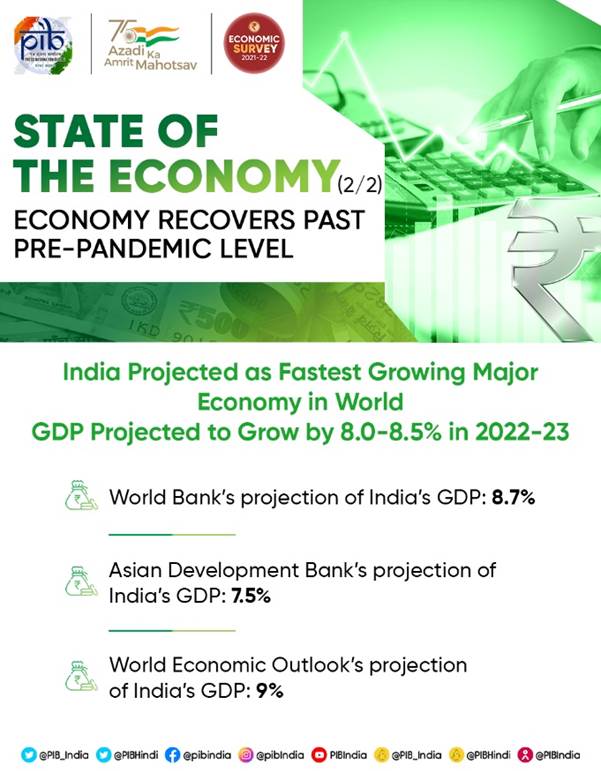
India to witness GDP growth of 8.0-8.5 per cent in 2022-23, supported by widespread vaccine coverage, gains from supply-side reforms and easing of regulations, robust export growth, and availability of fiscal space to ramp up capital spending.

The Union Minister for Finance & Corporate Affairs Smt Nirmala Sitharaman tabled the Economic Survey 2021-22 in Parliament today, which states that the year ahead is well poised for a pick-up in private sector investment with the financial system in a good position to provide support to the revival of economy. The growth projection for 2022-23 is based on the assumption that there will be no further debilitating pandemic related economic disruption, monsoon will be normal, withdrawal of global liquidity by major central banks will be broadly orderly, oil prices will be in the range of  US$70-$75/bbl, and global supply chain disruptions will steadily ease over the course of the year.
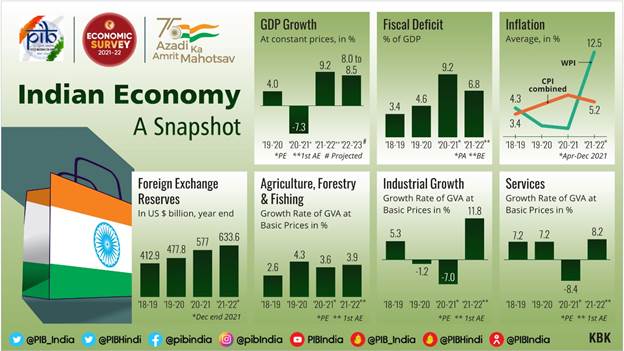
The Survey says, the above projection is comparable with the World Bank’s and Asian Development Bank’s latest forecasts of real GDP growth of 8.7 per cent and 7.5 per cent respectively for 2022-23. As per the IMF’s latest World Economic Outlook (WEO) growth projections released on 25th January, 2022, India’s real GDP is projected to grow at 9 per cent in both 2021-22 and 2022-23 and at 7.1 per cent in 2023-24. This projects India as the fastest growing major economy in the world in all these three years.
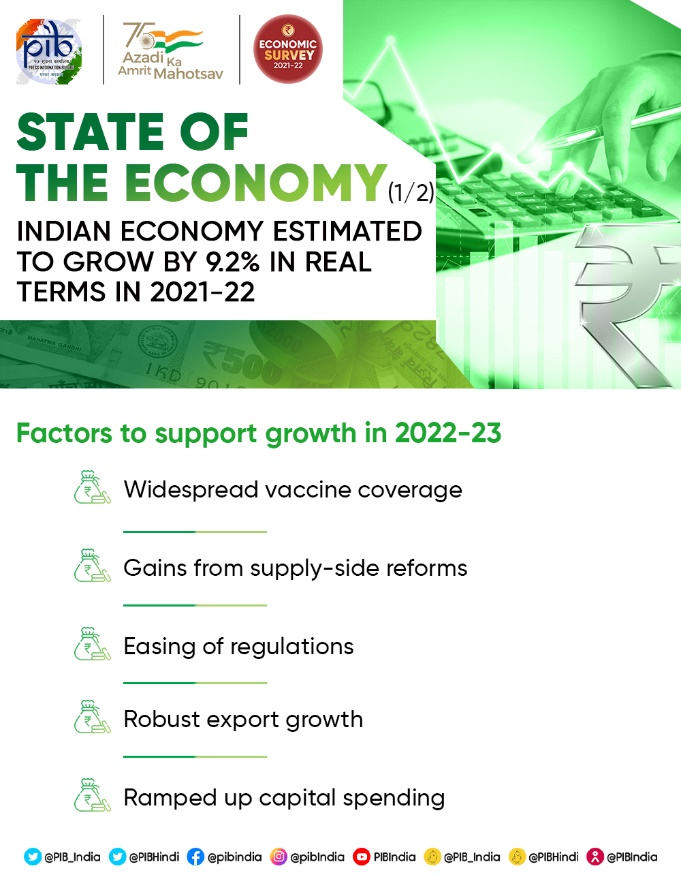
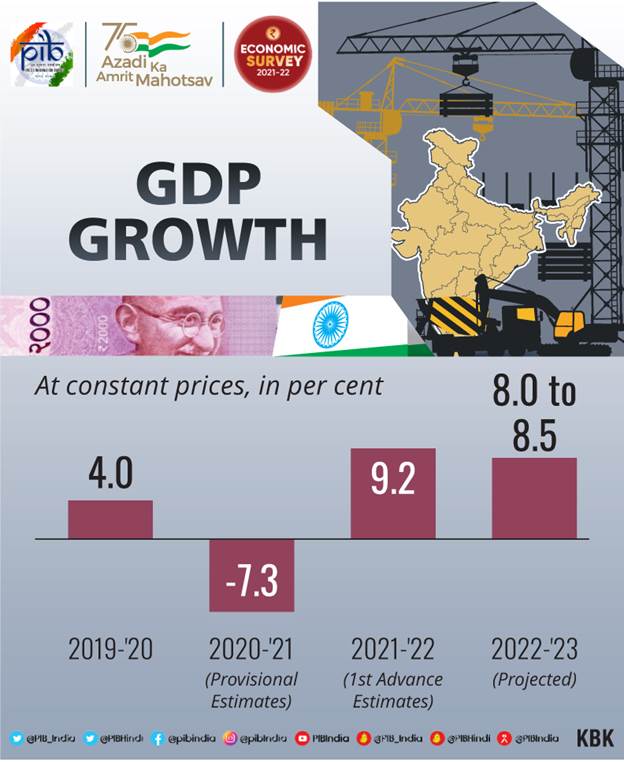
Referring to First Advance Estimates, the Survey states that the Indian economy is estimated to grow by 9.2 per cent in real terms in 2021-22, after a contraction of 7.3 per cent in 2020-21. This implies that overall economic activity has recovered past the pre-pandemic levels. Almost all indicators show that the economic impact of the “second wave” in Q1 was much smaller than that experienced during the full lockdown phase in 2020-21, even though the health impact was more severe.
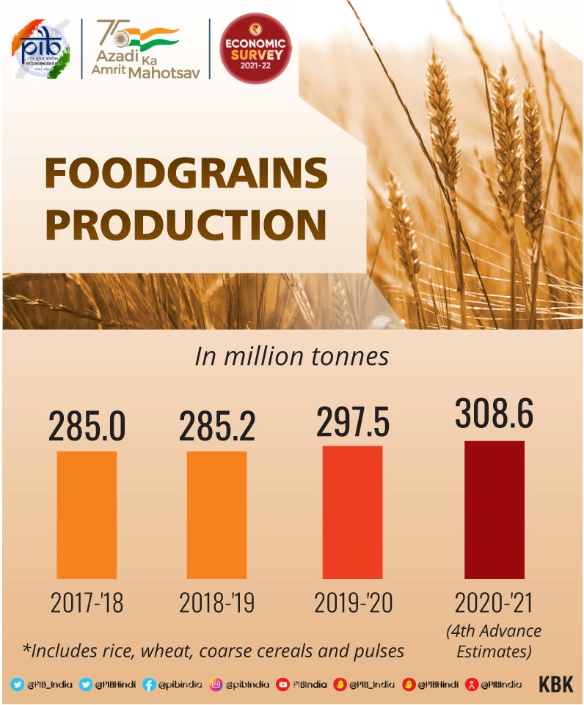
Dwelling on the sectoral aspects, the Survey states that Agriculture and allied sectors have been the least impacted by the pandemic and the sector is expected to grow by 3.9 per cent in 2021-22 after growing by 3.6 per cent in the previous year. The area sown under Kharif and Rabi crops, and the production of wheat and rice has been steadily increasing over the years. In the current year, food grains production for the Kharif season is estimated to post a record level of 150.5 million tonnes. Moreover, procurement of food grains under the central pool accordingly maintained its rising trend in 2021-22 along with minimum support prices, which augur well for national food security and farmers’ incomes. Importantly, the strong performance of the sector was supported by Government policies that ensured timely supplies of seed and fertilizers despite pandemic related disruptions. It was helped by good monsoon rains as reflected in reservoir levels being higher than the 10-year average.
According to Survey, the industrial sector went through a sharp rebound  from a contraction of 7 per cent in 2020-21 to an expansion of  11.8 per cent in this financial year. The manufacturing, construction and mining sub-sectors went through the same swing although the utilities segment experienced a more muted cycle as basic services such as electricity and water supply were maintained even at the height of the national lockdown. The share of industry in GVA is now estimated at 28.2 per cent.

The Survey states that the services sector has been the hardest hit by the pandemic, especially segments that involve human contact.  This sector is estimated to grow by 8.2 per cent this financial year following last year’s 8.4 per cent contraction. It should be noted that there is a wide dispersion of performance by different sub-sectors. Both the finance /Real Estate and the Public Administration segments are now well above pre-COVID levels. However, segments like Travel, Trade and hotels are yet to fully recover. There has been a boom in software and IT-enabled services exports even as earnings from tourism have declined sharply.

The Survey added that total consumption is estimated to have grown by 7.0 per cent in 2021-22 with government consumption remaining the biggest contributor as in the previous year. Government consumption is estimated to grow by a strong 7.6 per cent surpassing pre-pandemic levels. Private consumption is also estimated to have improved significantly to recover 97 per cent of corresponding pre-pandemic output level and it is poised to see stronger recovery with rapid coverage in vaccination and faster normalization of economic activity.

According to the Survey, Investment, as measured by Gross Fixed Capital Formation (GFCF) is expected to see strong growth of 15 per cent in 2021-22 and achieve full recovery of pre-pandemic level. Government’s policy thrust on quickening virtuous cycle of growth via capex and infrastructure spending has increased capital formation in the economy lifting the investment of GDP ratio to about 29.6 per cent in 2021-22, the highest in seven years. While private investment recovery is still at a nascent stage, there are many signals which indicate that India is poised for stronger investment. A sturdy and cleaned-up banking sector stands ready to support private investment adequately.

On the Exports and Imports front, the Survey states that India’s exports of both goods and services have been exceptionally strong so far in 2021-22. Merchandise exports have been above US$30 billion for eight consecutive months in 2021-22, despite many pandemic related global supply constraints. Net services exports have also risen sharply, driven by professional and management consulting services, audio visual and related services, freight transport services, telecommunications, computer and information services. From a demand perspective, India’s total exports are expected to grow by 16.5 per cent in 2021-22 surpassing pre-pandemic levels. Imports also recovered strongly with revival of domestic demand and continuous rise in price of imported crude and metals. Imports are expected to grow by 29.4 per cent in 2021-22 surpassing corresponding pre-pandemic levels. Resultantly, India’s net exports have turned negative in the first half of 2021-22, compared to a surplus in the corresponding period of 2020-21. But current account deficit is expected to remain within manageable limits.

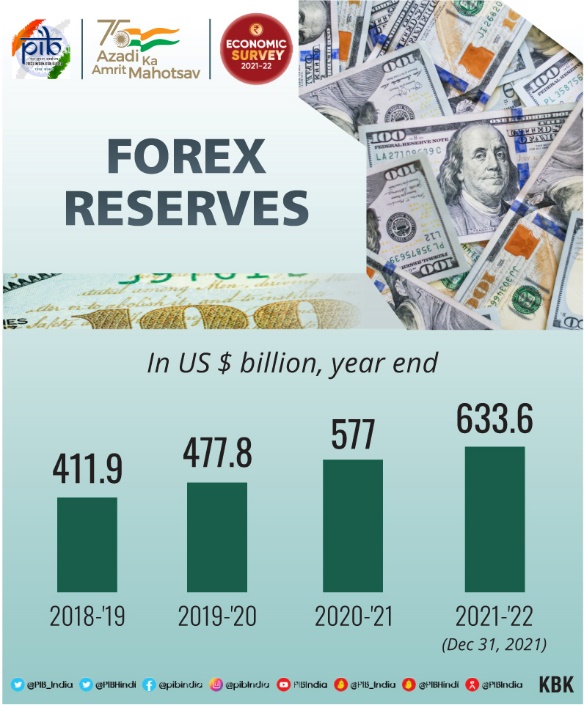
Further, the Survey points out that despite all the disruptions caused by the global pandemic, India’s balance of payments remained in surplus throughout the last two years. This allowed the Reserve Bank of India to keep accumulating foreign exchange reserves, which stand at US$634 billion on 31st December 2021. This is equivalent to 13.2 months of imports and higher than the country’s external debt.
The Survey notes that inflation has reappeared as a global issue in both advanced and emerging economies. The surge in energy prices, non-food commodities, input prices, disruption of global supply chains, and rising freight costs stoked global inflation during the year. In India, Consumer Price Index (CPI) inflation moderated to 5.2 per cent in 2021-22 (April-December) from 6.6 per cent in the corresponding period of 2020-21. It was 5.6 per cent (YoY) in December 2021, which is within the targeted tolerance band. The decline in retail inflation in 2021-22 was led by easing of food inflation. Wholesale Price Inflation (WPI), however, has been running in double-digits.

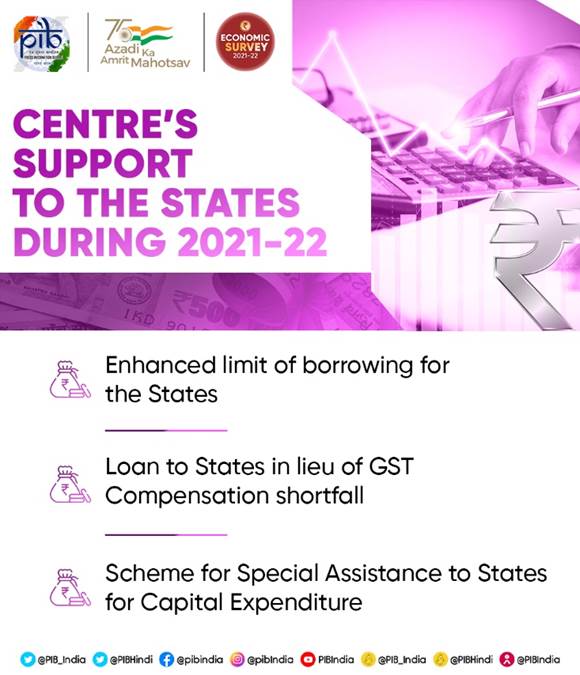
The Survey says that fiscal support given to the economy as well as the health response caused the fiscal deficit and government debt to rise in 2020-21. However, there has been a strong rebound in government revenues in 2021-22 so far. The revenue receipts of the central government during April-November 2021 have gone up by 67.2 per cent (YOY), as against an expected growth of 9.6 per cent in the 2021-22 Budget Estimates over provisional actuals. The tax collections have been buoyant for both direct and indirect taxes and the gross monthly GST collections have crossed ₹ 1 lakh crore consistently since July 2021.
 

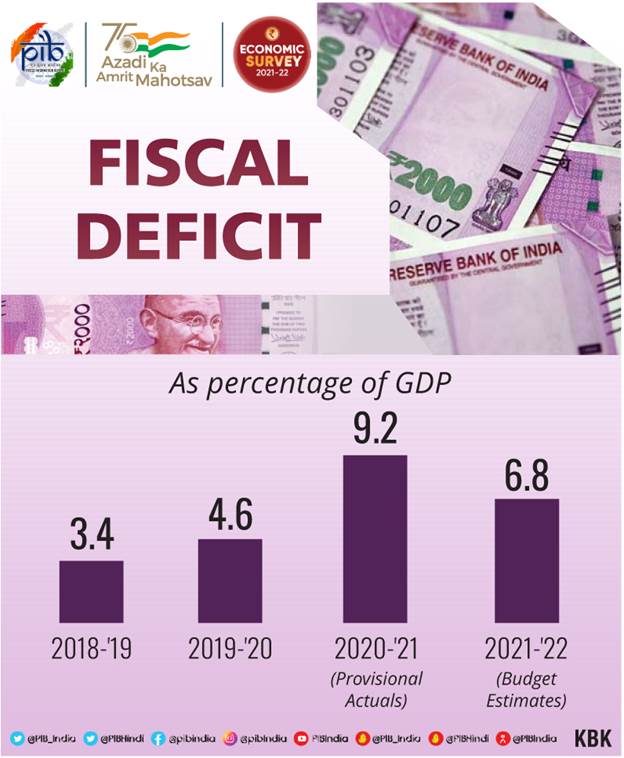
It adds that on the account of a sustained revenue collection and a targeted expenditure policy by the Government of India, the fiscal deficit for April-November 2021 has been contained at 46.2 per cent of Budget Estimates (BE) which is nearly one third of the proportion reached during the same period of the previous two years (135.1% of BE in April-November 2020 and 114.8% of BE in April-November 2019).
 

The Survey points out that the financial sector is always a possible area of stress during turbulent times. However, India’s capital markets have done exceptionally well and have allowed record mobilization of risk capital of Indian companies. The Sensex and Nifty scaled up to touch its peak at 61,766 and 18,477 on October 18, 2021. ₹ 89,066 crore was raised via 75 IPO issues in April- November 2021, much higher than in any year in the last decade. Moreover, the banking system is well capitalized and NPAs seems to have structurally declined. The Gross Non-Performing Advances (GNPA) ratio (i.e. GNPAs as a percentage of Gross Advances) and Net Non-Performing Advances (NNPA) ratio of Scheduled Commercial banks (SCBs) continued to decline since 2018-19. GNPA ratio of SCBs decreased from 7.5 per cent at end-September 2020 to 6.9 per cent at end-September 2021.

The Survey expresses that another distinguishing feature of India’s economic response has been an emphasis on supply-side reforms rather than a total reliance on demand management. These supply-side reforms include deregulation of numerous sectors, simplification of processes, removal of legacy issues like ‘retrospective tax’, privatization, production-linked incentives and so on. Even the sharp increase in capital spending by the Government can be seen as both demand and supply response as it creates infrastructure capacity for future growth.

There are two common themes in India’s supply-side strategy: (i) Reforms that improve flexibility and innovation in order to deal with the long-term unpredictability of the post-Covid world. This includes factor market reforms; deregulation of sectors like space, drones, geospatial mapping, trade finance factoring; process reforms like those in government procurement and in telecommunications sector; removal of legacy issues like retrospective tax; privatization and monetization, creation of physical infrastructure, and so on. (ii) Reforms aimed at improving the resilience o the Indian economy. These range from climate/environment related policies; social infrastructure such as public provision of tap water, toilets, basic housing, insurance for the poor, and so on; support for key industries under Atmanirbhar Bharat; a strong emphasis on reciprocity in foreign trade agreements, and so on.

An important theme that has been discussed through the course of the Economic Survey is that of ‘process reforms’. It is important to distinguish between deregulation and process reforms. The former relates to reducing or removing the role of government from a particular activity. In contrast, the latter broadly relates to simplification and smoothening of the process for activities where the government’s presence as a facilitator or regulator is necessary.

The Survey points out that the last two years have been difficult for the world economy on account of the COVID-19 pandemic. Repeated waves of infection, supply-chain disruptions and more recently, global inflation have created particularly challenging times for policy-making. Faced with these challenges, the Government of India opted for a ‘ Barbell Strategy” that combined a bouquet of safety-nets to cushion the impact on vulnerable sections of society and the business sector. It next pushed through a significant increase in capital expenditure on infrastructure to build back medium-term demand as well as aggressively implemented supply-side measures to prepare the economy for the sustained long-term expansion. This flexible and multi-layered approach is partly based on an “Agile” framework that used feedback-loops, and the monitoring of real-time data.

The Survey underlines that Monetary policy since the outbreak of the pandemic was calibrated to provide a cushion and support growth, but carefully controlled in order to avoid the medium term dislocations of excess liquidity. An important aspect of the safety-net was the use of Government guarantees to provide access to financial support to the economy in general and MSMEs in particular. In the last two years, government leveraged an array of eighty High Frequency Indicators (HFIs) representing industry, services, global trends, macro-stability indicators and several other activities, from both public and private sources to gauge the underlying state of the economy on a real-time basis. These HFIs helped policy makers tailor their response to an evolving situation rather than rely on pre-defined responses of a Waterfall framework, which has been the conventional method for framing policy in India and most of the world.

In conclusion, the Survey is quite optimistic that overall macro-economic stability indicators suggest that the Indian Economy is well placed to take on the challenges of 2022-23 and one of the reasons that the Indian Economy is in good position is its unique response strategy.

Topics

Acts Income Tax