

Loading...

⚠ ✕
❮ Top
☎ Help
☰
×

By creating an account you can:

Logo TaxTMI
Call Us / Help / Feedback✕

Contact Us At :

✉ E-mail: [email protected]

✆ Call / WhatsApp at: +91 99117 96707

For more information, Check Contact Us

FAQs :

To know Frequently Asked Questions, Check FAQs

Most Asked Video Tutorials :

For more tutorials, Check Video Tutorials

Submit Feedback/Suggestion :

Email :
Please provide your email address so we can follow up on your feedback.
Category :
Description :
Min 15 characters 0/2000
Make Most of Text Search ✕
  1. Checkout this video tutorial: How to search effectively on TaxTMI.
  2. Put words in double quotes for exact word search, eg: "income tax"
  3. Avoid noise words such as : 'and, of, the, a'
  4. Sort by Relevance to get the most relevant document.
  5. Press Enter to add multiple terms/multiple phrases, and then click on Search to Search.
  6. Text Search
  7. The system will try to fetch results that contains ALL your words.
  8. Once you add keywords, you'll see a new 'Search In' filter that makes your results even more precise.
  9. Text Search
╳
Add to...
You have not created any category. Kindly create one to bookmark this item!
✕
Create New Category
Hide
Title :
Description :
❮❮ Hide
❮ Default View
Expand ❯❯
Close ✕
🔎 Filters / Advanced Search ❯
TEXT

Press 'Enter' to add multiple search terms. Rules for Better Search

Search In
Main Text + AI Text ❯
  • Main Text
  • Main Text + AI Text
  • AI Text
Category: ?
Categorized by AI
---- All Categories ---- ❯
  • ---- All Categories ----
  • Income Tax
  • GST
  • Customs, DGFT & SEZ
  • FEMA & RBI
  • Corp. Laws, SEBI & IBC
  • PMLA, Black Money & ED
  • Budget
  • News and Press Release
  • PTI News
Month:
---- All Months ---- ❯
  • ---- All Months ----
  • January
  • February
  • March
  • April
  • May
  • June
  • July
  • August
  • September
  • October
  • November
  • December
Year:
---- All Years ---- ❯
  • ---- All Years ----
  • 2026
  • 2025
  • 2024
  • 2023
  • 2022
  • 2021
  • 2020
  • 2019
  • 2018
  • 2017
  • 2016
  • 2015
  • 2014
  • 2013
  • 2012
  • 2011
Sort By: ?
In Sort By 'Default', exact matches for text search are shown at the top, followed by the remaining results in their regular order.
Relevance Default Date
    IDFC FIRST Bank enables Direct Tax payments through UPI, cards, net banking and branches
    Sensex slumps 1,248 pts as IRDAI proposal hits financial shares; rising crude, US yields weigh
    Bajaj Finance Personal Loan Offers Rs. 40,000 to Rs. 55 Lakh with Tenures up to 108 Months
    MCA issues advisory - cautions public against high-return promises by non-compliant Nidhi Companies
    Banks likely to deploy excess liquidity over next few months amid strong credit demand: RBI Deputy Guv
    Assam Cabinet approves rules for compulsory registration of Muslim marriages
    The Indian Economy in an Ever More Volatile and Complex World - Special Address by Dr. Poonam Gupta, Deputy Governor, Reserve Bank of India at the 13t...
    Technopark software exports rise 17.3 pc to Rs 17,092 cr in FY26
    IIEST, Shibpur partners with TCS to launch state-of-the-art centre of excellence in AI
    AAP holds protest at GMADA office in Mohali as ED's searches continue
    CMRL ''payments'' to UDF, LDF leaders prevented Vigilance probe against Vijayan, claims Ker BJP
    US and China agree to extend trade truce by 2 months: Bessent
    DRI seizes around 21 kg foreign-origin gold worth Rs. 32 crore in crackdown on gold smuggling
    DRI seizes around 12 kg foreign-origin gold smuggled from Bangladesh worth Rs. 17 crore in a crackdown on cross border gold smuggling
    Union Minister for Finance & Corporate Affairs Smt. Nirmala Sitharaman inaugurates BRICS Heads of Tax Authorities Meeting in New Delhi
    DRI seizes 86 live Tokay Geckos in Assam in a crackdown on wildlife trafficking; two arrested
    DRI seizes 10,000 kg of firecrackers worth Rs. 3 crore at Nhava Sheva port
    CCI approves acquisition of certain additional equity share capital of IIFL Capital Services Ltd by FIH Mauritius Investments Ltd.
    CCI approves acquisition of Onesto Labs Private Limited by L’Oréal India Private Limited
    Central govt employees to get salary in advance on Sep 25 in view of 3-day bank strike
❮
❯
❯❯
Maximize Maximize Maximize
0 / 200
Expand Note
Add to Folder

No Folders have been created

+

Are you sure you want to delete "My most important" ?

NOTE:

News
Showing Results for :
Reset Filters
Results Found:
Show All Summaries Hide All Summaries
September 24, 2026
Show AI Summary
Direct tax payment gateway integration enables nationwide payments through digital options, branch channels, and customers' respective internet-banking services.
IDFC FIRST Bank's payment-gateway integration for Central Board of Direct Taxes collections enables Direct Tax payments through UPI, credit cards, debit cards, Retail and Corporate Internet Banking, and branch-based cheque, demand draft, or cash payments. Customers of other banks may use their own internet-banking facilities through the gateway. Taxpayers create a challan on the Income Tax e-Filing Portal, select Payment Gateway and IDFC FIRST Bank, choose a payment mode, complete payment, and download or print the paid challan. Payment confirmations are also accessible.
September 24, 2026
Show AI Summary
Insurance distribution controls target commissions, expenses and loan-linked sales, reshaping bancassurance arrangements and intermediary remuneration structures.
IRDAI's consultation proposals for insurance distribution contemplate lower Expenses of Management limits, tighter commission controls, and greater control over loan-linked insurance practices. The prospective framework concerns insurer and intermediary remuneration, distribution expenses, and bancassurance fee structures. Reported concerns centre on potential effects on insurer earnings, intermediary economics, and lending-linked distribution arrangements; the measures are not described as final operative obligations or enforcement action.
September 24, 2026
Show AI Summary
Personal loan eligibility and repayment planning: loan variants and digital applications remain subject to assessment, verification, and applicable terms.
Eligible customers may seek collateral-free personal loans within stated amount, tenure and interest-rate ranges. Loan amount, interest rate and tenure determine the EMI and total interest payable, while calculator results are estimates rather than final repayment obligations. Eligibility includes nationality, age, employment and credit-score conditions, but approval, final pricing and loan amount remain subject to lender assessment, document verification and applicable terms. Online applications require personal, financial and employment details and KYC verification.
September 24, 2026
Show AI Summary
Nidhi company deposits lack insurance protection, requiring verification of government declaration before relying on high-return promises.
Each company seeking to function as a Nidhi must file Form NDH-4 for declaration or updated Nidhi status and comply with the Companies Act, 2013 and applicable Nidhi Rules. Nidhi companies may accept deposits and grant loans only to members. Public investors should verify declared Nidhi status rather than rely on unusually high-return promises, agent representations, or informal assurances. Deposits with Nidhi companies are not insured by the Deposit Insurance and Credit Guarantee Corporation, and recovery may be difficult where a company fails or fraud occurs.
September 24, 2026
Show AI Summary
FCNR(B) liquidity deployment remains within banks' discretion, guided by credit pipelines, asset-liability positions, and prudent underwriting standards.
Banks retain full discretion to deploy liquidity mobilised through FCNR(B) deposits, based on their credit pipeline, lending proposals, liquidity outlook and asset-liability position. No sector-specific direction applies to use of these funds. FCNR(B) deposits are fixed-term foreign-currency deposits in which principal and interest are repayable in the same foreign currency, protecting non-resident depositors from direct rupee exchange-rate risk. Continued prudent credit appraisal and underwriting standards are expected.
September 24, 2026
Show AI Summary
Compulsory Muslim marriage registration shifts registration to registrars under a statewide procedural framework, with local officials authorised when needed.
Compulsory registration of Muslim marriages will operate under the Assam Muslim Marriage Registration (Compulsory) Rules, 2026, framed under the Assam Compulsory Registration of Muslim Marriage and Divorces Act, 2024. Registration will be undertaken by registrars, with panchayat-level officials potentially authorised where application volumes require additional capacity. The framework addresses the registration forum after kazis were barred from registering Muslim marriages.
September 24, 2026
Show AI Summary
Macroeconomic resilience supports fiscal consolidation, financial-sector stability, and orderly foreign-exchange management through persistent global and market shocks.
Policy management emphasises clear communication, policy certainty, macroeconomic and financial-sector stability, efficient use of buffers, and sustained structural reform. Fiscal prudence is treated as necessary to avoid unsustainable stimulus and preserve long-term stability. External-sector resilience rests on services exports and remittances, while oil and gold shocks and weaker capital inflows have created temporary balance-of-payments pressure. Further improvement is linked to lower oil dependence, export diversification, trade agreements, capital inflows and orderly foreign-exchange market management.
September 24, 2026
Show AI Summary
Software export growth strengthens IT ecosystem as campus expansion supports startup activity, infrastructure development, and skilled employment.
Software export revenue generated by Technopark reached Rs 17,092 crore in FY 2025-26, reflecting year-on-year growth of approximately 17.3 per cent. Growth is attributed to IT infrastructure, a skilled talent base, and company performance. Technopark also operates as an IT and ITeS hub and startup ecosystem centre, with ongoing campus development intended to expand its position among major IT hubs.
September 24, 2026
Show AI Summary
Artificial intelligence centre of excellence partnership advances industry-aligned training, supervised internships, startup mentorship, and applied research collaboration.
IIEST Shibpur and Tata Consultancy Services have entered into a Memorandum of Understanding to establish an Artificial Intelligence Centre of Excellence at the Electrical Engineering Department's high-performance computing laboratory. The collaboration supports industry-aligned training, professional certifications, practical projects, supervised internships, startup mentorship, curriculum benchmarking, and applied research in natural language processing, computer vision, image processing, and advanced data analytics.
September 24, 2026
Show AI Summary
Money-laundering searches prompt protests over alleged political misuse while operations continue at public development offices and residences.
Enforcement Directorate search and survey operations connected with a money-laundering investigation continued at development authority offices and premises linked with housing administration, a realty company, and private residences. AAP workers protested against the searches, alleging political and administrative pressure through central investigative agencies. The party further alleged that the operations could disrupt the development authority's functioning and impede Punjab government welfare schemes.
September 24, 2026
Show AI Summary
Money-laundering investigation procedure raises allegations over FIR registration, conflict concerns, and the choice between police, vigilance, or federal inquiry.
A police inquiry, rather than a Vigilance inquiry, was directed following an Enforcement Directorate communication seeking registration of an FIR for cognizable offences. It was contended that FIR registration should be dealt with by the police and that governmental or ministerial intervention would raise concerns where a person facing allegations is involved in deciding the investigative course. A transfer to a federal investigative agency was sought on grounds of investigative independence and perceived conflict of interest.
September 24, 2026
Show AI Summary
Trade truce extension maintains tariff pauses and export-restriction rollbacks while negotiations continue on broader economic commitments.
United States-China trade relations may remain governed by the Busan Agreement through January 10 under a stated two-month extension, though Chinese official confirmation is pending. The arrangement maintains pauses on elevated tariffs and prior rollbacks of restrictions affecting critical minerals and high-technology exports. Negotiations may produce a broader economic package or further continuation of existing terms, while implementation of agreed commitments is under review. The parties have also proposed reciprocal alerts on AI-related hacking incidents involving national-security concerns.
September 24, 2026
Show AI Summary
Gold Smuggling Enforcement: Concealed foreign-origin gold recovered from vehicles and a traveller, with arrests under customs law.
Gold-smuggling enforcement involved the seizure of approximately 21 kg of foreign-origin gold in two operations and the arrest of five persons under the Customs Act, 1962. Gold bars were recovered from sophisticated vehicle-chassis cavities, while gold bars and cut pieces were recovered from a passenger's specially designed cotton waist belt. The operations concerned suspected cross-border gold movement and targeted organised smuggling networks using sophisticated concealment methods.
September 24, 2026
Show AI Summary
Cross-border gold smuggling enforcement resulted in Customs Act seizures after coordinated recovery of foreign-origin gold from border locations and a passenger.
Cross-border smuggling of foreign-origin gold through the Bangladesh route led to coordinated recoveries and seizures under the Customs Act, 1962. Gold recovered near the India-Bangladesh border was taken over for customs proceedings, including a seizure under Section 110. Foreign-origin gold concealed by a train passenger was also recovered and seized, with investigation indicating its smuggling from Bangladesh.
September 24, 2026
Show AI Summary
BRICS tax cooperation creates standing platforms for international taxation, revenue statistics, professional capacity building and peer learning.
India-led BRICS tax cooperation established standing Working Groups on International Taxation and Transfer Pricing and Revenue Statistics, providing institutional platforms extending beyond individual Chairships. It also institutionalised an annual Young Tax Professionals Capacity Building Programme, launched the BRICS Tax Cross-Learning Lab for peer learning on client-centric administration and human-resources practices, and approved the Terms of Reference for the BRICS Tax Support Network.
September 24, 2026
Show AI Summary
Wildlife trafficking enforcement applies protected-species safeguards to seized Tokay Geckos and enables further statutory action against suspected illegal trade.
Wildlife-trafficking enforcement led to interception of two persons and seizure of 86 live Tokay Geckos under the Wildlife (Protection) Act, 1972. Tokay Geckos receive Schedule I protection under that legislation and are listed in Appendix II of CITES, regulating international trade. The persons and recovered geckos were transferred to the Mariani Range Forest Office for further action.
September 24, 2026
Show AI Summary
Restricted firecracker imports concealed through misdeclaration trigger seizure and criminal investigation under customs enforcement law.
Concealment of restricted firecrackers within an import container declared as bottles and wallpaper resulted in customs seizure under the Customs Act, 1962. Firecracker imports are restricted under the Foreign Trade Policy and require valid Directorate General of Foreign Trade authorisation and a Petroleum and Explosives Safety Organisation licence under the Explosives Rules, 2008. Investigation into attempted clandestine clearance led to the arrest under the Customs Act of a key syndicate member alleged to have orchestrated the import.
September 24, 2026
Show AI Summary
Merger-control approval permits FIHM's phased acquisition of IIFL Capital Services equity through subscription, open offer and promoter purchase.
Merger-control approval permits FIHM to acquire certain additional equity share capital of IIFL Capital Services through a preferential issue on a private-placement basis and through shares tendered in a mandatory open offer. FIHM may also buy shares from the target's promoters if its aggregate shareholding with HWIC remains below the Target Shareholding after these steps.
September 24, 2026
Show AI Summary
Full ownership acquisition in beauty and personal care receives competition approval for skin care and hair care operations.
Competition approval covers L'Ore al India Private Limited's acquisition of the entire shareholding in Onesto Labs Private Limited. The proposed combination concerns India's beauty and personal care sector and places the Target under the Acquirer's full ownership. Both entities operate in beauty and personal care products, including skin care and hair care.
September 23, 2026
Show AI Summary
Advance disbursement of central government pay addresses anticipated banking disruption, with subsequent adjustment against the following month's entitlements.
Advance disbursement of September 2026 salary, wages and pensions is authorised on 25 September for central government employees, industrial employees and pensioners because of the proposed bank strike. Payments constitute advance payments and must be adjusted after full monthly entitlements are determined, with any adjustment made from October salary or wages. End-of-month banking transactions should, where feasible, be processed in advance.

News

Back

All News

Showing Results for :
Reset Filters
No Records Found

News

Back

All News

Customs, DGFT & SEZ

SUMMARY OF THE ECONOMIC SURVEY 2021-22

January 31, 2022

Contents
Plus +
Summary
Note

Note

-

Bookmark

Print

Print

SUMMARY OF THE ECONOMIC SURVEY 2021-22

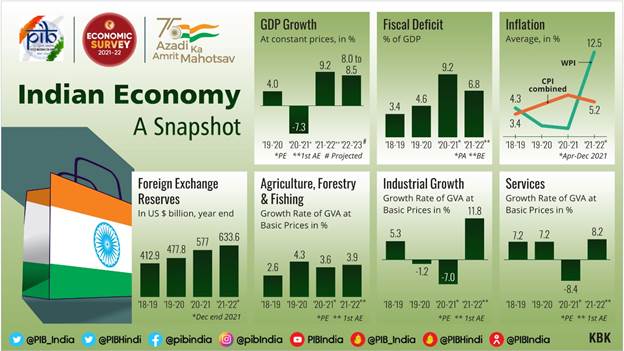
AS PER WORLD BANK, ADB AND IMF PROJECTIONS, INDIA TO REMAIN THE FASTEST GROWING MAJOR ECONOMY IN THE WORLD DURING 2021-24

INDIAN ECONOMY TO GROW BY 9.2% IN REAL TERMS IN 2021-22

AGRICULTURE TO GROW BY 3.9 % IN 2021-22 IN COMPARISON TO 3.6% IN THE PREVIOUS YEAR

INDUSTRIAL SECTOR TO WITNESS SHARP REBOUND FROM A CONTRACTION OF 7% IN 2020-21 TO EXPANSION OF 11.8% IN 2021-22

SERVICES TO CLOCK 8.2% GROWTH IN 2021-22 AFTER A CONTRACTION OF 8.4% LAST YEAR

FOREIGN EXCHANGE RESERVES STOOD AT US$ 634 BILLION AS ON 31ST DECEMBER 2021 EQUIVALENT TO OVER 13 MONTHS OF IMPORTS AND HIGHER THAN COUNTRY’S EXTERNAL DEBT

INVESTMENT IS EXPECTED TO SEE A STRONG GROWTH OF 15% IN 2021-22

CONSUMER PRICE INDEX (CPI) COMBINED INFLATION OF 5.6% IN DECEMBER 2021 IS WELL WITHIN TARGETED TOLERANCE BAND

FISCAL DEFICIT FOR APRIL-NOVEMBER 2021 CONTAINED AT 46.2% OF BUDGET ESTIMATES

CAPITAL MARKET BOOMS DESPITE PANDEMIC; OVER ₹ 89 THOUSAND CRORE RAISED VIA 75 IPO ISSUES IN APRIL-NOVEMBER 2021, MUCH HIGHER THAN IN ANY YEAR IN THE LAST DECADE

MACRO-ECONOMIC STABILITY INDICATORS SUGGEST INDIAN ECONOMY WELL PL


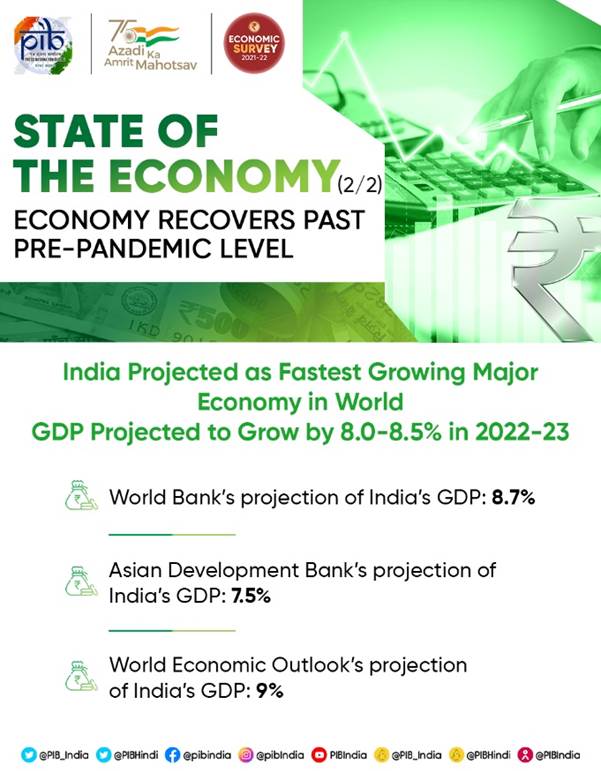
India to witness GDP growth of 8.0-8.5 per cent in 2022-23, supported by widespread vaccine coverage, gains from supply-side reforms and easing of regulations, robust export growth, and availability of fiscal space to ramp up capital spending.

The Union Minister for Finance & Corporate Affairs Smt Nirmala Sitharaman tabled the Economic Survey 2021-22 in Parliament today, which states that the year ahead is well poised for a pick-up in private sector investment with the financial system in a good position to provide support to the revival of economy. The growth projection for 2022-23 is based on the assumption that there will be no further debilitating pandemic related economic disruption, monsoon will be normal, withdrawal of global liquidity by major central banks will be broadly orderly, oil prices will be in the range of  US$70-$75/bbl, and global supply chain disruptions will steadily ease over the course of the year.
The Survey says, the above projection is comparable with the World Bank’s and Asian Development Bank’s latest forecasts of real GDP growth of 8.7 per cent and 7.5 per cent respectively for 2022-23. As per the IMF’s latest World Economic Outlook (WEO) growth projections released on 25th January, 2022, India’s real GDP is projected to grow at 9 per cent in both 2021-22 and 2022-23 and at 7.1 per cent in 2023-24. This projects India as the fastest growing major economy in the world in all these three years.
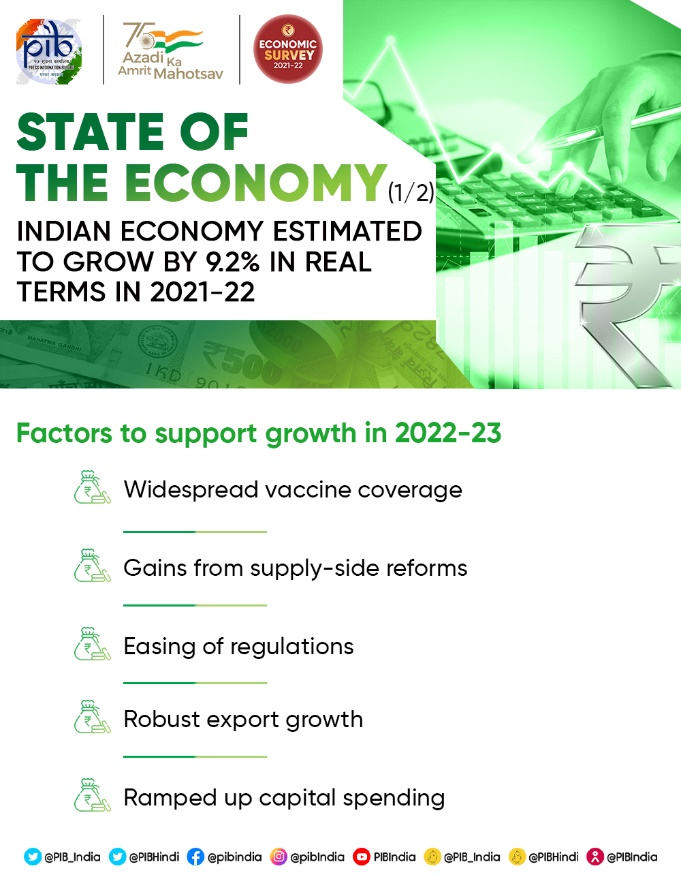
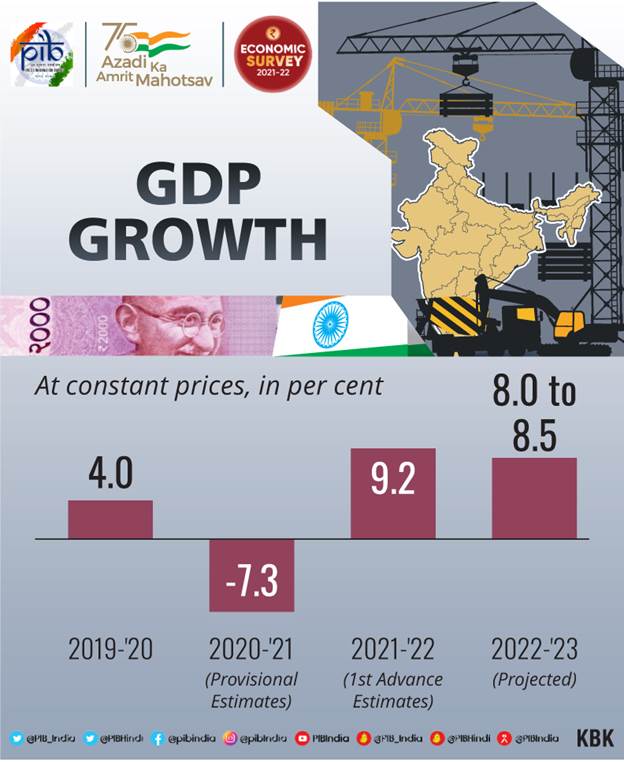
Referring to First Advance Estimates, the Survey states that the Indian economy is estimated to grow by 9.2 per cent in real terms in 2021-22, after a contraction of 7.3 per cent in 2020-21. This implies that overall economic activity has recovered past the pre-pandemic levels. Almost all indicators show that the economic impact of the “second wave” in Q1 was much smaller than that experienced during the full lockdown phase in 2020-21, even though the health impact was more severe.
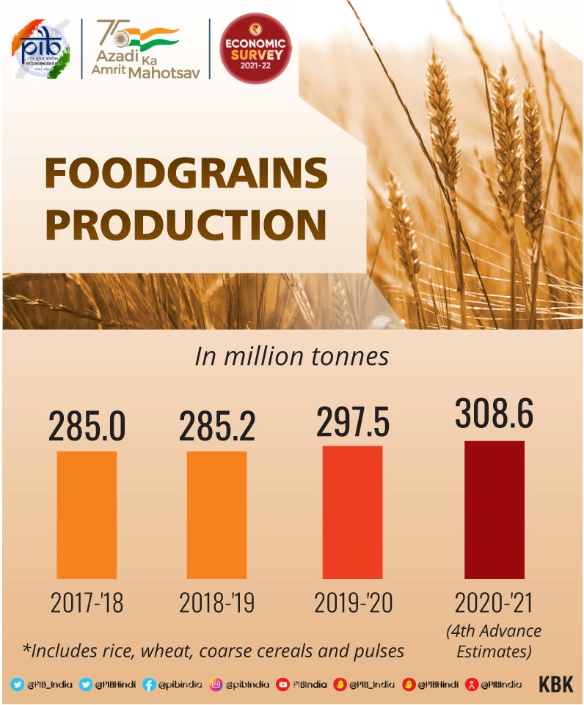
Dwelling on the sectoral aspects, the Survey states that Agriculture and allied sectors have been the least impacted by the pandemic and the sector is expected to grow by 3.9 per cent in 2021-22 after growing by 3.6 per cent in the previous year. The area sown under Kharif and Rabi crops, and the production of wheat and rice has been steadily increasing over the years. In the current year, food grains production for the Kharif season is estimated to post a record level of 150.5 million tonnes. Moreover, procurement of food grains under the central pool accordingly maintained its rising trend in 2021-22 along with minimum support prices, which augur well for national food security and farmers’ incomes. Importantly, the strong performance of the sector was supported by Government policies that ensured timely supplies of seed and fertilizers despite pandemic related disruptions. It was helped by good monsoon rains as reflected in reservoir levels being higher than the 10-year average.
According to Survey, the industrial sector went through a sharp rebound  from a contraction of 7 per cent in 2020-21 to an expansion of  11.8 per cent in this financial year. The manufacturing, construction and mining sub-sectors went through the same swing although the utilities segment experienced a more muted cycle as basic services such as electricity and water supply were maintained even at the height of the national lockdown. The share of industry in GVA is now estimated at 28.2 per cent.

The Survey states that the services sector has been the hardest hit by the pandemic, especially segments that involve human contact.  This sector is estimated to grow by 8.2 per cent this financial year following last year’s 8.4 per cent contraction. It should be noted that there is a wide dispersion of performance by different sub-sectors. Both the finance /Real Estate and the Public Administration segments are now well above pre-COVID levels. However, segments like Travel, Trade and hotels are yet to fully recover. There has been a boom in software and IT-enabled services exports even as earnings from tourism have declined sharply.

The Survey added that total consumption is estimated to have grown by 7.0 per cent in 2021-22 with government consumption remaining the biggest contributor as in the previous year. Government consumption is estimated to grow by a strong 7.6 per cent surpassing pre-pandemic levels. Private consumption is also estimated to have improved significantly to recover 97 per cent of corresponding pre-pandemic output level and it is poised to see stronger recovery with rapid coverage in vaccination and faster normalization of economic activity.

According to the Survey, Investment, as measured by Gross Fixed Capital Formation (GFCF) is expected to see strong growth of 15 per cent in 2021-22 and achieve full recovery of pre-pandemic level. Government’s policy thrust on quickening virtuous cycle of growth via capex and infrastructure spending has increased capital formation in the economy lifting the investment of GDP ratio to about 29.6 per cent in 2021-22, the highest in seven years. While private investment recovery is still at a nascent stage, there are many signals which indicate that India is poised for stronger investment. A sturdy and cleaned-up banking sector stands ready to support private investment adequately.

On the Exports and Imports front, the Survey states that India’s exports of both goods and services have been exceptionally strong so far in 2021-22. Merchandise exports have been above US$30 billion for eight consecutive months in 2021-22, despite many pandemic related global supply constraints. Net services exports have also risen sharply, driven by professional and management consulting services, audio visual and related services, freight transport services, telecommunications, computer and information services. From a demand perspective, India’s total exports are expected to grow by 16.5 per cent in 2021-22 surpassing pre-pandemic levels. Imports also recovered strongly with revival of domestic demand and continuous rise in price of imported crude and metals. Imports are expected to grow by 29.4 per cent in 2021-22 surpassing corresponding pre-pandemic levels. Resultantly, India’s net exports have turned negative in the first half of 2021-22, compared to a surplus in the corresponding period of 2020-21. But current account deficit is expected to remain within manageable limits.

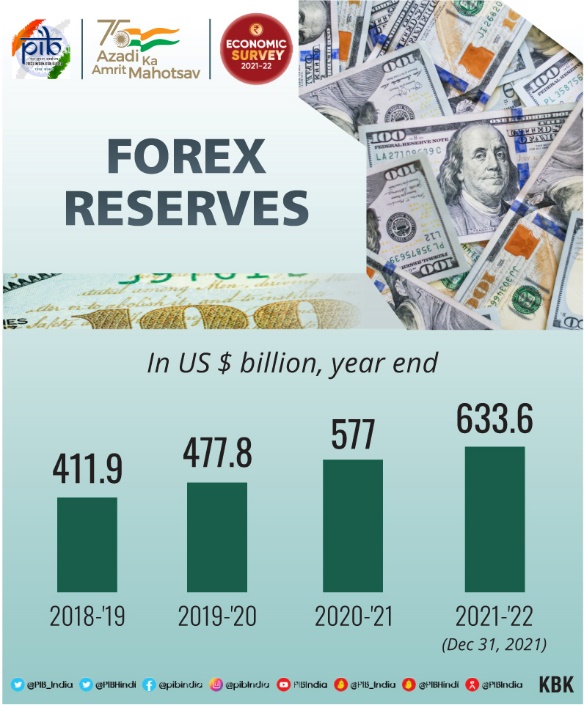
Further, the Survey points out that despite all the disruptions caused by the global pandemic, India’s balance of payments remained in surplus throughout the last two years. This allowed the Reserve Bank of India to keep accumulating foreign exchange reserves, which stand at US$634 billion on 31st December 2021. This is equivalent to 13.2 months of imports and higher than the country’s external debt.
The Survey notes that inflation has reappeared as a global issue in both advanced and emerging economies. The surge in energy prices, non-food commodities, input prices, disruption of global supply chains, and rising freight costs stoked global inflation during the year. In India, Consumer Price Index (CPI) inflation moderated to 5.2 per cent in 2021-22 (April-December) from 6.6 per cent in the corresponding period of 2020-21. It was 5.6 per cent (YoY) in December 2021, which is within the targeted tolerance band. The decline in retail inflation in 2021-22 was led by easing of food inflation. Wholesale Price Inflation (WPI), however, has been running in double-digits.

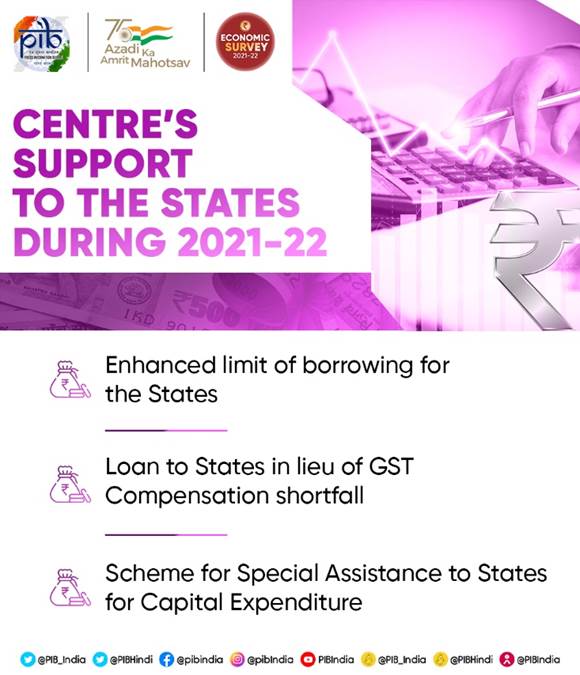
The Survey says that fiscal support given to the economy as well as the health response caused the fiscal deficit and government debt to rise in 2020-21. However, there has been a strong rebound in government revenues in 2021-22 so far. The revenue receipts of the central government during April-November 2021 have gone up by 67.2 per cent (YOY), as against an expected growth of 9.6 per cent in the 2021-22 Budget Estimates over provisional actuals. The tax collections have been buoyant for both direct and indirect taxes and the gross monthly GST collections have crossed ₹ 1 lakh crore consistently since July 2021.
 

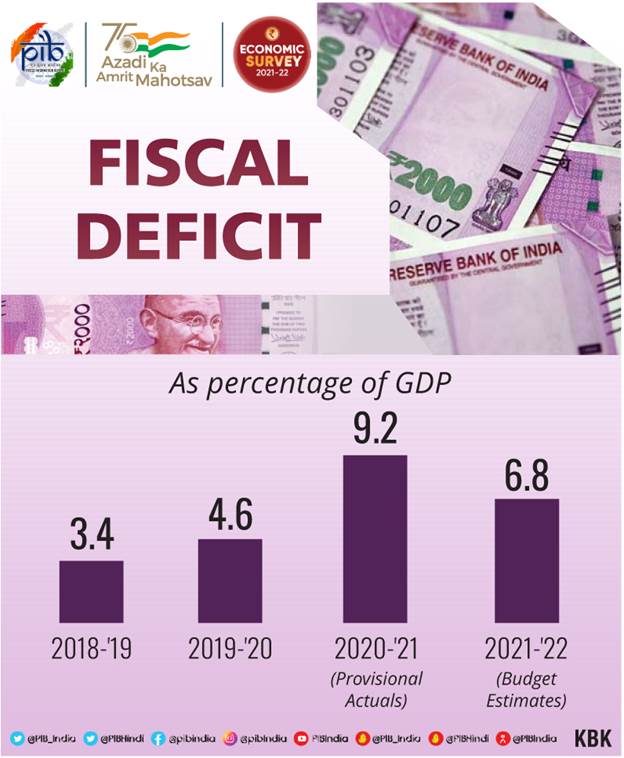
It adds that on the account of a sustained revenue collection and a targeted expenditure policy by the Government of India, the fiscal deficit for April-November 2021 has been contained at 46.2 per cent of Budget Estimates (BE) which is nearly one third of the proportion reached during the same period of the previous two years (135.1% of BE in April-November 2020 and 114.8% of BE in April-November 2019).
 

The Survey points out that the financial sector is always a possible area of stress during turbulent times. However, India’s capital markets have done exceptionally well and have allowed record mobilization of risk capital of Indian companies. The Sensex and Nifty scaled up to touch its peak at 61,766 and 18,477 on October 18, 2021. ₹ 89,066 crore was raised via 75 IPO issues in April- November 2021, much higher than in any year in the last decade. Moreover, the banking system is well capitalized and NPAs seems to have structurally declined. The Gross Non-Performing Advances (GNPA) ratio (i.e. GNPAs as a percentage of Gross Advances) and Net Non-Performing Advances (NNPA) ratio of Scheduled Commercial banks (SCBs) continued to decline since 2018-19. GNPA ratio of SCBs decreased from 7.5 per cent at end-September 2020 to 6.9 per cent at end-September 2021.

The Survey expresses that another distinguishing feature of India’s economic response has been an emphasis on supply-side reforms rather than a total reliance on demand management. These supply-side reforms include deregulation of numerous sectors, simplification of processes, removal of legacy issues like ‘retrospective tax’, privatization, production-linked incentives and so on. Even the sharp increase in capital spending by the Government can be seen as both demand and supply response as it creates infrastructure capacity for future growth.

There are two common themes in India’s supply-side strategy: (i) Reforms that improve flexibility and innovation in order to deal with the long-term unpredictability of the post-Covid world. This includes factor market reforms; deregulation of sectors like space, drones, geospatial mapping, trade finance factoring; process reforms like those in government procurement and in telecommunications sector; removal of legacy issues like retrospective tax; privatization and monetization, creation of physical infrastructure, and so on. (ii) Reforms aimed at improving the resilience o the Indian economy. These range from climate/environment related policies; social infrastructure such as public provision of tap water, toilets, basic housing, insurance for the poor, and so on; support for key industries under Atmanirbhar Bharat; a strong emphasis on reciprocity in foreign trade agreements, and so on.

An important theme that has been discussed through the course of the Economic Survey is that of ‘process reforms’. It is important to distinguish between deregulation and process reforms. The former relates to reducing or removing the role of government from a particular activity. In contrast, the latter broadly relates to simplification and smoothening of the process for activities where the government’s presence as a facilitator or regulator is necessary.

The Survey points out that the last two years have been difficult for the world economy on account of the COVID-19 pandemic. Repeated waves of infection, supply-chain disruptions and more recently, global inflation have created particularly challenging times for policy-making. Faced with these challenges, the Government of India opted for a ‘ Barbell Strategy” that combined a bouquet of safety-nets to cushion the impact on vulnerable sections of society and the business sector. It next pushed through a significant increase in capital expenditure on infrastructure to build back medium-term demand as well as aggressively implemented supply-side measures to prepare the economy for the sustained long-term expansion. This flexible and multi-layered approach is partly based on an “Agile” framework that used feedback-loops, and the monitoring of real-time data.

The Survey underlines that Monetary policy since the outbreak of the pandemic was calibrated to provide a cushion and support growth, but carefully controlled in order to avoid the medium term dislocations of excess liquidity. An important aspect of the safety-net was the use of Government guarantees to provide access to financial support to the economy in general and MSMEs in particular. In the last two years, government leveraged an array of eighty High Frequency Indicators (HFIs) representing industry, services, global trends, macro-stability indicators and several other activities, from both public and private sources to gauge the underlying state of the economy on a real-time basis. These HFIs helped policy makers tailor their response to an evolving situation rather than rely on pre-defined responses of a Waterfall framework, which has been the conventional method for framing policy in India and most of the world.

In conclusion, the Survey is quite optimistic that overall macro-economic stability indicators suggest that the Indian Economy is well placed to take on the challenges of 2022-23 and one of the reasons that the Indian Economy is in good position is its unique response strategy.

Topics

Acts Income Tax