

Loading...

⚠ ✕
❮ Top
☎ Help
☰
×

By creating an account you can:

Logo TaxTMI
Call Us / Help / Feedback✕

Contact Us At :

✉ E-mail: [email protected]

✆ Call / WhatsApp at: +91 99117 96707

For more information, Check Contact Us

FAQs :

To know Frequently Asked Questions, Check FAQs

Most Asked Video Tutorials :

For more tutorials, Check Video Tutorials

Submit Feedback/Suggestion :

Email :
Please provide your email address so we can follow up on your feedback.
Category :
Description :
Min 15 characters 0/2000
Make Most of Text Search ✕
  1. Checkout this video tutorial: How to search effectively on TaxTMI.
  2. Put words in double quotes for exact word search, eg: "income tax"
  3. Avoid noise words such as : 'and, of, the, a'
  4. Sort by Relevance to get the most relevant document.
  5. Press Enter to add multiple terms/multiple phrases, and then click on Search to Search.
  6. Text Search
  7. The system will try to fetch results that contains ALL your words.
  8. Once you add keywords, you'll see a new 'Search In' filter that makes your results even more precise.
  9. Text Search
╳
Add to...
You have not created any category. Kindly create one to bookmark this item!
✕
Create New Category
Hide
Title :
Description :
❮❮ Hide
❮ Default View
Expand ❯❯
Close ✕
🔎 Filters / Advanced Search ❯
TEXT

Press 'Enter' to add multiple search terms. Rules for Better Search

Search In
Main Text + AI Text ❯
  • Main Text
  • Main Text + AI Text
  • AI Text
Category: ?
Categorized by AI
---- All Categories ---- ❯
  • ---- All Categories ----
  • Income Tax
  • GST
  • Customs, DGFT & SEZ
  • FEMA & RBI
  • Corp. Laws, SEBI & IBC
  • PMLA, Black Money & ED
  • Budget
  • News and Press Release
  • PTI News
Month:
---- All Months ---- ❯
  • ---- All Months ----
  • January
  • February
  • March
  • April
  • May
  • June
  • July
  • August
  • September
  • October
  • November
  • December
Year:
---- All Years ---- ❯
  • ---- All Years ----
  • 2026
  • 2025
  • 2024
  • 2023
  • 2022
  • 2021
  • 2020
  • 2019
  • 2018
  • 2017
  • 2016
  • 2015
  • 2014
  • 2013
  • 2012
  • 2011
Sort By: ?
In Sort By 'Default', exact matches for text search are shown at the top, followed by the remaining results in their regular order.
Relevance Default Date
    CCI approves acquisition of certain equity shareholding in Continuum Green Energy Ltd by Chubu Electric Power Company Netherlands B.V.
    CCI approves acquisition of majority of the shares and voting rights in Volkswagen subsidiary Everllence SE by funds managed and/or advised by Bain Ca...
    CCI approves acquisition of 100% shareholding of FMC India by Crystal Crop Protection Ltd
    Commerce and Industry Minister Shri Piyush Goyal Arrives in Milwaukee, U.S. to Attend G20 Trade Ministers’ Meeting
    Monthly Review of Accounts of Union Government of India upto the month of August 2026 (FY 2026-27)
    Union Minister of Commerce and Industry Shri Piyush Goyal to Visit the United States to Participate in G20 Trade Ministers’ Meeting
    14th India-UAE High Level Joint Task Force Meeting Held in Mumbai
    CBDT extends due date for furnishing Return of Income for AY 2026-27 in respect of persons subject to audit under the Income-tax Act, 1961
    DRI busts pan-India gold smuggling network and seizes around 6.6 kg of foreign-origin gold worth more than Rs. 10 crore; 11, including a mastermind, a...
    CBN conducts anti-drug awareness programme for students under Mission Yuva Raksha for Nasha Mukt Bharat in Jaora, Madhya Pradesh
    CBN Rajasthan Unit seizes nearly four tonnes of contrabands in intensified enforcement operations across Rajasthan
    Union Minister of Commerce and Industry Shri Piyush Goyal Highlights Uttar Pradesh’s Growing Global Trade and Investment Opportunities
    Union Minister for Finance & Corporate Affairs Smt. Nirmala Sitharaman will embark on an official visit to Qatar from 27 to 29 September 2026
    USIBC bats for early conclusion of India-US trade deal
    Banks advise customers to complete essential transactions ahead of 3-day strike
    Centre to borrow Rs 7.86 lakh cr in Oct-Mar, FY27 borrowing slashed by Rs 1.2 lakh cr
    Government Approves One-Time Interest-Free Loan of ₹50,000 per Barn for FCV Tobacco Growers in Andhra Pradesh
    Issuance Calendar for Marketable Dated Securities for October 2026-March 2027
    Government’s Borrowing Plan for the second half of FY 2026-27
    APEDA Facilitates Export of GI-Tagged Gulbarga Tur Dal from Karnataka to Maldives
❮
❯
❯❯
Maximize Maximize Maximize
0 / 200
Expand Note
Add to Folder

No Folders have been created

+

Are you sure you want to delete "My most important" ?

NOTE:

News
Showing Results for :
Reset Filters
Results Found:
Show All Summaries Hide All Summaries
September 30, 2026
Show AI Summary
Merger control clearance permits Chubu's acquisition of equity in Continuum Green Energy through primary and secondary transactions.
Competition Commission of India approval covers the acquisition of certain equity shareholding in Continuum Green Energy Limited by Chubu Electric Power Company Netherlands B.V. The proposed combination comprises a primary subscription for, and secondary purchase of, the Target's equity shares from Continuum Green Energy Holdings Ltd., Singapore. The Target and its Indian subsidiaries primarily generate and sell renewable power from wind and solar sources.
September 30, 2026
Show AI Summary
Competition clearance authorises Bain Capital funds to acquire majority control of Everllence through a share transfer from Volkswagen.
Competition approval covers the indirect acquisition of a majority of the shares and voting rights in Everllence SE and its direct and indirect subsidiaries by funds managed or advised by Bain Capital Investors, LLC, from Volkswagen Aktiengesellschaft through a share transfer. Nikolaus (BC) Bidco GmbH acts as the purchaser and is a special purpose vehicle ultimately controlled by Bain Capital-managed or advised funds.
September 30, 2026
Show AI Summary
Full-shareholding acquisition in crop protection receives competition clearance, combining businesses spanning agrochemicals, seeds, and agricultural equipment.
Competition Commission of India approved Crystal Crop Protection Limited's acquisition of the entire, fully diluted shareholding of FMC India Private Limited from FMC Netherlands Holdings II B.V. and its affiliates. The approved combination comprises the acquisition of 100% of FMC India's shareholding by Crystal Crop. Crystal Crop is an Indian public limited company engaged in development, manufacture, and distribution of crop protection products, seeds, and agricultural equipment.
September 30, 2026
Show AI Summary
Investment facilitation supports cross-border manufacturing, technology, supply-chain, and business expansion partnerships between the two economies.
India-U.S. economic engagement extends beyond conventional trade to investment, manufacturing, technology, innovation, resilient supply chains, and high-value capabilities. Business engagement with manufacturing and technology companies addresses opportunities in India and expansion of partnerships. The Government of India indicates readiness to facilitate corporate operations, expansion, and investments in India.
September 30, 2026
Show AI Summary
Monthly fiscal accounts report receipts, tax devolution, and revenue and capital expenditure against budget estimates.
Monthly accounts up to August 2026 record total receipts of Rs.13,67,709 crore, comprising net tax revenue, non-tax revenue and non-debt capital receipts. Tax devolution to State Governments totals Rs.5,90,391 crore. Total expenditure is Rs.20,77,958 crore, divided between revenue expenditure of Rs.15,68,009 crore and capital expenditure of Rs.5,09,949 crore, with revenue expenditure including interest payments and major subsidies.
September 28, 2026
Show AI Summary
Rules-based multilateral trade engagement supports bilateral agreement negotiations, enterprise opportunities, investment partnerships, and developing-country policy space.
India's G20 trade engagement promotes a rules-based, open and non-discriminatory multilateral trading system while preserving policy space for developing countries. Bilateral discussions seek to expand opportunities for farmers, fishermen, women entrepreneurs, startups, MSMEs and other enterprises. India-United States engagement is intended to advance a balanced Bilateral Trade Agreement and an interim trade deal, alongside investment and industry outreach promoting manufacturing partnerships with Indian enterprises.
September 28, 2026
Show AI Summary
Cross-border investment facilitation under CEPA supports local-currency settlement, payment integration, joint projects and timely resolution of investor concerns.
Financial-sector cooperation covers local-currency settlement, integration of payment and messaging systems, and central-bank digital currencies, with steps to support timely implementation for more efficient, accessible and resilient bilateral trade and investment. The UAE-India Fast Track Mechanism remains available for addressing outstanding concerns affecting investments and companies in both jurisdictions, and the parties agreed to support timely resolution of such matters.
September 28, 2026
Show AI Summary
Return filing and tax audit deadlines are extended for the identified taxpayer category under the applicable statutory framework.
CBDT extends the Assessment Year 2026-27 Return of Income filing deadline for persons identified at serial no. 2 in the Table below Explanation 2 to section 139(1) of the Income-tax Act, 1961, from 31 October 2026 to 21 November 2026. The specified date for furnishing the audit report for the same class is extended from 30 September 2026 to 21 October 2026.
September 28, 2026
Show AI Summary
Courier-based gold smuggling enforcement targets concealed distribution through paper entities and foreign-origin gold consignments nationwide.
Coordinated customs enforcement targeted an organised gold-smuggling network that used courier consignments to distribute foreign-origin gold after cross-border entry. The operation led to seizure of 6.61 kg of gold bars under the Customs Act, 1962, and arrests of eleven associated persons. The network allegedly split gold into small consignments and used paper entities or persons without legitimate gold transactions to conceal distribution through courier channels.
September 28, 2026
Show AI Summary
Anti-drug awareness and cultivator outreach combine prevention, direct grievance redressal, and safeguards against illicit narcotics diversion.
Jan Sunwayi programmes provide direct, prompt and accessible grievance redressal for opium cultivators, including name corrections, Namantaran, and eligibility connected with the upcoming Settlement Operation. Cultivators are advised to avoid middlemen or intermediaries and seek clarification or assistance directly. These measures complement anti-drug awareness and preventive outreach aimed at preventing illegal trafficking, diversion and abuse of narcotic drugs and psychotropic substances.
September 28, 2026
Show AI Summary
NDPS enforcement targets concealed poppy straw, opium and cannabis trafficking through seizures, arrests, and continuing supply-chain investigation.
Narcotics enforcement operations in Rajasthan led to seizures of poppy straw, opium, hydroponic cannabis, cash, vehicles and a loaded country-made pistol, with four arrests. Poppy straw was recovered from vehicles and premises, including a truck where it was concealed beneath cement bags. Opium and cash were recovered from residential premises, while hydroponic cannabis concealed in an international parcel was recovered at the Foreign Post Office, Jaipur. The seized articles were taken under relevant provisions of the Narcotic Drugs and Psychotropic Substances Act, 1985, and supply-chain investigation continues.
September 28, 2026
Show AI Summary
Free trade agreement market access is positioned to expand export opportunities and international investment for local entrepreneurs.
Free Trade Agreement-led market access is positioned to expand international opportunities for entrepreneurs in Uttar Pradesh by supporting exports, investment inflows and access to overseas markets. International trade engagement is supported through direct business access to global markets, buyer-seller meetings and promotion of the State's products, cuisines and services. Export expansion, international investment, tourism and global recognition of State brands form the stated next phase of economic development, supported by coordination between governments and trade and industrial stakeholders.
September 28, 2026
Show AI Summary
Multilateral infrastructure cooperation guides annual development bank participation and bilateral engagement on sustainable investment and economic connectivity.
The official visit includes participation, as India's Governor, in the Annual Meeting of the Board of Governors of the Asian Infrastructure Investment Bank, alongside bilateral meetings and engagement with governmental leadership, business leaders and investors. The AIIB focuses on sustainable infrastructure and productive-sector investment in Asia to promote sustainable economic development, wealth creation and infrastructure connectivity.
September 25, 2026
Show AI Summary
Reciprocal trade agreement negotiations face tariff and subsidy pressures as both governments pursue lower bilateral trade barriers.
India-US bilateral trade negotiations seek completion of the first-phase Bilateral Trade Agreement through a reciprocal trade arrangement lowering trade barriers and tariffs. Further negotiations are required because of changed US tariff conditions, forced-labour tariffs on Indian goods, a possible investigation into excess industrial capacity and subsidies, and sanctions legislation relating to Russia. Ministerial and bilateral engagements will review progress on the proposed reciprocal arrangement.
September 25, 2026
Show AI Summary
Banking strike contingency measures direct customers toward advance transactions and digital channels as branch operations may be disrupted.
Banking-service continuity measures anticipate possible disruption from a three-day employee strike. Customers are advised to complete essential transactions in advance and use ATMs/ADWMs, mobile and internet banking, UPI, business correspondent points and other digital channels. Branch and office operations at participating institutions may be affected, while essential services are to be maintained where possible. Union demands include a five-day banking week, pension improvements and transition options from the National Pension System to the old pension scheme.
September 25, 2026
Show AI Summary
Government borrowing calendar: Reduced dated-securities borrowing will use weekly auctions, green bonds, switches and buyback operations.
Second-half dated-security borrowing will be completed through weekly auctions across maturities ranging from 3 years to 50 years, including Sovereign Green Bonds. Switching and buyback operations will continue to smooth the redemption profile, while a greenshoe option may permit retention of additional subscriptions. Treasury Bill borrowing will proceed through 91-day, 182-day and 364-day instruments. Auctions will offer non-competitive bidding for specified retail investors, and flexibility is retained to modify issuance terms or introduce non-standard maturity instruments, floating-rate bonds and inflation-indexed bonds.
September 25, 2026
Show AI Summary
Interest-free working capital assistance for FCV tobacco growers supports liquidity, institutional loan repayment, crop inputs, and reduced private borrowing.
A one-time, interest-free working-capital loan of Rs. 50,000 per barn is approved for FCV tobacco growers in Andhra Pradesh under the Interest-Free Working Capital Assistance Scheme. Covering about 44,000 growers, the assistance is proposed to be delivered through direct benefit transfer. It is intended to provide liquidity for household requirements, institutional loan repayment and crop inputs, while reducing dependence on private borrowing.
September 25, 2026
Show AI Summary
Government securities auction calendar establishes retail bidding access, flexible issuance terms, greenshoe subscriptions, and periodic debt switch operations.
Each auction carries a non-competitive bidding facility, under which five per cent of the notified amount is reserved for specified retail investors. The Government may modify indicated amounts, issuance periods and maturities, and may issue instruments with non-standard maturities, floating-rate bonds or inflation-indexed bonds, having regard to governmental requirements, market conditions and other relevant factors. It may retain additional subscriptions through a greenshoe option and conduct switch or buyback auctions of dated securities.
September 25, 2026
Show AI Summary
Market borrowing plan sets dated securities auctions, Treasury Bill issuance, redemption management, and temporary cash-flow support.
Government market borrowing for the second half of FY 2026-27 is to be raised through weekly auctions of dated securities, including Sovereign Green Bonds, across maturities from 3 to 50 years. Debt-management measures include switching and buyback operations to smooth the redemption profile and a greenshoe option for additional subscriptions. Treasury Bills are to be issued through weekly auctions in 91-day, 182-day and 364-day maturities. The Ways and Means Advances limit is fixed to address temporary mismatches in government accounts.
September 25, 2026
Show AI Summary
GI-tagged agricultural exports expand farmer access to international markets through FPO-led value chains and higher price realisation.
APEDA facilitated the export of a one-metric-tonne consignment of GI-tagged Gulbarga Tur Dal from Karnataka to the Maldives through an FPO-led brand. Gulbarga Tur Dal has held GI registration since 2019. The export-linked channel provides farmers a realisation of Rs.82 per kg compared with a prevailing market price of Rs.60 per kg, while supporting closer integration of FPOs and farmers into export-oriented supply chains.

News

Back

All News

Showing Results for :
Reset Filters
No Records Found

News

Back

All News

Customs, DGFT & SEZ

SUMMARY OF THE ECONOMIC SURVEY 2021-22

January 31, 2022

Contents
Plus +
Summary
Note

Note

-

Bookmark

Print

Print

SUMMARY OF THE ECONOMIC SURVEY 2021-22

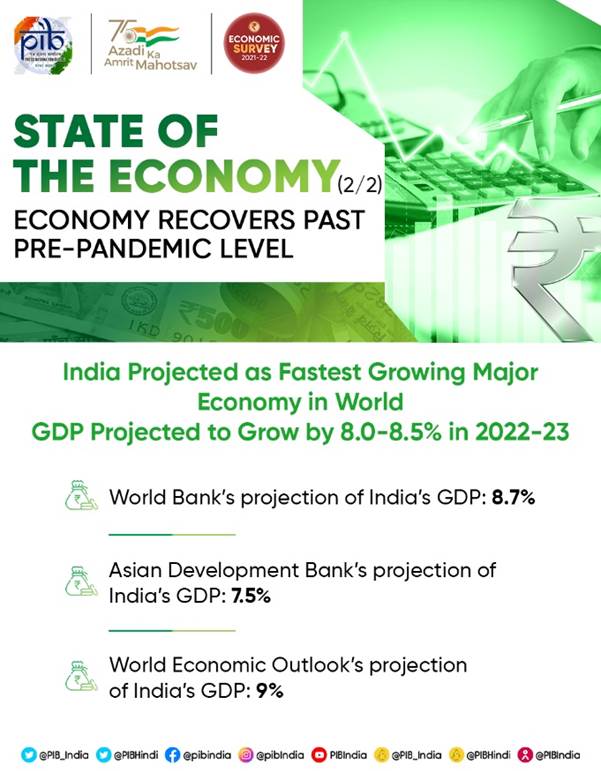
AS PER WORLD BANK, ADB AND IMF PROJECTIONS, INDIA TO REMAIN THE FASTEST GROWING MAJOR ECONOMY IN THE WORLD DURING 2021-24

INDIAN ECONOMY TO GROW BY 9.2% IN REAL TERMS IN 2021-22

AGRICULTURE TO GROW BY 3.9 % IN 2021-22 IN COMPARISON TO 3.6% IN THE PREVIOUS YEAR

INDUSTRIAL SECTOR TO WITNESS SHARP REBOUND FROM A CONTRACTION OF 7% IN 2020-21 TO EXPANSION OF 11.8% IN 2021-22

SERVICES TO CLOCK 8.2% GROWTH IN 2021-22 AFTER A CONTRACTION OF 8.4% LAST YEAR

FOREIGN EXCHANGE RESERVES STOOD AT US$ 634 BILLION AS ON 31ST DECEMBER 2021 EQUIVALENT TO OVER 13 MONTHS OF IMPORTS AND HIGHER THAN COUNTRY’S EXTERNAL DEBT

INVESTMENT IS EXPECTED TO SEE A STRONG GROWTH OF 15% IN 2021-22

CONSUMER PRICE INDEX (CPI) COMBINED INFLATION OF 5.6% IN DECEMBER 2021 IS WELL WITHIN TARGETED TOLERANCE BAND

FISCAL DEFICIT FOR APRIL-NOVEMBER 2021 CONTAINED AT 46.2% OF BUDGET ESTIMATES

CAPITAL MARKET BOOMS DESPITE PANDEMIC; OVER ₹ 89 THOUSAND CRORE RAISED VIA 75 IPO ISSUES IN APRIL-NOVEMBER 2021, MUCH HIGHER THAN IN ANY YEAR IN THE LAST DECADE

MACRO-ECONOMIC STABILITY INDICATORS SUGGEST INDIAN ECONOMY WELL PL


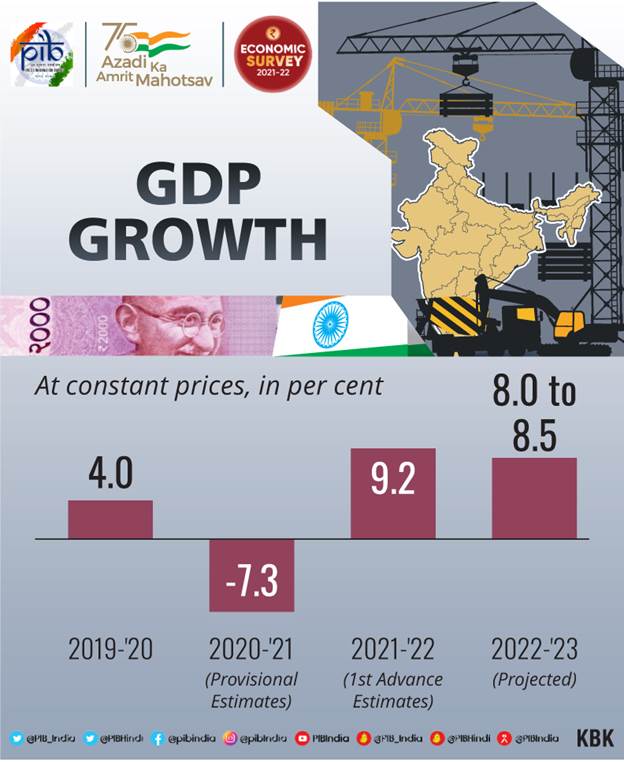
India to witness GDP growth of 8.0-8.5 per cent in 2022-23, supported by widespread vaccine coverage, gains from supply-side reforms and easing of regulations, robust export growth, and availability of fiscal space to ramp up capital spending.

The Union Minister for Finance & Corporate Affairs Smt Nirmala Sitharaman tabled the Economic Survey 2021-22 in Parliament today, which states that the year ahead is well poised for a pick-up in private sector investment with the financial system in a good position to provide support to the revival of economy. The growth projection for 2022-23 is based on the assumption that there will be no further debilitating pandemic related economic disruption, monsoon will be normal, withdrawal of global liquidity by major central banks will be broadly orderly, oil prices will be in the range of  US$70-$75/bbl, and global supply chain disruptions will steadily ease over the course of the year.
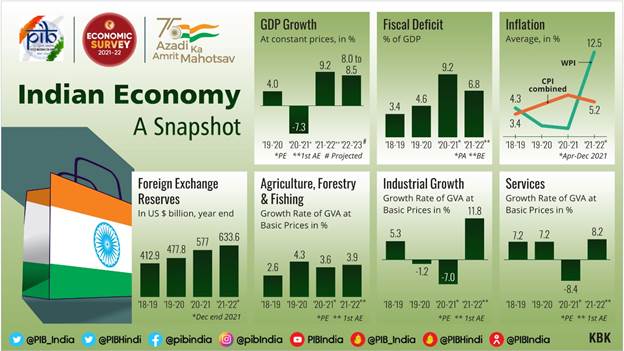
The Survey says, the above projection is comparable with the World Bank’s and Asian Development Bank’s latest forecasts of real GDP growth of 8.7 per cent and 7.5 per cent respectively for 2022-23. As per the IMF’s latest World Economic Outlook (WEO) growth projections released on 25th January, 2022, India’s real GDP is projected to grow at 9 per cent in both 2021-22 and 2022-23 and at 7.1 per cent in 2023-24. This projects India as the fastest growing major economy in the world in all these three years.
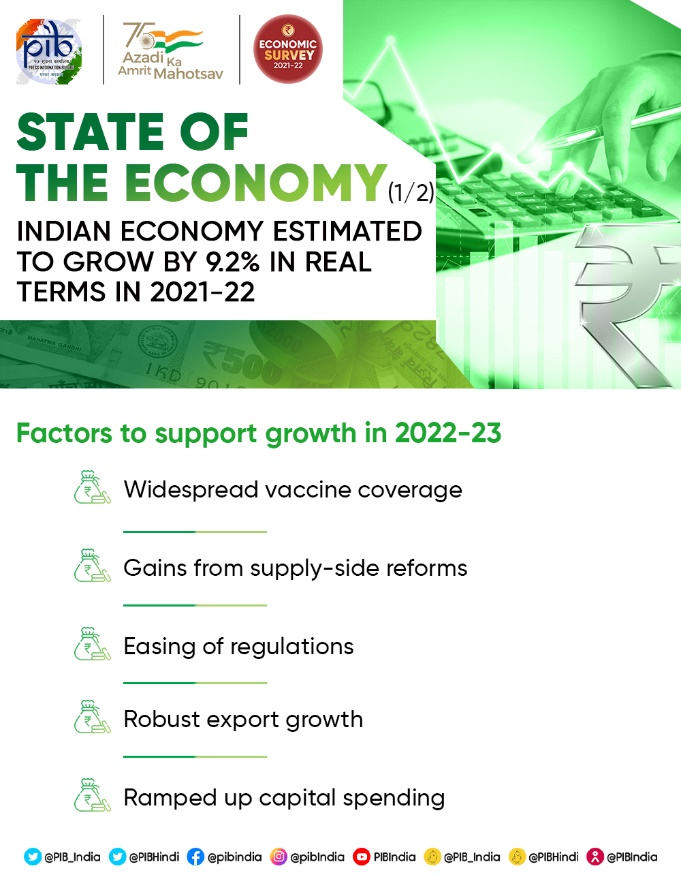
Referring to First Advance Estimates, the Survey states that the Indian economy is estimated to grow by 9.2 per cent in real terms in 2021-22, after a contraction of 7.3 per cent in 2020-21. This implies that overall economic activity has recovered past the pre-pandemic levels. Almost all indicators show that the economic impact of the “second wave” in Q1 was much smaller than that experienced during the full lockdown phase in 2020-21, even though the health impact was more severe.
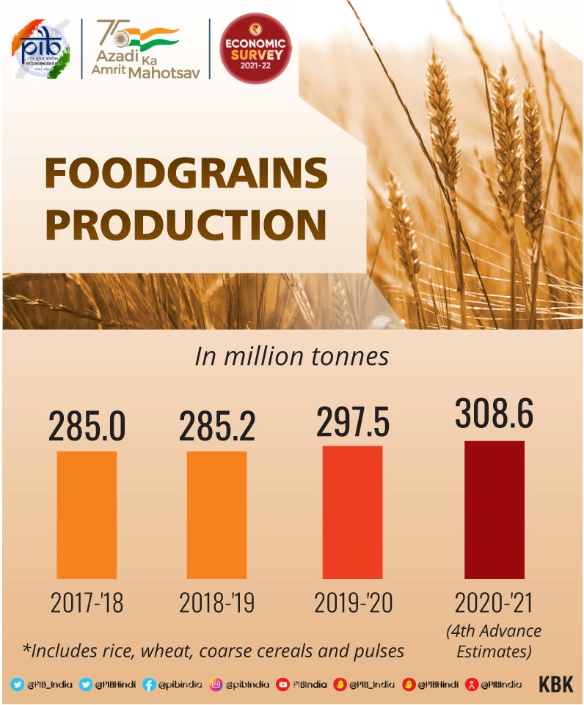
Dwelling on the sectoral aspects, the Survey states that Agriculture and allied sectors have been the least impacted by the pandemic and the sector is expected to grow by 3.9 per cent in 2021-22 after growing by 3.6 per cent in the previous year. The area sown under Kharif and Rabi crops, and the production of wheat and rice has been steadily increasing over the years. In the current year, food grains production for the Kharif season is estimated to post a record level of 150.5 million tonnes. Moreover, procurement of food grains under the central pool accordingly maintained its rising trend in 2021-22 along with minimum support prices, which augur well for national food security and farmers’ incomes. Importantly, the strong performance of the sector was supported by Government policies that ensured timely supplies of seed and fertilizers despite pandemic related disruptions. It was helped by good monsoon rains as reflected in reservoir levels being higher than the 10-year average.
According to Survey, the industrial sector went through a sharp rebound  from a contraction of 7 per cent in 2020-21 to an expansion of  11.8 per cent in this financial year. The manufacturing, construction and mining sub-sectors went through the same swing although the utilities segment experienced a more muted cycle as basic services such as electricity and water supply were maintained even at the height of the national lockdown. The share of industry in GVA is now estimated at 28.2 per cent.

The Survey states that the services sector has been the hardest hit by the pandemic, especially segments that involve human contact.  This sector is estimated to grow by 8.2 per cent this financial year following last year’s 8.4 per cent contraction. It should be noted that there is a wide dispersion of performance by different sub-sectors. Both the finance /Real Estate and the Public Administration segments are now well above pre-COVID levels. However, segments like Travel, Trade and hotels are yet to fully recover. There has been a boom in software and IT-enabled services exports even as earnings from tourism have declined sharply.

The Survey added that total consumption is estimated to have grown by 7.0 per cent in 2021-22 with government consumption remaining the biggest contributor as in the previous year. Government consumption is estimated to grow by a strong 7.6 per cent surpassing pre-pandemic levels. Private consumption is also estimated to have improved significantly to recover 97 per cent of corresponding pre-pandemic output level and it is poised to see stronger recovery with rapid coverage in vaccination and faster normalization of economic activity.

According to the Survey, Investment, as measured by Gross Fixed Capital Formation (GFCF) is expected to see strong growth of 15 per cent in 2021-22 and achieve full recovery of pre-pandemic level. Government’s policy thrust on quickening virtuous cycle of growth via capex and infrastructure spending has increased capital formation in the economy lifting the investment of GDP ratio to about 29.6 per cent in 2021-22, the highest in seven years. While private investment recovery is still at a nascent stage, there are many signals which indicate that India is poised for stronger investment. A sturdy and cleaned-up banking sector stands ready to support private investment adequately.

On the Exports and Imports front, the Survey states that India’s exports of both goods and services have been exceptionally strong so far in 2021-22. Merchandise exports have been above US$30 billion for eight consecutive months in 2021-22, despite many pandemic related global supply constraints. Net services exports have also risen sharply, driven by professional and management consulting services, audio visual and related services, freight transport services, telecommunications, computer and information services. From a demand perspective, India’s total exports are expected to grow by 16.5 per cent in 2021-22 surpassing pre-pandemic levels. Imports also recovered strongly with revival of domestic demand and continuous rise in price of imported crude and metals. Imports are expected to grow by 29.4 per cent in 2021-22 surpassing corresponding pre-pandemic levels. Resultantly, India’s net exports have turned negative in the first half of 2021-22, compared to a surplus in the corresponding period of 2020-21. But current account deficit is expected to remain within manageable limits.

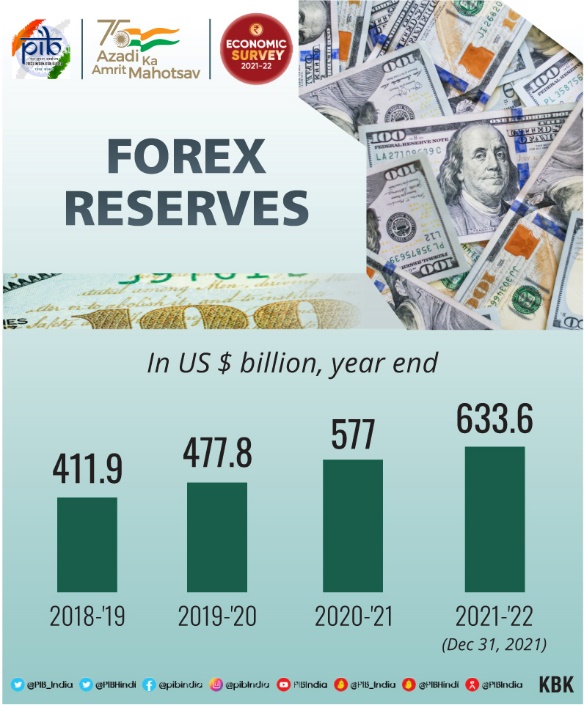
Further, the Survey points out that despite all the disruptions caused by the global pandemic, India’s balance of payments remained in surplus throughout the last two years. This allowed the Reserve Bank of India to keep accumulating foreign exchange reserves, which stand at US$634 billion on 31st December 2021. This is equivalent to 13.2 months of imports and higher than the country’s external debt.
The Survey notes that inflation has reappeared as a global issue in both advanced and emerging economies. The surge in energy prices, non-food commodities, input prices, disruption of global supply chains, and rising freight costs stoked global inflation during the year. In India, Consumer Price Index (CPI) inflation moderated to 5.2 per cent in 2021-22 (April-December) from 6.6 per cent in the corresponding period of 2020-21. It was 5.6 per cent (YoY) in December 2021, which is within the targeted tolerance band. The decline in retail inflation in 2021-22 was led by easing of food inflation. Wholesale Price Inflation (WPI), however, has been running in double-digits.

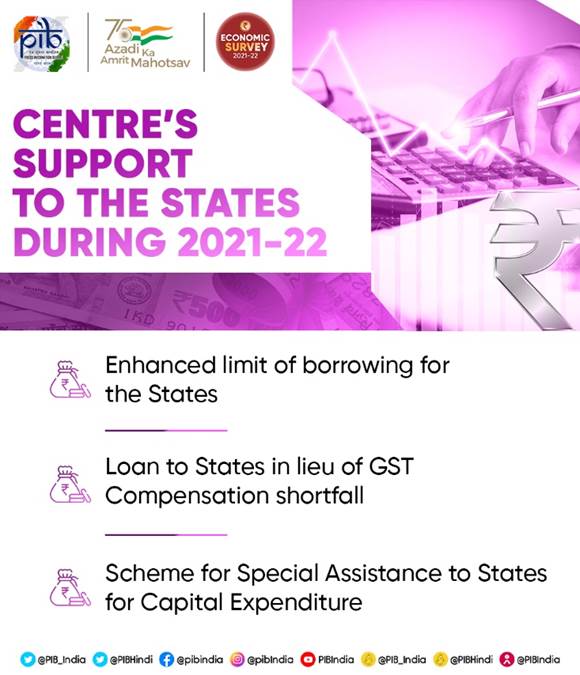
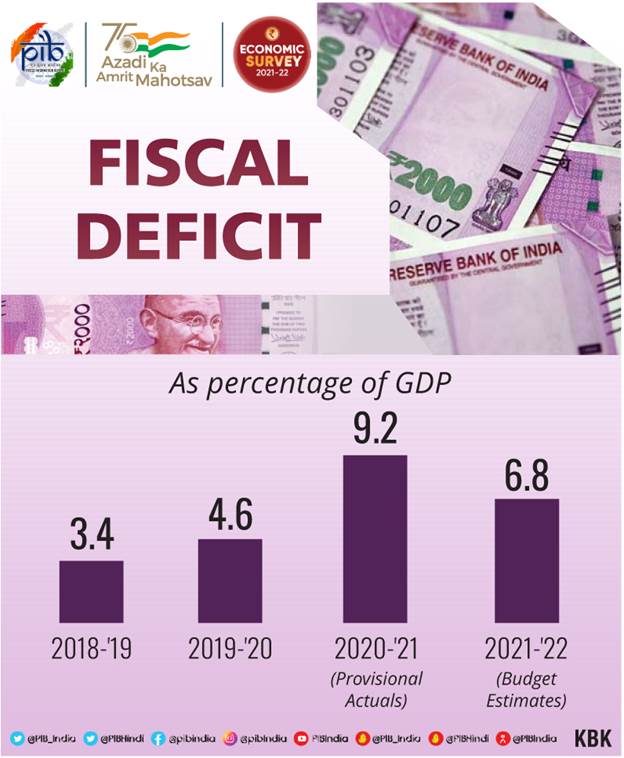
The Survey says that fiscal support given to the economy as well as the health response caused the fiscal deficit and government debt to rise in 2020-21. However, there has been a strong rebound in government revenues in 2021-22 so far. The revenue receipts of the central government during April-November 2021 have gone up by 67.2 per cent (YOY), as against an expected growth of 9.6 per cent in the 2021-22 Budget Estimates over provisional actuals. The tax collections have been buoyant for both direct and indirect taxes and the gross monthly GST collections have crossed ₹ 1 lakh crore consistently since July 2021.
 

It adds that on the account of a sustained revenue collection and a targeted expenditure policy by the Government of India, the fiscal deficit for April-November 2021 has been contained at 46.2 per cent of Budget Estimates (BE) which is nearly one third of the proportion reached during the same period of the previous two years (135.1% of BE in April-November 2020 and 114.8% of BE in April-November 2019).
 

The Survey points out that the financial sector is always a possible area of stress during turbulent times. However, India’s capital markets have done exceptionally well and have allowed record mobilization of risk capital of Indian companies. The Sensex and Nifty scaled up to touch its peak at 61,766 and 18,477 on October 18, 2021. ₹ 89,066 crore was raised via 75 IPO issues in April- November 2021, much higher than in any year in the last decade. Moreover, the banking system is well capitalized and NPAs seems to have structurally declined. The Gross Non-Performing Advances (GNPA) ratio (i.e. GNPAs as a percentage of Gross Advances) and Net Non-Performing Advances (NNPA) ratio of Scheduled Commercial banks (SCBs) continued to decline since 2018-19. GNPA ratio of SCBs decreased from 7.5 per cent at end-September 2020 to 6.9 per cent at end-September 2021.

The Survey expresses that another distinguishing feature of India’s economic response has been an emphasis on supply-side reforms rather than a total reliance on demand management. These supply-side reforms include deregulation of numerous sectors, simplification of processes, removal of legacy issues like ‘retrospective tax’, privatization, production-linked incentives and so on. Even the sharp increase in capital spending by the Government can be seen as both demand and supply response as it creates infrastructure capacity for future growth.

There are two common themes in India’s supply-side strategy: (i) Reforms that improve flexibility and innovation in order to deal with the long-term unpredictability of the post-Covid world. This includes factor market reforms; deregulation of sectors like space, drones, geospatial mapping, trade finance factoring; process reforms like those in government procurement and in telecommunications sector; removal of legacy issues like retrospective tax; privatization and monetization, creation of physical infrastructure, and so on. (ii) Reforms aimed at improving the resilience o the Indian economy. These range from climate/environment related policies; social infrastructure such as public provision of tap water, toilets, basic housing, insurance for the poor, and so on; support for key industries under Atmanirbhar Bharat; a strong emphasis on reciprocity in foreign trade agreements, and so on.

An important theme that has been discussed through the course of the Economic Survey is that of ‘process reforms’. It is important to distinguish between deregulation and process reforms. The former relates to reducing or removing the role of government from a particular activity. In contrast, the latter broadly relates to simplification and smoothening of the process for activities where the government’s presence as a facilitator or regulator is necessary.

The Survey points out that the last two years have been difficult for the world economy on account of the COVID-19 pandemic. Repeated waves of infection, supply-chain disruptions and more recently, global inflation have created particularly challenging times for policy-making. Faced with these challenges, the Government of India opted for a ‘ Barbell Strategy” that combined a bouquet of safety-nets to cushion the impact on vulnerable sections of society and the business sector. It next pushed through a significant increase in capital expenditure on infrastructure to build back medium-term demand as well as aggressively implemented supply-side measures to prepare the economy for the sustained long-term expansion. This flexible and multi-layered approach is partly based on an “Agile” framework that used feedback-loops, and the monitoring of real-time data.

The Survey underlines that Monetary policy since the outbreak of the pandemic was calibrated to provide a cushion and support growth, but carefully controlled in order to avoid the medium term dislocations of excess liquidity. An important aspect of the safety-net was the use of Government guarantees to provide access to financial support to the economy in general and MSMEs in particular. In the last two years, government leveraged an array of eighty High Frequency Indicators (HFIs) representing industry, services, global trends, macro-stability indicators and several other activities, from both public and private sources to gauge the underlying state of the economy on a real-time basis. These HFIs helped policy makers tailor their response to an evolving situation rather than rely on pre-defined responses of a Waterfall framework, which has been the conventional method for framing policy in India and most of the world.

In conclusion, the Survey is quite optimistic that overall macro-economic stability indicators suggest that the Indian Economy is well placed to take on the challenges of 2022-23 and one of the reasons that the Indian Economy is in good position is its unique response strategy.

Topics

Acts Income Tax