 TaxTMI
 Login
 TaxTMI
Login
Loading...
Press 'Enter' to add multiple search terms. Rules for Better Search

Press 'Enter' after typing page number.
Press 'Enter' after typing page number.


No Folders have been created
Are you sure you want to delete "My most important" ?
NOTE:
Press 'Enter' after typing page number.
Press 'Enter' after typing page number.

All News
Press 'Enter' after typing page number.
All News

Note

Bookmark

Share


WITH REVIVAL OF ECONOMY, EMPLOYMENT INDICATORS BOUNCED BACK TO PRE-PANDEMIC LEVELS DURING LAST QUARTER OF 2020-21
MONTHLY NET ADDITION IN EPF SUBSCRIPTIONS DURING 2021 SURPASS LEVELS OF CORRESPONDING MONTHS OF PRE-PANDEMIC YEAR 2019
DEMAND FOR MGNREGS WORK STABILIZES AFTER SECOND COVID SURGE BUT REMAINS HIGHER THAN PRE-PANDEMIC LEVEL
3 TIMES MORE ADDITIONAL WORKFORCE CREATED BETWEEN 2018-19 & 2019-20 AS COMPARED TO THE PREVIOUS PERIOD (2017-18 & 2018-19)
FEMALE WORKFORCE CONTRIBUTED TO 63 PERCENT OF ADDITIONAL WORKFORCE CREATED DURING 2018-19 AND 2019-20
The various indicators of employment have bounced back remarkably, after showing a decline during the first quarter of 2020-21, during the nationwide lockdown due to Covid pandemic. The Economic Survey 2021-22 which was tabled in the Parliament today by the Union Minister for Finance & Corporate Affairs, Smt Nirmala Sitharaman has analysed trends in labour market and the impact of Covid-19 on employment.
Trends in Urban Labour Market:
The Survey states that with the revival of the economy, the Unemployment Rate (UR), the Labour Force Participation Rate (LFPR) and the Worker Population Rate (WPR) almost reached their pre-pandemic levels during the last quarter of 2020-21 as per Periodic Labour Force Survey Data.
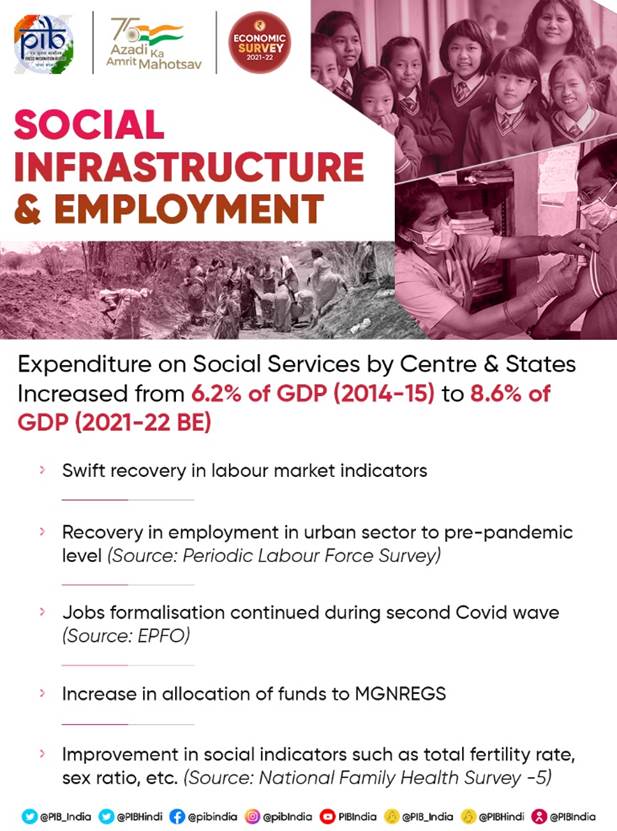
The Economic Survey also analyses trends in urban employment using Employees Provident Funds Organization (EPFO) payroll data. An analysis of the EPFO data suggests significant acceleration in formalization of the job market, during 2021. In fact, in November, 2021, the monthly net additional EPF subscription peaked with 13.95 lakh new subscribers, the highest in any given month since 2017, the Survey states. This translates into growth of 109.21 percent in EPF subscription from November, 2020. The Economic Survey further states that the monthly net addition in EPF subscriptions during 2021 has not only been higher than the corresponding monthly values in 2020 but they have also surpassed the levels of the corresponding months during pre-pandemic year 2019.
Trends in Rural Labour Market:
Economic Survey 2021-22 analyses trends in Rural Labour Market with the help of latest data on demand for work under Mahatma Gandhi National Rural Employment Guarantee Scheme (MGNREGS).
The Survey observes that the MGNREGS employment peaked during the nationwide lockdown in 2020. However an interesting trend was observed for many migrant source states like West Bengal, Madhya Pradesh, Odisha, Bihar, in which the MGNREGS employment in most months of 2021 has been lower than the corresponding level in 2020. In contrast, the demand for MGNREGS employment has been higher for migrant recipient states like Punjab, Maharashtra, Karnataka and Tamil Nadu for most months in 2021 over 2020.
Giving further details, the Economic Survey points out that the demand for MGNREGS work has stabilized after the second Covid wave. It further states that the aggregate MGNREGS employment is still higher than pre-pandemic level. During the second Covid wave, demand for MGNREGS employment reached the maximum level of 4.59 crore persons in June 2021.
Long Term Trends in Employment using Annual PLFS Data:
During PLFS 2019-20 (survey period from July 2019 to June 2020), employment at usual status continued to expand. Between 2018-19 and 2019-20, about 4.75 crore additional persons joined the workforce. This is about three times more than the employment created between 2017-18 and 2018-19. The rural sector contributed much more to this expansion relative to the urban sector (3.45 crore in rural sector and 1.30 crore in urban sector). Further, amongst the additional workers, 2.99 crore were females (63 percent). About 65 percent of the additional workers joined in 2019-20 were self employed. About 75 percent of the female workers who joined as self- employed were ‘unpaid family labour’. About 18 percent of the additional workers were Casual Labourer and 17 percent were ‘Regular Wage/Salaried Employee’. Further, the number of unemployed persons in 2019-20 has also decreased by 23 lakhs, constituted largely by males from the rural sector.
With respect to industry wise employment in India, of the workers added in 2019-20, more than 71 percent were in agricultural sector. Among the new workers in the agriculture sector, females account for about 65 percent. Trade, hotel and restaurant sector accounted for a little over 22 percent of the new workers, in line with previous year’s trend where the sector represented more than 28 percent of the new workers. The share of manufacturing has declined from 5.65 percent of new workers added in 2018-19 to about 2.41 percent of new workers added in 2019-20, and so has that of construction from 26.26 percent to 7.36 percent.
Important Policy Measures to boost livelihoods:
The Economic Survey has highlighted several policy responses to boost livelihoods. These include Aatmanirbhar Bharat Rojgaar Yojana which was announced as a part of Aatmanirbhar 3.0 package to boost the economy, increase the employment generation in post Covid recovery phase and to incentivise creation of new employment alongwith the social security benefits and restoration of loss of employment during Covid-19 pandemic.
To boost employment and livelihood for returnee migrant workers, Garib Kalyan Rojgar Abhiyan was launched in June 2020. It focused on 25 target driven works to provide employment and create infrastructure in the rural areas of 116 districts 6 states with resource envelope of ₹ 50,000 Crore.
Similarly, allocation to MGNREGS in FY 2021-22 increased to ₹ 73,000 crore, from ₹ 61,500 crore in FY 2020-21. Allocation for FY 2021-22 has been enhanced to ₹ 98000 crore so far. In FY 2021-22 over 8.70 crore individuals and 6.10 crore households were provided work so far.
The Survey also highlights several other social protection measures which have been stepped up like Pradhan Mantri Shramyogi Mandhan (PM-SYM) Yojana, National Pension Scheme for traders/shopkeepers/self employed persons, e-SHRAM portal to facilitate delivery of Social Security Schemes to workers and Labour Reforms for welfare of labour.

