Loading...

⚠ âś•
❮ Top
☎ Help
☰
×

By creating an account you can:

Logo TaxTMI
Call Us / Help / Feedbackâś•

Contact Us At :

✉ E-mail: [email protected]

✆ Call / WhatsApp at: +91 99117 96707

For more information, Check Contact Us

FAQs :

To know Frequently Asked Questions, Check FAQs

Most Asked Video Tutorials :

For more tutorials, Check Video Tutorials

Submit Feedback/Suggestion :

Email :
Please provide your email address so we can follow up on your feedback.
Category :
Description :
Min 15 characters 0/2000
Make Most of Text Search âś•
  1. Checkout this video tutorial: How to search effectively on TaxTMI.
  2. Put words in double quotes for exact word search, eg: "income tax"
  3. Avoid noise words such as : 'and, of, the, a'
  4. Sort by Relevance to get the most relevant document.
  5. Press Enter to add multiple terms/multiple phrases, and then click on Search to Search.
  6. Text Search
  7. The system will try to fetch results that contains ALL your words.
  8. Once you add keywords, you'll see a new 'Search In' filter that makes your results even more precise.
  9. Text Search
╳
Add to...
You have not created any category. Kindly create one to bookmark this item!
âś•
Create New Category
Hide
Title :
Description :
❮❮ Hide
❮ Default View
Expand ❯❯
Close âś•
🔎 Filters / Advanced Search ❯
TEXT

Press 'Enter' to add multiple search terms. Rules for Better Search

Search In
Main Text + AI Text ❯
  • Main Text
  • Main Text + AI Text
  • AI Text
Category: ?
Categorized by AI
---- All Categories ---- ❯
  • ---- All Categories ----
  • Income Tax
  • GST
  • Customs, DGFT & SEZ
  • FEMA & RBI
  • Corp. Laws, SEBI & IBC
  • PMLA, Black Money & ED
  • Budget
  • News and Press Release
  • PTI News
Month:
---- All Months ---- ❯
  • ---- All Months ----
  • January
  • February
  • March
  • April
  • May
  • June
  • July
  • August
  • September
  • October
  • November
  • December
Year:
---- All Years ---- ❯
  • ---- All Years ----
  • 2026
  • 2025
  • 2024
  • 2023
  • 2022
  • 2021
  • 2020
  • 2019
  • 2018
  • 2017
  • 2016
  • 2015
  • 2014
  • 2013
  • 2012
  • 2011
Sort By: ?
In Sort By 'Default', exact matches for text search are shown at the top, followed by the remaining results in their regular order.
Relevance Default Date
☰   Show Results ❯
    Secretary, DFS, Shri Sanjay Lohiya chairs review meeting on progress of Financial Inclusion Schemes with senior executives of Public Sector and Privat...
    Cabinet approves Commitment of Rs.10,000 Crore towards establishment of the SME Growth Fund for direct equity investments in Small and Medium Enterpri...
    Cabinet approves setting up of Integrated Transport & Logistics Authority
    IICA observed 3rd IICA CSR Day on Gandhi Jayanti with a Special Address by the DG & CEO to Participants of the IICA Certified CSR Professional Program...
    Preserving Financial Stability in an Evolving World - Special Address by Shri Sanjay Malhotra, Governor, Reserve Bank of India, at the Fifth Kautilya ...
    Central Bureau of Narcotics (CBN) Rajasthan Unit observes National Anti-Drug Addiction Day with awareness programmes and cleanliness campaigns across ...
    NABKISAN Lists India’s First WASH-Focused Social Bond, Raises ₹180 Crore
    DRI seizes around 7 kg amphetamine, 5 kg cocaine and 3.5 kg heroin in three operations as it intensifies crackdown on drug trafficking; 5 arrested
    Advisory on “Multistate Registration” Facility for GST Registration
    Forward-Looking Survey on Private Corporate Sector CAPEX Investment Intentions (Survey period: October–December 2026)
    CRIT and IIFT Organise Three-Day Orientation Course on Trade Negotiations
    Union Minister of Commerce and Industry Shri Piyush Goyal Participates in Opening Day of G20 Trade Ministers’ Meeting in Milwauke, U.S
    Insolvency and Bankruptcy Code has strengthened credit discipline, improved recovery climate and contributed to ease of doing business: Harsh Malhotra...
    Central Bureau of Narcotics, DNC office, conducts drug abuse and addiction awareness campaign under Operation Jagriti in Lucknow
    Commerce and Industry Minister Piyush Goyal Calls for WTO-Compliant Approach to Correcting Global Trade Distortions at the Concluding Day of G20 Trade...
    APEDA Facilitates Export of Bihar’s Makhana from Purnea to Greece
    APEDA Facilitates FPO-led Export of Frozen Food Products from Haryana to Canada
    Government Extends Operational Timelines of RELIEF (Resilience & Logistics Intervention for Export Facilitation) Intervention to Support Exporters Ami...
    Government Extends Remission of Duties and Taxes on Exported Products ( RoDTEP) Scheme upto 31st December 2026
    DRI cracks down on illegal wildlife trafficking; elephant ivory, leopard skin, live pangolins and tiger parts seized; 11 persons arrested
❮
❯
❯❯
Maximize Maximize Maximize
0 / 200
Expand Note
Add to Folder

No Folders have been created

+

Are you sure you want to delete "My most important" ?

NOTE:

News
Showing Results for :
Reset Filters
Results Found:
Show All Summaries Hide All Summaries
October 6, 2026
Show AI Summary
Financial inclusion drives digital lending, insurance claim awareness, portal enrolment, and banking access for marginalised sections.
Banks were urged to expand brick-and-mortar branches and banking correspondent coverage in unbanked villages, strengthen digital outreach, and implement end-to-end digital loan processing. Working-capital lending for micro-enterprises through UPI-linked credit lines and credit cards was highlighted. Banks were also directed to increase awareness of insurance claim eligibility, exercise care in claim-related grievance handling, and enrol new PMJJBY and PMSBY beneficiaries through the Jan Suraksha portal.
October 6, 2026
Show AI Summary
SME growth equity fund targets scalable enterprises, prioritising manufacturing and industrial clusters to strengthen investment, productivity and competitiveness.
Union Cabinet approval commits Rs.10,000 crore towards establishment of the SME Growth Fund as an Alternative Investment Fund framework for direct equity investment in small and medium enterprises. The initiative is intended to catalyse long-term, patient growth capital for SMEs and address the identified shortage of equity financing for enterprises beyond the early stage, where existing equity-support funds predominantly serve micro and early-stage businesses.
October 6, 2026
Show AI Summary
Integrated transport planning framework establishes an SPV for national master planning, major-project appraisal, monitoring, and transport data analytics.
Integrated Transport & Logistics Authority will function as a special purpose vehicle for integrated transport and logistics planning, research, technical project appraisal, monitoring, policy support and data analytics. It will prepare a long-term National Transport Master Plan, assess sectoral and annual plans for alignment and multimodal integration, technically appraise and monitor specified major infrastructure projects, and undertake impact assessments. It will also maintain a unified transport data repository and support logistics-policy review, capacity building, training, skilling, research and innovation.
October 6, 2026
Show AI Summary
Corporate social responsibility should shift from statutory compliance to needs-based, evidence-led collaboration with impact assessment and technology-enabled monitoring.
CSR is grounded in trusteeship and in companies' responsibilities to employees, communities and the environment, rather than shareholders alone. The framework includes the Unspent CSR Account, multi-year projects, certification of fund utilisation and impact assessment. CSR is intended to leverage corporate resources, technology and expertise, rather than merely supplement public expenditure. Needs-based project selection, community participation, need and social-impact assessment, implementing-agency capacity, resource pooling and technology-enabled monitoring are emphasised to move from compliance and spending towards evidence-based transformation.
October 5, 2026
Show AI Summary
Financial stability requires targeted oversight and system-wide resilience against interconnected debt, leverage, cyber, technology, and cross-border shocks.
Financial stability is pursued by strengthening resilience rather than preventing every shock. The framework combines prudent regulation, risk-based supervision, stress testing, countercyclical macroprudential measures, targeted temporary liquidity assistance and resolution. Monetary policy remains directed to price stability, while financial-stability risks are addressed through regulatory, supervisory and macroprudential tools. System-wide resilience requires sound banks and NBFCs, reliable payment and technology infrastructure, robust data on interconnected exposures, scenario analysis, credible safety nets, and proactive proportionate oversight of cyber, model and third-party risks.
October 5, 2026
Show AI Summary
Drug-abuse prevention awareness promotes informed refusal, resistance to peer pressure, community participation, drug-de-addiction pledges, and healthy drug-free lifestyles.
Drug-abuse prevention awareness in opium-cultivation areas focused on the harms of opium, cannabis and other illicit drugs, informed refusal at first exposure, resistance to peer pressure, and prevention of progression from use to dependence. Programmes for students, cultivators and residents used interactive sessions, campaign banners, community pledges, Gram Sabha participation and cleanliness drives to promote healthy drug-free lifestyles, community participation and collective action against addiction.
October 5, 2026
Show AI Summary
WASH-focused social bond financing mobilises capital for safe water, sanitation and hygiene access in rural and underserved communities.
NABKISAN Finance Limited listed India's first social bond dedicated exclusively to water, sanitation and hygiene on the National Stock Exchange. The five-year issue raised Rs. 180 crore, carries an 8.10% coupon, matures in September 2031, and holds domestic AAA stable credit ratings. Proceeds are earmarked for safe water, sanitation and hygiene solutions in rural and underserved communities.
October 5, 2026
Show AI Summary
NDPS Act drug-trafficking enforcement enabled seizures of amphetamine, cocaine and heroin through intelligence-led interceptions and concealed-consignment detection.
NDPS Act enforcement involved three intelligence-led operations addressing trafficking of amphetamine, cocaine and heroin. Searches of a vehicle's spare tyre, chocolate tubes in cabin baggage, and a backpack carried in a car-pooling taxi revealed concealed substances that tested positive through field-testing kits. The amphetamine, cocaine and heroin were seized, along with the vehicle in the amphetamine operation, and five persons were arrested under the NDPS Act, 1985.
October 3, 2026
Show AI Summary
Multistate GST registration enables normal taxpayers to submit common information once for simultaneous State and UT applications.
Multistate Registration enables normal taxpayers seeking GST registration under the same PAN in more than one State or Union Territory to apply simultaneously. A Master TRN is generated after selection of the intended jurisdictions and must be submitted with Common Registration Information. Individual TRNs are then generated for each selected jurisdiction, with common information auto-populated and editable. Applicants must provide principal and additional places of business, State-specific information, and Aadhaar authentication.
October 3, 2026
Show AI Summary
Private corporate CAPEX survey collects forward investment data through secure self-reporting while protecting enterprise-level confidentiality.
CAPEX 2026 collects information from selected large private corporate enterprises on past, provisional and intended capital expenditure across asset groups and sectors, including investment strategies, financing, green energy and robotics. Responses are self-compiled through a secure portal with bilingual and digital assistance. Complete, accurate and timely reporting supports validation and aggregate investment indicators. Individual enterprise information is protected through confidentiality safeguards, and unit-level CAPEX data are not disseminated.
October 3, 2026
Show AI Summary
International trade negotiations training addressed WTO rules, dispute settlement, sustainability, trade remedies, digital trade, and services.
Trade-negotiation capacity-building introduced foundational trade theory and the WTO framework, followed by instruction on treaty interpretation, trade data and dispute settlement. Specialised sessions addressed trade remedies, rules of origin, non-tariff measures, intellectual property rights, digital trade and services. It also considered labour, environmental and sustainability issues, including carbon border adjustment and deforestation requirements, within an increasingly complex global trade environment.
October 3, 2026
Show AI Summary
Food security safeguards distinguish transparent public stockholding measures from coercive trade actions within multilateral trade cooperation.
India maintains public stockholding, procures food from small and marginal farmers, and may adopt temporary, transparent measures during harvest shortfalls to preserve food availability and affordability. These food-security measures are identified as recognised within the WTO framework. A distinction is advanced between legitimate food-security interventions and coercive trade actions used to exert pressure on other countries. G20 Trade Ministers reached consensus on a statement addressing the weaponization of food through coercive trade actions and committed to continued cooperation.
October 3, 2026
Show AI Summary
Insolvency resolution reform prioritises timely, value-maximising outcomes through technology adoption, mediation, and legislative responsiveness across the insolvency ecosystem.
The Insolvency and Bankruptcy Code seeks faster, value-maximising resolutions through legislative responsiveness, technology adoption and adherence to prescribed timelines. Reform priorities include reducing case-disposal delays, speeding consideration of resolution plans, revising admission thresholds, mediation and sector-specific carveouts. The framework is associated with creditor recoveries, rescue of viable businesses and changed debtor-creditor behaviour.
October 3, 2026
Show AI Summary
Drug abuse prevention awareness promotes student education, peer outreach, and youth responsibility for a drug-free society.
Operation Jagriti promotes drug abuse and addiction awareness among students by addressing the harmful effects of substance use and practical prevention measures. Students are encouraged to avoid drugs, spread prevention awareness among peers and communities, and contribute responsibly to the Nasha Mukt Bharat objective of a drug-free India.
October 3, 2026
Show AI Summary
Forced-labour border measures require verifiable evidence, due process and WTO consistency while preserving cooperation without unilateral trade action.
Global trade distortions should be addressed through WTO-consistent, evidence-based anti-dumping and countervailing measures, without restricting developing countries' policy space for industrialisation. Most-Favoured-Nation treatment, consensus decision-making, special and differential treatment, and a two-tier dispute-settlement system remain central to multilateral trade governance. Imports produced using forced labour are prohibited, while border measures must rely on specific, verifiable evidence, observe due process and WTO rules, and avoid presumptions concerning entire countries, regions or sectors.
October 3, 2026
Show AI Summary
Export-led market access for Makhana expands overseas buyer linkages, supports higher producer returns, and promotes European market diversification.
Export-oriented market access for Bihar's Makhana is being expanded through a facilitated shipment of popped Makhana from Purnea to Greece. APEDA's support connects producers and exporters with international buyers and strengthens the export value chain. Higher price realisation than domestic selling prices indicates scope for improved producer returns, wider farmer and producer-group participation, and diversification into European markets. Export promotion is linked to a proposed Agri Export Policy and packhouse development.
October 3, 2026
Show AI Summary
FPO-led export market access links processed food producers with global buyers and strengthens agricultural value-chain participation.
APEDA facilitated an FPO-led export of frozen food products to Canada by Aterna Foods Producer Company Limited, with support under its Financial Assistance Scheme. The export included frozen vegetables, sweet corn, samosa and other processed food products. Market-linkage initiatives connect Farmer Producer Organisations and Farmer Producer Companies with exporters and global buyers, promoting export-oriented value chains and integrating agricultural produce with processing and international markets.
October 3, 2026
Show AI Summary
RELIEF timeline extension preserves credit-insurance support and premium protection for exporters facing West Asia maritime disruptions.
Component II of the RELIEF intervention extends operational timelines for exporters affected by West Asia maritime-logistics disruptions. It encourages eligible exporters to obtain ECGC cover for upcoming shipments to specified regions with 95% risk coverage. Benefits apply to qualifying Stand Alone Policies and Whole Turnover Policies, covering full container load, less than container load, and reefer containers, but excluding energy shipments. Eligible exporters' insurance premium cannot increase beyond the pre-disruption level during the relevant period.
October 3, 2026
Show AI Summary
RoDTEP duty remission continues for eligible exporters, preserving existing rates and value caps through the extended period.
RoDTEP Scheme continuation is extended until 31 December 2026 for exports made by Domestic Tariff Area units, Advance Authorisation holders, Special Economic Zone units and Export Oriented Units. The scheme remits embedded, un-rebated Central, State and local duties, taxes and levies borne on exported products. Existing RoDTEP rates and value caps remain unchanged throughout the extension.
October 3, 2026
Show AI Summary
Wildlife trafficking enforcement targeted unlawful possession, transport and proposed sale of ivory, leopard skin, pangolins and tiger parts.
Illegal wildlife trafficking operations addressed alleged possession, transportation, and attempted sale of elephant ivory, leopard skin, live pangolins, and tiger parts. Possession without licence and trade in elephant ivory or ivory articles are prohibited under the Wild Life (Protection) Act, 1972. Leopards, pangolins, tigers, and their body parts receive Schedule I protection, while pangolins are also listed in CITES Appendix I, prohibiting international trade. Recovered wildlife articles, live animals, and vehicles were transferred or seized for action by forest and specialised wildlife enforcement agencies.

News

Back

All News

Showing Results for :
Reset Filters
No Records Found

News

Back

All News

Customs, DGFT & SEZ

DESPITE COVID-19 SHOCK AGRICULTURE SECTOR GROWS AT 3.9% IN 2021-22 AND 3.6% IN 2020-21

January 31, 2022

Contents
Summary
Note

Note

-

Bookmark

Print

Print

DESPITE COVID-19 SHOCK AGRICULTURE SECTOR GROWS AT 3.9% IN 2021-22 AND 3.6% IN 2020-21

GROSS VALUE ADDED IS 18.8% FOR AGRICULTURE AND ALLIED SECTORS IN 2021-22

CROP DIVERSIFICATION PROGRAMME ENVISAGES WATER CONSERVATION AND SELF-SUFFICIENCY

BHARATIYA PRAKRITIK KRISHI PADDHATI PROGRAMME FOR ECO-FRIENDLY AGRI PRODUCTION

EDIBLE OIL PRODUCTION INCREASED BY ALMOST 43% FROM 2015-16 TO 2020-21

GOVERNMENT ALLOCATED OVER 1052 LAKH TONNES OF FOOD GRAINS TO STATES/UTs UNDER NATIONAL FOOD SECURITY ACT IN 2021-22

OVER 59 LAKH HECTARES COVERED WITH MICRO-IRRIGATION UNDER PRADHAN MANTRI KRISHI SINCHAYEE YOJANA SINCE 2015-16

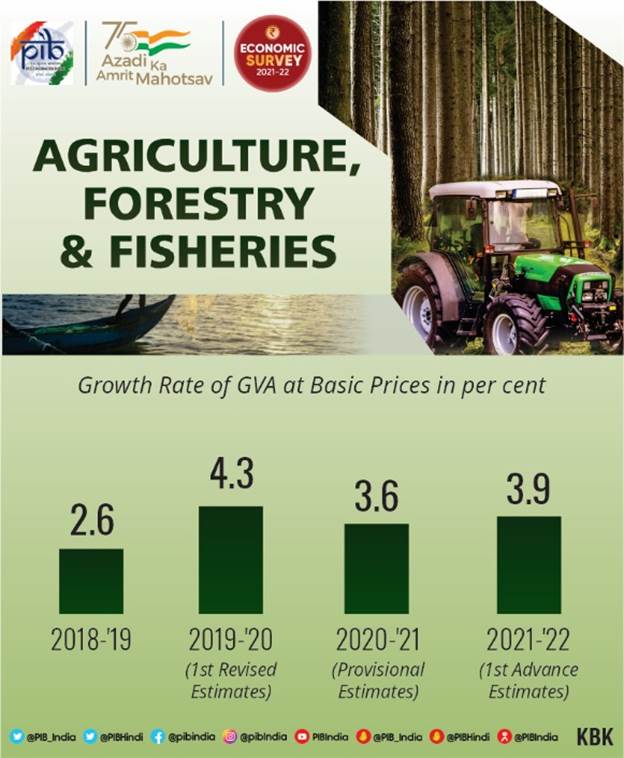
The Agriculture sector which accounts for 18.8 per cent of Gross Value Added (GVA) of the country in 2021-22 has experienced buoyant growth in the past 2 years. It grew at 3.9 per cent in 2021-22 and 3.6 per cent in 2020-21 showing resilience in the face of COVID-19 shock states the Economic Survey 2021-22 tabled in the Parliament by the Union Finance & Corporate Affairs Minister, Smt. Nirmala Sitharaman today.

The Survey attributes this to “good monsoon, various Government measures to enhance credit availability, improve investments, create market facility, promote infrastructure development and increased provision of quality inputs to the sector”. It also observes that livestock and fisheries have experienced buoyant growth and had helped the sector perform well.

Gross Value Added and Gross Capital Formation

The share of the agriculture and allied sector in total GVA of the economy has settled at around 18 per cent in the long term states the Survey. In the year 2021-22 it is 18.8 per cent and in the year 2020-21 it was 20.2 per cent. Another trend observed is, higher growth in allied sectors (Livestock, Forestry and Logging, Fishing and Aquaculture) compared to the crop sector. Recognising these allied sectors as engines of high growth the Committee on Doubling Farmers’ Income (DFI 2018) had also recommended focused policy with concomitant support system to boost agricultural incomes.

The Survey notes that there is a direct correlation between capital investments in agriculture and its growth rate. The Gross Capital Formation in the agricultural sector relative to the GVA in the sector is showing a fluctuating trend in sync with the variation in private sector investments, whereas the public sector investments have remained stable at 2-3 per cent over the years. The Survey suggests “higher access to institutional credit to farmers and greater participation of the private corporate sector” may improve private sector investment in agriculture. Towards this end the Survey recommends offering appropriate policy framework to crowd-in corporate investments along with increase in public investments along the entire agricultural value chain.

Agricultural Production                                    

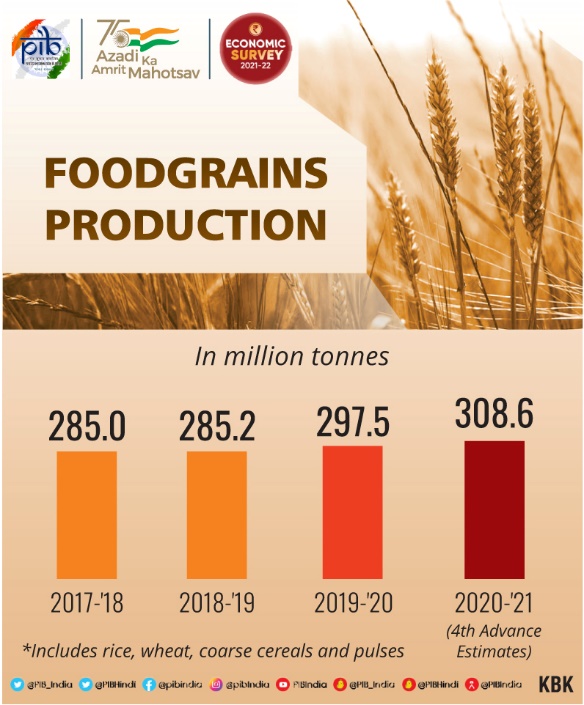
The Survey states that as per the First Advance Estimates for 2021-22 (Kharif only), total food grain production is estimated at a record level of 150.50 million tonnes, an increase of 0.94 million tonnes over Kharif production in the year 2020-21. Survey also points out that the production of rice, wheat and coarse cereals had increased at Compound Annual Growth Rates (CAGR) of 2.7, 2.9 and 4.8 per cent respectively over the period between 2015-16 and 2020-21. For pulses, oilseeds and cotton during the same period it has been 7.9, 6.1 and 2.8 per cent respectively.

India is the second largest producer of sugar in the world. India has become a “sugar surplus nation” says the Survey. It points out that since 2010-11, the production has outstripped the consumption except in the year 2016-17.  This has been made possible by insuring and protecting the sugarcane farmers against price risk through Fair and Remunerative Price (FRP), enhancing the liquidity of mills by incentivizing them to divert excess sugarcane/sugar to ethanol production and provide financial assistance for transport to sugar mills to facilitate export of sugar says Survey.

Crop Diversification

The Economic Survey warns that the existing cropping pattern is skewed towards cultivation of sugarcane, paddy and wheat which has led to depletion of fresh ground water resources at alarming rates, it also points out that extremely high water stress levels are recorded in the country’s north-western region.

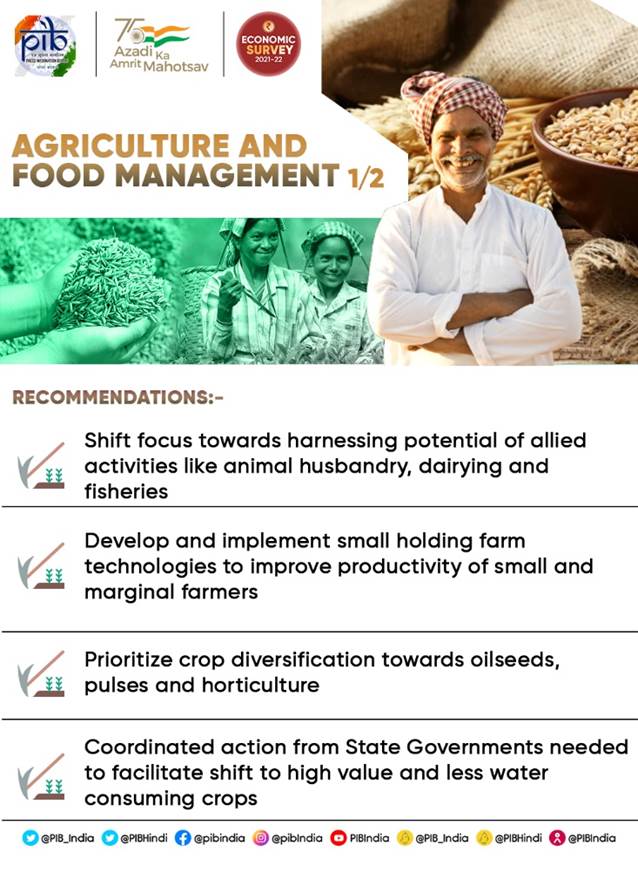
To promote water use efficiency and sustainable agriculture and ensure higher incomes to farmers, the Government is implementing Crop Diversification Programme in the original green revolution States viz., Punjab, Haryana and Western Uttar Pradesh as a sub-scheme under Rashtriya Krishi Vikas Yojana since 2013-14 to shift area under paddy cultivation towards less water intensive crops such as oilseeds, pulses and nutri-cereals etc. The programme also focuses on shifting areas under tobacco cultivation to alternative crops in States viz. Andhra Pradesh, Bihar, Gujarat, Karnataka, Maharashtra, West Bengal among other tobacco producing states. The Survey observes that government is also using price policy to signal farmers to diversify their crops.

Water and Irrigation

The Survey points that 60 per cent of the net irrigated area in the country is serviced through groundwater. The rate of extraction of groundwater is very high (more than 100%) in the states of Delhi, Haryana, Punjab and Rajasthan. Noting that increased coverage under micro-irrigation can be the most effective mode of water conservation, the Survey suggests these States need to focus on both medium and long term ground water recharge and conservation plans.

With the objective to mobilise resources to expand coverage of micro-irrigation, a Micro-Irrigation Fund (MIF) with corpus of ₹ 5000 crores was created under NABARD during 2018-19. As on 01.12.2021, projects with loans under MIF amounting to ₹ 3970.17 crore have been approved for 12.81 lakh hectares of micro-irrigation area. Further the Survey highlights that under Pradhan Mantri Krishi Sinchayee Yojana, as on 14.12.2021 total area of 59.37 lakh hectares has been covered under micro-irrigation in the country from 2015-16.

Natural Farming

In order to sustain agricultural production through eco-friendly processes in tune with nature, ensure chemical free produce and preserve soil productivity government is also encouraging farmers to adopt natural farming techniques. Towards this end the government is implementing a dedicated scheme of Bharatiya Prakritik Krishi Paddhati Programme (BPKP) notes the Survey.

Agricultural Credit and Marketing

According to the Economic Survey, the agricultural credit flow for the year 2021-22 has been fixed at ₹ 16,50,000 crores and till 30th September 2021, against this target a sum of ₹ 7,36,589.05 crores has been disbursed. Moreover, under Atma Nirbhar Bharat programme, the government also announced ₹ 2 lakh crore concessional credit boost to 2.5 crore farmers through Kisan Credit Cards (KCC). Towards this end, banks have issued KCCs to 2.70 crore eligible farmers as on 17.01.2022. Further Government has extended the KCC facility to fisheries and animal husbandry sector in 2018-19.

To link the farmers with markets and to help them in trading and realizing competitive and remunerative prices for their produce the government has been working continuously to improve market linkages and marketing infrastructure. Towards this end, the APMCs have been recognized as eligible entities under Agriculture Infrastructure Fund (AIF). Additionally under the National Agricultural Market (e-NAM) scheme as on 1st December 2021, 1000 mandis of 18 States and 3 UTs have been integrated with the e-NAM platform.
The Government has also launched a central sector scheme of ‘Formation and Promotion of 10,000 Farmer Producer Organisations (FPOs)’ to form and promote 10,000 FPOs by 2027-28. As on January 2022, a total of 1963 FPOs have been registered under the scheme. The government has also established a full-fledged Ministry of Co-operation in July 2021 with a view to provide greater focus on co-operative sector.

National Mission on Edible Oils

 India is the world’s second largest consumer and number one importer of vegetable oil. The Survey highlights that the oilseed production in India has been steadily growing since 2016-17. It was showing a fluctuating trend prior to that. It had grown at almost 43 per cent from 2015-16 to 2020-21. The Economic Survey also expects that the demand for edible oil in India would remain high due to population growth, urbanization and consequent change in dietary habits and traditional meal patterns.

In view of the persistently high import of edible oil, to increase oil production the Government had been implementing a centrally sponsored scheme of National Food Security Mission: Oilseeds (NFSM - Oilseeds) since 2018-19 across all districts in the country. The Survey highlights that under the scheme the government has set up 36 oilseed hubs between 2018-19 and 2019-20 to increase availability of high yielding quality seed. For Kharif 2021, the union government had allocated 9.25 lakhs of oilseed mini kits of high yielding varieties to states for distribution. Further, in August 2021, the Government had launched National Mission on Edible Oils – Oil Palm (NMEO-OP) to augment availability of edible oils by “harnessing area expansion and through price incentives” says the Survey. The scheme aims to cover an additional area of 6.5 lakh hetares for oil palm by 2025-26 and thereby reach a target of 10 lakh hectares ultimately. The Survey points out that currently 3.70 lakh hectares is under oil palm cultivation. Also, the scheme also aims to increase the Crude Palm Oil (CPO) production to 11.20 lakh tonnes by 2025-26 and up to 28 lakh tonnes by 2029-30.

Food Management
India runs one of the largest food management programmes in the world. The Survey highlights that during the year 2021-22, the government had allocated 1052.77 lakh tonnes of food grains to States/UTs under National Food Security Act, 2013 and other welfare schemes compared to 948.48 lakh tonnes in 2020-21. The government has further extended the coverage of food security through additional provision of 5Kg food grains per person per month through the Pradhan Mantri Gareeb Kalyan Yojana (PMGKY). Under the scheme during 2021-22, the government had allocated 437.37 LMT of food grains and in 2020-21, 322 LMT of food grains free of cost to around 80 crore NFSA beneficiaries to ameliorate the hardships faced by the poor due to economic disruption caused by COVID-19 pandemic.
The government had also approved the centrally sponsored pilot scheme ‘Fortification of Rice and its Distribution under PDS’ on 14.02.2019 for a period of three years. The scheme is being implemented in 15 districts (1 district per State) and government had distributed 3.38 LMT of fortified rice till December 2021 under the pilot scheme.

The Survey states that during Kharif Marketing Season (KMS) 2020-21, 601.85 lakh metric tonnes (LMT) of rice has been procured against an estimated target of 642.58 LMT. In the KMS 2021-22, a total of 566.58 LMT of paddy (equivalent to 379.98 LMT rice) was procured as on 16.01.2022. During RMS 2021-22, 433.44 LMT of wheat was procured against 389.92 LMT procured during RMS 2020-21. Also, during the Kharif & Rabi Marketing Season 2020-21, approximately 11.87 LMT of coarse grains has been procured which is highest in the last five years.

Agricultural Research and Education

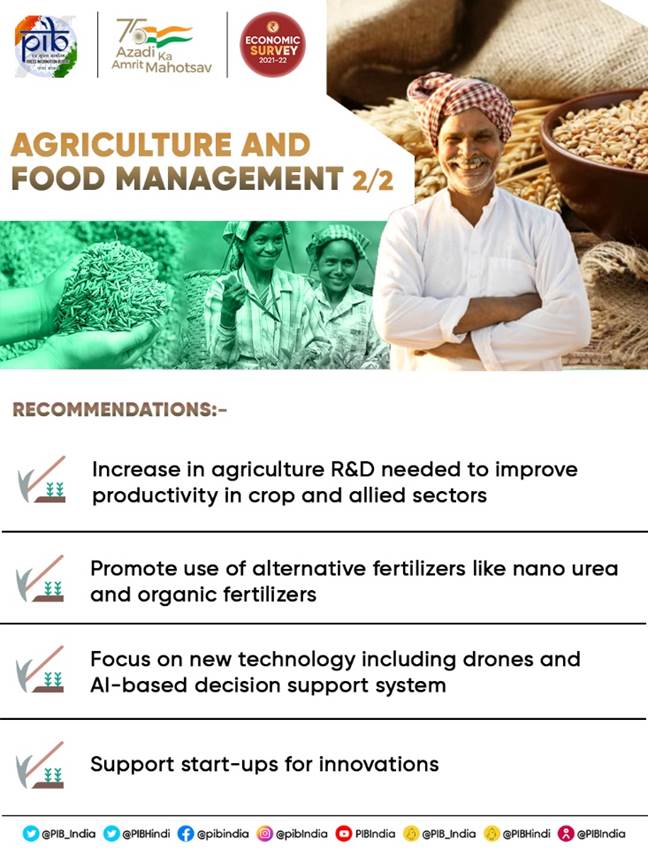
According to the Economic Survey, research shows that every rupee spent on agricultural research and development, yields much better returns. Increasing R&D spending on agriculture is, therefore, not only a vital necessity for ensuring food security, but also important from the socio-economic point of view.

Agricultural research and education is crucial for “development of environmentally sustainable global food system, ensuring food and nutrition security and increasing farm income by cost minimization and yield maximization” says the Survey. It points out that the National Agricultural Research System of India has produced significant results. The Indian Council of Agricultural Research (ICAR) during 2020 and 2021 notified/released a total of 731 new varieties/hybrids of field crops. The Department of Agriculture Research and Education (DARE) has developed 35 special trait varieties including bio-fortified and stress tolerant varieties of field and horticulture crops during 2021-22.

Topics

Acts Income Tax