

Just a moment...

Top
Help
×

By creating an account you can:

Logo TaxTMI
Call Us / Help / Feedback

Contact Us At :

E-mail: [email protected]

Call / WhatsApp at: +91 99117 96707

For more information, Check Contact Us

FAQs :

To know Frequently Asked Questions, Check FAQs

Most Asked Video Tutorials :

For more tutorials, Check Video Tutorials

Submit Feedback/Suggestion :

Email :
Please provide your email address so we can follow up on your feedback.
Category :
Description :
Min 15 characters0/2000
Make Most of Text Search
  1. Checkout this video tutorial: How to search effectively on TaxTMI.
  2. Put words in double quotes for exact word search, eg: "income tax"
  3. Avoid noise words such as : 'and, of, the, a'
  4. Sort by Relevance to get the most relevant document.
  5. Press Enter to add multiple terms/multiple phrases, and then click on Search to Search.
  6. Text Search
  7. The system will try to fetch results that contains ALL your words.
  8. Once you add keywords, you'll see a new 'Search In' filter that makes your results even more precise.
  9. Text Search
Add to...
You have not created any category. Kindly create one to bookmark this item!
Create New Category
Hide
Title :
Description :
❮❮ Hide
Default View
Expand ❯❯
Close ✕
🔎 News - Adv. Search
TEXT SEARCH:

Press 'Enter' to add multiple search terms. Rules for Better Search

Search In:
Main Text + AI Text
  • Main Text
  • Main Text + AI Text
  • AI Text
Category: ?
Categorized by AI
---- All Categories ----
  • ---- All Categories ----
  • Income Tax
  • GST
  • Customs, DGFT & SEZ
  • FEMA & RBI
  • Corp. Laws, SEBI & IBC
  • PMLA, Black Money & ED
  • Budget
  • News and Press Release
  • PTI News
Month:
---- All Months ----
  • ---- All Months ----
  • January
  • February
  • March
  • April
  • May
  • June
  • July
  • August
  • September
  • October
  • November
  • December
Year:
---- All Years ----
  • ---- All Years ----
  • 2026
  • 2025
  • 2024
  • 2023
  • 2022
  • 2021
  • 2020
  • 2019
  • 2018
  • 2017
  • 2016
  • 2015
  • 2014
  • 2013
  • 2012
  • 2011
Sort By: ?
In Sort By 'Default', exact matches for text search are shown at the top, followed by the remaining results in their regular order.
RelevanceDefaultDate
    Any attempt to defame CAS by manipulation will be dealt with sternly, warns Sebi's Pandey
    Rupee falls 2 paise to settle at 95.76 against US dollar
    QualityKiosk Establishes Hyderabad Engineering Hub to Advance AI Reliability, Agentic Engineering and AI Assurance for Global Enterprises
    ED raids SP leader Azam Khan's Trust and university in UP
    Rupee rises 1 paisa to 95.73 against US dollar in early trade
    CCI approves acquisition of 23% equity shareholding of TM International Logistics by Tata Steel Ltd
    CCI approves acquisition of additional shareholding of Acko Technology & Services Pvt Ltd. by General Atlantic Singapore ACK Pte. Ltd
    Union Minister of Commerce & Industry Shri Piyush Goyal invites Japanese businesses to deepen investments and partnerships in India
    Department of Commerce Organises Awareness Session on EU CBAM Regulations for Exporters
    PSB Confluence 2026 concludes with actionable strategies across seven themes for Public Sector Banks and Public Financial Institutions
    Previous LDF govt didn't fulfil many obligations related to Vizhinjam port: CM Satheesan
    Sitharaman calls on public sector banks to translate strength into competitiveness and leadership
    Sitharaman asks public sector banks to focus on youth; provide cool, simple banking to suit their needs
    I-T department officials discuss roadmap for improving services for taxpayers
    India-UK trade agreement to benefit Haryana's industries and services sector: CM Saini
    FM asks banks to keep pace with youth expectation; calls for outreach campaign from Oct 2
    CCI approves acquisition of certain equity shareholding in Bharti Life Insurance Company by Prudential Corporation Holdings
    Suspicious foreign remittances under I-T department scanner
    Delhi tightens rules for ration shops, makes big stock discrepancies an FIR offence
    Regional Rural Banks (RRBs) Record Strong Growth in Credit Delivery during FY 2025–26
❯❯
MaximizeMaximizeMaximize
0 / 200
Expand Note
Add to Folder

No Folders have been created

    +

    Are you sure you want to delete "My most important" ?

    NOTE:

    News
    Showing Results for :
    Reset Filters
    Results Found:
    Show All SummariesHide All Summaries
    August 19, 2026
    Show AI Summary
    Foreign exchange market movement shows rupee pressure from elevated crude prices, moderated by reserves, intervention and FCNR(B) inflows.
    Foreign exchange market movement saw the rupee depreciate marginally against the US dollar amid higher global crude oil prices, heightened West Asia tensions, a stronger dollar environment and weaker domestic equity markets. Central-bank intervention and foreign fund inflows provided support. Adequate foreign-exchange reserves and stronger-than-expected FCNR(B) scheme inflows were identified as factors limiting the scope for sharp depreciation.
    August 19, 2026
    Show AI Summary
    AI reliability engineering expands through an enterprise hub supporting AI assurance, agentic engineering, observability and trusted AI deployment.
    QualityKiosk Technologies has established a Hyderabad engineering hub to expand AI reliability engineering, AI assurance and agentic engineering capabilities. The centre supports engineering, marketing, branding, analyst-relations and advisory functions, while serving enterprise demand for AI reliability, product engineering, CloudOps and automation. It advances an AI reliability operating framework covering AI for reliability, reliability of AI, agentic engineering, shift-right engineering, frontier-system reliability, observability and platform-based delivery to promote governance, resilience, operational trust and assurance in AI-powered systems.
    August 19, 2026
    Show AI Summary
    Money laundering investigation examines alleged diversion of government contract funds and their use in creating trust and university assets.
    Money-laundering investigation under the Prevention of Money Laundering Act led to searches of premises associated with the Maulana Mohammad Ali Jauhar Trust, its university, linked companies, promoters and a chartered accountant. The inquiry concerns alleged diversion of government contract funds through private contractors and their alleged subsequent use, including for creating assets of the Trust and university. Separate planning-law issues concern allegations that most university buildings were constructed without approved plans.
    August 19, 2026
    Show AI Summary
    Foreign exchange market conditions supported marginal rupee strength despite crude oil pressures, regional tensions and oil-company dollar demand.
    Foreign exchange market conditions reflected a marginal strengthening of the rupee against the US dollar in early trading, supported by reported Reserve Bank of India intervention, a softer dollar index and foreign institutional equity inflows. Higher global crude oil prices, West Asia tensions and oil-company demand for dollars continued to exert pressure, resulting in a range-bound trading environment.
    August 19, 2026
    Show AI Summary
    Competition approval for Tata Steel's share acquisition restructures ownership of logistics joint venture following an existing partner's exit.
    Competition approval has been granted for Tata Steel Ltd.'s acquisition of IQ Martrade Holding Und Management GmbH's entire 23% equity shareholding in TM International Logistics Ltd., resulting in IQ Martrade's exit. Following completion, Tata Steel and NYK (Europe) B.V. will hold 74% and 26% equity shareholding, respectively. TM International Logistics primarily serves Tata Steel's logistics and cargo transportation requirements through railway cargo transportation, port operations and cargo handling, freight forwarding, and value-added logistics services.
    August 19, 2026
    Show AI Summary
    Competition approval enables increased insurtech shareholding through a rights issue, crossing the prescribed ownership threshold in insurance businesses.
    Competition approval has been granted for General Atlantic Singapore ACK Pte. Ltd. to acquire additional shareholding in Acko Technology & Services Private Limited through the target's rights issue, resulting in the acquirer crossing the 25% shareholding threshold on a fully diluted basis. The target is an Indian insurtech company with subsidiaries conducting licensed general and life insurance businesses, while another subsidiary awaits a corporate agency licence for insurance-policy distribution.
    August 19, 2026
    Show AI Summary
    India-Japan investment partnership prioritises technology, manufacturing and infrastructure collaboration, with Uttar Pradesh positioned for deeper Japanese commercial engagement.
    India-Japan economic cooperation is positioned for deeper investment and commercial partnerships in manufacturing, technology, infrastructure, energy, defence, artificial intelligence, semiconductors, critical minerals, batteries and next-generation mobility. Uttar Pradesh is identified as a prospective destination for Japanese investment because of its workforce, connectivity, manufacturing base, MSME sector, export capacity, transport infrastructure and industrial clusters. Investment facilitation is associated with reforms in ease of doing business, digital public infrastructure and multimodal logistics.
    August 19, 2026
    Show AI Summary
    Carbon border adjustment compliance requires reliable emissions data, reporting, accreditation and verification throughout exporters' supply chains.
    European Union Carbon Border Adjustment Mechanism compliance requires exporters to address covered products, embedded-emissions calculation, data collection, reporting, accreditation and verification. Preparedness across the export value chain depends on timely emissions data from suppliers and other stakeholders, supported by credible verification mechanisms. Capacity-building and engagement seek to facilitate workable compliance with evolving sustainability-related international trade requirements.
    August 19, 2026
    Show AI Summary
    Youth banking engagement promotes sustained customer relationships through digital access, campus outreach and financial support across evolving life stages.
    Public Sector Banks and Public Financial Institutions are urged to implement actionable strategies with clear ownership and realistic timelines. Youth banking engagement is to be strengthened through a focused campaign, a common digital access platform and physical outreach, supporting young customers' evolving financial needs. Priority sector lending requires granular monitoring, early identification of target gaps and productive credit flow to intended beneficiaries. Agriculture and horticulture value-chain financing may cover farmer producer organisations, storage, processing, logistics and market linkages, while credit card strategies include digital onboarding, cross-selling and RuPay-UPI integration.
    August 18, 2026
    Show AI Summary
    Port connectivity obligations shape Vizhinjam export-import operations, logistics integration, infrastructure acceleration, and scrutiny of prior stakeholder notification.
    Vizhinjam port concession obligations include road and rail connectivity to maximise the benefits of export-import operations. The State government proposes land acquisition funding for a ring-road project, is engaging with central ministries on rail connectivity, and is seeking to expedite national-highway construction. Mission Samudra is intended to connect Cochin port and 18 mini ports with Vizhinjam to support lower-cost, faster exports. Concerns were also raised over the State government not receiving prior intimation of a proposed stake transfer in the port project company.
    August 18, 2026
    Show AI Summary
    Public sector banking competitiveness requires distinct institutional strengths, early capability building and strategic support for economic growth priorities.
    Public sector banks are urged to use their customer base, branch networks, geographic reach, institutional experience and digital capabilities to build stronger competitive positions and leadership. Each bank may develop distinct areas of excellence based on geography, customer relationships, sectoral expertise, technology capabilities or international presence. Strategic priorities include deposit mobilisation, banking for youth, support for investment and global capability centres, agriculture and horticulture infrastructure, credit-card business reorientation and priority sector lending.
    August 18, 2026
    Show AI Summary
    Youth-focused banking requires public sector banks to deliver personalised digital services, financial awareness, and responsible credit engagement.
    Public sector banks are urged to implement sustained youth-focused banking through campus outreach, simple personalised round-the-clock services, dedicated youth support and financial awareness. Engagement should develop long-term relationships beyond account opening while preserving prudential standards. Youth should receive guidance on the formal credit ecosystem, including credit scores, credit history, bank credit products and government credit schemes, to support responsible credit discipline and future financial needs. A dedicated portal may provide a single access point for banking awareness and suitable financial opportunities.
    August 18, 2026
    Show AI Summary
    Taxpayer service improvement and litigation reduction guide administrative planning for stronger infrastructure, systems, coordination and future tax department functioning.
    Improvement of taxpayer services, reduction of tax litigation, infrastructure strengthening and preparation of an actionable roadmap for future Income Tax Department functioning were considered as operational priorities. Deliberations covered e-HRMS, service matters, reservation policy, systems administration, capacity building, expenditure budgeting, TDS administration, inter-agency coordination, and office infrastructure. Officials identified institutional challenges and priorities for strengthening taxpayer-facing and internal departmental functions.
    August 18, 2026
    Show AI Summary
    Duty-free UK market access strengthens export opportunities for Indian goods and services, supporting MSMEs, agriculture, manufacturing and global value-chain participation.
    India-UK Comprehensive Economic and Trade Agreement provides duty-free access to the UK market for nearly all Indian exports and may improve the competitiveness of Haryana's manufacturing, agricultural, MSME and services sectors. Preferential access covers products including textiles, engineering goods, auto parts, processed foods and pharmaceuticals, while agricultural exports remain subject to exceptions for sensitive products. The agreement also provides market access across 137 UK services sub-sectors, supporting IT, digital, professional, financial and technical services and facilitating global value-chain participation.
    August 18, 2026
    Show AI Summary
    Youth banking outreach promotes campus engagement, financial awareness, responsible credit discipline and long-term access to formal banking services.
    Public sector banks are urged to conduct a month-long "Banking for Youth" outreach campaign from 2 October 2026 for persons above 16 years of age. Outreach through educational and skill-development campuses should combine account opening, financial awareness and direct engagement. Banks should develop tailored youth strategies to build long-term banking relationships. Proposed measures include online learning content, lifestyle-linked benefits, dedicated youth banking support, and awareness of credit scores, credit products and government credit schemes. A dedicated youth banking-awareness portal may serve as a single access point for appropriate banking services and financial opportunities.
    August 18, 2026
    Show AI Summary
    Competition approval for Prudential's acquisition of equity shareholding in an Indian life insurer supports the proposed insurance-sector combination.
    Competition approval has been granted for Prudential Corporation Holdings Limited to acquire certain equity shareholding in Bharti Life Insurance Company Limited. The acquirer is the holding company for its group's insurance and asset-management operations in Asia and supports operations in Asia and Africa. The target is an IRDAI-licensed Indian life insurer.
    August 18, 2026
    Show AI Summary
    Suspicious foreign remittance verification targets shell entities and requires accountants to conduct diligent taxability checks before certification.
    Verification of suspicious outward foreign remittances focuses on entities with little or no reported business activity, their controllers, and accountants issuing tax-determination certificates. Scrutiny addresses remittances disproportionate to reported turnover, non-filers, entities not operating from declared addresses, and payments whose stated purposes appear inconsistent with reported activity. Form 15CB/Form 146 certification requires accountants to examine taxability through books of account and relevant documentation, validating tax deduction at source and applicable treaty compliance. Accountants must exercise due care, diligence and professional judgment before certifying remittances.
    August 18, 2026
    Show AI Summary
    Fair Price Shop regulation introduces graded stock-shortage penalties, mandatory FIRs for major discrepancies, and restructured licensing requirements.
    Fair Price Shop regulation introduces quantity-based penalties for stock discrepancies, ranging from performance-guarantee forfeiture and replenishment obligations to interim suspension, cancellation-related action and mandatory FIR registration for major shortages. Repeated or deliberate diversion or manipulation of public distribution supplies may lead to cancellation, blacklisting and FIR registration. Licensing now includes continuing regular licences and short-term temporary licences, with wider eligibility, points-based selection, card-linked performance guarantees and compulsory approved e-PoS, weighing-scale and iris-scanner use.
    August 18, 2026
    Show AI Summary
    Priority sector lending strengthened rural credit access through agricultural, micro-enterprise and weaker-section finance, reinforcing financial inclusion and sustainable development.
    Regional Rural Banks expanded rural credit delivery while maintaining strong Priority Sector Lending performance during FY 2025-26. Almost all Regional Rural Banks met the prescribed overall priority-sector target. Agriculture and allied activities remained the largest priority-sector component, with farm credit accounting for nearly all agricultural lending. MSME finance predominantly supported micro enterprises, rural entrepreneurs, artisans and small businesses. Lending to weaker sections and finance for housing, education, renewable energy and social infrastructure promoted inclusive access to institutional credit and sustainable rural development.

    News

    Back

    All News

    Showing Results for :
    Reset Filters
      No Records Found

      News

      Back

      All News

      whatsappJoin Channel
      Showing Results for : Reset Filters

      Summary of Economic Survey-2020-21

      January 29, 2021

      Contents
      Summary
      Note

      Note

      -

      Bookmark

      Print

      Print

      Summary of Economic Survey-2020-21

      V-Shaped Economic Recovery Due to Mega Vaccination Drive, Robust Recovery in the Services Sector and Robust Growth in Consumption and Investment

      V-Shaped Recovery is Due to Resurgence in High Frequency Indicators Such as Power Demand, Rail Freight, E-Way Bills, GST Collection, Steel Consumption, Etc

      India to Become the Fastest Growing Economy in Next Two Years as Per IMF

      India’s GDP is Estimated to Contract by 7.7 Per Cent in FY 2020-21

      Agriculture to Clock 3.4 Per Cent Growth, While Industry and Services to Contract by 9.6 Per Cent and 8.8 Per Cent Respectively this Year This Year

      India to Have a Current Account Surplus of 2 Per Cent of GDP in FY21, A Historic High After 17 Years

      Net FPI Inflows Recorded an All-Time Monthly High of 9.8 Billion Dollars in November 2020

      Scores of lives saved and V-Shaped Economic Recovery bear Testimony to India’s Boldness in taking Short-Term Pain for Long-Term Gain.

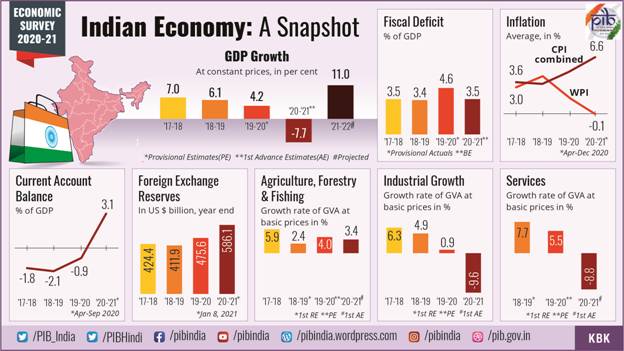
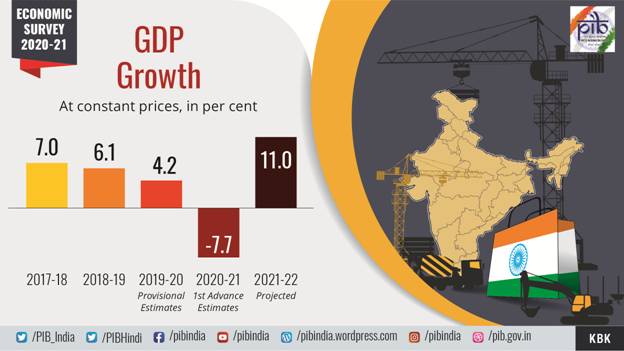
      India’s real GDP to record a growth of 11 per cent in 2021-22 and nominal GDP by 15.4 per cent-the highest since independence. The V-shaped economic recovery is supported by the initiation of a mega vaccination drive with hopes of a robust recovery in the services sector and prospects for robust growth in consumption and investment. The Union Minister for Finance & Corporate Affairs, Smt Nirmala Sitharaman presented the Economic Survey 2020-21 in Parliament today, which states that the rebound will be led by the low base and continued normalization in economic activities as the rollout of COVID-19 vaccines gathers traction. The fundamentals of the economy remain strong as gradual scaling back of lockdowns along with the astute support of Atmanirbhar Bharat Mission have placed the economy firmly on the path of revival. This path would entail a growth in real GDP by 2.4 percent over the absolute level of 2019-20-implying that the economy would take two years to reach and go past the pre-pandemic level. These projections are in line with IMF estimate of real GDP growth of 11.5 per cent in 2021-22 for India and 6.8 per cent in 2022-23. India is expected to emerge as the fastest growing economy in the next two years as per IMF.
      State of the Indian Economy- Eng.jpg

      The Survey says, India’s mature policy response to this “once-in-a-century” crisis  provides important lessons for democracies to avoid myopic policymaking and demonstrates the significant benefits of focusing on long-term gains.  India adopted a unique four-pillar strategy of containment, fiscal, financial, and long-term structural reforms. Calibrated fiscal and monetary support was provided given the evolving economic situation, cushioning the vulnerable in the lockdown and boosting consumption and investment while unlocking, mindful of fiscal repercussions and entailing debt sustainability. A favorable monetary policy ensured abundant liquidity and immediate relief to debtors via temporary moratoria, while unclogging monetary policy transmission.

      The Survey says, India’s GDP is estimated to contract by 7.7 per cent in FY2020-21, composed of a sharp 15.7 per cent decline in first half and a modest 0.1 per cent fall in the second half. Sector-wise, agriculture has remained the silver lining while contact-based services, manufacturing, construction were hit hardest, and have been recovering steadily. Government consumption and net exports have cushioned the growth from diving further down.
      GDP Growth- Eng.jpg

      As anticipated, while the lockdown resulted in a 23.9 per cent contraction in GDP in Q1, the recovery has been a V-shaped one as seen in the 7.5 per cent decline in Q2 and the recovery across all key economic indicators. Starting July, a resilient V-shaped recovery is underway, as demonstrated by the recovery in GDP growth in Q2 after the sharp decline in Q1. As India’s mobility and pandemic trends aligned and improved concomitantly, indicators like E-way bills, rail freight, GST collections and power consumption not only reached pre-pandemic levels but also surpassed previous year levels. The reignited inter and intra state movement and record-high monthly GST collections have marked the unlocking of industrial and commercial activity. A sharp rise in commercial paper issuances, easing yields, and sturdy credit growth to MSMEs portend revamped credit flows for enterprises to survive and grow.

      Dwelling on the sectoral trends, the Survey says that the year also saw manufacturing sector’s resilience, rural demand cushioning overall economic activity and structural consumption shifts in booming digital transactions. It adds that Agriculture is set to cushion the shock of the COVID-19 pandemic on the Indian economy in 2020-21 with a growth of 3.4 per cent in both Q1 and Q2. A series of progressive reforms undertaken by the government have contributed to nourishing a vibrant agricultural sector, which remains a silver lining to India’s growth story of FY 2020-21.

      A palpable V-shaped recovery in industrial production was observed over the year. Manufacturing rebounded and industrial value started to normalize. Indian services sector sustained its recovery from the pandemic driven declines with PMI Services output and new business rising for the third straight month in December.

      Bank credit remained subdued in FY 2020-21 amid risk aversion and muted credit appetite. However, credit growth to agriculture and allied activities accelerated to 7.4 per cent in October 2020 from 7.1 per cent in October 2019. October 2020 saw resilient credit flows to sectors such as construction, trade and hospitality, while bank credit remained muted to the manufacturing sector. Credit  growth to the services sector accelerated to 9.5 per cent in October 2020 from 6.5 per cent in October 2019.

      High food prices remained a major driver of inflation in 2020. However, inflation in December, 2020 fell back into the RBI’s target range of 4+/-2 per cent to reach 4.6 per cent to reach 4.6 per cent year-on-year as compared to 6.9 per cent in November. This was driven by a step fall in food prices, particularly of vegetables, cereals, and protein products and favorable base effects.

      The external sector provided an effective cushion to growth with India recording a current account surplus of 3.1 per cent of GDP in the first half of the year, largely supported by strong services exports, and weak demand leading to a sharper contraction in imports (with merchandise imports contracting by 39.7%) than exports (with merchandise exports contracting by 21.2%). Consequently, the Foreign exchange reserves rose to cover 18 months of imports in December 2020.

      External debt as a ratio to GDP rose marginally to 21.6 per cent at end-September 2020 from 20.6 per cent at end-March 2020. However, the ratio of foreign exchange reserves to total and short-term debt (original and residual) improved because of the sizable accretion in reserves.

      India remained a preferred investment destination in FY 2020-21 with FDI pouring in amidst global asset shifts towards equities and prospects of quicker recovery in emerging economies. Net FPI inflows recorded an all-time monthly high of US$ 9.8 billion in November 2020, as investors’ risk appetite returned, with a renewed search for yield, and US dollar weakened amid global monetary easing and fiscal stimulus packages. India was the only country among emerging markets to receive equity FII inflows in 2020.

      Buoyant Sensex and NIFTY resulted in India’s market-capitalisation to Gross Domestic Product (GDP) ratio crossing 100 per cent for the first time since October 2010. This, however, raises concerns on the disconnect between the financial markets and real sector.

      Exports are expected to decline by 5.8 per cent and imports by 11.3 per cent in the second half of the year. India is expected to have a Current Account Surplus of 2 per cent of GDP in FY21, a historic high after 17 years.

      On the supply side, Gross Value Added (GVA) growth is pegged at -7.2 per cent in 2020-21 as against 3.9 per cent in FY:2019-20. Agriculture is set to cushion the shock of the Covid-19 pandemic on the Indian economy in 2020-21 with a growth of 3.4 per cent, while industry and services are estimated to contract by 9.6 per cent and 8.8 per cent during the year.

      The Survey underlines that the year 2020 was dominated by the COVID-19 pandemic and the ensuing global economic downturn, the most severe one since the Global Financial Crisis. The lockdowns and social distancing norms brought the already slowing global economy to a standstill. Global economic output is estimated to fall by 3.5 percent in 2020 (IMF January 2021 estimates). In view of this, Governments and central banks across the world deployed a range of policy tools to support their economies such as lowering key policy rates, quantitative easing measures, loan guarantees, cash transfers and fiscal stimulus measures. India recognized the disruptive impact of the pandemic and charted its own unique path amidst dismal projections by several international institutions of the spread in the country given its huge population, high population density and an overburdened health infrastructure.

      The Survey observes that the intense lockdown implemented at the start of the pandemic – when India had only a 100 confirmed cases – characterized India’s unique response in several ways. First, the policy response was driven by the findings from both epidemiological and economic research. Specifically, faced with enormous uncertainty about the potential spread of the pandemic, the policy implemented the Nobel-prize winning research in Hansen and Sargent (2001) that recommends a policy focussed on minimising losses in a worst case scenario. Faced with an unprecedented pandemic, loss of scores of human lives captured this worst case scenario. Moreover, epidemiological research highlighted the importance of an initial, stringent lockdown especially in a country where high population density posed difficulties with respect to social distancing. Therefore, India’s policy humane response that focused on saving human lives, recognised that the short-term pain of an initial, stringent lockdown would lead to long-term gains both in the lives saved and in the pace of the economic recovery. The scores of lives that have been saved and the V-shaped economic recovery that is being witnessed  bear testimony to India’s boldness in taking short-term pain for long-term gain.

      Second, India recognised that the pandemic impacts both supply and demand in the economy. The slew of reforms – again unique amidst all major economies – were implemented to ensure that the supply-side disruptions, which were inevitable during the lockdown, are minimized in the medium to long-run. The demand side policy reflected the understanding that aggregate demand, especially that for non-essential items, reflects precautionary motives to save, which inevitably remains high when overall uncertainty is high. Therefore, during the initial months of the pandemic when uncertainty was high and lockdowns imposed economic restrictions, India did not waste precious fiscal resources in trying to pump up discretionary consumption. Instead, the policy focused on ensuring that all essentials were taken care of, which included direct benefit transfers to the vulnerable sections and the world’s largest food subsidy programme targeting 80.96 crore beneficiaries. Government of India also launched Emergency Credit Line Guarantee Scheme to provide much needed relief to stressed sectors by helping entities sustain employment and meet liabilities.

      During the unlock phase, when uncertainty declined and the precautionary motive to save subsided, on the one hand, and economic mobility increased, on the other hand, India has ramped up its fiscal spending. A favorable monetary policy ensured abundant liquidity and immediate relief to debtors via temporary moratoria, while unclogging monetary policy transmission. India’s demand-side policy, thus, underscores the idea that pressing on the accelerator while the brakes are clamped only wastes scarce fuel.

      The year 2020 threw at the world a bedlam of novel COVID-19 virus, threatening all that was taken for granted –mobility, safety, and a normal life itself. This, in turn, posed the most formidable economic challenge to India and to the world in a century. Bereft of a cure or a vaccine, public health policy became central to tackling this all-pervasive crisis. The imperative of flattening the disease curve was entwined with the livelihood cost of an imminent recession, which emanated from the restrictions in economic activities from the lockdown required to contain the pandemic. This inherent trade-off led to the policy dilemma of “lives versus livelihoods”.

      Topics

      ActsIncome Tax